


Overview
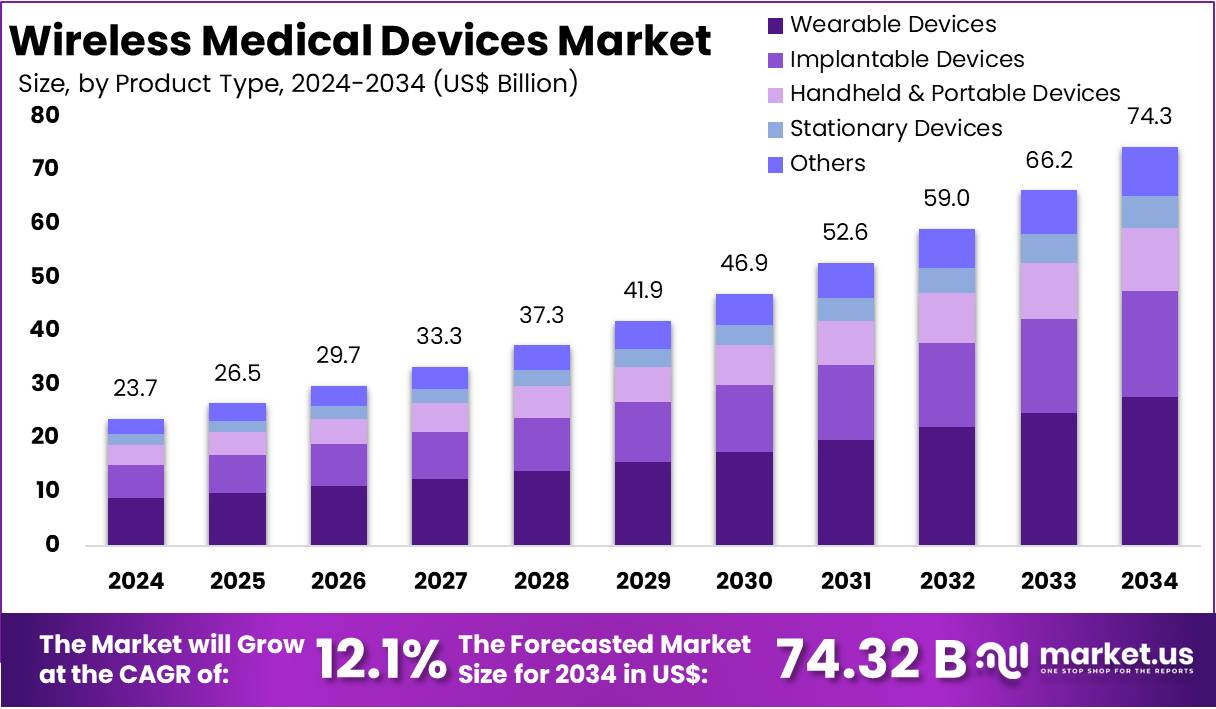
New York, NY – May 04, 2026 – The Wireless Medical Devices Market size is expected to be worth around US$ 74.3 billion by 2034 from US$ 23.7 billion in 2024, growing at a CAGR of 12.1% during the forecast period 2025 to 2034. North America held a dominant market position, capturing more than a 38.7% share and holds US$ 9.33 Billion market value for the year.
Wireless medical devices refer to healthcare technologies that use wireless communication protocols such as Bluetooth, Wi-Fi, or cellular networks to transmit medical data without physical connections. These devices are increasingly being integrated into modern healthcare systems to support real-time monitoring, diagnosis, and treatment.
The adoption of wireless medical devices has been driven by the growing demand for remote patient monitoring and the rising prevalence of chronic diseases such as cardiovascular disorders and diabetes. It has been observed that these devices enable continuous tracking of vital parameters, including heart rate, blood glucose levels, and blood pressure, thereby improving clinical decision-making and patient outcomes.
Common types of wireless medical devices include wearable fitness trackers, implantable cardiac monitors, wireless infusion pumps, and smart diagnostic equipment. These solutions are widely used across hospitals, ambulatory care centers, and home healthcare settings.
Technological advancements, particularly in the Internet of Things (IoT) and miniaturization of sensors, have significantly enhanced device efficiency and usability. In addition, the increasing penetration of smartphones has facilitated seamless connectivity and data accessibility for both healthcare providers and patients.
However, concerns related to data security, interoperability, and regulatory compliance continue to influence market growth. Despite these challenges, the wireless medical devices segment is expected to witness steady expansion, supported by ongoing innovation and the global shift toward digital healthcare infrastructure.
Key Takeaways
- In 2024, the wireless medical devices market generated revenue of US$ 23.7 billion and is projected to reach US$ 74.3 billion by 2034, expanding at a CAGR of 12.1%.
- By product type, the market is segmented into wearable devices, implantable devices, handheld & portable devices, stationary devices, and others. Among these, wearable devices dominated the segment in 2024, accounting for a 37.4% share.
- Based on type, the market is categorized into diagnostic & monitoring and therapeutic devices. The diagnostic & monitoring segment held a leading position with a 55.5% market share.
- In terms of technology, the market includes Bluetooth, Wi-Fi, Near Field Communication (NFC), Zigbee, RFID (Radio Frequency Identification), Ultra-wideband (UWB), and others. Bluetooth emerged as the dominant technology segment, capturing 29.7% of the total revenue.
- By application, the market is divided into cardiology, neurology, respiratory, diabetes management, point of care, and others. The point of care segment led the market with a share of 32.2%.
- Considering end-users, the market is segmented into hospitals & clinics, home healthcare, ambulatory surgical centers, diagnostic centers, long-term care & assisted living facilities, and others. Hospitals & clinics accounted for the largest share at 31.7%.
- Regionally, North America held the leading position, securing a market share of 38.7% in 2023.
Regional Analysis
North America is identified as the leading region in the wireless medical devices market, supported by the strong presence of major industry participants such as Medtronic, Philips, and GE Healthcare. Continuous innovation and product development have strengthened regional market dominance.
The rising prevalence of chronic diseases, including diabetes and cardiovascular conditions, along with a rapidly aging population, has significantly increased the demand for wireless monitoring and diagnostic solutions.
Favorable regulatory support, particularly from the U.S. Food and Drug Administration, and the integration of advanced technologies such as IoT and artificial intelligence in healthcare systems have further accelerated adoption. The United States accounts for the largest revenue share, while Canada demonstrates stable growth driven by increasing healthcare investments and technological progress.
Europe represents the second-largest regional market, driven by well-established healthcare infrastructure and strong policy support. Key countries such as Germany, United Kingdom, and France are leading adoption through investments in telemedicine and remote monitoring. Regulatory frameworks such as the Medical Device Regulation ensure product safety and innovation, although growth is moderately constrained by budget limitations and fragmented healthcare systems.
Emerging Trends
- More Focus on Remote Patient Monitoring: Healthcare providers are increasingly adopting wireless devices for remote patient monitoring. These tools track vital signs in real time, reduce hospital visits, improve chronic disease management, and enhance care delivery efficiency.
- Integration with Smartphones and Apps: Wireless medical devices are being integrated with smartphones and applications, enabling real-time data sharing, health alerts, and personalized feedback. This enhances patient engagement, improves accessibility, and strengthens communication between patients and healthcare professionals.
- Smaller and Smarter Devices: Wireless medical devices are becoming compact, lightweight, and technologically advanced. Improved sensors, longer battery life, and enhanced usability support continuous monitoring, offering greater convenience, accuracy, and seamless integration into daily patient routines.
- Growing Use of AI and Machine Learning: Artificial intelligence is increasingly embedded in wireless medical devices to analyze health data, detect abnormalities, and support early diagnosis. This enhances accuracy, reduces human error, and improves overall clinical decision-making efficiency.
- Rise in Home Healthcare Solutions: The demand for home healthcare is rising, supported by wireless medical devices that enable remote monitoring. These solutions reduce hospital dependency, lower costs, and provide convenient care, particularly for elderly patients and chronic conditions.
- Improved Connectivity with 5G and IoT: Advancements in 5G and IoT technologies are enhancing device connectivity, enabling faster and reliable data transmission. This supports real-time monitoring, improves response times, and strengthens integration across healthcare systems and smart environments.
Use Cases
- Managing Diabetes: Wireless glucose monitoring devices enable continuous tracking of blood sugar levels, providing real-time alerts and data insights. This supports timely intervention, improves treatment adjustments, and reduces risks associated with diabetes-related complications.
- Monitoring Heart Conditions: Wireless ECG devices and wearables provide continuous cardiac monitoring, detecting irregularities and enabling early intervention. These solutions improve patient safety, reduce emergency risks, and allow individuals to maintain daily activities with confidence.
- Tracking Fitness and Vital Signs: Wearable devices such as smartwatches monitor fitness metrics, including heart rate, sleep patterns, and oxygen levels. These tools support preventive healthcare, encourage healthy lifestyles, and provide valuable insights into overall physical well-being.
- Post-Surgery Recovery at Home: Wireless medical devices facilitate remote monitoring during post-surgical recovery by tracking vital parameters. This reduces hospital visits, supports timely medical intervention, and enhances patient comfort and safety in home environments.
- Chronic Disease Management: Wireless monitoring devices support ongoing management of chronic diseases by continuously tracking vital signs and transmitting data to healthcare providers. This enables early detection of complications and improves long-term patient outcomes.
- Elderly Care and Fall Detection: Wearable wireless devices assist elderly care by detecting falls, monitoring activity levels, and sending alerts to caregivers. These solutions enhance safety, promote independence, and ensure timely response during emergency situations.
Frequently Asked Questions on Wireless Medical Devices
- How do wireless medical devices work?
Wireless medical devices function by collecting patient data through embedded sensors and transmitting it to healthcare systems via wireless protocols. The transmitted data is analyzed using software platforms, allowing healthcare providers to monitor patient conditions without requiring continuous physical presence. - What are the key applications of wireless medical devices?
Wireless medical devices are widely used in remote patient monitoring, chronic disease management, fitness tracking, and hospital asset management. Their application is expanding across cardiology, diabetes care, and elderly care, driven by increasing demand for continuous and real-time health monitoring solutions. - What are the benefits of wireless medical devices?
The adoption of wireless medical devices improves patient convenience, reduces hospital visits, and enhances healthcare delivery efficiency. These devices enable continuous monitoring, early diagnosis, and timely intervention, thereby contributing to improved patient outcomes and reduced overall healthcare costs. - What factors are driving the growth of the wireless medical devices market?
Market growth is primarily driven by the increasing geriatric population, rising healthcare expenditure, and growing adoption of telehealth services. Additionally, advancements in IoT and wearable technologies are accelerating innovation and expanding the application scope of wireless medical devices. - Which regions are leading in the wireless medical devices market?
North America holds a dominant market share due to advanced healthcare infrastructure and high adoption of digital health technologies. However, Asia-Pacific is expected to witness the fastest growth, supported by improving healthcare systems and increasing investments in medical technology. - What are the major segments in the wireless medical devices market?
The market is segmented based on product type, application, and end-user. Key product segments include wearable devices, implantable devices, and handheld devices, while major applications cover monitoring, diagnostics, and therapeutic uses across hospitals and home care settings. - What is the future trend of the wireless medical devices market?
The market is expected to witness significant innovation with integration of artificial intelligence and advanced analytics. Increasing focus on personalized healthcare and expansion of remote monitoring solutions are anticipated to create new growth opportunities in the coming years.
Conclusion
The wireless medical devices market is positioned for sustained growth, driven by increasing demand for remote monitoring, rising chronic disease burden, and continuous technological advancements. The integration of IoT, artificial intelligence, and 5G connectivity has enhanced device functionality, enabling real-time, data-driven healthcare delivery.
Wearable and diagnostic devices continue to dominate due to their widespread adoption and clinical relevance. Although challenges related to data security and regulatory compliance persist, ongoing innovation and supportive healthcare infrastructure are expected to mitigate these concerns. Overall, the market is anticipated to expand steadily, supported by the global transition toward digital, patient-centric, and home-based healthcare solutions.
Discuss your needs with our analyst
Please share your requirements with more details so our analyst can check if they can solve your problem(s)




