


Overview
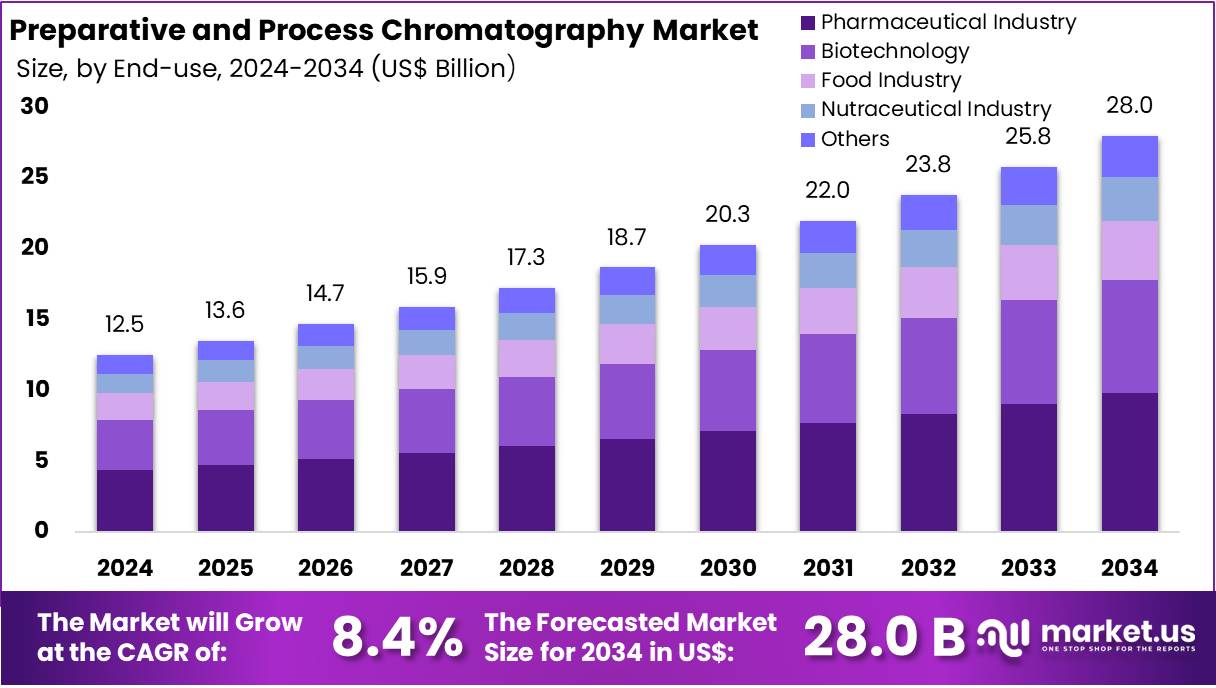
New York, NY – June 04, 2026 – The Global Preparative and Process Chromatography Market Size is expected to be worth around US$ 28 Billion by 2034, from US$ 12.5 Billion in 2024, growing at a CAGR of 8.4% during the forecast period from 2025 to 2034. North America held a dominant market position, capturing more than a 32.2% share and holds US$ 4 Billion market value for the year.
Preparative and process chromatography are advanced separation and purification techniques widely used across the pharmaceutical, biotechnology, food and beverage, chemical, and environmental industries. These chromatography methods are designed to isolate, purify, and recover valuable compounds from complex mixtures with high precision and efficiency.
Preparative chromatography is primarily utilized for the purification of target molecules in laboratory and pilot-scale applications. It enables the collection of purified compounds for research, drug discovery, and small-scale production. Process chromatography, on the other hand, is applied in large-scale manufacturing environments where high throughput, product consistency, and regulatory compliance are critical requirements.
The growing demand for biopharmaceuticals, monoclonal antibodies, vaccines, and specialty chemicals has significantly increased the adoption of chromatography-based purification technologies. Advances in chromatography resins, column technologies, automation systems, and continuous processing solutions have further enhanced operational efficiency and product yield while reducing production costs.
These technologies play a vital role in ensuring product quality, purity, and safety, particularly in highly regulated industries such as pharmaceuticals and biotechnology. Additionally, increasing investments in life sciences research and expanding biologics production capacities are supporting market growth.
As industries continue to prioritize high-purity products and efficient manufacturing processes, preparative and process chromatography are expected to remain essential technologies, driving innovation and supporting the development of next-generation therapeutic and industrial products.
Key Takeaways
- The global Preparative and Process Chromatography Market is anticipated to expand from US$ 12.5 billion in 2024 to approximately US$ 28 billion by 2034.
- The market is forecast to register a CAGR of 8.4% during the period from 2025 to 2034, reflecting sustained growth momentum.
- In 2024, the Process Chromatography segment dominated the product landscape, accounting for over 59.2% of the total market share, supported by its high scalability and operational efficiency.
- Based on type, the Liquid Chromatography segment held the largest market share in 2024, contributing more than 28.4% of global revenue.
- The Pharmaceutical Industry represented the leading end-use segment in 2024, capturing over 43.6% of the market, driven by increasing demand for drug development and biopharmaceutical production.
- North America emerged as the largest regional market in 2024, holding more than 32.2% of the global market share and generating approximately US$ 4 billion in revenue.
Regional Analysis
In 2024, North America accounted for the largest share of the global preparative and process chromatography market, representing more than 32.2% of total revenue and reaching a market value of approximately US$ 4 billion. The region’s leadership was primarily supported by its well-established pharmaceutical and biopharmaceutical industries, which continue to invest heavily in drug development, biologics manufacturing, and advanced purification technologies. The growing need for efficient molecule separation and purification processes has encouraged the widespread adoption of chromatography systems across production facilities.
The United States remained the primary growth engine within the region, benefiting from the presence of leading biotechnology companies, pharmaceutical manufacturers, and contract development and manufacturing organizations (CDMOs). Extensive research activities conducted by academic institutions, research laboratories, and healthcare organizations have further contributed to the increasing utilization of chromatography technologies. Additionally, favorable regulatory frameworks and strong public and private investments in life sciences research have strengthened market expansion.
The increasing demand for biologics, monoclonal antibodies, vaccines, and gene therapies has further accelerated the adoption of preparative and process chromatography solutions. These technologies play a critical role in maintaining product purity, quality, and regulatory compliance. As precision medicine and advanced therapeutics continue to gain momentum, North America is expected to retain its leading position in the market over the forecast period.
Emerging Trends
- Growing Focus on Biologic Drug Purification: The increasing development of biologic drugs, including monoclonal antibodies and therapeutic proteins, is driving demand for advanced chromatography solutions. These systems ensure high-purity separation, support regulatory compliance, and play a critical role in manufacturing treatments for cancer, autoimmune disorders, and other diseases.
- Increased Use in Continuous Manufacturing: Pharmaceutical manufacturers are increasingly adopting continuous production methods to improve efficiency and reduce waste. Modern chromatography systems are being optimized for continuous operations, enabling uninterrupted purification processes, enhanced product consistency, shorter production cycles, and greater flexibility in responding to market demands.
- Rise of Single-Use Technologies: Single-use chromatography components, such as disposable columns and filtration systems, are gaining popularity due to their operational flexibility and contamination control benefits. These solutions reduce cleaning requirements, lower maintenance costs, and support efficient production of biologics, personalized medicines, and clinical-stage therapies.
- Integration of Automation and Digital Monitoring: Automation and digital monitoring technologies are transforming chromatography operations by enabling real-time process control and performance optimization. These systems improve product quality, minimize human intervention, support regulatory compliance, reduce operational costs, and enhance overall manufacturing efficiency through data-driven decision-making.
- Environmental and Sustainability Considerations: Sustainability initiatives are influencing chromatography system development, with manufacturers focusing on reducing solvent consumption, waste generation, and energy usage. Eco-friendly purification processes and recyclable materials are becoming increasingly important as pharmaceutical companies seek environmentally responsible and cost-effective manufacturing practices.
- Customization for Niche Therapies: The growth of personalized medicine and rare disease treatments is creating demand for flexible chromatography platforms. Manufacturers are developing scalable and modular systems capable of handling specialized purification requirements, supporting efficient production of gene therapies, oncology treatments, and other precision medicine applications.
Use Cases
- Biopharmaceutical Production: Preparative and process chromatography is widely used in biopharmaceutical manufacturing to purify proteins, monoclonal antibodies, insulin, and vaccines. The technology effectively removes impurities and contaminants, ensuring product safety, quality, and regulatory compliance while supporting large-scale biologic drug production.
- Vaccine Manufacturing: Chromatography plays a vital role in vaccine production by separating active ingredients from unwanted byproducts and impurities. The technology supports both traditional and advanced vaccine platforms, ensuring product stability, efficacy, and safety while helping manufacturers meet stringent quality standards.
- Gene and Cell Therapy: Gene and cell therapy production relies on chromatography for the purification of viral vectors, engineered cells, and biological materials. The process helps remove contaminants, improve therapeutic effectiveness, and ensure patient safety, making it essential for advanced treatment development.
- Enzyme Production: Chromatography is extensively used in enzyme manufacturing to achieve high levels of purity and performance. The technology removes contaminants and unwanted residues, ensuring enzymes meet quality standards required across healthcare, food processing, biotechnology, and industrial applications.
- Food and Beverage Industry: In the food and beverage sector, chromatography helps isolate nutrients, proteins, amino acids, and flavor compounds from complex mixtures. The technology supports ingredient quality, product consistency, regulatory compliance, and the development of clean-label products with enhanced nutritional value.
- Academic and Industrial R&D: Research institutions and industrial laboratories use preparative chromatography to purify biomolecules and chemical compounds for analysis and experimentation. The technology supports drug discovery, biotechnology innovation, materials research, and product development by providing accurate and reliable sample purification.
Frequently Asked Questions on Preparative and Process Chromatography
- What are the major applications of preparative and process chromatography?
Preparative and process chromatography are widely used in pharmaceutical production, biotechnology research, food and beverage processing, chemical manufacturing, and environmental testing. These techniques help purify proteins, antibodies, vaccines, enzymes, and other high-value compounds required for commercial and research applications. - Why is chromatography important in biopharmaceutical manufacturing?
Chromatography plays a critical role in biopharmaceutical production by removing impurities and ensuring high product quality. It supports the purification of monoclonal antibodies, recombinant proteins, and vaccines, helping manufacturers meet stringent regulatory standards and improve therapeutic effectiveness. - What are the key types of chromatography used in purification processes?
Common chromatography techniques include liquid chromatography, ion exchange chromatography, affinity chromatography, hydrophobic interaction chromatography, and size exclusion chromatography. Each method is selected based on the physical and chemical properties of the molecules being separated and purified. - What factors are driving the adoption of preparative and process chromatography?
Growing demand for biologics, increasing pharmaceutical research activities, advancements in chromatography resins, and expanding biotechnology production capacities are key factors supporting adoption. The need for high-purity products and regulatory compliance further accelerates market penetration across industries. - Which region leads the Preparative and Process Chromatography Market?
North America led the global market in 2024, capturing more than 32.2% of total revenue. The region benefits from a strong pharmaceutical industry, extensive biotechnology research, advanced manufacturing infrastructure, and significant investments in therapeutic development. - Which end-use industry generates the highest demand for preparative and process chromatography?
The pharmaceutical industry represents the largest end-use segment, accounting for over 43.6% of market revenue in 2024. Growing drug development activities, biologics manufacturing, and stringent quality requirements continue to drive substantial demand from this sector. - What opportunities exist in the Preparative and Process Chromatography Market?
Significant opportunities are emerging from the expansion of biosimilars, personalized medicine, cell and gene therapies, and contract manufacturing services. Increasing investments in biotechnology infrastructure across emerging economies are also expected to create new growth avenues.
Conclusion
The Preparative and Process Chromatography Market is positioned for sustained growth, driven by increasing demand for biologics, vaccines, gene therapies, and other high-value pharmaceutical products. Advancements in chromatography technologies, including automation, continuous manufacturing, and single-use systems, are enhancing purification efficiency and supporting large-scale production requirements.
North America continues to lead the market due to its strong biotechnology and pharmaceutical ecosystem. As investments in life sciences research expand and personalized medicine gains momentum, chromatography will remain a critical purification technology, ensuring product quality, regulatory compliance, and innovation across pharmaceutical, biotechnology, food, and industrial applications.
Discuss your needs with our analyst
Please share your requirements with more details so our analyst can check if they can solve your problem(s)




