


Overview
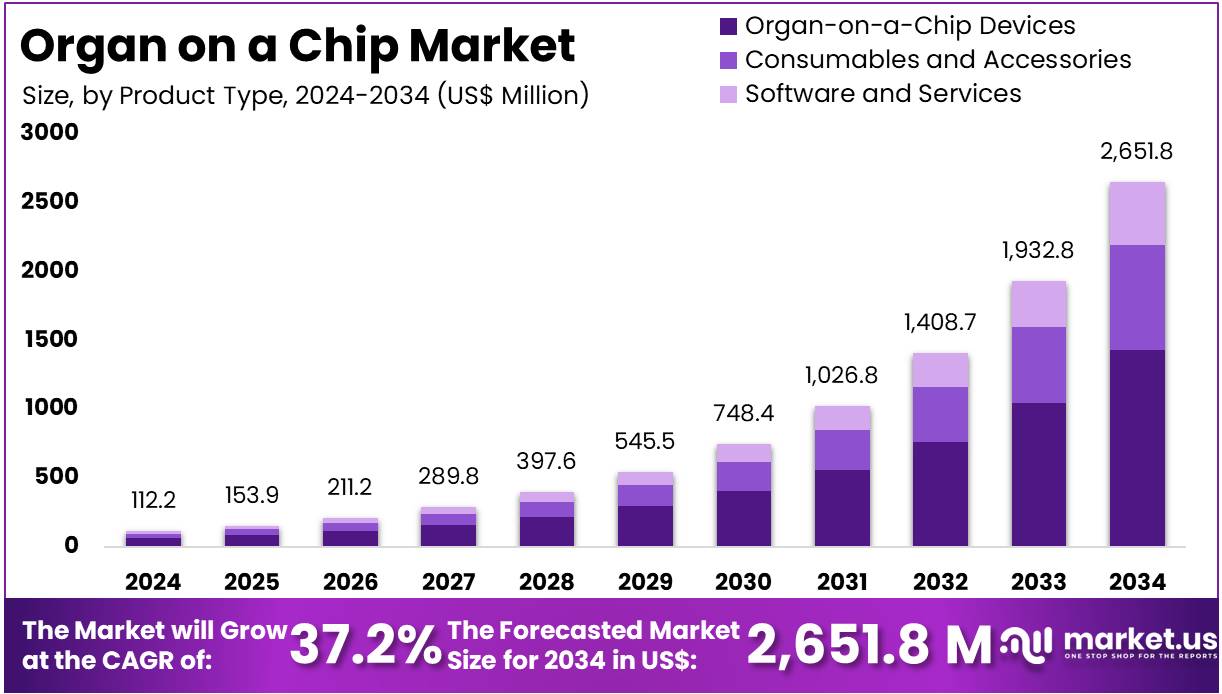
New York, NY – May 21, 2026 –The Global Organ on a Chip Market size is expected to be worth around US$ 2651.8 Million by 2034, from US$ 112.2 Million in 2024, growing at a CAGR of 37.7% during the forecast period from 2025 to 2034. North America held a dominant market position, capturing more than a 54.6% share and holds US$ 61.26 Million market value for the year.
The global focus on advanced preclinical testing models has accelerated the adoption of Organ-on-a-Chip technology across pharmaceutical, biotechnology, and academic research sectors. Organ-on-a-Chip refers to a microfluidic cell culture device designed to simulate the structure, function, and physiological response of human organs within a controlled laboratory environment. These miniature systems integrate living human cells with engineered microchannels to replicate tissue-level activities, enabling researchers to study drug responses, disease progression, and toxicity with greater accuracy than traditional in vitro models.
The increasing demand for alternatives to animal testing, combined with rising investments in precision medicine and drug discovery, has contributed significantly to market growth. Organ-on-a-Chip platforms are widely utilized in applications such as toxicology testing, cancer research, stem cell studies, and personalized medicine development. The technology supports improved prediction of human biological responses, thereby reducing clinical trial failures and development costs.
Pharmaceutical companies are increasingly adopting lung-on-chip, liver-on-chip, heart-on-chip, and kidney-on-chip models to enhance drug screening efficiency and regulatory compliance. In addition, advancements in microfabrication, biomaterials, and artificial intelligence integration are further strengthening the commercial potential of the industry.
Key Takeaways
- The global Organ-on-a-Chip market is expected to grow from US$ 112.2 million in 2024 to nearly US$ 2,651.8 million by 2034.
- The market is projected to register a strong CAGR of 37.7% during the forecast period from 2025 to 2034.
- By product type, Organ-on-a-Chip Devices accounted for the largest market share of over 54.1% in 2024.
- Based on organ type, the Heart-on-a-Chip segment dominated the market in 2024 with a share exceeding 28.5%.
- Drug Discovery & Development emerged as the leading application segment, contributing more than 44.2% of the total market share in 2024.
- Pharmaceutical & Biotechnology Companies represented the largest end-user segment, accounting for over 51.3% of market demand in 2024.
- North America held the leading regional position in 2024, capturing more than 54.6% of the global market, valued at approximately US$ 61.26 million.
Regional Analysis
In 2024, North America dominated the organ-on-a-chip market, accounting for more than 54.6% of the global share and generating approximately US$ 61.26 million in market value. The region’s strong position has been supported by advanced biomedical research infrastructure and the early adoption of innovative technologies by leading universities and research institutions. Growing emphasis on reducing animal testing has also contributed to market growth, supported by increasing ethical awareness and favorable regulatory initiatives promoting alternative testing methods.
The pharmaceutical industry in North America has played a significant role in expanding the adoption of organ-on-a-chip technologies. Microphysiological systems are increasingly being integrated into drug development processes due to their ability to improve testing precision, reduce development timelines, and lower overall research costs. Regulatory support, particularly from the U.S. Food and Drug Administration, has encouraged the use of non-animal testing models, accelerating innovation and commercialization across the sector.
In addition, strong collaboration between academic organizations and private companies continues to strengthen regional market growth. Robust intellectual property protection, rising research investments, and supportive government policies are expected to help North America maintain its leadership position in the coming years.
Emerging Trends
- Shift Toward Animal-Free Testing: Research laboratories and biotechnology companies are increasingly adopting organ-on-a-chip technology as an alternative to animal testing. These systems closely mimic human organ functions, providing more accurate results in drug development and toxicology studies while addressing ethical concerns surrounding animal-based experimentation practices.
- Miniaturization and Custom Design: Organ-on-a-chip devices are becoming smaller, more advanced, and highly customizable for specific research applications. Scientists can now design chips that simulate targeted organ functions, helping improve disease studies, reduce research costs, accelerate experiments, and enhance precision during early-stage drug screening processes.
- AI and Data Integration: Artificial intelligence is being integrated into organ-on-a-chip platforms to improve data analysis and research accuracy. AI-powered tools help researchers quickly process complex biological information, predict drug responses, reduce manual errors, and enhance the efficiency of pharmaceutical and biomedical development activities significantly.
- Personalized Medicine Testing: Organ-on-a-chip technology is supporting personalized medicine by enabling researchers to use patient-derived cells on microchips. This approach allows healthcare professionals to evaluate individual drug responses more accurately, helping improve treatment selection, reduce side effects, and develop patient-specific therapeutic strategies effectively.
- Multi-Organ Chips (Human-on-a-Chip): Multi-organ chip systems are gaining attention for their ability to simulate interactions between multiple human organs simultaneously. These platforms help researchers study whole-body drug responses, improve toxicity analysis, reduce animal testing requirements, and support advanced research on complex multi-organ diseases and conditions.
- Growing Use in Environmental Toxicology: Organ-on-a-chip systems are increasingly being used in environmental toxicology studies to evaluate the effects of pollutants, chemicals, and cosmetic ingredients on human organs. These devices provide faster, more reliable, and human-specific toxicity data while reducing dependence on traditional animal testing methods globally.
- Support from Regulatory Bodies: Regulatory agencies are gradually recognizing the potential of organ-on-a-chip technology in biomedical and pharmaceutical testing. Increasing government interest, pilot programs, and discussions around standardization are expected to encourage broader adoption and support the integration of non-animal testing methods into official regulations.
Use Cases
- Drug Development and Screening: Pharmaceutical companies use organ-on-a-chip devices to evaluate drug safety, toxicity, and effectiveness before clinical trials. Liver-on-a-chip models, for example, help detect harmful drug reactions early, reducing development costs, improving testing accuracy, and accelerating the overall drug discovery and screening process.
- Cancer Research: Cancer researchers use tumor-on-a-chip platforms to recreate realistic tumor environments for studying cancer growth and treatment responses. These systems help scientists test chemotherapy and immunotherapy approaches more effectively while providing faster, safer, and more targeted alternatives to traditional animal-based cancer research methods.
- Vaccine and Immunotherapy Testing: Organ-on-a-chip technology supports vaccine and immunotherapy development by simulating immune system and organ responses. Researchers use these models to study treatment interactions, predict side effects, evaluate immune reactions, and improve the safety and effectiveness of vaccines before human clinical testing begins.
- Infectious Disease Modeling: Organ-on-a-chip platforms are widely used to study infectious diseases by simulating how viruses and bacteria affect human tissues. Lung-on-a-chip and gut-on-a-chip systems became valuable during the COVID-19 pandemic, helping researchers analyze infections, test treatments, and improve outbreak response strategies effectively.
- Heart Disease and Drug Toxicity: Heart-on-a-chip models help researchers evaluate the effects of drugs on heart tissues under different conditions. These systems support early identification of toxic side effects, including irregular heart rhythms and tissue damage, improving patient safety and reducing failures during expensive clinical trial stages.
- Neurological Disease Studies: Brain-on-a-chip technology enables researchers to study neurological disorders such as Alzheimer’s and Parkinson’s disease in controlled laboratory settings. These models help scientists understand nerve cell behavior, test potential therapies, reduce animal experimentation, and support the development of advanced treatments for brain-related conditions.
Frequently Asked Questions on Organ on a Chip
- What factors are driving the growth of the organ-on-a-chip market?
The market growth is being driven by increasing demand for alternatives to animal testing, rising pharmaceutical research activities, and advancements in tissue engineering. Growing investments in personalized medicine and supportive regulatory initiatives are also encouraging the adoption of organ-on-a-chip technologies globally. - How are organ-on-a-chip devices used in drug development?
Organ-on-a-chip devices are widely used in preclinical drug testing to evaluate drug safety, toxicity, and effectiveness. These systems provide more human-relevant results compared to traditional laboratory models, helping pharmaceutical companies reduce development costs and improve clinical success rates. - Which industries are the major end users of organ-on-a-chip technology?
The pharmaceutical and biotechnology industries are the primary users of organ-on-a-chip technology. Academic research institutions, cosmetic companies, and contract research organizations are also increasingly adopting these platforms for disease modeling, toxicity studies, and advanced biomedical research applications. - Why is North America leading the organ-on-a-chip market?
North America leads the market due to its strong biomedical research ecosystem, advanced healthcare infrastructure, and high investment in pharmaceutical innovation. The region also benefits from favorable government support, strong intellectual property protection, and growing adoption of non-animal testing methods. - How does organ-on-a-chip technology support personalized medicine?
Organ-on-a-chip platforms enable researchers to use patient-specific cells for testing drug responses and disease behavior. This approach helps in developing customized treatment strategies, improving therapeutic outcomes, and reducing adverse effects, thereby supporting the advancement of personalized healthcare solutions. - What role does artificial intelligence play in organ-on-a-chip research?
Artificial intelligence is increasingly being integrated with organ-on-a-chip systems to analyze large biological datasets and improve predictive accuracy. AI-driven analytics help researchers identify drug responses, optimize experiments, and accelerate decision-making processes in pharmaceutical and biomedical research. - What is the future outlook for the organ-on-a-chip market?
The future outlook for the organ-on-a-chip market remains highly positive due to ongoing technological advancements and increasing research funding. Expanding applications in drug discovery, disease modeling, and regenerative medicine are expected to create significant growth opportunities over the coming years.
Conclusion
The global organ-on-a-chip market is expected to witness substantial growth over the forecast period, driven by increasing demand for advanced preclinical testing solutions and alternatives to animal-based research models. Technological advancements in microfluidics, biomaterials, and artificial intelligence are improving the accuracy and efficiency of organ simulation platforms.
Rising applications in drug discovery, toxicology testing, cancer research, and personalized medicine are further supporting market expansion. North America continues to lead the market due to strong research capabilities and regulatory support. With growing investments and broader industry adoption, organ-on-a-chip technology is expected to transform pharmaceutical and biomedical research globally.
Discuss your needs with our analyst
Please share your requirements with more details so our analyst can check if they can solve your problem(s)




