


Overview
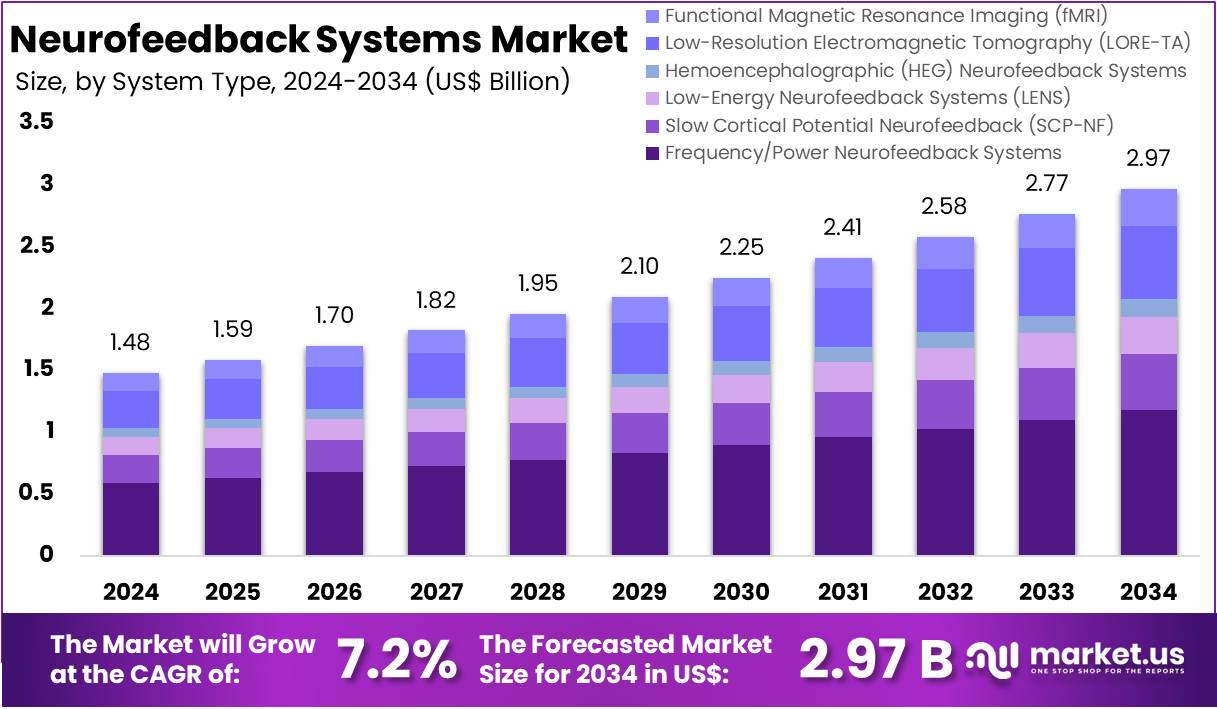
New York, NY – July 16, 2026 – Global Neurofeedback Systems Market size is expected to be worth around US$ 2.97 billion by 2034 from US$ 1.48 billion in 2024, growing at a CAGR of 7.2% during the forecast period 2025 to 2034. North America held a dominant market position, capturing more than a 39.2% share and holds US$ 580.2 Million market value for the year.
Neurofeedback systems are advanced medical and wellness technologies designed to monitor and train brain activity in real time. These systems use electroencephalography (EEG) sensors to measure electrical signals generated by the brain and provide immediate visual, auditory, or interactive feedback to the user. The objective is to help individuals learn to regulate specific brainwave patterns, supporting improved cognitive performance and emotional well-being through a non-invasive process.
Neurofeedback systems are increasingly being adopted across healthcare, research, sports performance, education, and mental wellness applications. They are commonly used as part of therapeutic programs for conditions such as attention-deficit/hyperactivity disorder (ADHD), anxiety, stress, insomnia, and certain neurological disorders, while ongoing research continues to evaluate their effectiveness across additional clinical indications. The growing emphasis on personalized healthcare, mental health awareness, and digital therapeutics has contributed to rising interest in neurofeedback technologies.
Modern neurofeedback platforms integrate advanced software, artificial intelligence, cloud connectivity, and user-friendly interfaces to deliver more accurate data analysis and customized training sessions. Portable and wearable neurofeedback devices have further expanded accessibility, enabling home-based monitoring and remote therapy under professional guidance. As technological innovation continues and demand for non-invasive brain training solutions increases, neurofeedback systems are expected to play an increasingly important role in cognitive health, neurological rehabilitation, and overall brain performance enhancement across diverse end-user settings.
Key Takeaways
- The global Neurofeedback Systems market was valued at US$ 1.48 billion in 2024 and is projected to reach US$ 2.97 billion by 2034, expanding at a CAGR of 7.2% during the forecast period.
- Based on System Type, Frequency/Power Neurofeedback Systems accounted for the largest market share of 39.8% in 2024.
- By Application, the market is segmented into Attention Deficit Hyperactivity Disorder (ADHD), Anxiety Disorders, Pain Management, Insomnia, and Other Applications. Among these, Attention Deficit Hyperactivity Disorder (ADHD) held the leading position with a 29.9% market share in 2024.
- Based on End User, the market is categorized into Hospitals, Physician Offices, Ambulatory Surgical Centers (ASCs), Home Care, and Others. Hospitals dominated the segment, capturing a 34.9% market share in 2024.
- North America emerged as the leading regional market, accounting for 39.2% of the global Neurofeedback Systems market in 2024.
Regional Analysis
North America Leads the Neurofeedback Systems Market
North America accounted for 39.2% of the global Neurofeedback Systems market in 2024, supported by the growing adoption of non-invasive therapies for neurological and mental health conditions. Neurofeedback systems are increasingly used to support the management of attention deficit hyperactivity disorder (ADHD), anxiety, depression, post-traumatic stress disorder (PTSD), and other cognitive disorders. Continuous advancements in wearable neurofeedback devices, artificial intelligence, and real-time brain monitoring technologies are improving treatment accuracy, accessibility, and personalized therapy.
The region also benefits from strong investments in neuroscience research and technological innovation. For instance, NASA’s Langley Research Center developed smart glasses capable of translating brainwave activity into attention-level measurements, demonstrating the expanding application of neurofeedback-based technologies in cognitive performance monitoring.
Canada is further contributing to regional market growth through increasing adoption of neurofeedback systems in hospitals, specialized clinics, and wellness centers. The integration of neuroscience, AI, and wearable technologies continues to strengthen the region’s leadership in the neurofeedback systems market
Emerging Trends
- Personalised and Preventive Neurofeedback Solutions: Neurofeedback is increasingly adopting personalized and preventive approaches using brain mapping, genetic testing, and biometric data to create customized treatment plans. This enables early detection of mental stress, supports long-term cognitive wellness, and expands neurofeedback beyond therapy into proactive brain-health maintenance.
- Advances in Closed-Loop and Real-Time Neurofeedback: Closed-loop neurofeedback systems continuously monitor brain activity and adjust feedback instantly during sessions. This real-time interaction improves learning, focus, emotional regulation, and anxiety management while enhancing meditation practices, delivering faster outcomes, greater engagement, and more effective brain-training experiences.
- Integration with Wellness Tourism and Brain-Health Programs: Neurofeedback is becoming part of wellness tourism through integration into luxury resorts, retreats, and brain-health programs. Combined with meditation, sleep improvement, and stress-management services, it attracts health-conscious travelers seeking preventive care, cognitive enhancement, and non-clinical mental wellness solutions.
Use Cases
- PTSD and Trauma Treatment: Neurofeedback is increasingly used for PTSD and trauma treatment by regulating abnormal brainwave activity associated with stress responses. Clinical studies report high remission rates, demonstrating its effectiveness in reducing flashbacks, anxiety, and emotional distress through a non-invasive, drug-free therapeutic approach.
- Attention-Related Disorders (e.g., ADHD): Neurofeedback helps manage ADHD by training the brain to improve attention, reduce impulsivity, and enhance focus through EEG-guided brainwave regulation. Suitable for children and adults, it offers a non-invasive alternative that may provide lasting benefits without medication-related side effects.
- Cognitive Enhancement and Memory Improvement: Neurofeedback supports cognitive enhancement by strengthening brainwave patterns linked to memory, attention, and mental clarity. Research indicates improvements in working, visual, and episodic memory, making it a promising solution for students, professionals, and older adults seeking cognitive performance optimization.
- Athletic and Motor Performance Enhancement: Athletes use neurofeedback to improve reaction time, coordination, motor control, and concentration through sensorimotor rhythm training. Studies demonstrate enhanced performance across sports, supporting better brain-body synchronization and helping individuals perform consistently under competitive and high-pressure conditions without performance-enhancing drugs.
- Neurorehabilitation (Concussion, TBI, Stroke, Alzheimer’s): Neurofeedback is gaining importance in neurorehabilitation by promoting brain plasticity after concussion, traumatic brain injury, stroke, and Alzheimer’s disease. EEG and brain-computer interface technologies support cognitive recovery, motor rehabilitation, and functional improvement through targeted, non-invasive brain training techniques.
Frequently Asked Questions on Neurofeedback Systems
- What are neurofeedback systems?
Neurofeedback systems are advanced medical and wellness technologies designed to monitor brainwave activity in real time and provide feedback that helps individuals regulate brain function. These systems use electroencephalography (EEG) sensors and specialized software to support cognitive improvement, stress management, and neurological rehabilitation in both clinical and research environments. - How do neurofeedback systems work?
Neurofeedback systems operate by measuring electrical brain activity through EEG sensors and displaying real-time feedback using visual, auditory, or interactive signals. This process enables users to recognize and modify brainwave patterns over repeated sessions, supporting improved attention, emotional regulation, relaxation, and cognitive performance under professional supervision. - What are the major applications of neurofeedback systems?
Neurofeedback systems are widely applied in the treatment and management of attention deficit disorders, anxiety, depression, epilepsy, insomnia, post-traumatic stress disorder, and cognitive rehabilitation. They are also used in sports performance enhancement, educational settings, wellness programs, and neuroscience research to improve mental performance and brain function. - Who are the primary end users of neurofeedback systems?
The primary end users include hospitals, neurology clinics, mental health centers, rehabilitation facilities, academic institutions, sports organizations, and research laboratories. In addition, wellness centers and individual consumers are increasingly adopting portable neurofeedback systems due to growing awareness of non-invasive brain training technologies. - What factors are driving the adoption of neurofeedback systems?
The adoption of neurofeedback systems is being driven by the increasing prevalence of neurological and mental health disorders, rising awareness of non-pharmacological therapies, technological advancements in EEG devices, and growing investments in neuroscience research. Improved accessibility of portable systems is also contributing to wider market acceptance. - Which regions dominate the neurofeedback systems market?
North America holds a significant share of the neurofeedback systems market due to advanced healthcare infrastructure, high research investments, and widespread adoption of innovative medical technologies. Europe follows closely, while the Asia-Pacific region is expected to witness rapid growth because of improving healthcare access and rising healthcare expenditure. - What is the future outlook for the neurofeedback systems market?
The future outlook for the neurofeedback systems market remains positive, supported by advancements in artificial intelligence, wearable EEG technologies, cloud-based analytics, and telehealth integration. Increasing acceptance of personalized brain training solutions and expanding clinical research are expected to create sustained growth opportunities throughout the forecast period.
Conclusion
The global neurofeedback systems market is positioned for steady growth, supported by rising awareness of mental health, increasing demand for non-invasive therapies, and continuous advancements in EEG technology, artificial intelligence, and wearable devices. Expanding applications across neurological rehabilitation, cognitive enhancement, ADHD management, sports performance, and emotional wellness are broadening the market’s adoption beyond traditional clinical settings.
North America continues to lead through strong research investments and technological innovation, while emerging markets offer significant growth opportunities. As personalized, real-time, and home-based neurofeedback solutions become more accessible, the market is expected to play an increasingly important role in preventive healthcare, brain optimization, and digital therapeutics worldwide.
Discuss your needs with our analyst
Please share your requirements with more details so our analyst can check if they can solve your problem(s)




