


Overview
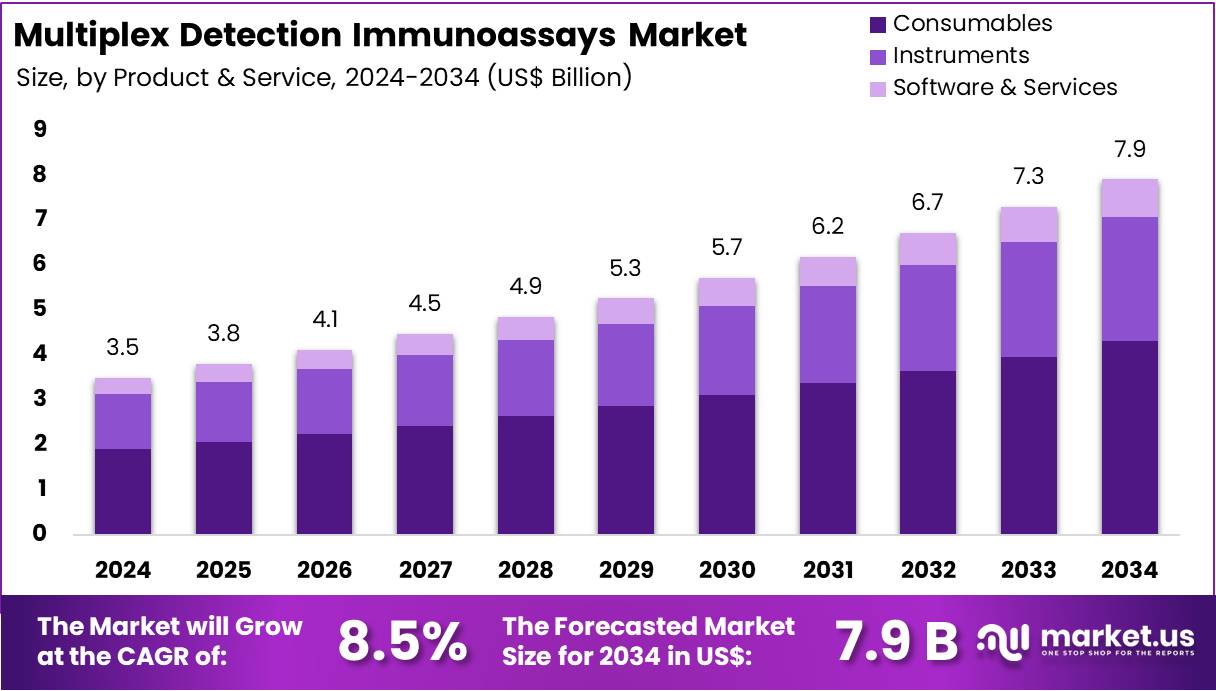
New York, NY – May 27, 2026 – The Global Multiplex Detection Immunoassays Market size is expected to be worth around US$ 7.9 Billion by 2034, from US$ 3.5 Billion in 2024, growing at a CAGR of 8.5% during the forecast period from 2025 to 2034.
The global multiplex detection immunoassays market is witnessing steady growth, driven by the rising demand for high-throughput diagnostic technologies and increasing prevalence of infectious diseases, cancer, and autoimmune disorders. Multiplex detection immunoassays are advanced diagnostic techniques that enable the simultaneous detection and measurement of multiple analytes, such as proteins, antibodies, cytokines, or biomarkers, within a single sample. These assays improve laboratory efficiency, reduce sample volume requirements, and provide faster and more accurate diagnostic outcomes.
The technology is widely utilized in clinical diagnostics, pharmaceutical research, biomarker discovery, and drug development applications. Growing investments in precision medicine and personalized healthcare are further supporting market expansion. In addition, increasing adoption of automated laboratory systems and advancements in bioanalytical technologies are accelerating the use of multiplex immunoassays across hospitals, diagnostic laboratories, and research institutes.
North America currently represents a significant market share due to the presence of advanced healthcare infrastructure, strong research funding, and early adoption of innovative diagnostic solutions. Meanwhile, the Asia-Pacific region is expected to witness notable growth owing to expanding healthcare expenditure, improving laboratory capabilities, and rising awareness regarding early disease diagnosis.
Key industry participants are focusing on technological innovations, strategic collaborations, and product launches to strengthen their market presence and expand their global customer base.
Key Takeaways
- The global multiplex detection immunoassays market is anticipated to expand from USD 3.5 billion in 2024 to approximately USD 7.9 billion by 2034, registering a CAGR of 8.5% during the forecast period.
- Consumables accounted for the largest share of the product and service segment in 2024, representing more than 54.4% of the market, primarily supported by their recurring usage in diagnostic testing procedures.
- Protein multiplex assays dominated the type segment in 2024 with over 54.5% market share, driven by increasing demand for efficient multi-biomarker detection technologies.
- Flow cytometry held the leading position among technologies in 2024, capturing more than 41.2% of the market due to its superior throughput capabilities and high assay sensitivity.
- North America emerged as the dominant regional market in 2024, accounting for 32.2% share and generating nearly USD 1.1 billion, supported by advanced healthcare infrastructure and widespread adoption of diagnostic technologies.
Regional Analysis
North America dominated the multiplex detection immunoassays market in 2024, accounting for more than 32.2% of the global share and generating approximately USD 1.1 billion in revenue. The region’s leadership is supported by advanced healthcare infrastructure, high healthcare expenditure, and early adoption of innovative diagnostic technologies.
Strong investments in biomedical and immunological research, particularly in the United States, have accelerated the use of multiplex assays in cancer diagnostics, infectious disease monitoring, and autoimmune disorder detection. The increasing prevalence of chronic diseases and growing demand for accurate and rapid diagnostic solutions continue to strengthen market growth across the region. Canada also contributes significantly through government-supported screening programs and preventive healthcare initiatives. Additionally, regulatory approvals for multiplex immunoassay devices have enhanced commercial adoption in clinical settings.
Asia Pacific is emerging as a rapidly expanding market due to rising healthcare investments, improving laboratory infrastructure, and growing awareness regarding early disease diagnosis. Countries including China, India, Japan, and South Korea are witnessing increasing demand for advanced diagnostic technologies driven by large patient populations and expanding healthcare access. Government health programs, precision medicine initiatives, and growing biotechnology research activities are further supporting the adoption of multiplex immunoassays across the region.
Emerging Trends
- Shift Toward Precision Medicine: Multiplex immunoassays support precision medicine by enabling simultaneous analysis of multiple biomarkers from one sample. This helps physicians develop personalized treatment strategies for cancer, chronic diseases, and rare disorders while improving diagnostic accuracy, treatment efficiency, and patient-specific healthcare decision-making across clinical settings.
- Growing Use in Infectious Disease Monitoring: Multiplex immunoassays are increasingly used for infectious disease surveillance because they can detect multiple pathogens within a single test. Their rapid and accurate results support outbreak management, faster treatment decisions, and improved monitoring of co-infections in hospitals, laboratories, and public health programs.
- Integration with Genomics and Proteomics: The integration of multiplex immunoassays with genomics and proteomics technologies enhances disease understanding by analyzing interactions between genes, proteins, and biomarkers. This combined approach improves disease profiling, supports precision medicine, and accelerates advancements in cancer research, autoimmune disease studies, and therapeutic development.
- Expansion into Point-of-Care Testing: Portable multiplex immunoassay devices are expanding point-of-care testing capabilities by delivering rapid diagnostic results directly at patient locations. These systems improve healthcare accessibility in rural areas, emergency settings, and clinics while enabling faster treatment decisions and reducing dependence on centralized laboratory infrastructure.
- Automation and High-Throughput Platforms: Automation and high-throughput multiplex platforms are transforming laboratory operations by processing large sample volumes quickly and accurately. These technologies reduce manual errors, improve testing consistency, and support large-scale clinical diagnostics, pharmaceutical research, and disease outbreak management with greater operational efficiency.
- Advancement in Bead- and Chip-Based Technologies: Bead-based and chip-based multiplex technologies are improving diagnostic sensitivity and efficiency by enabling simultaneous analysis of numerous biomarkers from minimal sample volumes. These advanced platforms support early disease detection, personalized medicine, and complex biological analysis while enhancing research and clinical diagnostic performance.
- Environmental and Food Safety Applications: Multiplex immunoassays are increasingly used in food safety and environmental monitoring to detect allergens, contaminants, and harmful microorganisms. Their rapid and accurate testing capabilities help manufacturers and regulatory agencies ensure product quality, maintain public safety standards, and support routine environmental assessments efficiently.
Use Cases
- Cancer Research and Diagnosis: Multiplex detection immunoassays are widely used in cancer research to identify multiple tumor biomarkers from a single sample. These assays support early diagnosis, monitor disease progression, and help physicians develop personalized treatment plans while improving research efficiency and reducing sample testing requirements.
- Autoimmune Disease Profiling: Multiplex immunoassays assist in diagnosing autoimmune disorders by simultaneously detecting multiple autoantibodies within one test. This improves diagnostic accuracy for diseases such as lupus and rheumatoid arthritis while enabling earlier treatment, better disease monitoring, and more effective long-term patient management strategies.
- Vaccine Development: In vaccine research, multiplex immunoassays help evaluate immune responses by detecting multiple antibodies and biomarkers simultaneously. These assays improve vaccine development efficiency, accelerate clinical trials, reduce testing costs, and provide comprehensive data that supports faster vaccine optimization and regulatory approval processes.
- Monitoring Infectious Disease Outbreaks: Multiplex immunoassays support infectious disease outbreak management by detecting several pathogens from a single sample. Their rapid testing capabilities improve disease surveillance, enable faster public health responses, reduce diagnostic delays, and assist healthcare providers in controlling infection spread more effectively during emergencies.
- Drug Development and Toxicology Studies: Pharmaceutical companies use multiplex immunoassays to evaluate drug safety and biological responses by analyzing multiple biomarkers simultaneously. These assays improve toxicology studies, support efficient drug development, reduce research costs, and provide deeper insights into treatment effectiveness and potential adverse reactions during clinical testing.
- Prenatal and Neonatal Testing: Multiplex immunoassays are increasingly utilized in prenatal and neonatal screening to identify multiple congenital and genetic disorders from small blood samples. These tests improve early diagnosis, support timely medical intervention, reduce testing complexity, and enhance healthcare outcomes for newborns and expecting mothers.
Frequently Asked Questions on Multiplex Detection Immunoassays
- What factors are driving the growth of the multiplex detection immunoassays market?
Market growth is primarily driven by increasing demand for high-throughput diagnostics, rising prevalence of chronic and infectious diseases, and growing adoption of personalized medicine. Technological advancements in diagnostic platforms and expanding biomedical research activities further support market expansion globally. - Which industries commonly use multiplex detection immunoassays?
Multiplex detection immunoassays are widely utilized across healthcare, biotechnology, pharmaceutical, and academic research industries. They are commonly applied in disease diagnosis, biomarker discovery, drug development, clinical trials, and translational research to improve testing accuracy and laboratory efficiency. - Why are protein multiplex assays gaining significant demand?
Protein multiplex assays are gaining strong demand due to their ability to simultaneously analyze multiple protein biomarkers within a single test. This capability supports faster disease detection, improves clinical decision-making, and enhances research efficiency in oncology, immunology, and infectious disease studies. - Which region dominates the multiplex detection immunoassays market?
North America currently dominates the multiplex detection immunoassays market due to advanced healthcare infrastructure, strong research funding, and high adoption of innovative diagnostic technologies. The region also benefits from increasing investments in precision medicine and disease surveillance programs. - What role does flow cytometry play in multiplex detection immunoassays?
Flow cytometry is a key technology used in multiplex detection immunoassays because it enables high-throughput analysis with excellent sensitivity and accuracy. The technology supports simultaneous measurement of multiple cellular and molecular parameters in clinical and research applications. - How are multiplex detection immunoassays used in clinical diagnostics?
In clinical diagnostics, multiplex detection immunoassays help identify multiple disease biomarkers from a single patient sample. This improves diagnostic speed, supports early disease detection, reduces laboratory workload, and enhances treatment planning for conditions including cancer and infectious diseases. - What is the future outlook for the multiplex detection immunoassays market?
The future outlook for the multiplex detection immunoassays market remains positive due to continuous technological advancements, increasing demand for personalized healthcare, and growing investments in biomedical research. Expanding applications in diagnostics and drug discovery are expected to drive long-term market growth.
Conclusion
The global multiplex detection immunoassays market is expected to witness substantial growth due to increasing demand for rapid, accurate, and high-throughput diagnostic solutions. Rising adoption of precision medicine, technological advancements in multiplex platforms, and expanding applications across oncology, infectious diseases, autoimmune disorders, and drug development are supporting market expansion.
North America remains the leading regional market, while Asia Pacific is emerging rapidly with growing healthcare investments and improving diagnostic infrastructure. Furthermore, advancements in automation, point-of-care testing, and genomics integration are expected to enhance market opportunities. Continuous research activities and expanding clinical applications will further drive long-term industry growth globally.
Discuss your needs with our analyst
Please share your requirements with more details so our analyst can check if they can solve your problem(s)




