


Overview
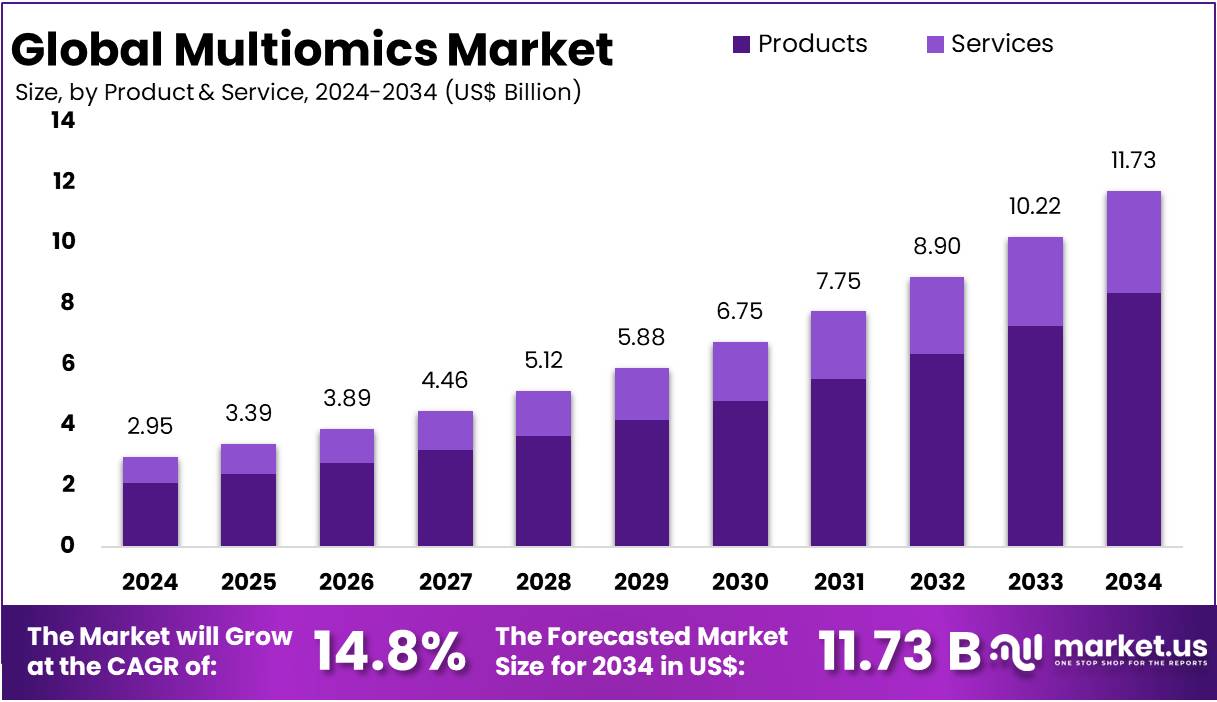
New York, NY – May 07, 2026 – The Global Multiomics Market Size is expected to be worth around US$ 11.73 Billion by 2034 from US$ 2.95 Billion in 2024, growing at a CAGR of 14.8% during the forecast period 2025 to 2034.
Multiomics refers to the integrated analysis of multiple “omics” disciplines, including genomics, transcriptomics, proteomics, metabolomics, and epigenomics, to provide a comprehensive understanding of biological systems and disease mechanisms. By combining data from different molecular layers, multiomics enables researchers and healthcare professionals to identify complex interactions within cells and tissues that cannot be captured through a single-omics approach.
The growing adoption of multiomics technologies is transforming precision medicine, drug discovery, and clinical diagnostics. These technologies support the identification of novel biomarkers, improve disease prediction accuracy, and facilitate the development of targeted therapies. Multiomics is increasingly being applied in oncology, neurology, immunology, and rare disease research, where understanding molecular complexity is critical for improving patient outcomes.
Advancements in next-generation sequencing, mass spectrometry, bioinformatics, and artificial intelligence have significantly enhanced the efficiency and scalability of multiomics analysis. In addition, increasing investments in life sciences research, rising demand for personalized healthcare, and expanding collaborations between academic institutions and biotechnology companies are contributing to market growth.
North America currently represents a leading region in the adoption of multiomics solutions due to its strong research infrastructure and high healthcare expenditure, while Asia-Pacific is emerging as a rapidly growing market supported by increasing genomics initiatives and expanding biotechnology capabilities.
&n
Key Takeaways
- In 2024, the global multiomics market generated revenue of US$ 9.5 billion and is projected to reach US$ 11.73 billion by 2033, expanding at a CAGR of 14.8% during the forecast period.
- Based on product and services, the market is segmented into Products (Reagents & Consumables, Instruments & Platforms, and Software & Analysis Tools) and Services. The Products segment dominated the market in 2023, accounting for a revenue share of 71.2%.
- By type, the market is categorized into Bulk Multiomics and Single-cell Multiomics. Among these, Bulk Multiomics held the leading position with a market share of 54.4% in 2023.
- In terms of platform, the market is segmented into Genomics, Proteomics, Transcriptomics, Metabolomics, Lipidomics, Microbiomics, Epigenomics, and Others. The Genomics segment emerged as the largest contributor, capturing 27.9% of the overall market revenue.
- Based on application, the market is divided into Cell Biology, Oncology, Neurology, and Immunology. Oncology accounted for the highest market share of 47.7% in 2023.
- By end user, the market is segmented into Academic & Research Institutes, Pharmaceutical & Biotechnology Companies, and Others. Pharmaceutical & Biotechnology Companies led the market with a share of 45.2%.
- North America dominated the global multiomics market in 2023, securing a market share of 45.0%.
Regional Analysis
North America dominates the global multiomics market, accounting for approximately 45.0% of the total market share. The region’s leadership is supported by advanced healthcare infrastructure, continuous technological innovations, and substantial investments in research and development activities.
The United States remains the primary growth engine, with leading biotechnology and life sciences companies such as Thermo Fisher Scientific, Illumina, and Agilent Technologies actively developing multiomics platforms and analytical solutions.
The growing adoption of next-generation sequencing (NGS), proteomics, transcriptomics, and metabolomics technologies is accelerating market expansion across clinical and research applications. For instance, Illumina’s NGS platforms support high-throughput genomic analysis integrated with proteomic and metabolomic data, enabling comprehensive biological insights and precision medicine applications.
In addition, organizations such as Labcorp and Bio-Rad Laboratories are strengthening their multiomics capabilities to advance biomarker discovery, disease profiling, and personalized therapeutics.
Government support also plays a crucial role in market growth. The National Institutes of Health (NIH) recently launched the Multi-Omics for Health and Disease Consortium with an initial first-year investment of nearly $11 billion. The initiative is projected to receive approximately $50.3 billion over the next five years, subject to funding availability, further supporting multiomics research and innovation across North America.
Emerging Trends
- Integration of Multiple Omics at the Single-Cell Level: Researchers combine genomics, transcriptomics, proteomics, and metabolomics at single-cell level to study cellular behavior. This improves understanding of disease heterogeneity, biomarker discovery, and targeted therapies across cancer and immune disorders.
- Advancements in Artificial Intelligence and Machine Learning: AI and machine learning improve multiomics data analysis by identifying complex biological patterns. These tools accelerate disease research, predict treatment responses, reduce analysis errors, and support precision medicine applications globally.
- Growth of Cloud-Based Analysis Platforms: Cloud-based platforms enable secure storage, sharing, and analysis of large multiomics datasets. They support remote collaboration, faster processing, scalable research workflows, and cost-effective data management for biomedical research institutions worldwide.
- Increased Focus on Data Integration and Standardization: Researchers are prioritizing standardized data integration across omics layers to improve compatibility, collaboration, and data quality. Shared workflows and open databases support efficient research, reduce duplication, and strengthen biomedical ecosystems.
Use Cases
- Understanding Cancer at a Deeper Level: Multiomics enables comprehensive cancer analysis through genomics, proteomics, metabolomics, and immune profiling. This approach improves biomarker discovery, personalized therapies, treatment accuracy, and survival outcomes while reducing treatment resistance risks.
- Improving Research on Brain Disorders: Scientists use multiomics to study Alzheimer’s, Parkinson’s, and neurological disorders by integrating genetic, protein, and metabolic data. This supports earlier disease detection, clearer progression tracking, and development of improved treatments.
- Designing Safer and More Effective Drugs: Pharmaceutical companies apply multiomics to identify drug targets, evaluate biological responses, and predict patient outcomes. This reduces development costs, improves drug safety, minimizes side effects, and accelerates precision drug discovery processes.
- Mapping How Genes Are Regulated: Multiomics helps researchers map gene regulation by combining genomics, transcriptomics, proteomics, and epigenomics data. These insights reveal disease mechanisms, biological pathways, developmental processes, and potential therapeutic targets for advanced medical research.
Frequently Asked Questions on Multiomics
- How is multiomics used in precision medicine?
Multiomics supports precision medicine by combining diverse biological datasets to identify patient-specific disease characteristics and therapeutic targets. This integrated approach improves diagnostic accuracy, enables personalized treatment selection, and enhances drug response prediction, particularly in oncology, neurology, and rare genetic disorders. - Which industries are the major end users of multiomics solutions?
Major end users of multiomics solutions include pharmaceutical companies, biotechnology firms, academic research institutes, clinical laboratories, and healthcare organizations. These industries utilize multiomics technologies for drug discovery, biomarker identification, disease diagnosis, and advanced biological research applications across multiple therapeutic areas. - What technologies are commonly used in multiomics research?
Common technologies used in multiomics research include next-generation sequencing, mass spectrometry, bioinformatics platforms, single-cell analysis tools, and artificial intelligence-based analytics. These technologies facilitate comprehensive biological data integration, allowing researchers to generate deeper insights into cellular and molecular processes. - Why is bioinformatics important in the multiomics market?
Bioinformatics plays a critical role in the multiomics market by managing, analyzing, and interpreting large-scale biological datasets. Advanced computational tools help researchers integrate diverse omics data efficiently, enabling accurate identification of biomarkers, disease pathways, and potential therapeutic targets for clinical and research purposes. - How does artificial intelligence support multiomics analysis?
Artificial intelligence enhances multiomics analysis by processing large and complex datasets rapidly and accurately. AI-driven algorithms assist in pattern recognition, predictive modeling, and biomarker discovery, improving research efficiency and accelerating the development of personalized therapies and advanced diagnostic solutions. - Which region dominates the global multiomics market?
North America currently dominates the global multiomics market due to strong healthcare infrastructure, significant research funding, and the presence of leading biotechnology companies. The region also benefits from increasing adoption of precision medicine and advanced genomic technologies across research and clinical settings.
Conclusion
The global multiomics market is experiencing significant growth due to increasing adoption of precision medicine, advancements in sequencing and bioinformatics technologies, and rising demand for personalized healthcare solutions.
The integration of genomics, proteomics, transcriptomics, and metabolomics is enabling deeper insights into disease mechanisms, biomarker discovery, and targeted therapeutics. Strong investments from government organizations, research institutions, and biotechnology companies are further accelerating innovation and market expansion.
North America continues to dominate the market owing to advanced healthcare infrastructure and robust R&D activities, while Asia-Pacific is emerging as a high-growth region driven by expanding genomics initiatives and biotechnology development.
Discuss your needs with our analyst
Please share your requirements with more details so our analyst can check if they can solve your problem(s)




