


Overview
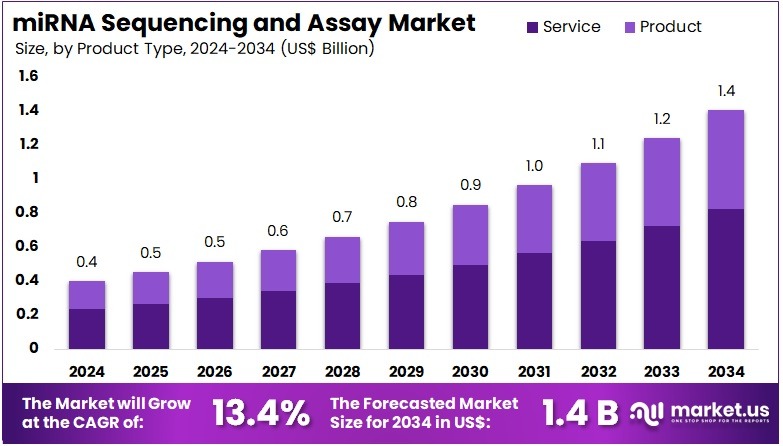
New York, NY – June 01, 2026 – The miRNA Sequencing and Assay Market Size is expected to be worth around US$ 1.4 billion by 2034 from US$ 0.4 billion in 2024, growing at a CAGR of 13.4% during the forecast period 2025 to 2034.
miRNA sequencing and assay technologies are essential tools used to study microRNAs (miRNAs), a class of small non-coding RNA molecules that regulate gene expression and play critical roles in various biological processes. These technologies have become increasingly important in molecular biology, genomics research, disease diagnostics, and drug development due to their ability to provide detailed insights into cellular functions and disease mechanisms.
miRNA sequencing enables researchers to identify, quantify, and analyze known and novel miRNAs within biological samples. Using advanced next-generation sequencing (NGS) platforms, scientists can generate comprehensive profiles of miRNA expression, helping to uncover genetic and molecular changes associated with cancer, cardiovascular disorders, neurological diseases, and other health conditions. The technology offers high sensitivity, accuracy, and scalability, making it suitable for both research and clinical applications.
miRNA assays are widely used for the detection, validation, and quantification of specific miRNA targets. These assays typically utilize techniques such as quantitative PCR (qPCR), microarrays, and hybridization-based methods to measure miRNA expression levels with precision. They are commonly employed in biomarker discovery, disease diagnosis, therapeutic monitoring, and personalized medicine research.
The growing focus on precision healthcare, increasing investments in genomics research, and expanding applications of RNA-based technologies are driving the adoption of miRNA sequencing and assay solutions. As understanding of gene regulation continues to advance, these technologies are expected to play an increasingly important role in biomedical research and clinical diagnostics.
Key Takeaways
- The global miRNA sequencing and assay market was valued at US$ 0.4 billion in 2024 and is projected to reach US$ 1.4 billion by 2033, expanding at a CAGR of 13.4% during the forecast period.
- Based on product type, the market is segmented into products and services. The services segment dominated the market in 2024, accounting for 58.4% of the total revenue share.
- By technology, the market is categorized into sequencing by synthesis, single molecule real-time sequencing, sequencing by oligonucleotide ligation and detection, Sanger sequencing, and nanopore sequencing. Among these, sequencing by synthesis emerged as the leading technology, capturing 45.3% of the market share in 2024.
- Based on application, the market is divided into cancer, schizophrenia, polyglutamine diseases, autoimmune diseases, and others. The polyglutamine diseases segment held the largest share, contributing 46.2% of total market revenue in 2024.
- By workflow, the market is segmented into sequencing, library preparation, and data analysis & storage. The sequencing segment led the market with a revenue share of 49.1% in 2024.
- In terms of end user, the market is classified into research and academic institutes, pharmaceutical & biotechnology companies, and others. The research and academic institutes segment accounted for the highest market share of 54.7% in 2024.
- North America maintained its dominant position in the global market, representing 40.7% of the total market share in 2024.
Regional Analysis
North America accounted for the largest share of the global miRNA sequencing and assay market in 2024, representing 40.7% of total revenue. The region’s strong position is supported by its advanced genomics research infrastructure, substantial healthcare spending, and widespread adoption of molecular diagnostic technologies. Increasing recognition of microRNAs (miRNAs) as valuable biomarkers for diseases, particularly cancer, has significantly boosted the demand for sequencing and assay solutions.
Research institutions, academic centers, and clinical laboratories across the United States and Canada continue to expand their use of miRNA-based diagnostic and research applications. In addition, support from organizations such as the National Institutes of Health (NIH), which has funded multiple miRNA-focused research initiatives, is accelerating technological advancements and strengthening the regional market. The presence of major biotechnology and sequencing technology companies further contributes to North America’s leadership position.
Asia Pacific is expected to register the fastest growth rate during the forecast period. Market expansion is being driven by rising healthcare investments, improving access to advanced genomic technologies, and increasing focus on precision medicine across countries such as China, India, Japan, and South Korea. Government initiatives promoting biotechnology innovation and genomic research are supporting wider adoption of miRNA sequencing and assay technologies.
Furthermore, the growing burden of chronic diseases, expanding research collaborations, and increasing funding for molecular biology studies are creating favorable conditions for market growth. As biotechnology capabilities continue to advance across the region, Asia Pacific is expected to emerge as a major growth hub for the miRNA sequencing and assay industry.
Emerging Trends
- Rising Use in Cancer Detection: Researchers increasingly use miRNA sequencing for early detection of breast, liver, and colorectal cancers. As sensitive biomarkers, miRNAs reveal abnormal gene activity before tumors develop fully. Growing adoption in hospitals and laboratories is improving cancer screening, treatment outcomes, and patient survival rates.
- Shift Toward Personalized Medicine: miRNA profiling supports personalized medicine by identifying unique genetic patterns that influence treatment response. Physicians can select therapies tailored to individual patients, improving effectiveness and minimizing side effects. The technology also aids preventive care by detecting health risks before symptoms emerge.
- Growth of Non-Invasive Testing: miRNAs can be detected in blood, saliva, urine, and other body fluids, enabling non-invasive diagnostics. These tests eliminate the need for surgical biopsies, provide safer patient experiences, and support continuous disease monitoring through repeated, convenient, and less painful testing.
- Advancements in Sequencing Tools: Modern miRNA sequencing platforms offer faster processing, improved accuracy, and reduced costs. Laboratories can analyze larger sample volumes while minimizing errors. These advancements are expanding access to miRNA technologies, encouraging broader adoption across hospitals, research institutions, and diagnostic centers worldwide.
- Integration with AI and Bioinformatics: AI and bioinformatics tools enhance miRNA data analysis by identifying patterns within large datasets. These technologies improve diagnostic accuracy, accelerate research, and uncover disease pathways. Their integration supports predictive healthcare, biomarker discovery, and development of targeted therapeutic strategies.
Use Cases
- Early Cancer Diagnosis: Hospitals are using miRNA sequencing to identify cancers at earlier stages with high accuracy. In breast cancer screening programs, miRNA-based tests detect tumors before traditional methods, enabling earlier treatment initiation, improving patient outcomes, and supporting routine screening for high-risk populations.
- Tracking Drug Response in Clinical Trials: Clinical researchers use miRNA assays to monitor treatment effectiveness during drug trials. Changes in miRNA expression reveal patient responses, helping identify beneficiaries of specific therapies. This approach improves trial efficiency, reduces costs, and accelerates development of new medicines.
- Research on Brain Disorders: Universities apply miRNA sequencing to study Alzheimer’s and other neurodegenerative diseases. Specific miRNA biomarkers linked to early cognitive decline enable earlier diagnosis. These insights help researchers understand disease mechanisms and identify potential therapeutic targets for neurological disorders.
- Cardiovascular Risk Prediction: miRNA profiling helps identify individuals at risk of cardiovascular disease before symptoms appear. Early detection allows physicians to implement preventive measures, including lifestyle modifications and medication. This proactive approach may reduce long-term rates of heart attacks and strokes.
- Infection Monitoring and Management: Healthcare providers use miRNA sequencing to monitor infectious diseases such as hepatitis and COVID-19. Tracking miRNA changes helps assess disease progression, predict complications, and adjust treatments promptly. This improves patient management, supports recovery, and enhances overall infection control strategies.
Frequently Asked Questions on miRNA Sequencing and Assay
- Why is miRNA sequencing important in biomedical research?
miRNA sequencing is important because miRNAs regulate gene expression and influence numerous biological processes. Accurate sequencing enables the identification of disease-associated miRNAs, supports biomarker discovery, improves understanding of molecular pathways, and contributes to the development of personalized medicine approaches. - What technologies are commonly used for miRNA sequencing?
Common technologies include next-generation sequencing (NGS), quantitative polymerase chain reaction (qPCR), microarray platforms, and digital PCR systems. These technologies offer varying levels of sensitivity, throughput, and accuracy depending on specific research objectives and sample requirements. - How is artificial intelligence supporting miRNA data analysis?
Artificial intelligence and machine learning tools are increasingly used to analyze large miRNA datasets, identify biomarkers, predict disease outcomes, and uncover hidden biological patterns. These technologies improve analytical efficiency and support more accurate interpretation of sequencing results. - What role do miRNAs play in disease diagnosis?
miRNAs serve as potential biomarkers because their expression profiles often change in response to disease development. Measuring specific miRNA signatures can support early diagnosis, disease monitoring, prognosis assessment, and evaluation of treatment effectiveness in various medical conditions. - What is the miRNA sequencing and assay market?
The miRNA sequencing and assay market comprises products, technologies, software, and services used for microRNA analysis. The market supports research institutions, biotechnology companies, pharmaceutical organizations, and healthcare providers engaged in genomics and molecular diagnostics activities. - Which region holds a significant share of the miRNA sequencing and assay market?
North America holds a significant market share due to strong research infrastructure, substantial healthcare spending, and the presence of leading biotechnology companies. Europe and Asia-Pacific are also experiencing notable growth supported by increasing genomics investments. - How are pharmaceutical companies contributing to market demand?
Pharmaceutical companies are increasing demand by incorporating miRNA analysis into drug discovery, target validation, and clinical development programs. These technologies help identify novel therapeutic targets and improve the efficiency of precision medicine strategies. - What impact does biomarker research have on the market?
Biomarker research significantly supports market growth by increasing the need for accurate miRNA detection and profiling tools. The identification of reliable biomarkers enables earlier disease detection and enhances personalized treatment approaches across healthcare sectors.
Conclusion
The miRNA sequencing and assay market is experiencing strong growth, driven by increasing applications in disease diagnosis, precision medicine, biomarker discovery, and drug development. Advancements in sequencing technologies, integration of artificial intelligence, and growing adoption of non-invasive testing methods are expanding the market’s potential across research and clinical settings.
North America currently leads the market due to its robust research infrastructure, while Asia Pacific is emerging as the fastest-growing region. As investments in genomics and molecular diagnostics continue to rise, miRNA sequencing and assay technologies are expected to play a critical role in advancing personalized healthcare and improving patient outcomes worldwide.
Discuss your needs with our analyst
Please share your requirements with more details so our analyst can check if they can solve your problem(s)




