


Overview
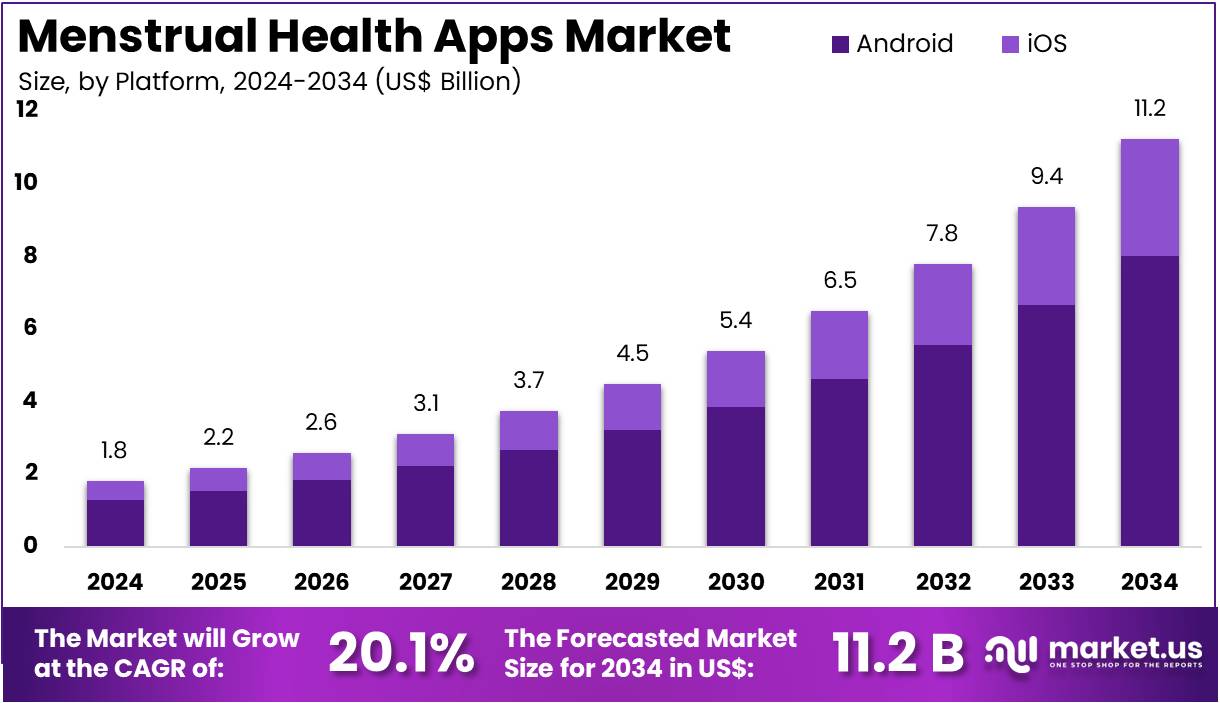
New York, NY – July 02, 2026 – Global Menstrual Health Apps Market size is expected to be worth around US$ 11.2 Billion by 2034 from US$ 1.8 Billion in 2024, growing at a CAGR of 20.1% during the forecast period 2025 to 2034.
Menstrual health apps are digital health applications designed to help individuals monitor and manage their menstrual cycles, fertility, ovulation, symptoms, and overall reproductive health. These apps enable users to record cycle dates, track physical and emotional symptoms, predict upcoming periods and fertile windows, and receive personalized health insights based on recorded data. Many platforms also include features such as medication reminders, pregnancy tracking, wellness tips, and integration with wearable devices to support comprehensive health monitoring.
The growing adoption of smartphones, increasing awareness of menstrual and reproductive health, and rising demand for personalized digital healthcare solutions have contributed significantly to the expansion of menstrual health apps worldwide. These applications provide users with convenient access to health information and encourage proactive management of menstrual health, making them valuable tools for individuals across different age groups. In addition, continuous technological advancements, including artificial intelligence and data analytics, have enhanced the accuracy of cycle predictions and personalized recommendations, improving the overall user experience.
Healthcare providers and researchers are also recognizing the value of menstrual health apps for supporting patient engagement, symptom tracking, and health education. Furthermore, increasing emphasis on women’s health, digital health innovation, and preventive healthcare is expected to strengthen the adoption of these applications across both developed and emerging markets. As a result, menstrual health apps have become an important component of the evolving digital healthcare ecosystem, supporting informed health decisions and improving access to personalized reproductive health management.
Key Takeaways
- In 2024, the menstrual health apps market was valued at US$ 1.8 billion and is projected to reach US$ 11.2 billion by 2034, expanding at a CAGR of 20.1% during the forecast period.
- Based on platform, the market is segmented into Android and iOS, with the Android segment dominating the market, accounting for a 71.3% share.
- By application, the market is categorized into period cycle tracking, fertility & ovulation management, and menstrual health management. Among these, the period cycle tracking segment held the largest market share of 58.5%.
- North America emerged as the leading regional market, accounting for 39.4% of the global market share.
Regional Analysis
North America accounted for the largest share of the menstrual health apps market, representing 39.4% of total revenue. This leadership is supported by high smartphone penetration, widespread internet access, and increasing awareness of menstrual and reproductive health. According to the U.S. National Telecommunications and Information Administration (NTIA), 83% of people aged three years and older used the internet in 2023, compared with 80% in 2021.
Additionally, 72% of households had both fixed and mobile internet connections in 2023, up from 69% in 2021, creating a strong foundation for digital health applications. In Canada, government initiatives promoting digital healthcare and expanding access to online health services have further encouraged the adoption of health-focused mobile applications. Women across the region are increasingly using menstrual health apps to monitor menstrual cycles, track fertility, predict ovulation, and manage symptoms through convenient and private digital platforms.
Moreover, the integration of menstrual tracking capabilities into widely used health ecosystems such as Apple Health and Google Fit has strengthened user engagement by providing comprehensive and personalized health insights. These technological advancements, combined with strong digital infrastructure and growing interest in preventive healthcare, continue to support North America’s leading position in the global menstrual health apps market.
Emerging Trends
- Accelerated Adoption of Digital Health Technologies: The rapid expansion of digital health technologies has significantly increased the adoption of menstrual health apps worldwide. Government healthcare initiatives promoting mobile health solutions and universal health coverage are encouraging individuals to use these applications for convenient menstrual tracking, reproductive health monitoring, and improved access to personalized healthcare services.
- Prevalent Symptom and Pain Tracking Features: Symptom and pain tracking has become a standard feature in menstrual health applications, with nearly 64% offering dedicated modules for monitoring cramps, bleeding intensity, mood fluctuations, and other symptoms. These capabilities enable users to better understand menstrual patterns while supporting more informed healthcare consultations and self-management.
- Integration of Artificial Intelligence for Personalized Insights: Artificial intelligence is transforming menstrual health apps by delivering highly personalized cycle predictions and reproductive health recommendations. AI algorithms continuously analyze user-entered health information, historical cycle data, and behavioral patterns to provide accurate notifications, fertility insights, wellness suggestions, and individualized health guidance for improved user experiences.
- High Willingness Among Users to Engage with Health Apps: Consumer acceptance of digital healthcare continues to strengthen the menstrual health apps market. According to a CDC survey, 57% of women expressed willingness to use mobile health applications for managing their healthcare, encouraging developers to introduce innovative features and improve accessibility through digital reproductive health solutions.
Use Cases
- Accurate Cycle Prediction: Accurate menstrual cycle prediction remains one of the primary applications of menstrual health apps, with approximately 91% of leading platforms providing estimates for cycle start and end dates. These predictions help users plan daily activities, travel, work schedules, fertility management, and healthcare appointments with greater confidence.
- Comprehensive Symptom Management: Menstrual health apps enable comprehensive symptom management by allowing users to record pain intensity, emotional changes, sleep quality, energy levels, and medication usage throughout each cycle. This continuously collected information supports personal health monitoring while providing valuable records for healthcare professionals during clinical evaluations.
- Research Data Collection and Analysis: Menstrual health applications increasingly contribute to medical research by collecting anonymized, large-scale reproductive health data. An NIH-supported study involving 358 users identified measurable menstrual cycle length changes following COVID-19 vaccination, demonstrating the growing importance of these platforms in advancing population health research and scientific understanding.
Frequently Asked Questions on Menstrual Health Apps
- What is the menstrual health apps market?
The menstrual health apps market refers to the global industry involved in the development, distribution, and commercialization of mobile applications that support menstrual cycle tracking, fertility management, pregnancy planning, and reproductive health monitoring. Market growth is supported by increasing smartphone adoption, rising awareness of women’s health, and continuous advancements in digital healthcare technologies. - What factors are driving the growth of the menstrual health apps market?
The growth of the menstrual health apps market is driven by increasing awareness regarding menstrual health, growing smartphone penetration, rising demand for personalized healthcare solutions, and expanding adoption of digital health platforms. Additionally, advancements in artificial intelligence and wearable device integration are improving app functionality and enhancing user engagement across various age groups. - What features are commonly available in menstrual health apps?
Most menstrual health apps include cycle tracking, ovulation prediction, fertility monitoring, symptom logging, medication reminders, pregnancy planning tools, mood tracking, and health analytics. Many advanced applications also integrate with wearable devices, provide educational resources, and offer personalized health recommendations based on user-generated data and predictive algorithms. - Who are the primary users of menstrual health apps?
The primary users of menstrual health apps include menstruating individuals, women planning pregnancies, users monitoring fertility, and those managing menstrual disorders such as irregular cycles or polycystic ovary syndrome (PCOS). Healthcare providers may also recommend these applications to support patient monitoring and improve reproductive health awareness. - How does artificial intelligence improve menstrual health apps?
Artificial intelligence enhances menstrual health apps by analyzing historical cycle data to generate more accurate predictions for menstruation, ovulation, and fertility windows. AI also identifies irregular health patterns, delivers personalized wellness recommendations, and improves user experiences by continuously refining predictions based on individual health records and behavioral trends. - Which regions dominate the menstrual health apps market?
North America currently holds a significant share of the menstrual health apps market due to high smartphone usage, advanced healthcare infrastructure, and strong awareness of women’s digital health solutions. Meanwhile, Asia-Pacific is witnessing the fastest growth, supported by expanding internet access, rising healthcare investments, and increasing adoption of mobile health technologies. - How do wearable devices support menstrual health apps?
Wearable devices enhance menstrual health apps by automatically collecting physiological data such as body temperature, heart rate, sleep quality, and physical activity. This real-time information improves cycle prediction accuracy, provides deeper health insights, and enables users to better understand hormonal changes and overall reproductive wellness. - What is the future outlook for the menstrual health apps market?
The future outlook for the menstrual health apps market remains highly positive due to increasing digital health adoption, continuous technological innovation, and growing emphasis on preventive healthcare. Future developments are expected to include improved artificial intelligence capabilities, telehealth integration, wearable connectivity, and personalized reproductive health management solutions.
Conclusion
The menstrual health apps market is experiencing substantial growth, supported by rising awareness of reproductive health, increasing smartphone penetration, and continuous advancements in digital healthcare technologies. Features such as artificial intelligence, wearable device integration, symptom tracking, and personalized health insights are enhancing user engagement and improving health outcomes.
North America remains the leading regional market, while emerging economies offer significant growth opportunities through expanding digital health adoption. As preventive healthcare and personalized wellness continue to gain importance, menstrual health apps are expected to play an increasingly vital role in reproductive health management, research, and the broader digital healthcare ecosystem over the coming years.
Discuss your needs with our analyst
Please share your requirements with more details so our analyst can check if they can solve your problem(s)




