


Overview
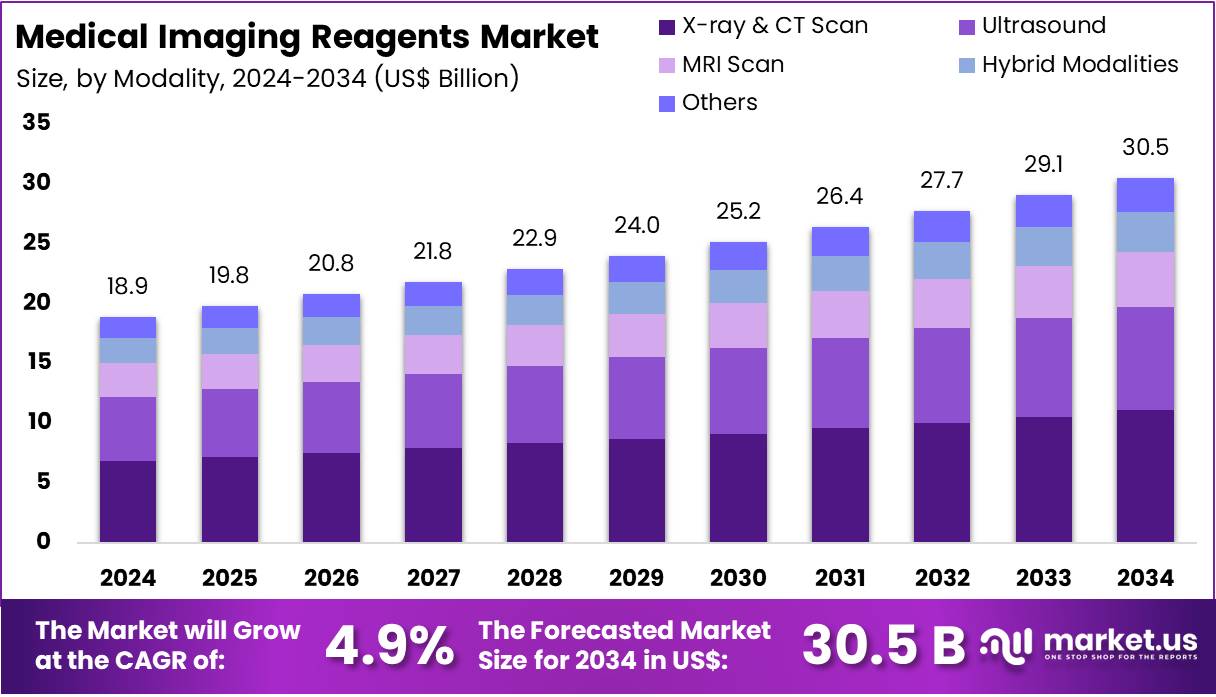
New York, NY – May 27, 2026 – The Global Medical Imaging Reagents Market Size is expected to be worth around US$ 30.5 Billion by 2034, from US$ 18.9 Billion in 2024, growing at a CAGR of 4.9% during the forecast period from 2025 to 2034.
The global market for medical imaging reagents is witnessing steady growth, driven by the increasing demand for advanced diagnostic imaging procedures across healthcare systems. Medical imaging reagents are specialized substances used during imaging examinations to improve the visibility of organs, tissues, blood vessels, and abnormal structures within the body. These reagents play a critical role in enhancing image clarity and diagnostic accuracy in modalities such as magnetic resonance imaging (MRI), computed tomography (CT), ultrasound, positron emission tomography (PET), and nuclear imaging.
The growth of the market can be attributed to the rising prevalence of chronic diseases, including cancer, cardiovascular disorders, and neurological conditions, which require early and accurate diagnosis. Additionally, the increasing adoption of minimally invasive diagnostic techniques and advancements in imaging technologies are supporting market expansion. Healthcare providers are increasingly utilizing contrast agents and radiopharmaceuticals to improve clinical outcomes and enable precise treatment planning.
Technological innovations in imaging reagents, including the development of targeted molecular imaging agents and safer contrast media, are further contributing to market development. North America currently represents a significant share of the market owing to advanced healthcare infrastructure and high diagnostic imaging volumes, while Asia-Pacific is expected to witness notable growth due to expanding healthcare investments and improving access to diagnostic services.
Key Takeaways
- The global medical imaging reagents market is anticipated to increase from US$ 18.9 billion in 2024 to nearly US$ 30.5 billion by 2034.
- The market is forecast to register a CAGR of 4.9% during the period from 2025 to 2034.
- In 2024, contrast reagents accounted for the largest share within the class segment, representing over 43.2% of the global market.
- The neurological disorder segment emerged as the leading application area in 2024, contributing more than 28.7% of total market revenue.
- X-ray and CT scan modalities dominated the modality segment in 2024, capturing above 36.3% of the overall market share.
- North America led the global market in 2024, generating revenue of approximately US$ 7.8 billion and holding over 41.7% of the total market share.
Regional Analysis
North America maintained a leading position in the global medical imaging reagents market in 2024, accounting for more than 41.7% of the total share and generating approximately US$ 7.8 billion in revenue. The region’s dominance is supported by well-established healthcare infrastructure, high adoption of advanced imaging systems, and increasing diagnostic imaging procedures across healthcare facilities. The United States remains a major contributor due to strong demand for early and accurate disease diagnosis.
The regional market is further strengthened by the presence of major pharmaceutical and biotechnology companies actively investing in the development of innovative imaging agents and contrast media. Favorable regulatory support and rising investments in molecular imaging research are also encouraging product innovation and commercialization. In addition, the growing aging population and increasing prevalence of chronic diseases are driving demand for diagnostic imaging services. Broad availability of PET, MRI, and CT technologies across hospitals and diagnostic centers continues to support market expansion throughout the region.
Emerging Trends
- Shift Toward Gadolinium-Free Contrast Agents: Growing concerns regarding the safety of gadolinium-based contrast agents are encouraging the development of safer gadolinium-free alternatives. These advanced reagents reduce health and environmental risks while maintaining imaging quality, supporting improved patient safety and expanding diagnostic access for vulnerable patient populations.
- Growth of Molecular Imaging Reagents: Molecular imaging reagents are gaining significant importance due to their ability to detect diseases at the cellular level. These reagents support early diagnosis, particularly in cancer and neurological disorders, while improving treatment monitoring and advancing precision medicine and targeted healthcare approaches.
- Increased Use in Personalized Medicine: Medical imaging reagents are increasingly supporting personalized medicine by helping physicians evaluate patient-specific biological conditions before treatment selection. Specialized reagents identify unique disease markers, especially in oncology, enabling targeted therapies, reducing treatment uncertainty, and improving clinical outcomes and patient care.
- Integration with Smart Imaging Technologies: The integration of imaging reagents with technologies such as artificial intelligence and augmented reality is improving diagnostic precision and surgical guidance. These smart imaging solutions enhance disease detection, reduce medical errors, and support better decision-making during complex medical and surgical procedures.
Use Cases
- Cancer Detection and Monitoring: Medical imaging reagents are widely used in cancer diagnosis and monitoring through PET and other advanced imaging techniques. These reagents help identify tumor size, location, and activity, enabling early detection, effective treatment planning, and continuous monitoring of patient treatment response.
- Heart Disease Diagnosis: Imaging reagents improve the visualization of heart tissues and blood vessels during CT and MRI procedures. They assist healthcare providers in identifying blockages, monitoring blood flow, and diagnosing cardiovascular conditions quickly, supporting timely treatment and reducing the need for unnecessary invasive procedures.
- Brain Imaging in Neurology: Medical imaging reagents support the early detection of neurological disorders such as Alzheimer’s disease, epilepsy, and stroke. These agents provide detailed brain imaging, helping physicians evaluate nerve activity, identify affected regions, and monitor disease progression and therapeutic effectiveness over time.
- Guidance During Surgeries: Imaging reagents are increasingly used during surgical procedures to improve real-time tissue visualization and surgical precision. Near-infrared dyes and other advanced agents help surgeons identify tumors and critical structures accurately, reducing complications, minimizing tissue damage, and improving overall patient recovery outcomes.
Frequently Asked Questions on Medical Imaging Reagents
- What factors are driving the growth of the medical imaging reagents market?
The growth of the medical imaging reagents market is primarily driven by the increasing prevalence of chronic diseases, rising demand for early diagnosis, and growing adoption of advanced imaging technologies. Expanding healthcare infrastructure and continuous innovation in imaging agents are also supporting market expansion globally. - Which imaging modalities commonly use medical imaging reagents?
Medical imaging reagents are widely used in imaging modalities such as MRI, CT scans, PET scans, ultrasound, and nuclear imaging. These reagents enhance image quality and diagnostic precision, enabling physicians to detect abnormalities and monitor disease progression more effectively. - Why are contrast reagents important in diagnostic imaging?
Contrast reagents improve the visibility of internal body structures by enhancing image contrast during diagnostic procedures. They are essential for identifying tumors, cardiovascular disorders, neurological conditions, and other abnormalities that may not be clearly visible through standard imaging techniques alone. - Which region dominates the global medical imaging reagents market?
North America currently leads the global medical imaging reagents market due to its advanced healthcare infrastructure, strong presence of pharmaceutical companies, and high volume of diagnostic imaging procedures. Increased investments in molecular imaging research are also contributing to regional market growth. - How are technological advancements influencing the market?
Technological advancements are enabling the development of safer, more targeted, and highly effective imaging reagents. Innovations in molecular imaging, radiopharmaceuticals, and precision diagnostics are improving disease detection capabilities while supporting the growing demand for personalized healthcare solutions worldwide. - What role do medical imaging reagents play in cancer diagnosis?
Medical imaging reagents play a critical role in cancer diagnosis by enhancing the detection of tumors and abnormal tissue growth. These agents assist healthcare providers in identifying cancer at earlier stages, improving treatment planning, monitoring therapeutic response, and supporting better patient outcomes.
Conclusion
The global medical imaging reagents market is expected to witness stable growth over the forecast period, supported by rising demand for accurate and early disease diagnosis across healthcare systems worldwide. Increasing prevalence of chronic diseases, technological advancements in imaging technologies, and growing adoption of personalized medicine are contributing significantly to market expansion.
The development of safer contrast agents, molecular imaging reagents, and AI-integrated diagnostic solutions is further improving diagnostic efficiency and patient outcomes. North America continues to dominate the market due to advanced healthcare infrastructure, while Asia-Pacific is emerging as a high-growth region driven by expanding healthcare investments and increasing access to diagnostic imaging services.
Discuss your needs with our analyst
Please share your requirements with more details so our analyst can check if they can solve your problem(s)




