


Overview
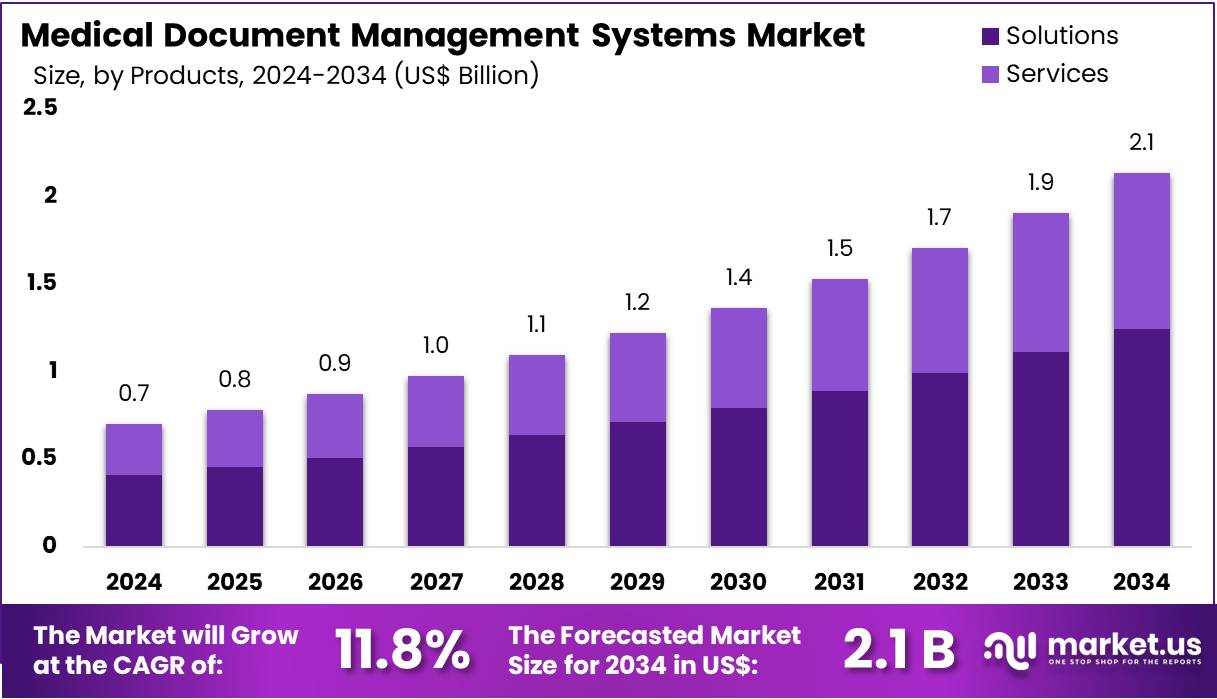
New York, NY – May 14, 2026 – The Global Medical Document Management Systems Market size is expected to be worth around US$ 2.1 Billion by 2034, from US$ 0.7 Billion in 2024, growing at a CAGR of 11.8% during the forecast period from 2025 to 2034.
The global market for Medical Document Management Systems (MDMS) is witnessing steady growth due to the increasing digital transformation across the healthcare sector. These systems are designed to store, organize, retrieve, and manage patient records, clinical documents, billing information, and administrative files in a secure digital environment. The adoption of MDMS solutions has increased significantly among hospitals, clinics, diagnostic laboratories, and healthcare institutions to improve operational efficiency and regulatory compliance.
The growing emphasis on reducing paperwork, improving patient data accessibility, and enhancing workflow automation is supporting market expansion. In addition, rising healthcare data volumes and the increasing need for secure information exchange are encouraging healthcare providers to invest in advanced document management technologies. Cloud-based deployment models are gaining traction owing to their scalability, remote accessibility, and cost-effectiveness.
Technological advancements such as artificial intelligence, machine learning, and electronic health record integration are further improving the functionality of medical document management platforms. These innovations help healthcare professionals streamline document processing, reduce administrative burden, and minimize data retrieval time.
North America currently holds a significant share of the market due to advanced healthcare infrastructure and early adoption of digital healthcare solutions. Meanwhile, the Asia-Pacific region is expected to witness notable growth driven by increasing healthcare investments and expanding digitalization initiatives.
The market is expected to continue expanding as healthcare organizations prioritize secure, efficient, and paperless document management solutions.
Key Takeaways
- In 2024, the global Medical Document Management Systems market was valued at US$ 0.7 billion and is projected to reach US$ 2.1 billion by 2034, expanding at a CAGR of 11.8% during the forecast period.
- Based on product type, the market is segmented into solutions and services. The solutions segment dominated the market in 2024, accounting for a revenue share of 58.2%.
- By application, the market is categorized into patient medical records management, patient billing documents management, and admission & registration document management. Among these, patient medical records management emerged as the leading segment with a market share of 53.3% in 2024.
- On the basis of mode of delivery, the market is segmented into on-premise, web-based, and cloud-based solutions. The cloud-based segment held the largest market share of 63.5% in 2024 due to increasing demand for scalable and remotely accessible healthcare data management solutions.
- In terms of end users, the market is divided into hospitals & clinics, nursing homes/assisted living facilities/long-term care, healthcare payers, and others. Hospitals & clinics led the market with a revenue share of 52.8% in 2024.
- North America accounted for the largest regional share of the Medical Document Management Systems market, capturing 44.4% of the global market revenue in 2024.
Regional Analysis
North America accounted for the largest revenue share of 44.4% in the medical document management systems market, driven by the growing adoption of electronic health records (EHRs), stringent data security regulations, and the increasing need for efficient healthcare workflows. In 2023, the U.S. Centers for Medicare & Medicaid Services (CMS) reported a significant rise in EHR adoption among healthcare providers to improve patient data management and care coordination.
Furthermore, the U.S. Department of Health and Human Services (HHS) allocated funding in 2022 to strengthen health information technology infrastructure, including investments in advanced document management solutions. In Canada, the Canadian Institute for Health Information (CIHI) highlighted increased usage of digital health tools in 2023, particularly for secure document storage and retrieval. Additionally, the U.S. Food and Drug Administration (FDA) emphasized the importance of robust document management systems to ensure regulatory compliance in pharmaceutical and clinical research sectors.
Asia Pacific is expected to register the fastest CAGR during the forecast period due to rapid healthcare digitization, supportive government initiatives, and increasing investments in healthcare IT infrastructure across countries such as India, China, Japan, and Australia.
Emerging Trends
- Shift Toward Cloud-Based Platforms: Healthcare providers are rapidly adopting cloud-based medical document management systems to replace traditional on-site software. These platforms enable faster record access, real-time data sharing, lower hardware costs, simplified maintenance, remote accessibility, and improved coordination across departments, ultimately enhancing operational efficiency and patient care outcomes.
- Integration with Electronic Health Records (EHRs): Medical document management systems are increasingly integrated with Electronic Health Records (EHRs) to centralize patient information. This integration allows healthcare professionals to access lab reports, prescriptions, and imaging results within one platform, improving workflow efficiency, reducing errors, accelerating clinical decisions, and enhancing overall patient care quality.
- Growing Role of Artificial Intelligence (AI): Artificial Intelligence is transforming medical document management by automating document sorting, tagging, retrieval, and error detection. AI-powered systems reduce manual workload, improve accuracy, streamline workflows, and support regulatory compliance. Healthcare organizations are increasingly adopting AI tools to enhance operational efficiency and ensure reliable document handling processes.
- Focus on Data Security and Privacy: Healthcare organizations are prioritizing data security and patient privacy due to rising cyber threats and data breaches. Modern medical document systems include encryption, two-factor authentication, access controls, and compliance features aligned with regulations such as HIPAA, helping hospitals protect sensitive information and avoid legal or financial risks.
- Mobile-Friendly and Remote Access Solutions: The demand for mobile-friendly medical document systems is increasing as healthcare professionals require remote access to patient records. These platforms support smartphones, tablets, and laptops, enabling doctors to review reports, approve files, and provide care anytime, supporting telemedicine services, home healthcare, and faster medical decision-making.
- Automated Workflow and Task Management: Hospitals are adopting automated workflow features within medical document systems to reduce manual administrative tasks. Automation supports approvals, reminders, digital signatures, alerts, and document tracking, improving transparency and efficiency. By minimizing repetitive work, healthcare staff can focus more on patient care and service quality improvements.
- Customization for Different Departments: Medical document management systems now offer customizable features tailored to different hospital departments such as billing, radiology, pathology, and nursing. Customized templates, workflows, and document labels improve operational efficiency, reduce confusion, and enable healthcare professionals to manage department-specific documentation requirements more effectively and accurately.
- Adoption in Small Clinics and Rural Areas: Small clinics and rural healthcare centers are increasingly implementing medical document management systems to replace paper-based records. Affordable cloud-based platforms simplify document storage, sharing, and retrieval while reducing administrative burden. These solutions improve operational efficiency, support better patient care, and require minimal technical expertise for implementation.
Use Cases
- Managing Patient Records Digitally: Hospitals use Medical Document Management Systems (MDMS) to store patient records digitally instead of relying on paper files. These systems allow healthcare professionals to quickly access medical histories, prescriptions, reports, and scans, reducing delays, improving patient care, and protecting sensitive information from physical loss or damage.
- Improving Medical Billing Processes: MDMS helps healthcare providers manage billing records, insurance claims, and payment documents efficiently. Automated billing workflows reduce manual errors, improve claim accuracy, accelerate insurance approvals, and simplify document retrieval. This enhances financial operations while ensuring patients receive accurate bills and faster insurance claim settlements.
- Handling Consent Forms and Legal Documents: Healthcare providers use MDMS to digitally manage consent forms and legal documents related to treatments and surgeries. Electronic signatures, timestamped records, and secure digital storage improve accessibility, ensure legal validity, reduce paperwork, and provide hospitals with reliable documentation during audits, disputes, or emergency medical situations.
- Sharing Documents Between Departments: MDMS enables seamless document sharing between hospital departments, including laboratories, pharmacies, nursing units, and physicians. Staff can instantly access test results, prescriptions, and patient reports without waiting for physical file transfers, improving communication, reducing treatment delays, and supporting better collaboration across healthcare teams.
- Tracking Document Changes and Versions: Medical document systems provide version control features that track document updates, including who made changes and when modifications occurred. This helps healthcare providers maintain accurate records, avoid outdated information, improve accountability, create transparent audit trails, and ensure staff always access the latest patient information.
- Backing Up Critical Information: MDMS offers secure cloud-based backup solutions to protect sensitive healthcare information from disasters, cyberattacks, or system failures. Backup systems ensure quick data recovery, uninterrupted patient care, compliance with security regulations, and long-term protection of valuable medical records through encrypted and controlled digital storage environments.
Frequently Asked Questions on Medical Document Management Systems
- What factors are driving the growth of the Medical Document Management Systems Market?
The market is primarily driven by increasing adoption of electronic health records (EHRs), rising healthcare digitization, stringent regulatory requirements, and growing demand for secure data management solutions. Healthcare organizations are also investing in technologies that improve operational efficiency and patient data accessibility. - How do Medical Document Management Systems benefit healthcare organizations?
These systems help healthcare organizations streamline administrative processes, reduce manual errors, improve document accessibility, and enhance patient care coordination. They also support compliance with healthcare regulations while minimizing operational costs associated with paper-based record management systems. - Which healthcare sectors commonly use Medical Document Management Systems?
Medical Document Management Systems are widely used across hospitals, clinics, pharmaceutical companies, diagnostic laboratories, and clinical research organizations. These sectors rely on efficient document handling systems to manage patient records, regulatory files, billing information, and operational documentation securely. - Why is data security important in Medical Document Management Systems?
Data security is essential because healthcare organizations handle sensitive patient information that must remain confidential and protected from cyber threats. Advanced document management systems include encryption, secure access controls, and backup solutions to ensure compliance with healthcare privacy regulations. - Which region dominates the Medical Document Management Systems Market?
North America currently dominates the market due to high adoption of healthcare IT solutions, strong regulatory frameworks, and increasing investments in digital healthcare infrastructure. The presence of advanced healthcare facilities and established technology providers further supports regional market growth. - How does cloud technology impact Medical Document Management Systems?
Cloud-based solutions provide healthcare organizations with scalable, cost-effective, and remotely accessible document management capabilities. These systems improve collaboration, enable faster data retrieval, reduce infrastructure costs, and support secure storage of large volumes of healthcare-related information. - What is the future outlook for the Medical Document Management Systems Market?
The market is expected to witness substantial growth due to increasing digital transformation in healthcare, growing focus on patient data management, and rising regulatory compliance requirements. Advancements in artificial intelligence and cloud computing are also expected to enhance system capabilities further.
Conclusion
The global Medical Document Management Systems (MDMS) market is expected to witness significant growth due to increasing healthcare digitalization, rising adoption of cloud-based platforms, and growing demand for secure patient data management solutions. Healthcare providers are focusing on improving operational efficiency, workflow automation, and regulatory compliance through advanced document management technologies.
Integration with Electronic Health Records (EHRs), artificial intelligence, and remote access capabilities is further enhancing system performance and usability. North America currently leads the market, while Asia Pacific is projected to grow rapidly. Overall, the market outlook remains positive as healthcare organizations continue transitioning toward efficient, secure, and paperless documentation systems.
Discuss your needs with our analyst
Please share your requirements with more details so our analyst can check if they can solve your problem(s)




