


Overview
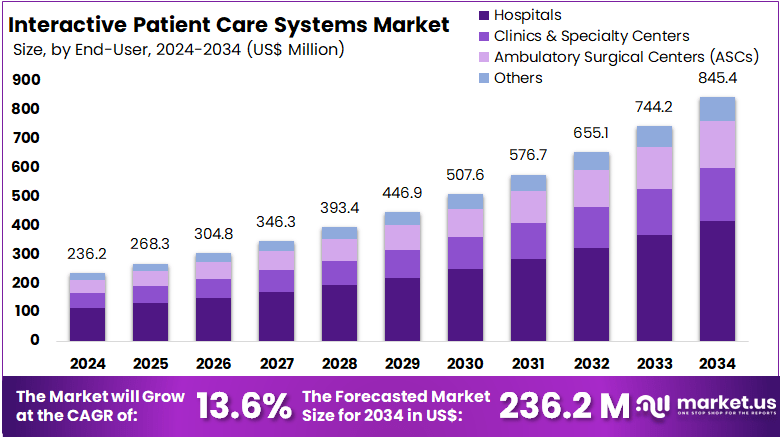
New York, NY – June 08, 2026 –The Global Interactive Patient Care Systems Market size is expected to be worth around US$ 845.4 Million by 2034, from US$ 236.2 Million in 2024, growing at a CAGR of 13.6% during the forecast period from 2025 to 2034.
Interactive Patient Care Systems (IPCS) is a healthcare technology company specializing in patient engagement and communication solutions designed to enhance the care experience across hospitals and healthcare facilities. The company provides advanced digital platforms that enable healthcare providers to deliver personalized information, education, and entertainment directly to patients throughout their care journey.
IPCS solutions integrate with hospital systems to support real-time communication between patients, caregivers, and clinical staff. Through interactive bedside technologies, patients can access health education materials, care plans, medication information, discharge instructions, and hospital services, helping them become more informed and engaged in their treatment process.
The company’s platform is designed to improve patient satisfaction, strengthen communication, and support better health outcomes by encouraging active participation in care decisions. Healthcare organizations utilize IPCS solutions to streamline workflows, enhance operational efficiency, and create a more connected care environment.
Interactive Patient Care Systems also supports healthcare providers in meeting patient experience and quality improvement objectives through data-driven insights and engagement analytics. Its technology enables hospitals to monitor patient interactions, identify areas for service enhancement, and deliver more personalized care experiences.
With a focus on innovation, patient-centered care, and digital transformation, IPCS continues to support healthcare organizations in modernizing patient engagement strategies. The company remains committed to advancing healthcare communication through scalable solutions that improve both patient experiences and clinical effectiveness.
Key Takeaways
- The global Interactive Patient Care Systems market is expected to expand from US$ 236.2 million in 2024 to nearly US$ 845.4 million by 2034.
- The market is forecast to register a CAGR of 13.6% during the period from 2025 to 2034, driven by the increasing adoption of patient-centric healthcare technologies.
- By component, the hardware segment emerged as the largest contributor in 2024, accounting for over 57.35% of the total market share.
- Based on application, the acute care segment held the leading position in 2024, representing more than 32.4% of the overall market.
- Among end users, hospitals dominated the market in 2024, capturing a share exceeding 37.5%.
- North America maintained its leadership in the global market in 2024, accounting for more than 44.4% of the total revenue share and reaching a market value of approximately US$ 104.8 million.
Regional Analysis
North America accounted for the largest share of the Interactive Patient Care Systems market in 2024, representing more than 44.4% of global revenue and reaching a market value of approximately US$ 104.8 million. The region’s leadership was primarily driven by its advanced healthcare infrastructure and the early adoption of digital health technologies across hospitals and healthcare facilities in the United States and Canada.
The widespread implementation of electronic health records (EHRs) played a significant role in market growth. Healthcare providers increasingly integrated interactive patient care platforms with clinical systems, enabling real-time access to medical information, enhanced communication, and improved patient engagement. Supportive government initiatives promoting healthcare digitization and cost-effective care delivery further accelerated adoption across the region.
High levels of digital literacy among patients also contributed to market expansion. Patients were more comfortable using interactive bedside systems, educational content platforms, and digital communication tools, encouraging greater participation in their care journey. In addition, hospitals invested heavily in smart healthcare infrastructure, including bedside terminals, mobile-enabled platforms, and connected patient engagement solutions.
Strong collaboration between healthcare organizations and technology providers fostered continuous innovation, including AI-powered communication features and multilingual interfaces. These advancements improved accessibility, patient satisfaction, and care outcomes. Supported by ongoing technological developments and favorable healthcare policies, North America is expected to maintain its leading position in the global Interactive Patient Care Systems market throughout the forecast period.
Emerging Trends
- Growth of Remote Patient Monitoring (RPM): Remote Patient Monitoring is expanding rapidly as healthcare providers increasingly support home-based care and value-based healthcare models. Advanced technologies such as artificial intelligence, blockchain, fog computing, and IoT sensors are being integrated to enhance system responsiveness, security, and patient monitoring capabilities.
- Better Patient Engagement via Interactive Tools: Healthcare organizations are adopting interactive engagement platforms to improve communication, education, and patient participation in care decisions. Increased use of patient portals and mobile applications allows individuals to access medical records, monitor health information, and manage treatments more effectively.
- Expansion of Conversational Agent and Chatbot Support: Healthcare providers are increasingly deploying virtual assistants and AI-powered chatbots to support remote patient care. These tools collect symptom information, deliver personalized health guidance, encourage treatment adherence, and notify healthcare professionals when clinical intervention becomes necessary.
- Interactive Data Dashboards for Quality Monitoring: Interactive healthcare dashboards are gaining popularity for monitoring clinical performance, patient outcomes, and healthcare costs. These platforms provide visual insights into hospitalization trends, treatment effectiveness, and operational metrics, enabling healthcare organizations to make data-driven decisions more efficiently.
- Use of Virtual Patient Simulations in Training: Healthcare education institutions are increasingly utilizing virtual patient simulations to strengthen clinical training programs. These interactive learning environments help healthcare professionals develop diagnostic, communication, and decision-making skills through realistic scenarios while reducing risks associated with live patient training.
Use Cases
- Remote Monitoring of Chronic Conditions: Interactive patient care systems support continuous monitoring of chronic diseases by enabling real-time tracking of patient health data. These solutions help reduce hospital admissions, improve treatment outcomes, support early intervention, and enhance overall quality of life for patients.
- Post-Surgical Virtual Care: Post-surgical remote monitoring programs enable healthcare providers to track patient recovery after discharge. Interactive care platforms facilitate medication management, symptom monitoring, and timely intervention, contributing to improved recovery outcomes, reduced complications, and lower hospital readmission rates.
- Telemedicine and Interactive Audio-Video Consultations: Interactive audio-video consultation platforms have become essential components of telemedicine services. These technologies enable real-time communication between patients and clinicians, improve access to healthcare services, and support efficient delivery of remote medical consultations and follow-up care.
- Interactive Training Cases for Providers: Interactive clinical case studies are increasingly used to train healthcare professionals in managing complex patient scenarios. These tools provide guided learning experiences that strengthen clinical judgment, improve treatment planning capabilities, and support evidence-based decision-making across healthcare settings.
- Data Visualization Dashboards for Policy and Quality: Healthcare organizations and policymakers use interactive data visualization dashboards to evaluate healthcare quality, costs, and patient outcomes. These tools enable detailed analysis of trends, support performance benchmarking, and assist in developing targeted strategies for healthcare improvement.
Frequently Asked Questions on Interactive Patient Care Systems
- How do Interactive Patient Care Systems benefit healthcare facilities?
Interactive Patient Care Systems help healthcare facilities improve patient satisfaction, streamline communication, reduce administrative workloads, and enhance care coordination. They also support clinical workflows by providing patients with easy access to health information, educational resources, and care plans. - What factors are driving the growth of the Interactive Patient Care Systems market?
Market growth is being driven by increasing healthcare digitalization, rising adoption of electronic health records, growing demand for patient-centered care, and investments in smart hospital infrastructure. Healthcare providers are increasingly adopting technologies that improve patient engagement and operational efficiency. - Which component segment leads the Interactive Patient Care Systems market?
The hardware segment currently holds the largest share of the market. Bedside terminals, interactive displays, tablets, and communication devices are widely deployed in healthcare facilities to support patient engagement, education, entertainment, and communication throughout treatment journeys. - Why are hospitals the largest end users of Interactive Patient Care Systems?
Hospitals represent the leading end-user segment because they require advanced communication and engagement tools to enhance patient experiences. These systems help hospitals improve care delivery, increase patient satisfaction scores, and support quality improvement initiatives. - Which region dominates the Interactive Patient Care Systems market?
North America dominates the global market due to its advanced healthcare infrastructure, high adoption of digital health technologies, strong healthcare spending, and supportive government initiatives that encourage the implementation of patient engagement and communication solutions. - What role does artificial intelligence play in Interactive Patient Care Systems?
Artificial intelligence enhances Interactive Patient Care Systems by enabling personalized communication, automated patient assistance, predictive insights, and multilingual support. These capabilities improve accessibility, patient engagement, and healthcare outcomes while helping providers deliver more efficient care. - What is the future outlook for the Interactive Patient Care Systems market?
The market is expected to experience strong growth over the coming decade, supported by technological advancements, increasing patient engagement initiatives, and growing investments in connected healthcare environments. Demand for personalized and digital patient experiences is expected to remain strong.
Conclusion
The Interactive Patient Care Systems market is poised for substantial growth, driven by increasing healthcare digitalization, rising demand for patient-centered care, and continuous advancements in connected healthcare technologies. The integration of artificial intelligence, remote patient monitoring, telemedicine platforms, and interactive engagement tools is transforming how healthcare providers communicate with and support patients.
North America remains the leading regional market due to its advanced healthcare infrastructure and strong adoption of digital health solutions. As hospitals and healthcare organizations continue investing in smart care environments, Interactive Patient Care Systems are expected to play an increasingly important role in improving patient engagement, operational efficiency, and clinical outcomes worldwide.
Discuss your needs with our analyst
Please share your requirements with more details so our analyst can check if they can solve your problem(s)




