


Overview
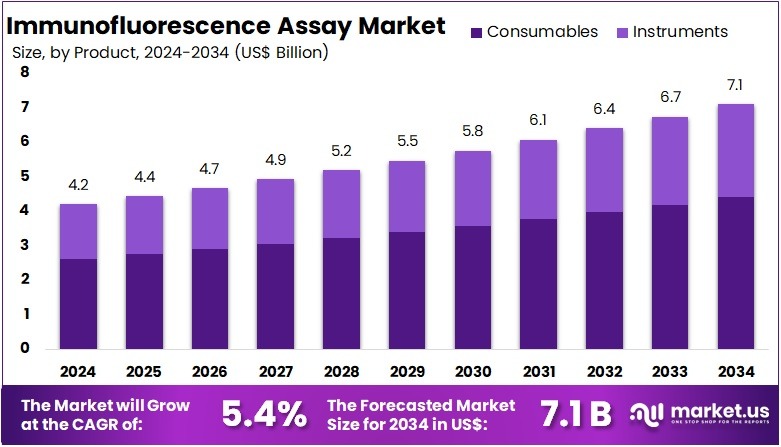
New York, NY – June 12, 2026 – The Immunofluorescence Assay Market Size is expected to be worth around US$ 7.1 billion by 2034 from US$ 4.2 billion in 2024, growing at a CAGR of 5.4% during the forecast period 2025 to 2034.
Immunofluorescence Assay (IFA) is a widely used laboratory technique that enables the detection and visualization of specific antigens, proteins, and antibodies within biological samples through the use of fluorescently labeled antibodies. The technology plays a critical role in clinical diagnostics, biomedical research, drug discovery, and disease monitoring by providing highly sensitive and specific results.
The increasing prevalence of infectious diseases, autoimmune disorders, and cancer has significantly contributed to the growing adoption of immunofluorescence assays across healthcare and research settings. The assay is extensively utilized for the diagnosis of various diseases, including viral infections, bacterial infections, and autoimmune conditions. Its ability to deliver rapid and accurate detection of target biomarkers has made it an essential tool in modern diagnostic laboratories.
Technological advancements in fluorescence microscopy, digital imaging systems, and automated assay platforms have further enhanced the efficiency, accuracy, and throughput of immunofluorescence testing. Additionally, the integration of advanced imaging technologies and artificial intelligence-based analytical tools is improving data interpretation and supporting more precise clinical decision-making.
North America currently represents a major market for immunofluorescence assays due to the presence of advanced healthcare infrastructure, significant research investments, and strong adoption of innovative diagnostic technologies. Meanwhile, emerging economies in Asia-Pacific are witnessing increasing demand driven by expanding healthcare facilities, rising research activities, and growing awareness of early disease diagnosis and personalized medicine approaches.
Key Takeaways
- The global Immunofluorescence Assay market was valued at US$ 4.2 billion in 2024 and is projected to reach US$ 7.1 billion by 2034, expanding at a CAGR of 5.4% during the forecast period.
- By product, the Consumables segment, comprising antibodies, kits & reagents, and accessories, led the market with a revenue share of 62.1% in 2024.
- Based on type, the Indirect Immunofluorescence segment emerged as the leading category, accounting for 66.7% of the global market share in 2024.
- By application, Infectious Diseases represented the largest revenue-generating segment, contributing 39.5% of the total market revenue in 2024.
- Among end users, Pharmaceutical & Biopharmaceutical Companies held the dominant position, capturing 47.3% of the market share in 2024.
- Regionally, North America maintained its leadership in the global Immunofluorescence Assay market, accounting for 40.4% of total revenue in 2024.
Regional Analysis
North America dominated the global Immunofluorescence Assay (IFA) market in 2024, accounting for 40.4% of total revenue. The region’s leadership is supported by a high prevalence of chronic diseases, advanced healthcare infrastructure, strong research capabilities, and significant investments in diagnostic technologies.
The United States remains the largest contributor, benefiting from favorable government initiatives and the presence of leading market participants. According to the National Cancer Institute, approximately 2.04 million new cancer cases and 618,120 cancer-related deaths are expected in the U.S. in 2025, highlighting the growing need for advanced diagnostic solutions.
Asia Pacific is anticipated to register the fastest growth during the forecast period. Rapid healthcare infrastructure development, increasing research activities, and rising healthcare expenditures in countries such as China and India are driving the adoption of immunofluorescence assays. Additionally, the region bears a substantial burden of infectious and chronic diseases, creating strong demand for accurate and efficient diagnostic technologies across healthcare settings.
Emerging Trends
- Advanced Imaging Techniques: Advanced imaging technologies such as super-resolution microscopy and fluorescence lifetime imaging are significantly enhancing immunofluorescence capabilities. These methods provide highly detailed cellular visualization, enabling researchers to monitor protein localization and activity in real time, thereby improving disease research, drug development, and cellular biology studies.
- Multiplexed Immunofluorescence: Multiplexed immunofluorescence enables the simultaneous detection of multiple biomarkers within a single tissue sample. This approach provides a comprehensive understanding of cellular interactions and tissue composition, particularly in cancer research, while reducing testing requirements and supporting the advancement of precision medicine strategies.
- High-Throughput and Automated Screening: Automation and high-throughput screening technologies are transforming immunofluorescence workflows by enabling rapid analysis of large sample volumes. These systems improve efficiency, reduce human error, enhance reproducibility, and accelerate research activities, particularly in drug discovery, oncology, infectious diseases, and genetic studies.
- Better Probes and Reagents: Continuous advancements in fluorescent probes and reagents are improving assay sensitivity, image quality, and experimental reliability. Brighter dyes, reduced background interference, and enhanced reagent stability allow researchers to generate more accurate results while supporting long-term imaging and complex biological investigations.
Use Cases
- Cancer Diagnosis and Research: Immunofluorescence plays a critical role in cancer diagnosis and research by identifying specific protein markers within tumor tissues. The technique helps determine cancer type, stage, and progression while supporting biomarker discovery, therapeutic evaluation, and the development of personalized treatment approaches.
- Autoimmune Disease Detection: Immunofluorescence is widely used to diagnose autoimmune disorders by detecting abnormal antibody deposits in tissues. The technique provides clear visual evidence of disease-related immune activity, enabling early diagnosis, treatment monitoring, and improved management of conditions such as lupus and autoimmune skin diseases.
- Neuroscience and Brain Research: In neuroscience, immunofluorescence is used to visualize proteins associated with neurological disorders including Alzheimer’s disease, Parkinson’s disease, and multiple sclerosis. It enables researchers to study cellular changes, understand disease mechanisms, and evaluate potential therapeutic interventions for complex brain disorders.
- Infectious Disease Research: Immunofluorescence is extensively applied in infectious disease research to detect and localize pathogens within biological samples. The technique supports rapid diagnosis, outbreak investigations, treatment assessment, and studies of infection pathways, making it valuable for addressing diseases such as COVID-19 and influenza.
Frequently Asked Questions on Immunofluorescence Assay
- How does an Immunofluorescence Assay work?
The assay works by binding fluorescent-tagged antibodies to specific antigens present in cells or tissues. When exposed to a suitable light source, the fluorescent labels emit light, allowing visualization under a fluorescence microscope and enabling accurate detection of biological targets. - What are the main types of Immunofluorescence Assays?
The two primary types are direct and indirect immunofluorescence assays. Direct assays use labeled primary antibodies, while indirect assays utilize labeled secondary antibodies. Indirect methods are generally preferred because they offer greater signal amplification and enhanced detection sensitivity. - What are the key applications of Immunofluorescence Assays?
Immunofluorescence Assays are widely used in disease diagnosis, autoimmune disorder detection, infectious disease testing, cancer research, and biomarker discovery. They also play an important role in academic research and pharmaceutical development by enabling detailed cellular analysis. - What are the advantages of Immunofluorescence Assays?
The technology provides high sensitivity, excellent specificity, and the ability to visualize target molecules within cells and tissues. It supports multiplex detection and generates detailed spatial information, making it valuable for both diagnostic and research applications. - Which industries commonly use Immunofluorescence Assays?
Healthcare institutions, clinical diagnostic laboratories, pharmaceutical companies, biotechnology firms, and academic research organizations frequently use Immunofluorescence Assays. These sectors rely on the technology for disease detection, drug development, and biological research activities. - What factors are driving the growth of the Immunofluorescence Assay Market?
Market expansion is primarily driven by rising prevalence of chronic and infectious diseases, growing investments in life sciences research, increasing adoption of precision medicine, and continuous advancements in fluorescence imaging and diagnostic technologies. - Which region dominates the Immunofluorescence Assay Market?
North America currently holds a significant market share due to advanced healthcare infrastructure, substantial research funding, and strong biotechnology and pharmaceutical sectors. Europe and Asia-Pacific are also experiencing notable growth driven by increasing healthcare investments. - How does technological innovation impact the market?
Technological advancements such as automated imaging systems, multiplex assays, artificial intelligence-assisted image analysis, and high-throughput screening platforms improve assay performance and efficiency. These innovations enhance adoption rates across clinical and research environments.
Conclusion
The Immunofluorescence Assay (IFA) market is experiencing steady growth, supported by increasing demand for accurate diagnostic technologies, expanding biomedical research activities, and rising prevalence of infectious diseases, cancer, and autoimmune disorders. Technological advancements in imaging systems, automation, multiplexing capabilities, and reagent development are enhancing assay performance and broadening application areas.
North America continues to lead the market due to its advanced healthcare ecosystem, while Asia-Pacific is emerging as a high-growth region. As precision medicine and biomarker-based diagnostics gain momentum, immunofluorescence assays are expected to remain essential tools for clinical diagnostics, drug discovery, and life sciences research.
Discuss your needs with our analyst
Please share your requirements with more details so our analyst can check if they can solve your problem(s)




