


Overview
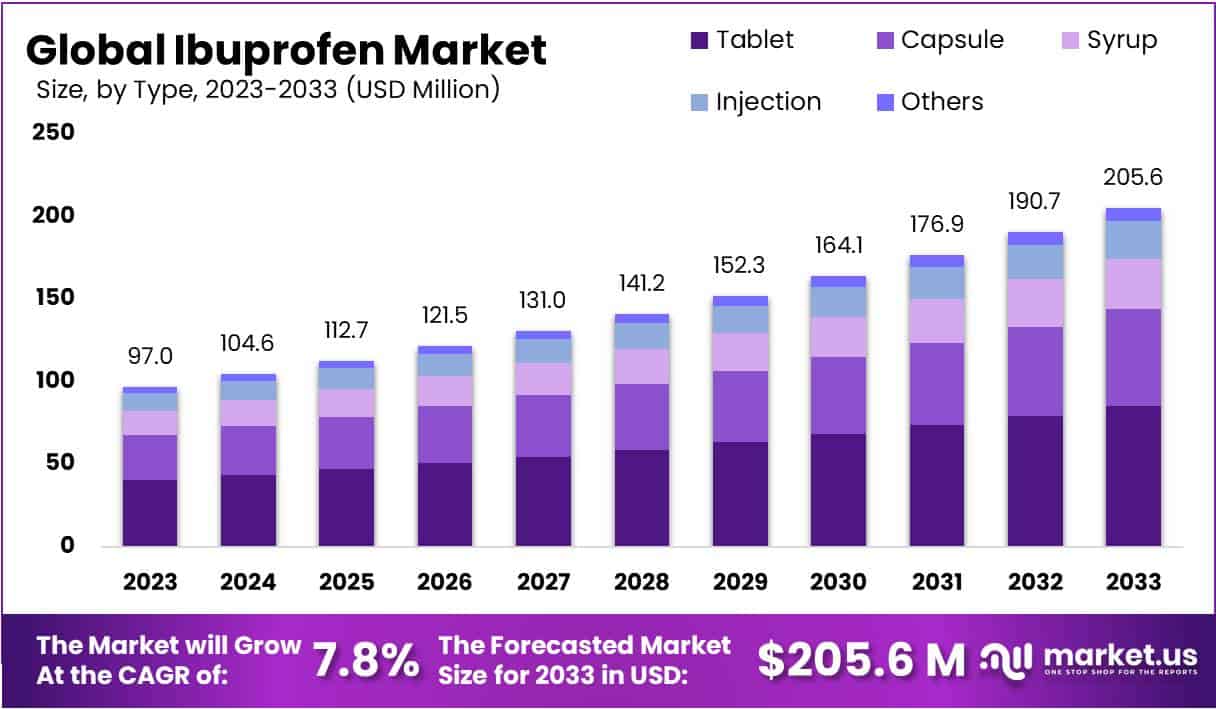
New York, NY – July 22, 2026 – The Global Ibuprofen Market Size is anticipated to reach approximately USD 205.6 Million by the year 2033, showing significant growth from its 2023 valuation of USD 97 Million. This growth is expected to occur at a Compound Annual Growth Rate (CAGR) of 7.8% during the forecast period spanning from 2024 to 2033.
Ibuprofen is a widely used nonsteroidal anti-inflammatory drug (NSAID) that helps relieve pain, reduce inflammation, and lower fever. It is commonly used to manage mild to moderate pain associated with headaches, toothaches, muscle pain, back pain, menstrual cramps, arthritis, and minor injuries. The medicine works by inhibiting cyclooxygenase (COX) enzymes, which reduces the production of prostaglandins chemical compounds responsible for pain, inflammation, and fever.
Available in tablets, capsules, suspensions, and topical formulations, ibuprofen is sold under various brand names as well as in generic forms. It is available over the counter in many countries at lower doses, while higher-strength formulations may require a prescription. Due to its well-established safety and efficacy profile when used as directed, ibuprofen remains one of the most commonly used pain-relief medications worldwide.
Although generally considered safe for short-term use, prolonged or excessive consumption may increase the risk of gastrointestinal irritation, ulcers, kidney impairment, and cardiovascular complications, particularly in individuals with pre-existing health conditions. Healthcare professionals recommend using the lowest effective dose for the shortest duration necessary to manage symptoms.
The widespread use of ibuprofen across hospitals, clinics, pharmacies, and home healthcare settings underscores its importance in modern pain management. Ongoing research continues to explore improved formulations, combination therapies, and enhanced drug delivery systems to optimize patient outcomes and safety.
Key Takeaways
- Market Growth Outlook: The ibuprofen market is projected to reach USD 205.6 million by 2033, growing at a CAGR of 7.8% from USD 97.0 million in 2023.
- Tablet Segment Leadership: Tablets accounted for the largest share of the market, capturing 41.6% in 2023, supported by their convenience, affordability, and widespread patient preference.
- Leading Application Segment: The Rheumatoid Arthritis and Osteoarthritis segment held a 30.8% market share in 2023, followed by cancer-related applications and general pain management.
- Product Type Segmentation: The market is categorized into tablets, capsules, syrup, injections, and other formulations, catering to diverse patient needs and treatment requirements.
- Regional Market Leadership: North America dominated the global ibuprofen market with a 41.6% share in 2023, supported by advanced healthcare infrastructure, high healthcare expenditure, and broad access to pharmaceutical products.
Ibuprofen Statistics Information
- Ibuprofen tablets are available in strengths ranging from 200 mg to 800 mg, providing flexible dosing options for pain and inflammation management.
- The recommended prescription dosage is typically 400–800 mg, taken three times daily, depending on the severity of the condition being treated.
- Peak blood concentrations are reached within 1–2 hours after oral administration, allowing ibuprofen to provide relatively fast pain relief.
- Ibuprofen has a short half-life of approximately 1.8–2 hours and is completely eliminated from the body within 24 hours after the final dose.
- More than 99% of ibuprofen binds to plasma proteins, while the drug is extensively metabolized in the liver, with only a small amount excreted unchanged.
- Daily doses of 2,400 mg provide anti-inflammatory effects comparable to 4 g of aspirin and can completely relieve symptoms of gouty arthritis within 72 hours.
- Ibuprofen is widely used for osteoarthritis, rheumatoid arthritis, dental pain, menstrual pain, fever, and minor aches, making it one of the most commonly prescribed and over-the-counter NSAIDs.
- A single 400 mg dose is effective for controlling pain after third molar (wisdom tooth) surgery, with liquid gel formulations offering faster pain relief than standard tablets.
- The risk of toxicity is low at doses below 100 mg/kg but becomes severe or potentially life-threatening at doses above 400 mg/kg.
- Serious gastrointestinal adverse reactions occur in approximately 1.5% of ibuprofen users, compared with 1.0% for placebo and 12.5% for aspirin, indicating a comparatively favorable gastrointestinal safety profile among traditional NSAIDs.
Regional Analysis
In 2023, North America held the leading position in the global ibuprofen market, accounting for more than 41.6% of total revenue and reaching a market value of USD 40.35 million. The region’s dominance is supported by high healthcare spending, advanced healthcare infrastructure, and strong awareness of pain management among consumers.
A well-established pharmaceutical industry, combined with extensive distribution networks, has ensured the widespread availability and accessibility of ibuprofen products across hospitals, pharmacies, and retail outlets. However, manufacturers operate within a strict regulatory environment, where compliance with quality and safety standards can influence product approvals and commercialization timelines.
The market also faces competition from prescription pain medications and alternative pain management therapies, encouraging companies to focus on product innovation and differentiation. Looking ahead, North America is expected to retain its market leadership, supported by continued investments in research and development, strategic partnerships, technological advancements, and increasing demand for effective pain relief solutions driven by an aging population and growing health awareness.
Emerging Trends
- Safe Use Guidelines for Ibuprofen: Health authorities recommend adult ibuprofen doses of 400–600 mg up to four times daily, with a maximum daily limit of 3,200 mg. Pediatric dosing is based on body weight and should be determined by healthcare professionals to ensure effective pain relief while minimizing adverse effects.
- Innovations in Ibuprofen Formulations: Pharmaceutical companies are introducing extended-release tablets, topical gels, sprays, and liquid formulations to improve convenience, medication adherence, and prolonged pain relief. These innovations are particularly beneficial for chronic pain management by providing more consistent therapeutic effects and enhanced patient compliance.
- Updated Recommendations for Ibuprofen Use: Medical guidelines recommend taking ibuprofen with food or milk to reduce gastrointestinal irritation. Its use is generally discouraged after the 20th week of pregnancy because of potential fetal risks, reinforcing the importance of following healthcare provider recommendations for safe administration.
- Growing Interest in Alternative Pain Management: Increasing awareness of gastrointestinal and cardiovascular risks linked to prolonged ibuprofen use is encouraging healthcare providers to consider alternative NSAIDs and non-drug pain management strategies. This trend supports personalized treatment approaches while reducing long-term safety concerns.
Use Cases
- Pain and Inflammation Management: Ibuprofen remains a leading treatment for pain and inflammation associated with arthritis, musculoskeletal injuries, headaches, and menstrual cramps. Its combined analgesic and anti-inflammatory properties make it an effective option for managing both acute and chronic conditions across diverse patient populations.
- Fever Reduction in Children and Adolescents: Ibuprofen is widely recommended for reducing fever in pediatric patients due to its proven effectiveness and favorable safety profile. Unlike aspirin, it is not associated with Reye’s syndrome, making it a preferred antipyretic for children and adolescents under medical guidance.
- Use in Special Patient Populations: Ibuprofen plays an important role in managing inflammatory disorders such as rheumatoid arthritis and osteoarthritis. Healthcare providers tailor dosing according to individual patient needs, balancing effective symptom relief with safety considerations to optimize long-term therapeutic outcomes.
Frequently Asked Questions on Ibuprofen
- How does ibuprofen work?
Ibuprofen works by inhibiting cyclooxygenase (COX-1 and COX-2) enzymes, which are responsible for producing prostaglandins that trigger pain, inflammation, and fever. By reducing prostaglandin production, ibuprofen helps alleviate discomfort, minimize swelling, and lower elevated body temperature in patients with various inflammatory and pain-related conditions. - What are the common dosage forms of ibuprofen?
Ibuprofen is available in multiple dosage forms, including tablets, capsules, oral suspensions or syrups, injections, topical gels, and chewable tablets. These formulations provide flexibility for different age groups, medical conditions, and healthcare settings, ensuring convenient administration and improved patient compliance across various treatment requirements. - What are the possible side effects of ibuprofen?
Common side effects of ibuprofen include stomach irritation, heartburn, nausea, dizziness, and indigestion. Long-term or excessive use may increase the risk of gastrointestinal bleeding, kidney damage, cardiovascular complications, and ulcers, particularly among elderly individuals or patients with pre-existing health conditions. - What factors are driving the growth of the ibuprofen market?
The ibuprofen market is expanding due to the increasing prevalence of chronic pain disorders, arthritis, musculoskeletal conditions, and fever-related illnesses. Rising healthcare expenditure, greater awareness of self-medication, growing availability of generic products, and expanding pharmaceutical manufacturing capabilities are further supporting long-term market growth. - Which product segment dominates the ibuprofen market?
The tablet segment accounts for the largest share of the ibuprofen market due to its affordability, ease of administration, long shelf life, and widespread consumer acceptance. Tablets remain the preferred dosage form across hospitals, pharmacies, and home healthcare settings for both prescription and over-the-counter use. - Which region leads the global ibuprofen market?
North America holds the largest share of the global ibuprofen market, supported by advanced healthcare infrastructure, high healthcare spending, strong pharmaceutical manufacturing capabilities, and broad access to over-the-counter medications. Increasing awareness of pain management and a growing aging population continue to support regional market leadership.
Conclusion
The global ibuprofen market is expected to witness steady growth, driven by the increasing prevalence of chronic pain, arthritis, musculoskeletal disorders, and rising demand for effective over-the-counter pain relief. Tablets remain the leading product segment due to their affordability and ease of use, while North America continues to dominate the market with strong healthcare infrastructure and pharmaceutical accessibility.
Ongoing innovations in drug formulations, expanding generic availability, and increasing healthcare awareness are further supporting market expansion. Although long-term safety concerns require careful use, continued research, improved formulations, and broader therapeutic applications are expected to strengthen the market’s growth potential through 2033.
Discuss your needs with our analyst
Please share your requirements with more details so our analyst can check if they can solve your problem(s)




