


Overview
New York, NY – July 06, 2026 – The Home Healthcare Market size is expected to be worth around US$ 900.1 Billion by 2034 from US$ 420.8 billion in 2024, growing at a CAGR of 7.9% during the forecast period 2025 to 2034. North America held a dominant market position, capturing more than a 40.2% share and holds US$ 169.2 Billion market value for the year.
Home healthcare refers to a wide range of medical and non-medical services provided to patients in the comfort of their homes. These services are designed for individuals recovering from illness or surgery, managing chronic diseases, living with disabilities, or requiring long-term elderly care. Home healthcare aims to improve patient outcomes while reducing the need for prolonged hospital stays and frequent readmissions.
The sector includes skilled nursing, physical therapy, occupational therapy, speech therapy, rehabilitation services, medication management, wound care, palliative care, and personal care assistance. Advances in digital health technologies, including remote patient monitoring and telehealth, have further enhanced the quality and accessibility of home-based care by enabling continuous communication between patients and healthcare professionals.
The growing prevalence of chronic diseases, rapid population aging, rising healthcare costs, and increasing preference for personalized care have significantly contributed to the expansion of the home healthcare sector. Governments and healthcare providers are also promoting home-based care as a cost-effective approach to improve healthcare delivery and reduce pressure on hospitals and long-term care facilities. 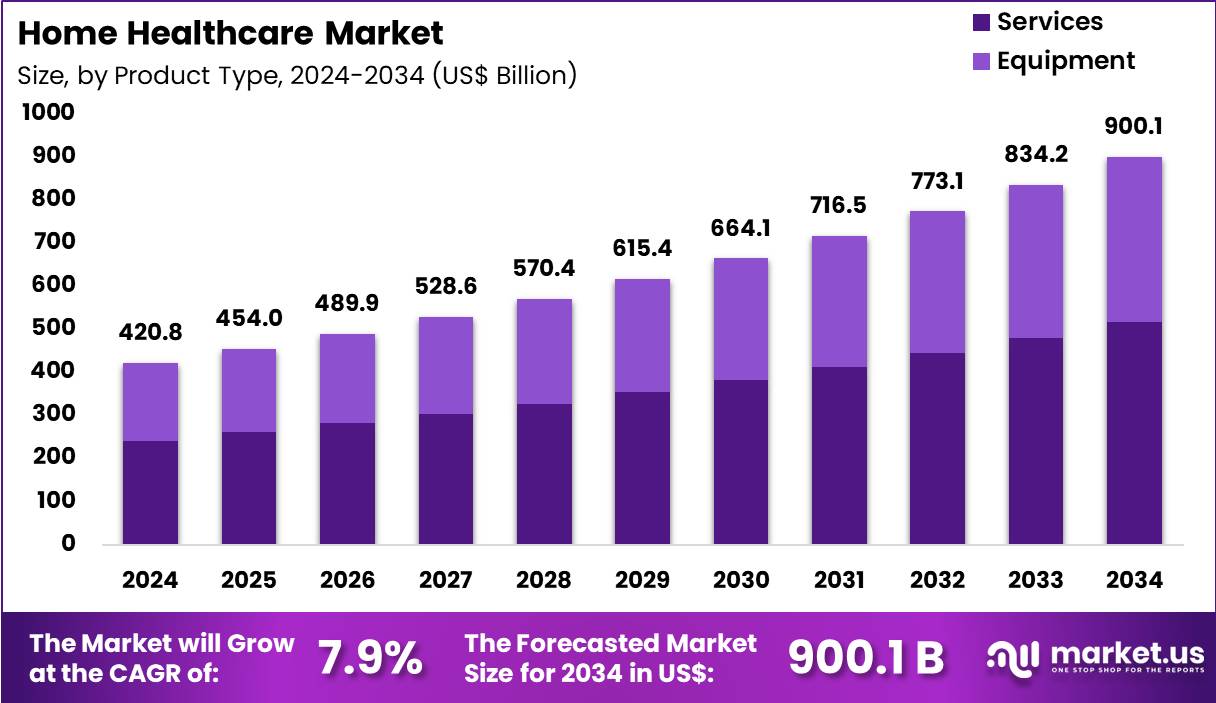
Key Takeaways
- In 2024, the global home healthcare market was valued at US$ 420.8 billion and is projected to reach US$ 900.1 billion by 2034, expanding at a CAGR of 7.9% during the forecast period.
- Based on product type, the market is segmented into equipment and services. The services segment accounted for the largest market share of 57.4% in 2024.
- By application, the market is categorized into cardiovascular disorder & hypertension, diabetes & kidney disorders, cancer, wound care, and others. Among these, the cardiovascular disorder & hypertension segment dominated the market with a 38.6% share in 2024.
- North America emerged as the leading regional market, capturing 40.2% of the global home healthcare market share in 2024.
Regional Analysis
North America accounted for the largest share of the global home healthcare market in 2024, driven by the widespread adoption of remote patient monitoring technologies, strong healthcare infrastructure, and increasing demand for home-based care services. The rising prevalence of chronic diseases, including cardiovascular disorders, diabetes, and respiratory conditions, along with a growing aging population, has significantly increased the need for personalized healthcare delivered at home.
Technological advancements such as wearable health devices, AI-enabled telemedicine platforms, and connected monitoring solutions have enhanced patient care and improved healthcare accessibility. Favorable government reimbursement policies, Medicare support, and the growing adoption of value-based care models have further accelerated market growth by reducing hospital admissions and improving treatment outcomes.
Asia Pacific is projected to register the fastest growth during the forecast period, supported by rapid population aging, expanding healthcare infrastructure, and increasing access to digital healthcare services. Countries such as China are witnessing a substantial rise in the elderly population, creating strong demand for home nursing, telehealth, and remote patient monitoring solutions.
Government initiatives promoting elderly care, long-term care insurance, and healthcare modernization are expected to strengthen market development. In addition, growing investments in smart medical devices, artificial intelligence-based healthcare platforms, and collaborations between technology providers and healthcare organizations are enhancing the availability, affordability, and quality of home healthcare services across the region.
Emerging Trends in Home Healthcare
Integration of Assistive Robotics: Assistive robotics is becoming increasingly important in home healthcare by supporting caregivers and improving patient independence. Socially assistive robots and robotic nursing systems help with mobility, medication reminders, daily living activities, and companionship. Their adoption enhances care efficiency, reduces caregiver burden, and improves the overall patient experience. AI-Enabled Personalized Care: Artificial intelligence is enhancing home healthcare through personalized and data-driven care delivery.
AI-powered solutions, such as predictive analytics, virtual assistants, and intelligent chatbots, facilitate early disease detection, continuous patient engagement, and optimized care planning. These technologies improve clinical outcomes while increasing operational efficiency. Adoption of Wearable Health Devices: Wearable technologies, including smartwatches and fitness trackers, are increasingly being used to continuously monitor vital health parameters such as heart rate, blood pressure, and physical activity.
The real-time health data generated by these devices supports proactive disease management, enables timely interventions, and promotes patient engagement in self-care. Expansion of Remote Patient Monitoring (RPM): Remote patient monitoring is gaining widespread adoption by enabling healthcare providers to track patients’ health conditions from their homes. RPM solutions improve chronic disease management, reduce unnecessary hospital visits, and facilitate continuous clinical oversight, enhancing patient outcomes while lowering healthcare costs.
Rising Adoption of Telehealth Services: Telehealth continues to reshape healthcare delivery by enabling virtual consultations, follow-up appointments, and remote clinical support. The growing adoption of telehealth improves healthcare accessibility, particularly for patients in rural or underserved areas, while reducing travel requirements and enhancing care continuity.
Use Cases in Home Healthcare
- Chronic Disease Management: Home healthcare solutions support patients with chronic conditions through continuous monitoring, remote consultations, and AI-powered health insights. These technologies enable timely treatment adjustments, improve medication adherence, reduce hospital admissions, and enhance long-term disease management.
- Elderly Care and Aging-in-Place: Home healthcare services enable older adults to live independently by providing assistance with daily activities, medication management, emergency response systems, and continuous health monitoring. These services improve safety, enhance quality of life, and reduce the need for institutional care.
- Post-Acute and Post-Surgical Recovery: Patients recovering from surgery benefit from home healthcare through remote monitoring, wearable devices, and virtual consultations. Continuous observation allows early identification of complications, supports faster recovery, and minimizes hospital readmissions while allowing patients to recover comfortably at home.
- Mental Health and Behavioral Care: Digital mental health platforms, virtual therapy sessions, and mobile health applications expand access to psychological support from home. These services improve treatment accessibility, encourage continuous patient engagement, and support better mental health outcomes for individuals with limited mobility or access to healthcare facilities.
Opportunities in Home Healthcare
- Growing Integration of Digital Technologies: The increasing adoption of artificial intelligence, machine learning, remote monitoring, and digital health platforms is creating significant opportunities to improve care quality, optimize clinical workflows, and reduce healthcare costs through personalized and data-driven care delivery.
- Greater Patient Engagement and Self-Management: Digital health applications, wearable devices, and remote monitoring tools empower patients to actively participate in managing their health. Improved access to real-time health information supports better treatment adherence, preventive care, and overall health outcomes.
- Expansion of Comprehensive Home-Based Care Services: Home healthcare providers are expanding beyond traditional nursing services to include preventive care, rehabilitation, chronic disease management, palliative care, and remote specialty consultations. This broadening service portfolio is creating new growth opportunities while addressing the evolving healthcare needs of aging populations and patients seeking care at home.
Frequently Asked Questions on Home Healthcare
- What are the major drivers of the home healthcare market? The market is primarily driven by the growing elderly population, increasing prevalence of chronic diseases, rising healthcare expenditure, and demand for cost-effective treatment options. Technological advancements in telemedicine, wearable devices, and remote patient monitoring further accelerate the adoption of home healthcare services.
- What services are included in home healthcare? Home healthcare services include skilled nursing, physical therapy, occupational therapy, speech therapy, wound care, medication management, palliative care, personal assistance, and remote health monitoring. These services are tailored to individual patient needs and help improve recovery while minimizing hospital visits.
- Which products are commonly used in home healthcare? Home healthcare products include mobility aids, wheelchairs, hospital beds, oxygen therapy equipment, blood glucose monitors, blood pressure monitors, infusion pumps, respiratory care devices, and remote patient monitoring systems. These products enable safe, effective, and continuous care within the home environment.
- Which factors are increasing the demand for home healthcare? Demand is increasing due to the rising incidence of chronic diseases, aging populations, preference for personalized care, shorter hospital stays, and advancements in connected healthcare technologies. Government support for home-based care and improved reimbursement policies are also contributing to sustained market expansion.
- Which region dominates the home healthcare market? North America holds the largest share of the home healthcare market due to its advanced healthcare infrastructure, high adoption of digital health technologies, favorable reimbursement policies, and increasing prevalence of chronic diseases. Strong investments in telehealth and remote monitoring continue to support regional market leadership.
- Which region is expected to witness the fastest market growth? The Asia Pacific region is anticipated to register the fastest growth, supported by rapid population aging, expanding healthcare infrastructure, increasing healthcare spending, and rising adoption of digital health solutions. Government initiatives promoting elderly care and home-based healthcare services further strengthen regional growth prospects.
- What role does technology play in home healthcare? Technology has transformed home healthcare through telemedicine, wearable medical devices, artificial intelligence, and remote patient monitoring systems. These innovations enable real-time health tracking, improve communication between patients and providers, enhance treatment outcomes, and reduce unnecessary hospitalizations while improving overall healthcare efficiency.
- What is the future outlook for the home healthcare market? The home healthcare market is expected to experience strong long-term growth as healthcare systems increasingly emphasize patient-centered and cost-effective care. Continued innovations in digital health, expanding aging populations, supportive government initiatives, and growing awareness of home-based treatment are expected to create significant market opportunities worldwide.
Conclusion
The global home healthcare market is positioned for sustained growth, driven by aging populations, the rising burden of chronic diseases, and increasing demand for cost-effective, patient-centered care. Advancements in telehealth, remote patient monitoring, artificial intelligence, wearable devices, and assistive technologies are transforming the delivery of healthcare services at home while improving clinical outcomes and reducing hospital dependency.
Favorable government initiatives, expanding reimbursement support, and continued investments from healthcare providers are further strengthening market development. As healthcare systems increasingly prioritize personalized and value-based care, home healthcare is expected to play a vital role in enhancing accessibility, improving quality of life, and supporting long-term healthcare sustainability worldwide.
Discuss your needs with our analyst
Please share your requirements with more details so our analyst can check if they can solve your problem(s)




