


Overview
New York, NY – July 21, 2026 –The Global High-performance Liquid Chromatography (HPLC) Market Size is anticipated to reach approximately USD 8.1 Billion by 2033, compared to its 2023 value of USD 4.5 Billion. This reflects a steady growth rate of 6.1% from 2024 to 2033, highlighting the expanding significance of HPLC technology in various industries.
High-performance Liquid Chromatography (HPLC) is a widely used analytical technique designed to separate, identify, and quantify individual components in complex liquid mixtures with high precision and accuracy. The technique operates by passing a liquid sample through a column packed with specialized stationary-phase particles under high pressure. As the sample moves through the column, different compounds interact differently with the stationary and mobile phases, enabling effective separation based on their chemical properties.
HPLC plays a critical role across pharmaceutical, biotechnology, food and beverage, environmental, chemical, and clinical research industries. It is extensively used for drug development, quality control, impurity profiling, stability testing, food safety analysis, environmental monitoring, and biomolecule characterization. The technology provides rapid analysis, high sensitivity, excellent reproducibility, and reliable quantitative results, making it an essential tool for laboratories and research institutions worldwide.
Continuous technological advancements have further enhanced HPLC performance through the development of automated systems, advanced detectors, improved column technologies, and software-based data analysis. These innovations have increased analytical efficiency while reducing analysis time and improving accuracy.
Growing regulatory requirements for product quality and safety, coupled with increasing investments in pharmaceutical research and life sciences, continue to support the widespread adoption of HPLC systems. As industries increasingly prioritize precision testing and regulatory compliance, HPLC remains a fundamental analytical technology for ensuring product quality, research excellence, and scientific innovation.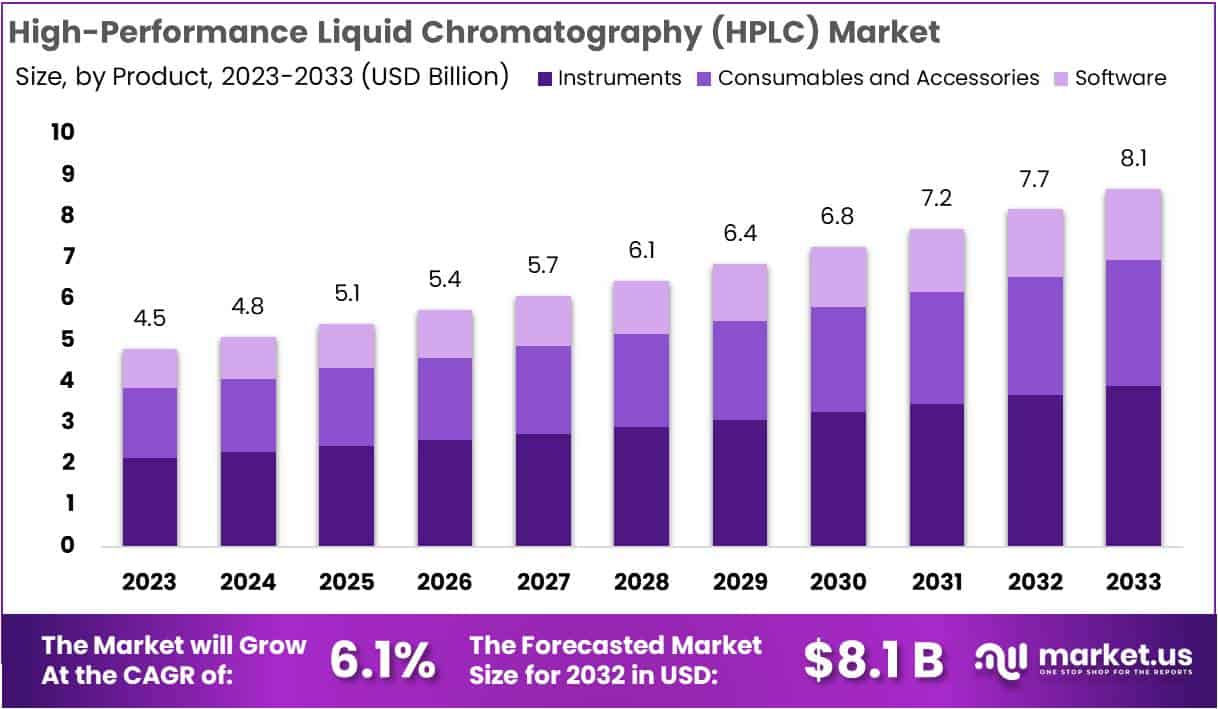
Key Takeaways
- Market Growth Outlook: The HPLC market is projected to reach USD 8.1 billion by 2033 , expanding at a CAGR of 6.1% during the 2024–2033 forecast period.
- Leading Product Segment: The Instruments segment accounted for more than 45% of the global market share in 2023, supported by increasing demand for advanced HPLC systems.
- Top Application Segment: Clinical Research Applications emerged as the leading application area, securing 65.7% of the market share in 2023, reflecting the growing use of HPLC in medical and life sciences research.
- Major End-User Segment: Pharmaceutical and Biotechnology Companies represented the largest end-user category, capturing 40.3% of the global market share in 2023.
- Regional Market Leadership: North America dominated the global HPLC market with a 30.4% revenue share in 2023, supported by the strong pharmaceutical and research infrastructure in the United States.
Regional Analysis
In 2023, North America held the leading position in the global High-performance Liquid Chromatography (HPLC) market, accounting for more than 30.4% of total revenue and reaching a market value of USD 1.5 billion. The region’s leadership was supported by its advanced research infrastructure, strong technological capabilities, and the presence of a well-established pharmaceutical and biotechnology industry.
The United States remained the primary growth driver, benefiting from significant investments in drug development, life sciences research, and laboratory automation. Increasing adoption of HPLC for pharmaceutical quality control, clinical research, and regulatory compliance further strengthened regional demand. The growing focus on precision medicine, biomarker analysis, and the development of innovative therapeutics also accelerated the use of HPLC systems across research institutions and healthcare organizations.
Moreover, the presence of leading HPLC manufacturers, continuous technological advancements, and favorable research funding reinforced North America’s competitive position. These factors collectively enabled the region to maintain its market leadership and support ongoing innovation in analytical testing technologies.
Emerging Trends
- Advanced Technologies: The HPLC market is witnessing rapid technological advancements with the adoption of unified HPLC and ultra-high-performance liquid chromatography (UHPLC). Modern systems feature multidimensional separation, dual injection capabilities, and enhanced pressure technologies, improving analytical accuracy, operational flexibility, and efficiency across pharmaceutical, biotechnology, environmental, and academic research applications.
- Increased Precision and Automation: Manufacturers are introducing highly automated HPLC systems with advanced software, intelligent diagnostics, and precision-enhancing features. These innovations improve workflow efficiency, minimize human error, strengthen regulatory compliance, and enable laboratories to achieve consistent analytical performance while reducing maintenance requirements and operational complexity.
- Integration with Mass Spectrometry (MS): The integration of HPLC with mass spectrometry has become increasingly important for advanced analytical testing. This combination provides superior sensitivity, accurate compound identification, and comprehensive molecular analysis, supporting applications in pharmaceutical development, biopharmaceutical research, food safety testing, and environmental monitoring.
- Focus on High-Throughput Solutions: Growing demand for rapid analytical testing is accelerating the adoption of high-throughput HPLC systems. These solutions process large sample volumes with high accuracy, reducing turnaround times while supporting pharmaceutical quality control, environmental analysis, clinical diagnostics, and regulatory testing requirements.
Use Cases
- Pharmaceutical Applications: HPLC is extensively used throughout pharmaceutical research and manufacturing for drug development, impurity analysis, stability studies, and quality control. It also supports pharmacokinetic and bioavailability studies, enabling accurate evaluation of drug safety, efficacy, regulatory compliance, and manufacturing consistency.
- Food Safety: The food and beverage industry relies on HPLC to detect contaminants, pesticides, additives, and mycotoxins while analyzing nutritional ingredients and flavor compounds. This technology supports regulatory compliance, strengthens quality assurance programs, and helps manufacturers deliver safe, high-quality food products to consumers.
- Environmental Monitoring: HPLC plays a significant role in environmental monitoring by detecting pollutants, organic contaminants, and hazardous chemicals in water, soil, and air samples. Accurate analytical results support environmental protection initiatives, pollution assessment, regulatory compliance, and sustainable resource management across industrial and public sectors.
- Clinical Diagnostics: Clinical laboratories utilize HPLC for biomarker analysis, metabolite profiling, toxicology testing, and therapeutic drug monitoring. The technology delivers highly accurate diagnostic results that assist healthcare professionals in disease diagnosis, patient monitoring, treatment optimization, and precision medicine applications.
Frequently Asked Questions on High-performance Liquid Chromatography
- What is High-performance Liquid Chromatography (HPLC)?
High-performance Liquid Chromatography (HPLC) is an analytical technique used to separate, identify, and quantify components in liquid samples. It delivers highly accurate and reliable results, making it widely used in pharmaceutical research, biotechnology, food testing, environmental analysis, and clinical laboratories for quality assurance and scientific research. - What is driving the growth of the High-performance Liquid Chromatography market?
The HPLC market is expanding due to increasing pharmaceutical research and development, growing demand for quality control testing, rising investments in biotechnology, and stricter regulatory requirements. Technological advancements in chromatography systems and increasing adoption in clinical diagnostics also support sustained market growth. - Which industries are the primary users of HPLC systems?
HPLC systems are extensively used by pharmaceutical and biotechnology companies, academic research institutes, food and beverage manufacturers, environmental testing laboratories, chemical companies, and clinical research organizations. These industries rely on HPLC for precise analysis, regulatory compliance, product development, and quality control applications. - Which product segment holds the largest share of the HPLC market?
The instruments segment accounts for the largest share of the HPLC market because of continuous demand for advanced chromatography systems with improved automation, sensitivity, and analytical performance. Laboratories continue investing in modern instruments to improve testing efficiency and data accuracy. - Which application dominates the High-performance Liquid Chromatography market?
Clinical research represents the leading application segment in the HPLC market, supported by its extensive use in drug discovery, biomarker analysis, pharmacokinetic studies, and disease research. Growing investments in life sciences and personalized medicine continue to increase demand for HPLC technologies. - Which region leads the global High-performance Liquid Chromatography market?
North America holds the largest share of the global HPLC market, driven by its advanced pharmaceutical industry, strong biotechnology sector, extensive research activities, and favorable government funding. The region also benefits from the presence of leading analytical instrument manufacturers and research institutions. - What is the future outlook for the High-performance Liquid Chromatography market?
The High-performance Liquid Chromatography market is expected to witness steady growth over the coming years, supported by expanding pharmaceutical manufacturing, increasing biotechnology research, rising environmental testing requirements, and continuous technological advancements that enhance analytical speed, precision, and operational efficiency.
Conclusion
The High-performance Liquid Chromatography (HPLC) market is poised for sustained growth, supported by increasing demand for accurate analytical testing across pharmaceutical, biotechnology, clinical research, food safety, and environmental monitoring applications. Continuous advancements in automation, UHPLC technologies, mass spectrometry integration, and high-throughput systems are enhancing analytical performance and operational efficiency.
Strong regulatory requirements for product quality and safety, coupled with rising investments in life sciences research, continue to drive market expansion. With North America maintaining a leading position and pharmaceutical companies remaining the largest end users, HPLC is expected to remain a critical analytical technology, enabling scientific innovation, regulatory compliance, and high-quality laboratory testing worldwide.
Discuss your needs with our analyst
Please share your requirements with more details so our analyst can check if they can solve your problem(s)




