


Overview
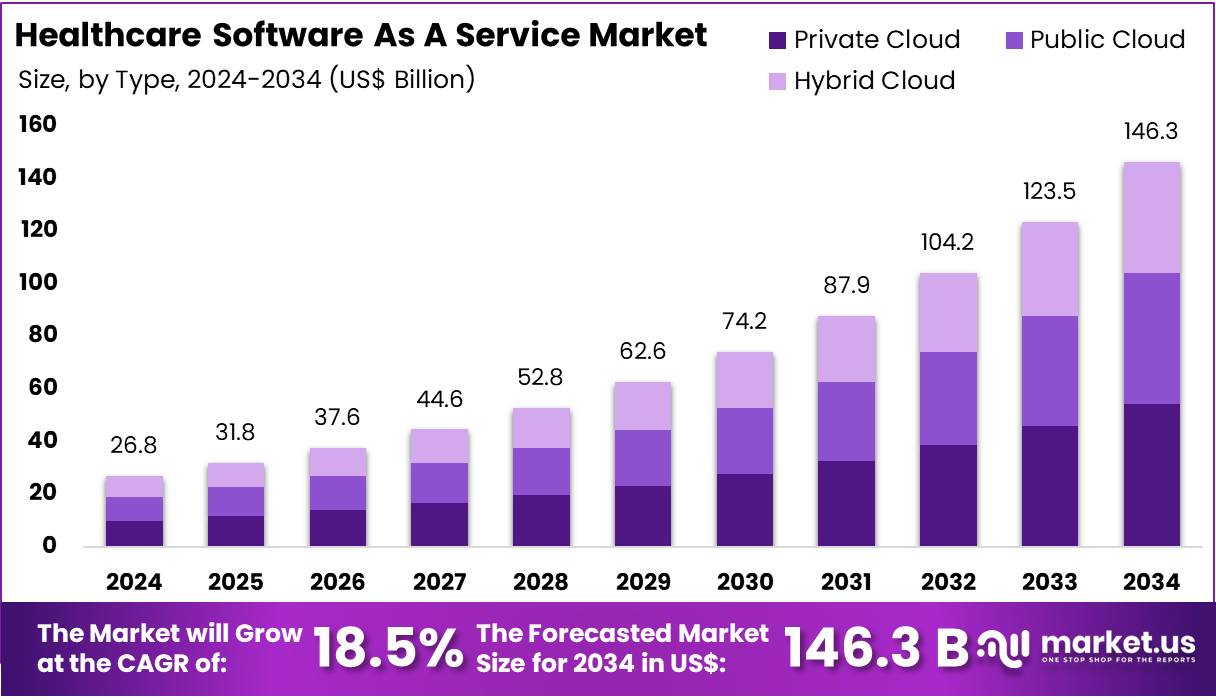
New York, NY – July 03, 2026 – The Global Healthcare Software As A Service Market Size is expected to be worth around US$ 146.3 Billion by 2034, from US$ 26.8 Billion in 2024, growing at a CAGR of 18.5% during the forecast period from 2025 to 2034. North America held a dominant market position, capturing more than a 43.4% share and holds US$ 11.6 Billion market value for the year.
Healthcare Software as a Service (SaaS) is a cloud-based software delivery model that enables healthcare organizations to access clinical, administrative, and operational applications through the internet without the need for extensive on-premise infrastructure. These platforms support a wide range of functions, including electronic health records (EHR), telemedicine, patient engagement, medical billing, practice management, analytics, and healthcare data management. By offering subscription-based access, Healthcare SaaS solutions help providers reduce capital expenditures, improve operational efficiency, and accelerate digital transformation.
The increasing adoption of cloud computing, growing demand for remote healthcare services, and the need for secure and scalable healthcare IT solutions are driving the expansion of the Healthcare SaaS market. Healthcare providers are increasingly leveraging SaaS platforms to enhance care coordination, streamline workflows, and improve patient outcomes while ensuring compliance with evolving regulatory standards. Additionally, the integration of advanced technologies such as artificial intelligence, machine learning, and predictive analytics is expanding the capabilities of Healthcare SaaS solutions, enabling data-driven clinical and operational decision-making.
North America holds a significant share of the Healthcare SaaS market, supported by advanced healthcare infrastructure, widespread adoption of digital health technologies, and strong investments in healthcare IT. Meanwhile, the Asia-Pacific region is expected to witness substantial growth, driven by expanding healthcare infrastructure, increasing cloud adoption, supportive government initiatives, and rising demand for cost-effective digital healthcare solutions across emerging economies.
Key Takeaways
- The Healthcare Software as a Service market was valued at US$ 26.8 billion in 2024 and is projected to reach US$ 146.3 billion by 2034, expanding at a CAGR of 18.5% during the forecast period.
- By solution type, the EHR Systems segment accounted for the largest market share of 16.5% in 2024.
- Based on deployment model, the Private Cloud segment led the market, capturing a 37.1% revenue share in 2024.
- By end user, Healthcare Providers emerged as the leading segment, contributing 72.7% of the total market revenue in 2024.
- North America dominated the global Healthcare Software as a Service market, accounting for a 43.4% share in 2024.
Regional Analysis
North America Leads the Healthcare Software as a Service Market
North America accounted for the largest share of the global Healthcare Software as a Service (SaaS) market in 2024, representing 43.4% of total revenue. The region’s leadership is supported by advanced healthcare infrastructure, widespread adoption of digital health technologies, and favorable regulatory frameworks across the United States and Canada. Healthcare organizations continue to invest in cloud-based solutions, including electronic health records (EHRs), telemedicine, and patient management platforms, to improve operational efficiency, strengthen data security, and enhance patient care.
The growing integration of artificial intelligence into SaaS platforms is further enabling predictive analytics, clinical decision support, and personalized healthcare delivery. In January 2025, Innovaccer secured US$ 275 million in Series F funding to expand its AI-powered cloud solutions and accelerate innovation in healthcare management.
Asia Pacific to Register the Fastest Growth
Asia Pacific is expected to record the highest CAGR during the forecast period, driven by rapid digital transformation, expanding healthcare infrastructure, and supportive government initiatives promoting electronic medical records and telehealth services. Rising cloud adoption is enabling healthcare providers, particularly small and mid-sized organizations, to implement cost-effective SaaS solutions without significant infrastructure investments.
Increasing demand for efficient healthcare services, fueled by population growth and aging demographics, is further supporting market expansion. In April 2025, HealthMetrics rebranded Across Asia Assist Indonesia following its acquisition, strengthening its digital healthcare administration capabilities and expanding cloud-based healthcare services across Indonesia.
Emerging Trends
- Near-Universal Adoption of Cloud-Based EHR Systems: Cloud-based Electronic Health Record (EHR) platforms have become the industry standard, with 96% of U.S. non-federal acute care hospitals and 78% of office-based physicians using certified EHRs. SaaS deployment reduces infrastructure costs while improving scalability, accessibility, and data security.
- Growing Interoperability Through APIs and FHIR: Healthcare organizations are increasingly implementing standards-based APIs and FHIR to enable secure data exchange. Regulatory initiatives and the demand for seamless information sharing are accelerating interoperability, improving care coordination, patient access, and integration across healthcare systems.
- Continued Integration of Telehealth Platforms: Telehealth SaaS solutions remain an essential component of healthcare delivery beyond the pandemic. Stable adoption across public and private insurance populations reflects the growing importance of virtual consultations, remote patient monitoring, and chronic disease management in modern healthcare.
- Expansion of Patient Engagement Solutions: SaaS-based patient portals and mobile health applications are becoming more widespread, enabling appointment scheduling, secure communication, prescription management, and access to medical records. These digital tools enhance patient engagement, improve healthcare experiences, and support better long-term health outcomes.
- Increasing Adoption of National Data Exchange Networks: Healthcare providers are expanding participation in trusted health information exchange frameworks such as TEFCA. SaaS platforms are supporting secure nationwide data sharing, strengthening interoperability, reducing duplicate testing, and improving collaboration among healthcare organizations.
Use Cases
- Cloud-Hosted EHR and Practice Management: Healthcare providers increasingly rely on cloud-based SaaS platforms for electronic health records, scheduling, billing, and administrative operations. These solutions reduce implementation costs, simplify software maintenance, improve workflow efficiency, and enable scalable healthcare management across organizations.
- Telemedicine Platforms: SaaS-based telemedicine platforms enable virtual consultations, remote patient monitoring, and follow-up care through secure digital channels. These solutions improve healthcare accessibility, reduce unnecessary hospital visits, and support continuous patient care for both urban and remote populations.
- API-Enabled Patient Portals: Patient portals powered by SaaS applications provide secure access to medical records, laboratory results, prescription refills, and provider communication. API integration enhances interoperability while improving patient convenience, engagement, and participation in healthcare decision-making.
- Interoperability and Healthcare Data Exchange: SaaS platforms equipped with FHIR-enabled APIs facilitate secure information exchange between hospitals, clinics, laboratories, pharmacies, and digital health applications. Improved interoperability supports coordinated care, minimizes information silos, and enhances clinical decision-making across healthcare ecosystems.
- TEFCA-Compliant Network Connectivity: SaaS solutions supporting TEFCA participation enable healthcare organizations to securely exchange patient information across regional and national networks. These platforms improve continuity of care, reduce redundant diagnostic procedures, and strengthen collaboration among healthcare providers.
Frequently Asked Questions on Healthcare Software As A Service Market
- What is the Healthcare Software as a Service Market?
The Healthcare Software as a Service Market comprises the global industry involved in developing, delivering, and supporting cloud-based healthcare software solutions. The market includes subscription-based platforms used by hospitals, clinics, laboratories, pharmacies, insurers, and other healthcare providers to improve operational efficiency, patient care, and regulatory compliance. - What factors are driving the growth of the Healthcare Software as a Service Market?
The market is being driven by increasing adoption of cloud computing, rising demand for digital healthcare services, expanding telemedicine usage, growing healthcare data volumes, and the need for cost-effective IT infrastructure. Regulatory initiatives supporting healthcare digitization are also encouraging broader adoption across healthcare organizations. - What are the major applications of Healthcare SaaS solutions?
Healthcare SaaS solutions are widely used for electronic health records, revenue cycle management, practice management, telehealth, medical imaging, laboratory information systems, patient relationship management, and healthcare analytics. These applications streamline clinical workflows, improve collaboration, and enhance decision-making across healthcare settings. - Which end users are adopting Healthcare SaaS solutions?
Healthcare SaaS platforms are adopted by hospitals, specialty clinics, physician practices, diagnostic laboratories, pharmacies, healthcare insurance companies, ambulatory surgical centers, and government healthcare organizations. Growing digital transformation initiatives have expanded adoption across both public and private healthcare sectors. - What are the key benefits of Healthcare Software as a Service?
Healthcare SaaS offers benefits including lower upfront investment, scalable deployment, automatic software updates, remote accessibility, enhanced collaboration, improved data security, and reduced IT maintenance. These advantages help healthcare providers improve operational efficiency while delivering better patient experiences and optimized resource utilization. - Which regions are leading the Healthcare Software as a Service Market?
North America leads the Healthcare Software as a Service Market due to advanced healthcare infrastructure, strong cloud adoption, and supportive regulatory policies. Europe also represents a significant market, while Asia-Pacific is experiencing rapid growth driven by healthcare digitalization and increasing investments in cloud technologies. - How does artificial intelligence influence Healthcare SaaS platforms?
Artificial intelligence enhances Healthcare SaaS platforms by enabling predictive analytics, clinical decision support, automated documentation, personalized patient engagement, and workflow optimization. AI-powered capabilities improve diagnostic accuracy, reduce administrative workloads, and support more efficient healthcare delivery across multiple clinical environments. - What is the future outlook for the Healthcare Software as a Service Market?
The Healthcare Software as a Service Market is expected to experience sustained growth as healthcare providers continue adopting cloud-based technologies. Increasing integration of artificial intelligence, data analytics, interoperability solutions, and remote healthcare services is anticipated to create new opportunities for innovation and market expansion.
Conclusion
The Healthcare Software as a Service (SaaS) market is poised for strong long-term growth, supported by the increasing adoption of cloud technologies, digital healthcare transformation, and rising demand for efficient, scalable healthcare IT solutions. Continuous advancements in artificial intelligence, interoperability standards, telemedicine, and patient engagement platforms are enhancing the value of SaaS across healthcare ecosystems.
North America continues to lead the market due to its advanced digital infrastructure, while Asia Pacific is emerging as the fastest-growing region. As healthcare providers prioritize cost optimization, data security, and improved patient outcomes, Healthcare SaaS solutions are expected to play an increasingly critical role in modern healthcare delivery worldwide.
Discuss your needs with our analyst
Please share your requirements with more details so our analyst can check if they can solve your problem(s)




