


Overview
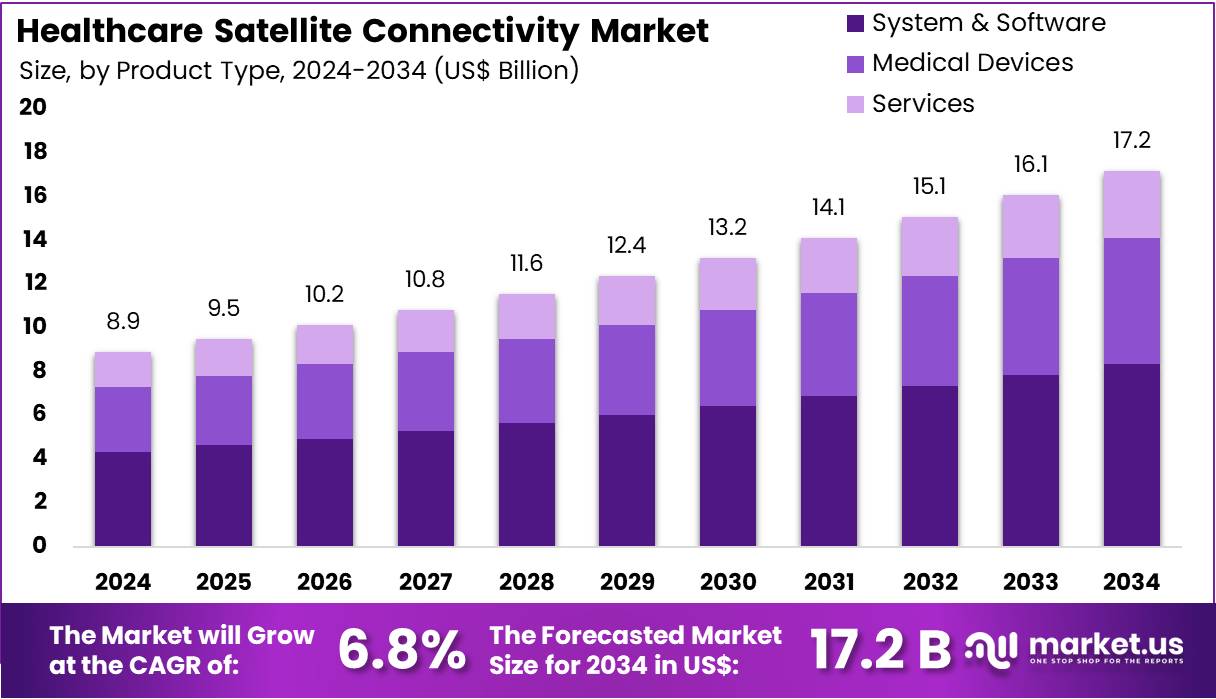
New York, NY – June 09, 2026 – The Healthcare Satellite Connectivity Market Size is expected to be worth around US$ 17.2 billion by 2034 from US$ 8.9 billion in 2024, growing at a CAGR of 6.8% during the forecast period 2025 to 2034.
Healthcare Satellite Connectivity is emerging as a critical technology for improving access to medical services in remote, rural, and underserved regions. By leveraging satellite communication networks, healthcare providers can establish reliable connectivity where traditional terrestrial infrastructure such as fiber-optic cables and cellular networks are unavailable or unreliable.
The technology supports a wide range of healthcare applications, including telemedicine consultations, remote patient monitoring, emergency response coordination, electronic health record transmission, and real-time diagnostic data sharing. Healthcare satellite connectivity enables medical professionals to connect with patients and healthcare facilities across geographically challenging locations, ensuring timely access to specialist care and critical medical information.
Growing demand for digital healthcare services, increasing adoption of telehealth platforms, and the need to strengthen healthcare resilience during natural disasters and public health emergencies are driving market expansion. Satellite-based connectivity solutions also play a vital role in supporting mobile clinics, disaster relief operations, and maritime and aviation healthcare services.
Advancements in satellite technologies, including high-throughput satellites (HTS) and low Earth orbit (LEO) satellite constellations, are improving network performance, reducing latency, and enhancing service reliability. These developments are enabling more efficient delivery of healthcare services and expanding connectivity coverage worldwide.
As healthcare systems continue to prioritize digital transformation and equitable access to care, satellite connectivity is expected to become an increasingly important component of global healthcare infrastructure.
Key Takeaways
- The Healthcare Satellite Connectivity Market was valued at US$ 8.9 billion in 2024 and is projected to reach US$ 17.2 billion by 2033, expanding at a CAGR of 6.8% during the forecast period.
- By product type, the market is segmented into medical devices, systems & software, and services. The systems & software segment dominated the market in 2024, accounting for 48.7% of total revenue.
- Based on technology, the market is categorized into fixed satellite services (FSS), mobile satellite services (MSS), and specialty markers. Fixed satellite services emerged as the leading segment, capturing 46.8% of the market share in 2024.
- In terms of application, the market comprises telemedicine, connected imaging, and clinical operations. Telemedicine held the largest market share of 53.6%, driven by the growing adoption of remote healthcare services.
- By end user, the market is divided into hospitals & clinics, clinical research organizations, research & diagnostic laboratories, and others. Hospitals & clinics remained the largest segment, contributing 58.4% of total market revenue in 2024.
- Regionally, North America maintained its dominant position in the Healthcare Satellite Connectivity Market, accounting for a 39.9% revenue share in 2024.
Regional Analysis
North America accounted for the largest share of the Healthcare Satellite Connectivity Market, representing 39.9% of total revenue. The region’s leadership is primarily driven by the growing need to deliver healthcare services to remote, rural, and underserved communities where conventional broadband and terrestrial communication infrastructure remain limited.
Large geographic distances, sparse populations, and infrastructure challenges have increased the demand for satellite-enabled healthcare solutions. The rapid adoption of telehealth, remote patient monitoring, and virtual consultations has further strengthened the need for reliable connectivity. Satellite communication networks help bridge the digital divide by ensuring uninterrupted access to healthcare services in areas with inadequate internet coverage.
Meanwhile, the Asia Pacific region is projected to register the fastest growth rate during the forecast period. Market expansion is being supported by increasing investments in digital healthcare infrastructure and the rising adoption of telemedicine across developing and emerging economies.
Many countries in the region face significant geographical challenges, including remote islands, mountainous terrains, and rural populations that are difficult to serve through traditional communication networks. Satellite connectivity provides a practical solution for extending healthcare access to these areas. In addition, government initiatives focused on improving rural healthcare services and growing demand for specialist medical consultations are expected to accelerate the deployment of satellite-based healthcare communication systems across the region.
Emerging Trends
- Government Funding for Rural Broadband via Satellite: Government programs are increasingly supporting satellite-enabled healthcare connectivity in rural regions. Funding initiatives and broadband subsidies help healthcare providers reduce communication costs while expanding access to telemedicine, patient monitoring, and digital healthcare services in areas lacking reliable terrestrial networks.
- Satellite Supporting Telehealth Expansion: Satellite connectivity is becoming a critical enabler of telehealth services by providing dependable broadband access in remote locations. The technology allows healthcare providers to deliver virtual consultations, exchange medical information, and maintain continuity of care where conventional internet infrastructure remains unavailable.
- Integration of Satellite and 5G Networks: The integration of satellite networks with terrestrial 5G infrastructure is emerging as a significant trend in healthcare communications. Hybrid connectivity models improve network reliability, coverage, and performance, supporting low-latency healthcare applications such as remote diagnostics, virtual consultations, and real-time patient monitoring.
- Addressing Rural Healthcare Connectivity Challenges: Limited broadband access continues to restrict digital healthcare adoption in many rural communities. Healthcare organizations are increasingly exploring satellite communication solutions to overcome infrastructure gaps, improve access to remote healthcare services, and support advanced technologies such as AI-driven diagnostics and telemedicine.
Use Cases
- Rural Telemedicine Consultations: Satellite connectivity enables healthcare professionals in remote clinics to connect with specialists located in urban healthcare centers. This capability improves access to expert medical advice, reduces patient travel requirements, and supports timely diagnosis and treatment in underserved communities.
- Remote Patient Monitoring: Healthcare providers use satellite broadband to transmit patient health data from rural and underserved locations. The technology supports real-time monitoring, electronic medical record updates, and continuous patient care, enabling healthcare teams to make informed clinical decisions remotely.
- Training and Tele-Education for Healthcare Workers: Satellite-based communication platforms facilitate remote education, specialist supervision, and professional training for healthcare workers. These solutions support knowledge sharing, virtual learning programs, and collaborative case reviews, helping improve healthcare quality in regions with limited educational resources.
- Emergency Communication and Disaster Response: Satellite networks provide reliable communication during natural disasters and emergency situations when terrestrial infrastructure is damaged or unavailable. Healthcare facilities can maintain connectivity with medical centers, coordinate response efforts, and continue delivering essential healthcare services to affected populations.
- Hybrid Satellite–5G Healthcare Connectivity: Combining satellite and 5G technologies enables highly reliable healthcare communication networks with broad geographic coverage. These hybrid solutions support advanced healthcare applications, including remote diagnostics, wearable device monitoring, teleconsultations, and real-time transmission of critical medical data in rural areas.
Frequently Asked Questions on Healthcare Satellite Connectivity
- Why is Healthcare Satellite Connectivity important in modern healthcare?
Healthcare Satellite Connectivity helps bridge healthcare access gaps by providing reliable communication links in remote, rural, and underserved regions. It enables continuous patient care, supports virtual consultations, and ensures healthcare facilities remain connected during natural disasters and infrastructure disruptions. - What is driving the growth of the Healthcare Satellite Connectivity Market?
Market growth is being driven by the increasing adoption of telemedicine, rising demand for remote healthcare services, expanding digital health initiatives, and the need for dependable connectivity in geographically challenging locations. Advancements in satellite technologies are also supporting broader adoption. - Which applications commonly use Healthcare Satellite Connectivity?
Healthcare Satellite Connectivity is widely used in telemedicine, connected imaging, remote patient monitoring, emergency medical services, and clinical operations. These applications rely on secure and reliable communication networks to transmit medical information and facilitate healthcare delivery across long distances. - What are the main technologies used in Healthcare Satellite Connectivity?
The market primarily utilizes Fixed Satellite Services (FSS) and Mobile Satellite Services (MSS). These technologies provide connectivity for healthcare facilities, mobile clinics, ambulances, and remote medical operations, ensuring uninterrupted communication regardless of location or terrain conditions. - Which end-user segment dominates the Healthcare Satellite Connectivity Market?
Hospitals and clinics represent the largest end-user segment due to their growing reliance on telehealth platforms, digital patient management systems, and remote consultation services. These facilities require dependable connectivity to maintain efficient healthcare operations and patient care services. - Which region leads the Healthcare Satellite Connectivity Market?
North America currently leads the market due to its strong healthcare infrastructure, extensive telehealth adoption, and ongoing efforts to improve healthcare accessibility in rural and underserved communities. Investments in advanced communication technologies further support regional market growth. - Why is the Asia Pacific Healthcare Satellite Connectivity Market growing rapidly?
Asia Pacific is experiencing rapid growth because of increasing investments in digital healthcare infrastructure, rising telemedicine adoption, and government initiatives aimed at expanding healthcare access in remote areas. Satellite connectivity provides an effective solution to overcome regional geographic challenges. - How does satellite connectivity support telemedicine services?
Satellite connectivity enables healthcare providers to conduct virtual consultations, share diagnostic data, and monitor patients remotely in areas lacking reliable broadband infrastructure. This capability improves healthcare accessibility while reducing travel requirements for both patients and medical professionals.
Conclusion
The Healthcare Satellite Connectivity Market is gaining significant momentum as healthcare providers seek reliable communication solutions for remote and underserved regions. Growing adoption of telemedicine, remote patient monitoring, and digital healthcare services is driving demand for satellite-enabled connectivity worldwide. Technological advancements in satellite networks, combined with increasing government support for rural healthcare infrastructure, are further accelerating market growth.
North America remains the leading regional market, while Asia Pacific is expected to witness the fastest expansion. As healthcare systems continue to prioritize accessibility, connectivity, and digital transformation, satellite communication is expected to play an increasingly vital role in delivering efficient, equitable, and resilient healthcare services globally.
Discuss your needs with our analyst
Please share your requirements with more details so our analyst can check if they can solve your problem(s)




