


Overview
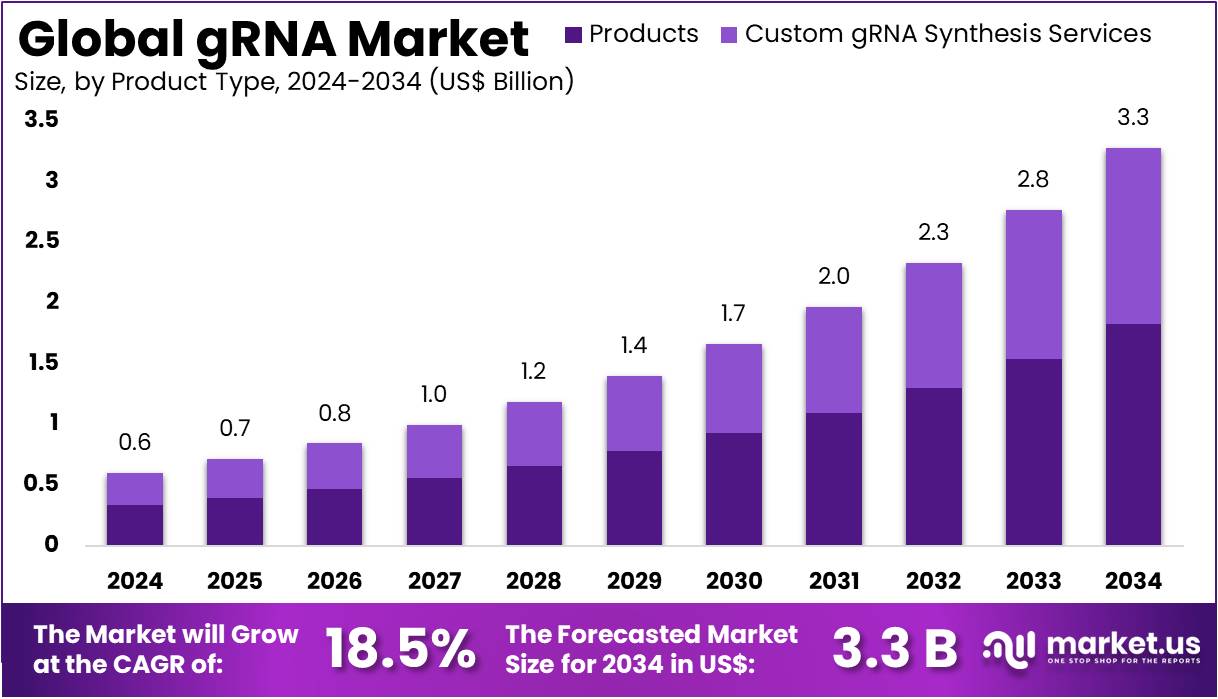
New York, NY – June 03, 2026 – The Global gRNA Market Size is expected to be worth around US$ 3.3 Billion by 2034, from US$ 0.6 Billion in 2024, growing at a CAGR of 18.5% during the forecast period from 2025 to 2034.
Guide RNA (gRNA) is a critical component of CRISPR gene-editing technology, enabling precise targeting and modification of genetic material. Acting as a molecular navigator, gRNA directs the CRISPR-associated (Cas) protein to a specific DNA sequence within a cell, where genetic changes can be introduced with high accuracy. The technology has transformed genetic research by providing a faster, more efficient, and cost-effective alternative to traditional genome-editing methods.
A typical gRNA consists of two key elements: a targeting sequence that matches the DNA region of interest and a scaffold sequence that binds to the Cas enzyme. Together, these components ensure that the CRISPR system reaches the intended genomic location and performs the desired modification. The most widely used system, CRISPR-Cas9, relies on gRNA to identify and edit genes associated with diseases, agricultural traits, and industrial biotechnology applications.
The growing adoption of gRNA-based technologies is driving advancements across healthcare, agriculture, and life sciences research. In medicine, gRNA supports the development of gene therapies for inherited disorders, cancer, and rare diseases. In agriculture, it facilitates the creation of crops with improved yield, disease resistance, and environmental adaptability.
As genome-editing technologies continue to evolve, gRNA remains a foundational element in enabling precise, scalable, and innovative genetic engineering solutions worldwide.
Key Takeaways
- The global gRNA market was valued at US$ 0.6 billion in 2024 and is projected to reach US$ 3.3 billion by 2034, expanding at a CAGR of 18.5% during the forecast period.
- By product type, the market is categorized into products and custom gRNA synthesis services. The products segment dominated the market in 2024, accounting for a 55.7% revenue share.
- Based on gRNA type, the market is segmented into research-use and GMP-grade gRNA. The research-use segment held the largest share of 60.2% in 2024.
- In terms of application, the market is divided into genome engineering, functional genomics, epigenetics, disease model studies, and others. Genome engineering emerged as the leading application segment, capturing 45.5% of the market revenue in 2024.
- By end user, the market is segmented into pharmaceutical & biotechnology companies, CMOs & CROs, and academic research institutes. Pharmaceutical & biotechnology companies led the market with a revenue share of 65.4% in 2024.
- North America was the leading regional market in 2024, representing 48.5% of the global gRNA market revenue.
Regional Analysis
North America accounted for the largest share of the global gRNA market in 2024, representing 48.5% of total revenue. The region’s leadership is primarily driven by the extensive adoption of CRISPR-based gene editing technologies in both therapeutic development and academic research. Strong financial support from public institutions and private organizations has accelerated advancements in genome engineering and precision medicine.
The increasing number of clinical studies focused on gene-editing therapies for genetic disorders, rare diseases, and cancer has further strengthened demand for high-quality guide RNAs. In addition, a well-established biotechnology ecosystem, advanced research infrastructure, and supportive regulatory frameworks have contributed to sustained market growth across North America.
Asia Pacific is projected to witness the fastest growth during the forecast period. Rising investments in biotechnology research, expanding genomic studies, and growing adoption of CRISPR technologies are key factors supporting regional market expansion. Countries such as China, Japan, and South Korea are actively promoting innovation in gene editing through government-backed funding programs and research initiatives.
The increasing prevalence of genetic disorders and the growing focus on developing advanced therapeutic solutions are also driving demand for guide RNAs. Furthermore, strategic collaborations between regional biotechnology companies and international research organizations are accelerating technology development and commercialization, positioning Asia Pacific as a rapidly emerging market for guide RNA products and services.
Emerging Trends
- Growing Use in Human Gene Therapy: The use of gRNA in human gene therapy is increasing as CRISPR-based treatments advance for genetic disorders and cancer. Its ability to accurately target specific genes supports safer and more effective therapies, driving demand for high-quality gRNA in clinical and research applications.
- Rising Demand for Personalized Medicine: Personalized medicine is expanding rapidly, creating greater demand for gRNA technologies. By enabling precise targeting of patient-specific genetic mutations, gRNA supports customized treatments, improving therapeutic outcomes and accelerating the adoption of precision medicine across healthcare systems worldwide.
- Automation and High-Throughput Synthesis: Automation technologies are transforming gRNA production by enabling high-throughput synthesis with greater speed, consistency, and scalability. These systems reduce manufacturing errors, improve productivity, and help meet growing demand from research institutions, biotechnology companies, and clinical development programs.
- Improved gRNA Design Software: Advanced gRNA design software is enhancing gene-editing precision through sophisticated algorithms and predictive analytics. These tools minimize off-target effects, improve targeting efficiency, and accelerate development timelines, allowing researchers to create optimized gRNA sequences with greater confidence and reliability.
- Expansion into Agriculture and Livestock: gRNA applications are expanding into agriculture and livestock production, supporting the development of disease-resistant crops and improved animal traits. This technology enhances productivity, sustainability, and food security while creating new commercial opportunities for gene-editing solution providers.
- Shift Toward GMP-Grade Manufacturing: Demand for GMP-grade gRNA is rising as gene-editing therapies move into clinical development and commercialization. Manufacturers are investing in quality-controlled production facilities to meet regulatory requirements and ensure the safety, consistency, and effectiveness of therapeutic applications.
- Collaborations and Academic Partnerships: Strategic collaborations between academic institutions, biotechnology firms, and research organizations are accelerating innovation in gRNA technologies. These partnerships combine scientific expertise, funding, and commercialization capabilities, supporting the development of advanced gene-editing solutions and expanding market opportunities.
Use Cases
- Gene Editing for Disease Treatment: gRNA is widely used in gene-editing therapies to correct disease-causing genetic mutations. By guiding CRISPR systems to precise DNA locations, it enables targeted treatment of inherited disorders, offering the potential for long-term therapeutic benefits and improved patient outcomes.
- Cancer Research and Drug Development: In cancer research, gRNA enables scientists to identify and modify genes associated with tumor growth and progression. This capability supports the discovery of new drug targets, accelerates therapeutic development, and contributes to more effective precision oncology treatments.
- Functional Genomics Studies: gRNA plays a crucial role in functional genomics by allowing researchers to investigate gene functions through targeted gene editing. These studies help identify disease-related genes, improve biological understanding, and support the development of innovative therapeutic strategies.
- Agricultural Crop Improvement: Agricultural researchers use gRNA to enhance crop characteristics such as disease resistance, drought tolerance, and yield performance. This approach supports sustainable farming practices, reduces reliance on chemical inputs, and helps address growing global food security challenges.
- Creating Disease Models in Animals: gRNA is used to create genetically modified animal models that replicate human diseases. These models provide valuable insights into disease mechanisms, support preclinical research, and improve the evaluation of new therapies before they advance to human trials.
- Stem Cell Engineering: In regenerative medicine, gRNA enables precise genetic modifications in stem cells to support tissue repair and disease treatment. This technology contributes to the development of personalized therapies and holds significant potential for addressing chronic and degenerative conditions.
- Synthetic Biology and Industrial Biotech: gRNA supports synthetic biology applications by enabling genetic engineering of microorganisms used in industrial production. These modified organisms improve the efficiency of manufacturing processes for biofuels, bioplastics, and other sustainable products, promoting environmentally responsible innovation.
Frequently Asked Questions on gRNA Market
- How does gRNA work in CRISPR technology?
gRNA functions as a molecular guide by binding to a complementary DNA sequence and directing the Cas enzyme to that location. Once the target is identified, the enzyme cuts the DNA, allowing researchers to modify, remove, or insert genetic material. - What are the major applications of gRNA?
gRNA is widely used in genome engineering, functional genomics, epigenetics research, disease model development, and therapeutic discovery. Its ability to facilitate precise gene editing has made it an essential tool in biotechnology, pharmaceutical research, and academic studies. - What factors are driving the growth of the gRNA market?
Market growth is being driven by increasing adoption of CRISPR technologies, rising investments in gene-editing research, expanding applications in drug discovery, and growing demand for precision medicine. Continuous advancements in genomic research are also supporting market expansion. - Which end-user segment dominates the gRNA market?
Pharmaceutical and biotechnology companies represent the largest end-user segment due to their extensive use of gRNA in drug development, gene therapy research, and clinical studies. These organizations account for a significant share of overall market revenue. - Why is North America leading the gRNA market?
North America leads the market because of strong research funding, advanced biotechnology infrastructure, widespread adoption of CRISPR technologies, and increasing clinical trials involving gene-editing therapies. The region also benefits from supportive regulatory and innovation ecosystems. - Which region is expected to grow the fastest in the gRNA market?
Asia Pacific is projected to record the highest growth rate due to increasing biotechnology investments, government support for genomic research, expanding healthcare infrastructure, and rising adoption of gene-editing technologies in countries such as China, Japan, and South Korea. - What is the difference between research-use and GMP-grade gRNA?
Research-use gRNA is designed primarily for laboratory and preclinical studies, while GMP-grade gRNA is manufactured under strict quality standards for clinical and therapeutic applications. GMP-grade products are essential for developing gene-editing therapies intended for human use. - What is the future outlook for the gRNA market?
The future outlook for the gRNA market remains highly positive, supported by expanding applications in gene therapy, personalized medicine, agricultural biotechnology, and advanced genomic research. Continuous technological innovation is expected to create new growth opportunities over the coming decade.
Conclusion
The gRNA market is experiencing strong growth, driven by the expanding adoption of CRISPR-based gene-editing technologies across healthcare, biotechnology, agriculture, and life sciences research. Increasing investments in gene therapy, personalized medicine, and genomic research are accelerating demand for high-quality guide RNA products and services.
North America currently leads the market due to its advanced research ecosystem, while Asia Pacific is emerging as the fastest-growing region. Continued advancements in gRNA design, automation, GMP-grade manufacturing, and strategic collaborations are expected to further enhance market development. As gene-editing applications continue to expand, gRNA will remain a critical enabler of innovation and precision genetic engineering worldwide.
Discuss your needs with our analyst
Please share your requirements with more details so our analyst can check if they can solve your problem(s)




