


Overview
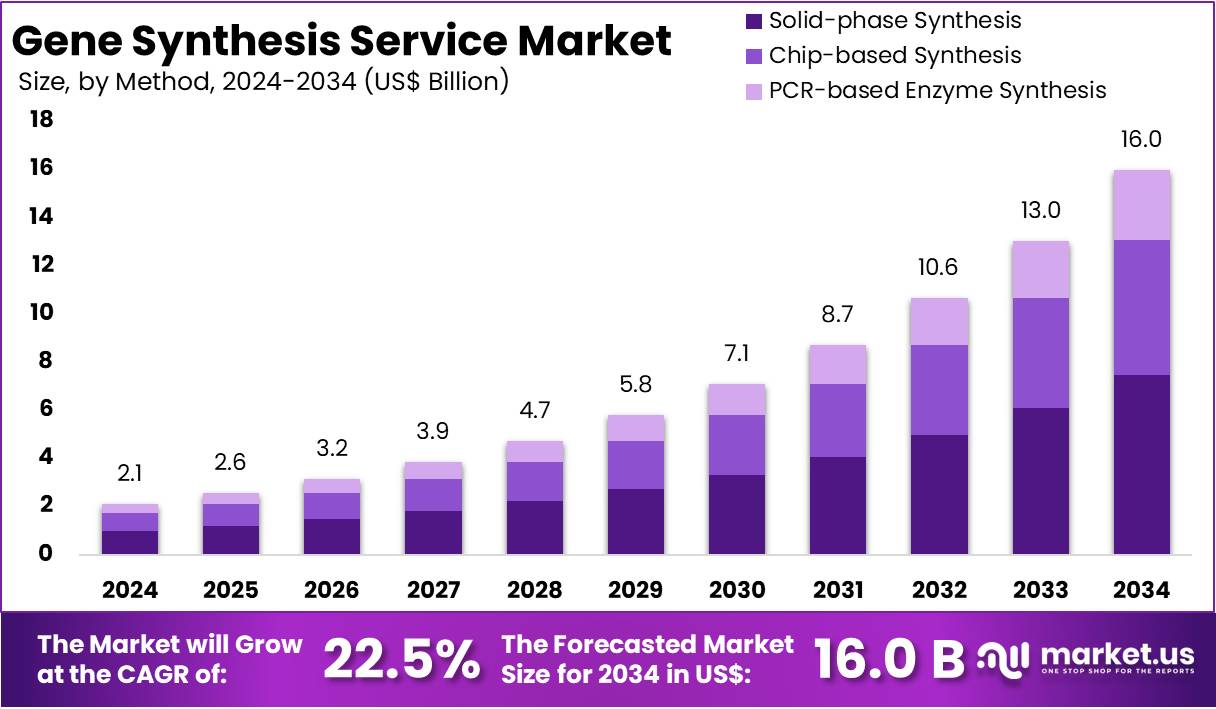
New York, NY – May 26, 2026 – The Global Gene Synthesis Service Market size is expected to be worth around US$ 16 Billion by 2034, from US$ 2.1 Billion in 2024, growing at a CAGR of 22.5% during the forecast period from 2025 to 2034.
The global gene synthesis service market is witnessing significant growth, driven by the increasing demand for synthetic biology, genetic engineering, and advanced molecular research across pharmaceutical, biotechnology, and academic sectors. Gene synthesis services involve the artificial creation of customized DNA sequences, enabling researchers to design genes without the need for traditional cloning methods. These services support a wide range of applications, including vaccine development, therapeutic antibody production, protein engineering, CRISPR-based gene editing, and agricultural biotechnology.
The growing adoption of precision medicine and cell and gene therapies has accelerated the requirement for accurate and rapid gene synthesis solutions. In addition, technological advancements in automated DNA synthesis platforms, next-generation sequencing, and bioinformatics tools have improved synthesis accuracy, scalability, and turnaround time. Outsourcing gene synthesis activities to specialized service providers is also increasing, as organizations seek cost-efficient and high-quality solutions for research and commercial applications.
North America dominates the market due to strong biotechnology infrastructure, substantial research funding, and the presence of major synthetic biology companies. Meanwhile, Asia-Pacific is expected to witness rapid expansion owing to rising investments in biotechnology research, expanding pharmaceutical manufacturing capabilities, and growing government support for life sciences innovation.
Key market participants are focusing on expanding synthesis capacity, reducing production timelines, and introducing high-throughput DNA synthesis technologies to strengthen their competitive position in the global market.
Key Takeaways
- The global gene synthesis service market was valued at USD 2.1 billion in 2024 and is projected to reach USD 16.0 billion by 2034, expanding at a CAGR of 22.5% during the forecast period.
- In 2024, the solid-phase synthesis segment accounted for the largest market share, contributing 46.7% of the global revenue.
- The antibody DNA synthesis segment emerged as the leading category in 2024, representing 60.4% of the total market revenue.
- The gene & cell therapy development segment dominated the application landscape, holding 36.2% of the global revenue share in 2024.
- Biotechnology and pharmaceutical companies remained the leading end-user segment, accounting for 52.4% of the total market revenue in 2024.
- North America led the global gene synthesis service market in 2024, capturing more than 42.1% of the overall revenue share.
Regional Analysis
The North America gene synthesis service market is witnessing robust expansion, supported by rapid advancements in synthetic biology, rising adoption of personalized medicine, and increasing investments in biotechnology research and development activities. The region benefits from a strong biotechnology ecosystem, advanced healthcare infrastructure, and the presence of leading pharmaceutical and life sciences companies, all of which contribute to market growth.
Technological developments, particularly the integration of artificial intelligence, automation, and advanced bioinformatics tools into gene synthesis workflows, are significantly improving synthesis speed, precision, and operational efficiency. These innovations are reducing production errors and accelerating research timelines, enabling researchers to develop customized genetic solutions more effectively. The introduction of advanced services, including rapid-turnaround gene synthesis platforms, is further strengthening market expansion across academic, clinical, and commercial research applications.
The growing burden of chronic diseases, including cancer and cardiovascular disorders, is also increasing the demand for novel therapeutic approaches such as gene and cell therapies. In addition, the rising focus on precision medicine is creating strong demand for customized gene synthesis tailored to individual genetic profiles. Increasing collaboration between biotechnology firms, research institutions, and healthcare organizations is further supporting innovation and driving the continued growth of the gene synthesis service market across North America.
Emerging Trends
- More Demand for Custom DNA Sequences: The demand for customized DNA sequences is increasing as researchers seek precise genetic solutions for specific applications. Tailor-made gene synthesis supports innovation in medicine, agriculture, and industrial biotechnology, enabling faster product development, improved research accuracy, and wider adoption of personalized genetic engineering technologies.
- Rise of Automation and AI in Synthesis: Automation and artificial intelligence are improving gene synthesis speed, precision, and operational efficiency. Advanced systems reduce manual errors, lower production costs, and accelerate delivery timelines. AI-driven design tools also help optimize genetic sequences, making complex research projects easier and more reliable.
- Growing Interest in Synthetic Biology: The expanding field of synthetic biology is increasing the importance of gene synthesis technologies. Scientists are engineering organisms for healthcare, agriculture, and environmental applications. Gene synthesis provides essential genetic components required to develop innovative vaccines, resilient crops, and sustainable environmental protection solutions.
- Cost Reduction Through New Technologies: Technological advancements in DNA synthesis methods are significantly reducing production costs and improving accessibility. Faster workflows and reduced material usage make gene synthesis more affordable for startups, research institutions, and biotechnology firms, supporting wider adoption and accelerating innovation across multiple industries worldwide.
- Collaboration Between Academia and Industry: Partnerships between universities, biotechnology companies, and pharmaceutical organizations are strengthening gene synthesis innovation. Academic expertise combined with industrial resources accelerates research, enhances product development capabilities, and supports the commercialization of advanced genetic technologies for healthcare, agriculture, and industrial biotechnology applications.
- Expanding Applications Beyond Medicine: Gene synthesis applications are expanding beyond healthcare into agriculture, renewable energy, food production, and environmental management. Engineered genes support the development of sustainable biofuels, high-yield crops, and pollution-control organisms, creating new growth opportunities and increasing the technology’s importance across global industries.
Use Cases
- Drug Discovery and Development: Pharmaceutical companies use gene synthesis to create customized DNA sequences for disease research and drug development. Synthetic genes help identify therapeutic targets, improve laboratory testing accuracy, and accelerate the development of innovative treatments while reducing overall research costs and development timelines.
- Vaccine Development: Gene synthesis plays a critical role in developing modern vaccines, including mRNA and DNA-based vaccines. Researchers can rapidly design genetic material for emerging diseases, enabling faster vaccine production, improved response to viral mutations, and stronger global preparedness for future public health emergencies.
- Agricultural Improvements: Gene synthesis supports the development of crops with improved resistance to pests, diseases, and climate conditions. Scientists can create plants with higher nutritional value and better productivity, helping farmers reduce chemical usage, improve sustainability, and meet increasing global food demand efficiently.
- Industrial Biotechnology: Industrial biotechnology companies use gene synthesis to engineer microorganisms capable of producing biofuels, enzymes, and biodegradable materials. These innovations support sustainable manufacturing processes, reduce dependence on fossil fuels, and contribute to environmentally friendly industrial production across multiple commercial sectors worldwide.
- Gene Therapy Research: Gene synthesis is essential for developing gene therapies that replace defective genes responsible for genetic disorders. Researchers use synthetic genes to test treatment safety and effectiveness, supporting advancements in therapies for diseases such as muscular dystrophy, cystic fibrosis, and inherited vision disorders.
- Environmental Applications: Gene synthesis enables the creation of engineered microorganisms for environmental cleanup and waste management applications. These organisms can break down pollutants, plastics, and toxic chemicals, supporting sustainable bioremediation strategies and helping restore ecosystems affected by industrial contamination and environmental pollution.
Frequently Asked Questions on Gene Synthesis Service
- What factors are driving the growth of the gene synthesis service market?
The market is primarily driven by increasing demand for synthetic biology, rising investments in biotechnology research, growing adoption of personalized medicine, and expanding applications in gene and cell therapy development. Technological advancements in automated DNA synthesis platforms are also supporting market expansion globally. - How is gene synthesis used in pharmaceutical and biotechnology industries?
Gene synthesis is widely utilized in pharmaceutical and biotechnology industries for therapeutic protein production, vaccine development, antibody engineering, and drug discovery activities. It also supports advanced research involving CRISPR gene editing, molecular diagnostics, and the development of precision medicine solutions. - Which regions dominate the global gene synthesis service market?
North America holds a leading position in the global gene synthesis service market due to strong research infrastructure, high biotechnology investments, and the presence of major market participants. Asia-Pacific is also witnessing rapid growth supported by increasing healthcare and life sciences investments. - What are the major applications of gene synthesis services?
Major applications of gene synthesis services include vaccine development, gene and cell therapy research, synthetic biology, agricultural biotechnology, antibody DNA synthesis, and diagnostic testing. These services are increasingly being adopted across academic institutions, biotechnology firms, and pharmaceutical companies worldwide. - How does artificial intelligence impact gene synthesis services?
Artificial intelligence enhances gene synthesis services by improving sequence design accuracy, optimizing synthesis workflows, and reducing operational errors. AI-driven automation also accelerates turnaround times and supports large-scale genetic data analysis, helping companies improve efficiency and research productivity. - Who are the key end users in the gene synthesis service market?
Biotechnology and pharmaceutical companies represent the largest end-user segment in the market due to extensive research and therapeutic development activities. Academic and research institutes, contract research organizations, and diagnostic laboratories also contribute significantly to the demand for gene synthesis services.
Conclusion
The global gene synthesis service market is expected to witness strong long-term growth, supported by rising demand for synthetic biology, precision medicine, and advanced genetic research. Continuous advancements in automation, artificial intelligence, and high-throughput DNA synthesis technologies are improving efficiency, accuracy, and scalability across research and commercial applications.
Expanding use cases in vaccine development, gene therapy, agriculture, industrial biotechnology, and environmental solutions are further strengthening market potential. In addition, increasing collaborations between biotechnology companies, research institutions, and healthcare organizations are accelerating innovation. With growing investments and expanding applications, the gene synthesis service market is positioned for substantial future expansion globally.
Discuss your needs with our analyst
Please share your requirements with more details so our analyst can check if they can solve your problem(s)




