


Overview
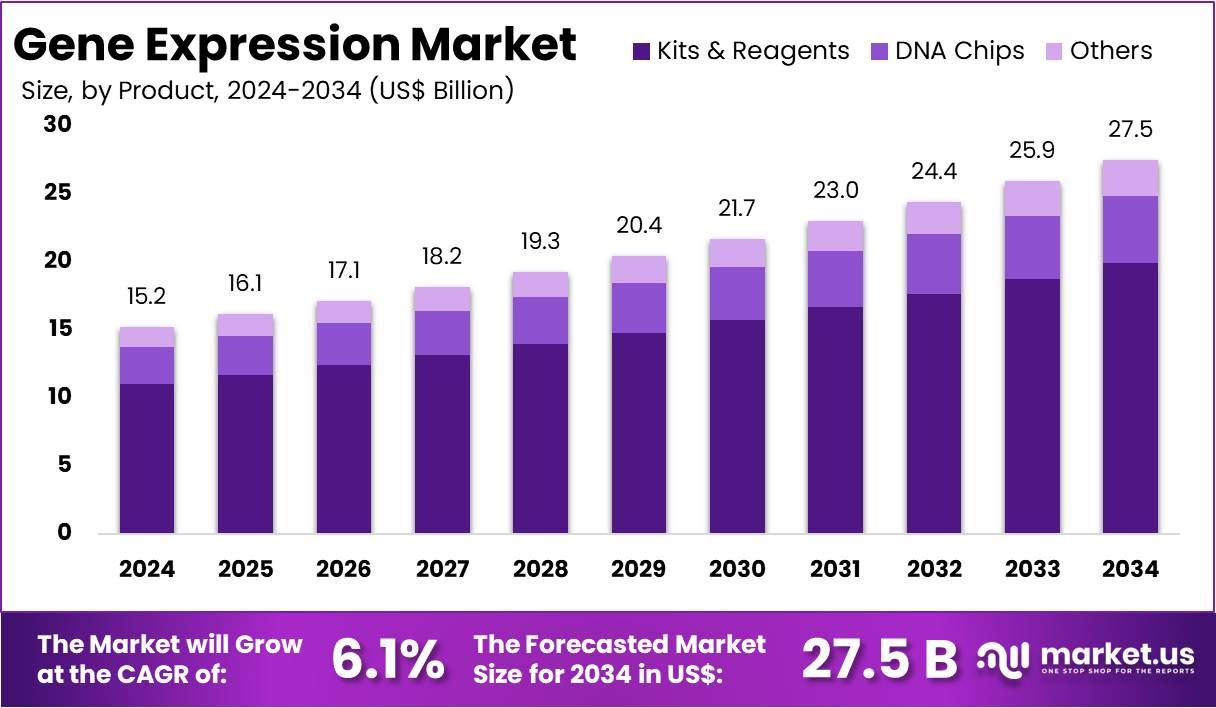
New York, NY – May 07, 2026 – The Global Gene Expression Market Size is expected to be worth around US$ 27.5 Billion by 2034, from US$ 15.2 Billion in 2024, growing at a CAGR of 6.1% during the forecast period from 2025 to 2034.
Gene expression is a fundamental biological process through which the information encoded in genes is converted into functional products such as proteins. This process plays a critical role in regulating cellular functions, growth, development, and response to environmental changes. Gene expression determines how cells behave and enables different cell types in the human body to perform specialized functions despite containing the same genetic material.
The process generally involves two key stages: transcription and translation. During transcription, genetic information from DNA is copied into messenger RNA (mRNA). In the translation stage, the mRNA serves as a template for protein synthesis. The regulation of gene expression ensures that proteins are produced in the right amounts, at the appropriate time, and in specific cells or tissues.
Advancements in gene expression research have significantly contributed to the understanding of various diseases, including cancer, neurological disorders, and genetic conditions. Modern technologies such as RNA sequencing, microarrays, and real-time PCR are widely utilized to analyze gene activity and identify disease biomarkers.
The growing focus on precision medicine, biotechnology innovation, and genomic research is increasing the importance of gene expression studies across pharmaceutical, clinical, and academic sectors. Continuous research efforts are expected to support the development of targeted therapies, improve diagnostic capabilities, and enhance personalized treatment approaches in the coming years.
Key Takeaways
- The global gene expression market was valued at USD 15.2 billion in 2024 and is projected to reach USD 27.5 billion by 2034, expanding at a CAGR of 6.1% during the forecast period.
- The kits & reagents segment dominated the market in 2024, accounting for 72.3% of the global revenue share.
- The cDNA synthesis & conversion segment emerged as the leading category, capturing 28.2% of the total market revenue in 2024.
- The drug discovery & development segment held the largest market share of 42.2% in 2024.
- The RNA expression segment accounted for the highest revenue share of 42.1% in the global market in 2024.
- North America led the global gene expression market, representing 44.2% of the total revenue share in 2024.
Regional Analysis
North America established a strong position in the global gene expression market due to rising government investments in genomic and molecular biology research. Increasing support from public organizations has accelerated advancements in gene expression technologies, particularly in areas such as personalized medicine, cancer research, and genetic disorder analysis.
Government agencies, including the National Institutes of Health (NIH), the National Human Genome Research Institute (NHGRI), and Health Canada, continue to provide substantial funding for research initiatives aimed at improving genomic understanding and therapeutic development.
In 2023, Genome Canada announced an investment of approximately USD 18.1 million to support 13 late-stage research and development projects focused on addressing critical challenges in healthcare, agriculture, and environmental sustainability through genomics. Such initiatives are contributing to the expansion of advanced gene expression applications across the region.
The regional market is further supported by the strong presence of leading biotechnology and life sciences companies, including Thermo Fisher Scientific, Bio-Rad Laboratories, and Promega Corporation, which continue to invest in product innovation and research collaborations. Additionally, in February 2024, the U.S. National Science Foundation allocated nearly USD 12.7 million to nine research teams studying RNA functions and their potential applications in crop disease prevention and cancer therapy development.
Emerging Trends
- Single-Cell and Spatial Gene Expression: Single-cell and spatial gene expression technologies help researchers study gene activity in individual cells and specific tissue locations. These tools improve understanding of cell interactions, cancer progression, brain disorders, and real-time cellular behavior with greater accuracy.
- Non-Invasive Testing Using Blood Samples: Liquid biopsy enables researchers to analyze gene activity through blood samples instead of tissue collection. This non-invasive method supports early disease detection, treatment monitoring, improved patient comfort, and safer diagnostic procedures in modern healthcare applications.
- Combining Gene Expression with Other Data (Multi-Omics): Multi-omics combines gene expression data with genomic, proteomic, and epigenetic information to better understand disease mechanisms. This integrated approach improves biomarker discovery, personalized treatment development, diagnostic accuracy, and identification of potential drug targets.
- Faster and More Precise Lab Techniques: Advanced laboratory technologies allow researchers to analyze thousands of genes quickly and accurately. Improved tools provide reliable results, reduce errors, lower operational costs, and support faster discoveries in cancer research and precision medicine applications worldwide.
Use Cases
- Understanding and Diagnosing Cancer: Gene expression analysis helps identify cancer types, disease severity, and treatment response. This information supports personalized therapies, improves treatment selection, reduces side effects, and increases recovery chances through more accurate and targeted cancer management strategies.
- Monitoring Diabetes and Other Chronic Diseases: Gene expression studies help doctors monitor chronic diseases such as diabetes and cardiovascular disorders. These analyses identify early biological changes, improve treatment planning, support preventive healthcare strategies, and reduce complications through timely medical intervention and monitoring.
- Improving Personalized Medicine: Gene expression supports personalized medicine by identifying how patients respond to specific treatments and medications. This approach improves treatment effectiveness, minimizes adverse reactions, optimizes drug selection, and enables healthcare providers to deliver patient-specific therapeutic solutions efficiently.
- Developing New Drugs: Pharmaceutical companies use gene expression analysis to identify disease-related genes and evaluate drug performance. This approach accelerates drug discovery, improves clinical trial success, reduces development costs, and supports the creation of safer and more effective medicines.
Frequently Asked Questions on Gene Expression
- What factors influence gene expression?
Gene expression can be influenced by genetic mutations, environmental conditions, hormones, nutrition, and external stress factors. Regulatory proteins and epigenetic modifications also affect how genes are activated or suppressed, significantly impacting cellular behavior and overall physiological processes. - What are the common techniques used for gene expression analysis?
Common gene expression analysis techniques include quantitative PCR, microarray analysis, RNA sequencing, and northern blotting. These technologies help researchers measure RNA levels, identify gene activity patterns, and support disease diagnosis, drug discovery, and biomarker identification studies. - What is RNA sequencing in gene expression studies?
RNA sequencing is an advanced technology used to analyze and quantify RNA molecules within a biological sample. It enables researchers to identify active genes, study genetic variations, and gain deeper insights into cellular functions, disease progression, and therapeutic responses. - How does epigenetics affect gene expression?
Epigenetics affects gene expression through chemical modifications that regulate gene activity without altering DNA sequences. Processes such as DNA methylation and histone modification can activate or silence genes, influencing development, aging, disease susceptibility, and environmental adaptation in organisms. - What role does gene expression play in personalized medicine?
Gene expression supports personalized medicine by helping healthcare professionals identify patient-specific genetic profiles and treatment responses. This information enables the development of targeted therapies, improves treatment effectiveness, reduces adverse effects, and enhances clinical outcomes for various diseases. - What are the major drivers of the gene expression market?
The growth of the gene expression market is driven by increasing demand for personalized medicine, rising cancer prevalence, and advancements in sequencing technologies. Expanding biotechnology research, government funding initiatives, and growing pharmaceutical investments are also contributing significantly to market expansion. - Which industries are the major end users of gene expression technologies?
Pharmaceutical companies, biotechnology firms, academic research institutes, and diagnostic laboratories are major end users of gene expression technologies. These organizations utilize gene analysis tools for drug discovery, biomarker identification, disease diagnosis, and the development of innovative therapeutic solutions.
Conclusion
Gene expression plays a vital role in understanding cellular functions, disease mechanisms, and therapeutic responses, making it an essential component of modern biomedical research. Continuous advancements in sequencing technologies, single-cell analysis, liquid biopsy, and multi-omics approaches are significantly improving diagnostic accuracy and personalized treatment development.
The increasing adoption of gene expression technologies across pharmaceutical, biotechnology, and clinical sectors is driving strong market growth globally. Supportive government funding, expanding genomic research activities, and rising demand for precision medicine are expected to further accelerate innovation in this field. Consequently, the gene expression market is anticipated to witness sustained expansion and technological advancement over the forecast period.
Discuss your needs with our analyst
Please share your requirements with more details so our analyst can check if they can solve your problem(s)




