


Overview
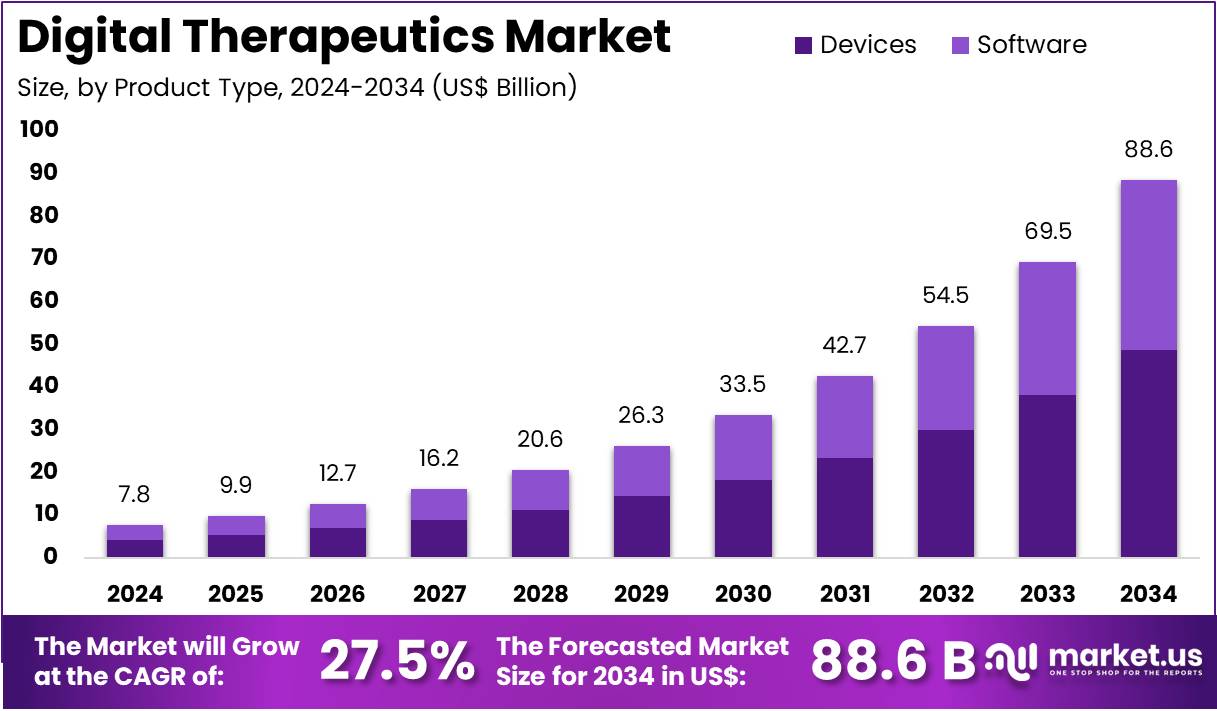
New York, NY – July 03, 2026 – Global Digital Therapeutics Market Size is expected to be worth around US$ 88.6 billion by 2034 from US$ 7.8 billion in 2024, growing at a CAGR of 27.5% during the forecast period 2025 to 2034.
Digital therapeutics (DTx) refers to evidence-based software solutions designed to prevent, manage, or treat medical conditions. These interventions deliver clinically validated therapeutic outcomes through digital platforms such as mobile applications, web-based programs, and connected devices. The growth of this market is driven by increasing prevalence of chronic diseases, rising healthcare digitization, and demand for personalized treatment approaches.
Digital therapeutics are developed based on rigorous clinical trials and regulatory standards, ensuring measurable health outcomes comparable to traditional medical treatments in selected indications. They are commonly used in areas such as diabetes management, mental health disorders, cardiovascular diseases, and respiratory conditions.
Integration of artificial intelligence and data analytics enhances patient monitoring, adherence, and treatment optimization. Healthcare providers and payers are increasingly adopting digital therapeutics to reduce long-term treatment costs and improve patient engagement. Regulatory bodies in several regions are establishing frameworks to ensure safety, efficacy, and data privacy.
The market is expected to witness steady expansion due to growing investments in digital health infrastructure and increasing acceptance of remote care models. Continuous innovation and collaboration between technology firms and healthcare organizations are anticipated to further strengthen adoption across global healthcare systems.
Overall, digital therapeutics represent a rapidly evolving segment of digital health, offering scalable, evidence based solutions that support improved clinical outcomes and long term healthcare system efficiency globally across international markets.
Key Takeaways
- In 2024, the digital therapeutics market generated revenue of US$ 7.8 billion and is projected to grow at a CAGR of 27.5%, reaching approximately US$ 88.6 billion by 2034.
- By product type, the market is segmented into devices and software, with devices accounting for the leading share of 55% in 2023.
- Based on application, the market is categorized into diabetes, obesity, central nervous system diseases, gastrointestinal disorders, cardiovascular diseases, and others. Among these, diabetes represented the dominant segment, holding a 38% market share.
- In terms of sales channels, the market is divided into business-to-business (B2B) and business-to-consumer (B2C) segments, with B2B emerging as the leading channel, contributing 60.1% of total revenue in the digital therapeutics market.
- Regionally, North America led the global market, accounting for a 40.2% share in 2023.
Digital Therapeutics Statistics
- The adoption of Electronic Health Record (EHR) systems in the United States reached approximately 90% among physicians in 2021, reflecting strong digital integration in healthcare management. This widespread implementation has significantly improved patient data accessibility and clinical decision-making processes.
- Around 85% of physicians in the United States utilize EHR systems to record Social Determinants of Health (SDOH), while nearly 97% use these systems for documenting Behavioral Determinants of Health (BDOH), indicating high dependence on structured digital health data collection.
- Globally, more than 365,000 health-related applications are currently available across major app stores, with nearly 5 million daily downloads recorded worldwide. This highlights rapid expansion and increasing consumer adoption of mobile health solutions.
- In the United Kingdom, approximately 50% of adults have engaged with some form of health technology, while only around 7% have specifically used tools categorized as digital therapeutics, indicating early-stage adoption of advanced therapeutic applications.
- Since 2017, digital therapeutics has emerged as one of the fastest-growing segments in health technology, supported by substantial venture capital investments and increasing interest from healthcare innovators and pharmaceutical companies.
- In a U.S.-based case study, digital health app adoption reached 20% among a targeted patient population. Additionally, retention rates from 90 days to 12 months were reported at 89%, significantly higher than the industry benchmark of around 45%.
- Clinical evaluations of digital therapeutic platforms showed that between weeks 9 and 12, approximately 77.3% of patients using combined digital and traditional therapy stopped opioid use, compared to 62.1% under traditional treatment alone, indicating improved treatment outcomes.
- Patient adherence data indicates that individuals scheduling treatments on fixed days achieved around 80% compliance, whereas those following interval-based scheduling demonstrated lower adherence of approximately 64%, highlighting the importance of structured engagement models.
- Digital health platforms in 2022 enabled the collection of over 800,000 electronic patient-reported outcomes (ePROs) and supported more than 160,000 home-based drug administrations, demonstrating large-scale operational efficiency in patient monitoring.
- A 2023 industry survey by HealthXL revealed that more than 40% of stakeholders across pharmaceuticals, digital health, and venture capital sectors expect digital health programs to demonstrate measurable value within a 1–2 year timeframe.
- Behavioral health programs reported a 40% conversion rate from order to enrollment for digital therapeutic tools, with several patients engaging with the platform for more than two hours, indicating strong user interaction levels.
- Non-communicable diseases continue to represent a major global health burden, accounting for approximately 74% of all deaths worldwide, underscoring the growing need for scalable and technology-driven healthcare interventions.
Regional Analysis
North America accounted for the largest share of 40.2% in the digital therapeutics market, driven by strong regulatory clarity, increasing reimbursement support, and rising adoption of software-based treatment solutions. The region has witnessed growing demand due to the high prevalence of chronic diseases and mental health disorders, which has strengthened the need for scalable and accessible care solutions. According to the CDC, in 2022, approximately 18.2% of adults reported symptoms of anxiety and 21.4% reported symptoms of depression, reflecting a substantial patient base for digital mental health interventions.
The U.S. Food and Drug Administration (FDA) has supported market expansion through approvals and clearances of multiple Software as a Medical Device (SaMD) solutions across therapeutic areas such as migraine and ADHD. In addition, companies such as Teladoc Health reported US$1.04 billion in revenue from its BetterHelp segment in 2024, highlighting strong commercial adoption. Similarly, DarioHealth recorded a 32.9% revenue increase in 2024, supported by growing B2B2C partnerships. Evolving reimbursement frameworks from the Centers for Medicare & Medicaid Services (CMS) are further enabling broader integration into healthcare systems.
Asia Pacific is projected to register the fastest CAGR during the forecast period, supported by rising healthcare expenditure, increasing smartphone penetration, and expanding government digital health initiatives. China’s digital health market reached US$18.08 billion in 2024, while India’s Ayushman Bharat Digital Mission has generated over 730 million ABHA IDs by 2025. Japan’s Medical DX Promotion Plan, with a US$400 million investment, further strengthens regional growth prospects.
Emerging Trends
- Expansion of Telemedicine in Mental Health: Telemedicine in mental health is expanding rapidly as digital healthcare adoption increases. Remote consultation services are improving accessibility, especially for rural and underserved populations. The trend is reducing geographic barriers and strengthening patient-centered care delivery models across global mental health systems.
- Advancements in Personalized Medicine for Mental Health: Personalized medicine is advancing mental health treatment through genetic profiling-based interventions. Tailored therapies are improving treatment accuracy and patient response rates. This approach is enhancing clinical effectiveness while supporting deeper insights into the biological basis of mental health disorders.
- Incorporation of AI and Virtual Reality in Mental Health Therapy: AI and VR technologies are increasingly integrated into mental health therapy. AI improves diagnostic accuracy through data analysis, while VR enables immersive exposure-based treatments for conditions such as PTSD and anxiety. These innovations are improving engagement and therapeutic outcomes significantly.
Use Cases
- Treatment of Chronic Diseases: Digital therapeutics are being widely applied in chronic disease management such as diabetes and cardiovascular conditions. Real-time monitoring tools enable continuous tracking and timely treatment adjustments. This approach improves disease control, patient adherence, and long-term health outcomes.
- Mental Health Interventions: Digital platforms are transforming mental health care by enabling remote access to therapies like cognitive behavioral therapy. Mobile apps and software solutions support individuals with depression and anxiety, improving accessibility, consistency, and continuity of mental health treatment services.
- Support for Behavioral Changes: Digital therapeutics support behavioral modification for conditions such as obesity and diabetes. These tools provide tracking, coaching, and personalized feedback. The approach enhances patient engagement and promotes sustained healthy behaviors, contributing to long-term disease prevention and improved lifestyle management.
- Regulatory Approvals and Innovation: The digital therapeutics sector is progressing through key regulatory approvals and innovations. FDA-authorized solutions such as migraine therapy devices and adolescent depression applications demonstrate growing clinical validation. These developments highlight increasing integration of digital solutions into mainstream healthcare systems.
Frequently Asked Questions on Digital Therapeutics
- What is Digital Therapeutics?
Digital Therapeutics refers to evidence-based software-driven medical interventions used for prevention, management, or treatment of diseases. These solutions are clinically validated and designed to complement or replace traditional therapies, improving healthcare delivery efficiency and patient outcomes across multiple therapeutic areas. - How does Digital Therapeutics work?
Digital therapeutics operate through clinically validated software applications that deliver structured therapeutic interventions. These systems utilize behavioral science, data analytics, and adaptive algorithms to monitor patients, personalize treatment pathways, and continuously modify interventions based on real-time health and usage data inputs. - Which conditions are treated using Digital Therapeutics?
Digital therapeutics are widely applied in chronic and behavioral conditions including diabetes, obesity, depression, anxiety, cardiovascular disorders, and substance use disorders. Their use is also expanding into preventive healthcare, rehabilitation, and long-term disease management programs across integrated healthcare ecosystems. - What are the key benefits of Digital Therapeutics?
Digital therapeutics provide improved patient engagement, personalized treatment delivery, and enhanced clinical outcomes. Additional benefits include reduced healthcare expenditure, greater accessibility to care, continuous remote monitoring, and support for scalable healthcare models, enabling more efficient management of patient populations. - What is the regulatory status of Digital Therapeutics?
Digital therapeutics are increasingly classified as regulated medical devices in several regions. Regulatory authorities require clinical validation, safety assessment, and efficacy evidence before approval. These frameworks ensure reliability, although global regulations continue to evolve alongside rapid digital health innovation. - What are the key growth drivers of the Digital Therapeutics Market?
Market growth is driven by increasing prevalence of chronic diseases, rising healthcare digitization, and demand for cost-effective treatment solutions. Expanding smartphone penetration and supportive reimbursement frameworks further accelerate adoption across both developed and emerging healthcare markets globally. - What is the regional outlook of the Digital Therapeutics Market?
North America dominates the digital therapeutics market due to advanced healthcare infrastructure and high digital adoption. Europe follows with strong regulatory systems, while Asia-Pacific is expected to witness the fastest growth owing to expanding healthcare access and digital transformation initiatives. - Who are the key participants in the Digital Therapeutics Market?
Key participants include software developers, healthcare providers, pharmaceutical companies, and digital health startups. Collaboration among these stakeholders is essential for innovation, clinical validation, and large-scale commercialization of digital therapeutic solutions across global healthcare systems.
Conclusion
Digital therapeutics is positioned as a rapidly expanding segment within the broader digital health ecosystem, supported by strong clinical validation, regulatory progress, and increasing healthcare digitization. The market growth is driven by rising chronic disease burden, demand for personalized care, and integration of advanced technologies artificial intelligence and data analytics.
Adoption across B2B healthcare systems and consumer platforms continues to strengthen, particularly in North America and Asia Pacific. Despite early-stage adoption in certain regions, long-term prospects remain favorable due to improving reimbursement frameworks and expanding digital infrastructure. Overall, digital therapeutics is expected to significantly enhance healthcare efficiency and patient outcomes.
Discuss your needs with our analyst
Please share your requirements with more details so our analyst can check if they can solve your problem(s)




