


Overview
New York, NY – Aug 11, 2026 – The Global External Defibrillators Market size is expected to reach around US$ 9.3 Billion by 2034, up from US$ 4.4 Billion in 2024, growing at a CAGR of 7.8% during the forecast period from 2025 to 2034. North America held a dominant market position, capturing more than a 39.6% share and a market value of US$1.7 Billion.
The external defibrillators market is expanding due to the increasing burden of cardiovascular emergencies and growing adoption of rapid-response cardiac care systems. External defibrillators, including automated external defibrillators (AEDs) and professional defibrillators, provide controlled electrical shocks to restore heart rhythm during ventricular fibrillation and pulseless ventricular tachycardia. Rising installation across hospitals, airports, schools, workplaces, sports facilities, and public areas is improving access to lifesaving treatment.
Cardiovascular disease remains a major factor driving demand. According to the World Health Organization (WHO), CVD caused approximately 19.8 million deaths in 2022, accounting for nearly 32% of global deaths. Around 85% of these deaths were associated with heart attacks and strokes, increasing the need for immediate emergency intervention. Annual CVD-related deaths have risen from approximately 17.9 million, reflecting a growing healthcare burden.
Out-of-hospital cardiac arrest (OHCA) continues to create significant demand for AED deployment. The U.S. reports more than 356,000 OHCA cases annually, with survival outcomes strongly linked to response time. Studies indicate survival to hospital admission ranges around 23.8%, while survival to discharge remains between 7.6% and 9.6%.
Early defibrillation improves patient outcomes, with survival rates reaching up to 70% when AEDs are used within two minutes of collapse. However, only about 3.7% of OHCA patients receive AED shocks before EMS arrival. Increasing public-access defibrillation programs, regulatory support, and replacement demand for batteries and pads are expected to drive continued market growth.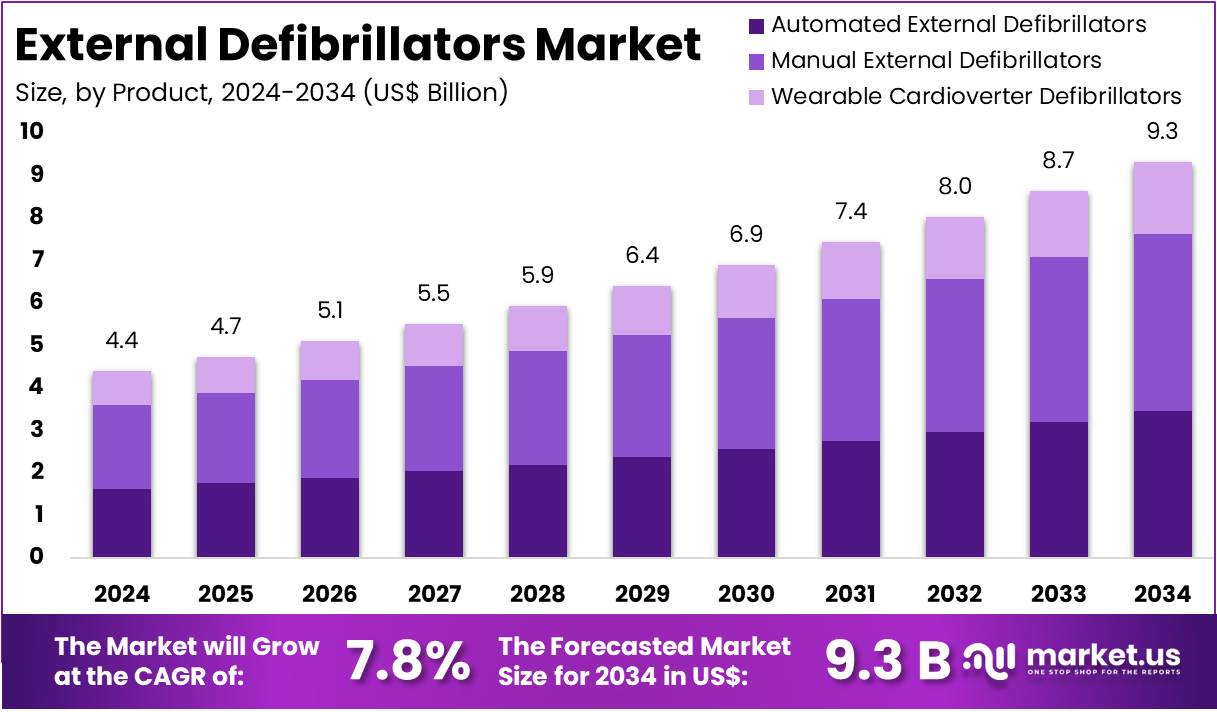
Key Takeaways
- The global external defibrillators market is expected to increase from US$ 4.4 billion in 2024 to US$ 9.3 billion by 2034, expanding at a CAGR of 7.8% during 2025–2034 due to rising demand for advanced cardiac emergency care technologies.
- Manual external defibrillators dominated the product segment in 2024, accounting for more than 44.8% of the market share, driven by widespread utilization in hospitals, emergency departments, and critical care settings.
- The adult patient segment held the largest market position in 2024, capturing over 47.3% share, attributed to the higher prevalence of cardiovascular emergencies and sudden cardiac arrest cases among adults.
- Hospitals and cardiac centers represented the leading end-user segment in 2024, securing more than 26.5% market share due to their advanced diagnostic, treatment, and emergency response capabilities.
- North America dominated the global external defibrillators market in 2024 with a 39.6% market share, valued at approximately US$ 1.7 billion, supported by developed healthcare infrastructure, strong adoption of AED programs, and favorable regulatory initiatives.
Statistical Information
- Rising Adoption of External Defibrillators Due to Cardiovascular Disease Burden: Cardiovascular disease (CVD) remains the leading cause of death globally, creating strong demand for emergency cardiac care devices such as external defibrillators. According to the World Health Organization (WHO), CVD caused approximately 17.9 million deaths annually in 2019, representing 32% of all global deaths. WHO reported that cardiovascular deaths increased to around 19.8 million in 2022, with 85% of CVD deaths linked to heart attacks and strokes, highlighting the need for rapid rhythm restoration technologies.
- Increasing Demand for AEDs Due to Out-of-Hospital Cardiac Arrest (OHCA): Out-of-hospital cardiac arrest continues to create significant demand for public-access defibrillation programs. According to the American Heart Association (AHA), more than 356,000 people experience EMS-assessed OHCA annually in the United States, including approximately 90% occurring outside hospitals. Survival remains highly dependent on early intervention, making AED availability in public areas increasingly important.
- Low Pre-Hospital AED Shock Rates Highlight Growth Opportunity: Despite the benefits of early defibrillation, AED utilization before emergency medical service arrival remains limited. Data from the Cardiac Arrest Registry to Enhance Survival (CARES) program reported that only around 3.7% of OHCA patients received an AED shock before EMS arrival, while bystander CPR was performed in approximately 43.8% of cases. These gaps indicate continued need for wider AED placement and public training programs.
- Sudden Cardiac Arrest Remains a Major Cause of Emergency Deaths: Sudden cardiac arrest (SCA) continues to be a critical healthcare challenge, increasing the need for rapid defibrillation solutions. According to the American Heart Association (AHA), sudden cardiac arrest affects more than 356,000 people annually in the United States, and approximately 90% of individuals who experience cardiac arrest outside hospitals do not survive. Early AED availability remains one of the most important factors for improving survival.
- Growing Aging Population Increases Cardiac Emergency Risk: Population aging is increasing the number of people vulnerable to cardiovascular emergencies. According to the United Nations Department of Economic and Social Affairs (UN DESA), the global population aged 65 years and older reached approximately 761 million in 2021 and is projected to rise significantly in coming decades. Older adults have higher risks of coronary artery disease and sudden cardiac events, supporting demand for emergency cardiac equipment.
- High Annual Sudden Cardiac Arrest Cases Increase AED Demand: Sudden cardiac arrest continues to create a significant requirement for external defibrillators across healthcare and public environments. According to the American Heart Association (AHA), more than 356,000 out-of-hospital cardiac arrests (OHCA) occur annually in the United States. Approximately 90% of OHCA cases are fatal, mainly due to delayed access to CPR and defibrillation. Increasing AED availability in public locations is considered essential for improving survival outcomes.
- Aging Population Creates Higher Risk of Cardiac Emergencies: Population aging is increasing the number of individuals at risk for cardiovascular events. According to the United Nations, the global population aged 65 years and above reached 761 million people in 2021 and is expected to exceed 1.6 billion by 2050. Older populations have higher risks of coronary artery disease, arrhythmias, and sudden cardiac events.
- Heart Disease Remains the Leading Cause of Death in the United States: The continued prevalence of heart disease supports long-term demand for emergency cardiac equipment. According to the CDC, heart disease caused approximately 702,880 deaths in the United States in 2022, representing about 1 in every 5 deaths. Coronary heart disease accounted for the largest share of these fatalities.
Regional Analysis
North America led the global market in 2024, holding a 39.6% share
North America leads the external defibrillators market due to a high cardiovascular disease burden, advanced emergency response infrastructure, and strong public-access defibrillation programs. According to the American Heart Association (AHA), more than 356,000 out-of-hospital cardiac arrests (OHCA) occur annually in the United States, highlighting the need for rapid AED availability. Early CPR and defibrillation programs continue to improve survival outcomes in communities. Regulatory support from the U.S. Food and Drug Administration (FDA) strengthens market adoption by ensuring AED safety, effectiveness, and quality standards.
The Cardiac Arrest Registry to Enhance Survival (CARES) tracks OHCA outcomes across regions, supporting improvements in emergency response planning and AED placement. Canada also contributes to regional growth, with approximately 45,000 sudden cardiac arrests reported annually. Government initiatives, workplace AED programs, CPR training, and community awareness campaigns are increasing device accessibility. Growing demand for replacement pads, batteries, and maintenance services further supports North America’s leadership in the external defibrillators market.
Emerging Trends
- Expansion of Public Access Defibrillation (PAD) Programs: Public-access AED programs are expanding as governments and healthcare organizations focus on reducing sudden cardiac arrest deaths outside hospitals. The U.S. experiences more than 356,000 OHCA cases annually, with 60%–80% dying before hospital arrival. Increased AED placement in airports, schools, and workplaces is becoming a key trend.
- Integration of Smart and Connected AED Technologies: Manufacturers are developing advanced AED systems with automated rhythm analysis, self-testing functions, connectivity, and remote monitoring capabilities. The FDA highlights that modern AEDs automatically analyze heart rhythm and deliver shocks when required. These improvements support better device readiness, maintenance tracking, and faster emergency response.
- Growing Focus on Faster Emergency Response Systems: Reducing the time between cardiac arrest and defibrillation is becoming a major priority. The American Heart Association emphasizes that early AED application improves survival outcomes, leading to increased adoption of community responder networks and strategically placed AED stations. Public-access defibrillation programs aim to reduce delays before EMS arrival.
- Increasing AED Training and Awareness Programs: Community CPR and AED training programs are expanding to improve bystander response. According to Healthy People 2030 data, bystander AED use in public cardiac arrests increased to 12.6% in 2024, compared with a 9.0% baseline in 2020. Higher awareness is encouraging AED adoption in workplaces, schools, and public facilities.
- Growth of Regulatory Compliance and Device Safety Monitoring: Regulatory authorities are strengthening AED quality requirements to improve reliability and patient safety. The U.S. FDA classifies AED systems under medical device regulations and monitors product performance through post-market reporting. In FDA records, AED-related device monitoring includes thousands of reported events annually, supporting continuous improvements in design and maintenance.
Use Cases
- Hospitals and Emergency Care Centers: Hospitals remain a major application area for professional defibrillators due to their use in emergency departments, intensive care units, and cardiac care units. Advanced cardiac life support guidelines recommend immediate defibrillation for shockable rhythms such as ventricular fibrillation and pulseless ventricular tachycardia, supporting continuous hospital demand.
- Airports and Transportation Facilities: Airports and transportation hubs are increasingly installing AEDs because of high passenger movement and the need for immediate emergency response. FDA recognizes public-access AED locations including airports, community centers, schools, and government buildings. Rapid availability helps provide treatment before emergency responders arrive.
- Workplace and Industrial Safety Applications: Workplaces are adopting AED programs as part of emergency preparedness strategies. Organizations with large employee populations, manufacturing facilities, offices, and industrial locations are increasing AED availability. OSHA supports workplace first-aid preparedness, including access to lifesaving emergency equipment during cardiac emergencies.
- Schools and Sports Facilities: Schools, universities, and sports centers are expanding AED deployment because physical activity can trigger sudden cardiac events. Public-access defibrillation programs supported by healthcare organizations encourage AED placement in high-risk community locations. Early AED availability combined with CPR can significantly improve survival chances after cardiac arrest.
- Community and Residential Emergency Response: Community-based AED networks are growing to address cardiac arrests occurring outside healthcare facilities. The CDC reports that more than 356,000 OHCA events occur annually in the U.S., creating demand for AED accessibility in neighborhoods and public areas. Mobile responder systems and AED location mapping are emerging solutions to reduce response delays.
Frequently Asked Questions on External Defibrillators
- What factors are driving the growth of the external defibrillators market?
The external defibrillators market is growing due to increasing cardiovascular disease cases, rising sudden cardiac arrest incidents, expansion of public-access AED programs, government safety initiatives, and growing awareness about CPR and early defibrillation benefits. - Why are automated external defibrillators (AEDs) increasingly adopted?
AEDs are increasingly adopted because they are portable, easy to operate, and designed for quick emergency response. Automated rhythm analysis, voice instructions, and safety features allow trained and untrained users to provide immediate assistance during cardiac emergencies. - How does cardiovascular disease impact the external defibrillators market?
Cardiovascular disease significantly supports market demand because it remains a leading cause of death worldwide. According to WHO, CVD caused approximately 19.8 million deaths in 2022, increasing the need for rapid cardiac emergency treatment solutions. - What regulations influence the external defibrillators market?
Regulatory bodies such as the U.S. FDA establish safety, effectiveness, and quality requirements for AED devices and accessories. These regulations ensure reliable performance, encourage innovation, and support replacement demand through maintenance and compliance requirements. - Why is North America a leading region in the external defibrillators market?
North America leads due to advanced healthcare infrastructure, strong emergency response systems, regulatory support, and widespread AED programs. The United States experiences more than 356,000 out-of-hospital cardiac arrests annually, creating significant demand for defibrillation devices. - How do public-access AED programs support market growth?
Public-access AED programs increase device availability in locations where cardiac emergencies may occur. These initiatives promote AED installation, CPR training, and emergency preparedness, helping reduce response time and improve survival before emergency medical teams arrive. - What challenges affect external defibrillator adoption?
Major challenges include high initial equipment costs, maintenance requirements, limited public awareness, and insufficient training. However, government programs, healthcare campaigns, and simplified AED designs are helping overcome these barriers and improve accessibility. - Why are AED accessories important for market growth?
AED accessories such as electrode pads, batteries, and replacement components create recurring demand because they require regular replacement. Maintenance guidelines from regulatory agencies encourage organizations to keep devices ready for emergency use.
Conclusion
The external defibrillators market is witnessing steady growth due to the rising burden of cardiovascular diseases, increasing sudden cardiac arrest cases, and growing awareness of early defibrillation benefits. Expansion of public-access AED programs, supportive government regulations, and improvements in device technology are strengthening adoption across hospitals, workplaces, schools, and public locations.
North America continues to lead due to advanced healthcare infrastructure and strong emergency response systems. Increasing focus on CPR training, connected AED solutions, and regular device maintenance is expected to support future market expansion. Overall, external defibrillators remain critical tools for improving survival outcomes during cardiac emergencies.
Discuss your needs with our analyst
Please share your requirements with more details so our analyst can check if they can solve your problem(s)




