


Overview
New York, NY – Aug 11, 2026 – The Global Bioinformatics Market size is expected to be worth around US$ 55 Billion by 2034, from US$ 17.1 Billion in 2024, growing at a CAGR of 12.4% during the forecast period from 2025 to 2034. North America held a dominant market position, capturing more than a 40.2% share and a US$ 6.9 Billion market value for the year.
Bioinformatics is transforming biological research by integrating biology, computer science, mathematics, and data analytics to process complex genomic, proteomic, and molecular datasets. The field supports applications such as precision medicine, drug discovery, clinical diagnostics, agricultural genomics, and pathogen surveillance. The rapid adoption of next-generation sequencing (NGS), artificial intelligence (AI), machine learning, and cloud-based computing has expanded the ability to analyze large-scale biological information efficiently.
The bioinformatics market is experiencing strong growth due to increasing genomic research activities, rising demand for personalized healthcare, and expansion of molecular diagnostics. Global genomic initiatives have accelerated adoption, with the World Health Organization’s Global Genomic Surveillance Strategy targeting improved sequencing access and data-sharing capabilities across all 194 member states by 2032. As of January 2022, 68% of countries had established pathogen genomic surveillance capacity, compared with 54% in March 2021, highlighting rapid infrastructure development.
The increasing availability of genomic data is creating demand for advanced bioinformatics platforms. By 2023, more than 14 million SARS-CoV-2 whole-genome sequences had been deposited in global databases, requiring sophisticated analysis tools for variant identification and surveillance. In clinical genomics, England’s NHS Genomic Medicine Service performs over 680,000 genomic tests annually across cancer, rare diseases, and inherited disorders.
Declining sequencing costs, growing investments in computational biology, and government-supported genomic programs are driving long-term market expansion. The integration of secure data platforms, automated analytics, and AI-based interpretation tools is expected to further strengthen bioinformatics adoption across healthcare, research, and biotechnology industries worldwide.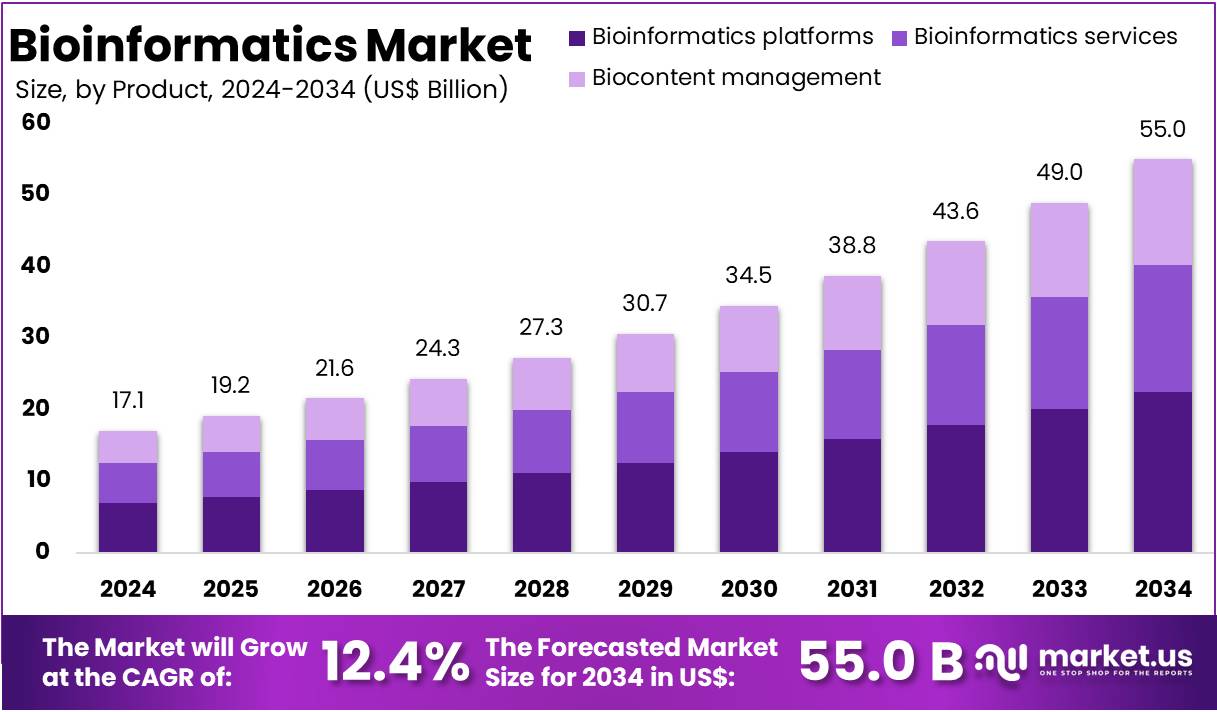
Key Takeaways
- The global bioinformatics market is expected to reach US$ 55 billion by 2034, expanding from US$ 17.1 billion in 2024 at a CAGR of 12.4%.
- In 2024, Bioinformatics Platforms dominated the product segment, accounting for more than 41% of the global market share.
- The Genomics segment led the application segment in 2024, capturing over 32.7% of the total bioinformatics market share.
- Pharmaceutical and Biotechnology Companies represented the largest end-user segment in 2024, holding a 41.8% market share.
- North America held a leading position in the global bioinformatics market in 2024, contributing more than 40.2% of the market share, with a market value of US$ 6.9 billion.
Statistical Information
- Expansion of Genomics Research Increasing Demand for Bioinformatics Platforms: Large-scale genomic research programs are generating massive biological datasets and increasing demand for bioinformatics platforms, cloud-based analysis, and computational pipelines. The NIH All of Us Research Program has made genomic and health data from more than 747,000 participants available for research, including over 535,000 whole-genome sequences, nearly 482,000 electronic health records, and more than 1.3 billion genetic variants, creating significant requirements for advanced bioinformatics solutions.
- Declining DNA Sequencing Costs Supporting Bioinformatics Adoption: The reduction in genome sequencing costs has accelerated the use of sequencing technologies across research and healthcare, increasing the need for data processing and interpretation software. According to the National Human Genome Research Institute (NHGRI), the cost of sequencing a human genome decreased from approximately US$95 million in 2001 to around US$500 in recent years, enabling broader adoption of genomic analysis workflows.
- North America Leadership Supported by Genomic Research Infrastructure: North America’s strong position in bioinformatics adoption is supported by government-funded genomic programs, advanced healthcare infrastructure, and biotechnology innovation. The NIH All of Us program alone has collected data from more than 747,000 participants, including 535,000+ whole-genome sequences, creating one of the largest integrated genomic and electronic health record datasets for biomedical research.
- Genetic Variant Discovery Increasing Bioinformatics Interpretation Requirements: The expansion of population-scale sequencing programs is increasing the need for automated genetic variant annotation and interpretation platforms. NIH-supported genomic research involving approximately 250,000 participants identified around 1 billion genetic variants, including more than 275 million previously unidentified variants, demonstrating the growing requirement for computational variant analysis solutions.
- Antimicrobial Resistance Surveillance Driving Genomic Data Analysis: Genomic surveillance of antimicrobial resistance is increasing the need for bioinformatics tools capable of detecting resistance genes and tracking transmission patterns. The U.S. CDC estimates that antimicrobial-resistant infections cause more than 2.8 million infections and over 35,000 deaths annually in the United States, increasing demand for genomic monitoring approaches.
- Human Genome Project Creating Foundation for Modern Bioinformatics: The Human Genome Project established the foundation for modern computational genomics by producing a reference sequence covering approximately 92% of the human genome initially in 2003, later improved to a nearly complete reference genome containing around 3.05 billion base pairs. This genomic resource continues to support bioinformatics research, disease analysis, and drug discovery.
- Rare Disease Genomics Creating Demand for Variant Interpretation Tools: Rare disease research is increasing reliance on bioinformatics systems for identifying disease-causing genetic variants. The National Institutes of Health estimates that there are approximately 7,000 rare diseases affecting 25–30 million people in the United States, with many requiring genomic sequencing and computational interpretation for diagnosis.
- Cancer Genomic Data Growth Supporting Bioinformatics Infrastructure: Cancer genomics is generating large datasets that require advanced computational analysis. The National Cancer Institute’s Genomic Data Commons contains genomic and clinical information from more than 85 cancer studies, representing data from over 40,000 patients and approximately 2.5 petabytes of genomic data.
- NIH Precision Medicine Database Expansion Increasing Bioinformatics Demand: The expansion of the NIH All of Us Research Program is creating one of the largest integrated genomic and healthcare datasets, increasing demand for cloud-based bioinformatics platforms and advanced analytics. The program now provides researchers access to data from more than 747,000 participants, including over 535,000 whole genome sequences, nearly 482,000 electronic health records, and more than 1.3 billion genetic variants for precision medicine research.
Regional Analysis
North America maintained a dominant position in the market, capturing more than 40.2%
North America maintains a leading position in the bioinformatics market due to strong genomic research infrastructure, government-supported precision medicine programs, and advanced biotechnology capabilities. The United States has become a major hub for genomic innovation through initiatives such as the NIH All of Us Research Program, which has collected health and genomic data from more than 747,000 participants, supporting large-scale computational biology research.
The region also benefits from advanced sequencing adoption, with organizations such as NIH, CDC, and FDA supporting genomic research, pathogen surveillance, and clinical applications. The increasing use of artificial intelligence, cloud computing, and next-generation sequencing is strengthening bioinformatics adoption across healthcare and life sciences.
North America’s pharmaceutical and biotechnology ecosystem, including companies involved in sequencing, molecular diagnostics, and data analytics, continues to drive innovation. Growing demand for personalized medicine, cancer genomics, and rare disease testing is further expanding the need for bioinformatics platforms and analytical solutions across the region.
Emerging Trends
- Artificial Intelligence and Machine Learning Integration: AI and machine learning are transforming bioinformatics by improving genomic analysis, disease prediction, and drug discovery. NIH-supported data science initiatives use advanced computational models to analyze large biological datasets containing billions of genetic and molecular data points.
- Multi-Omics Data Integration for Precision Medicine: Integration of genomics, transcriptomics, proteomics, and metabolomics is becoming a major trend. NIH’s All of Us Research Program provides access to genomic and health data from more than 747,000 participants, supporting personalized healthcare research.
- Cloud-Based Bioinformatics Platforms: Cloud computing is expanding bioinformatics capabilities by enabling secure storage and analysis of large sequencing datasets. NIH-supported programs use cloud infrastructure to manage genomic information, electronic health records, and research datasets at population scale.
- Genomic Surveillance for Infectious Diseases: Bioinformatics is increasingly used for pathogen identification, mutation tracking, and outbreak monitoring. WHO’s Global Genomic Surveillance Strategy aims to strengthen genomic sequencing and data-sharing capabilities across 194 Member States by 2032.
- Cancer Genomics and Precision Oncology: Bioinformatics is becoming essential in cancer research by analyzing tumor mutations and biomarkers. The National Cancer Institute’s genomic programs use computational tools to study data from more than 40,000 cancer patients for targeted treatment development.
- AI-Based Protein Structure Prediction: Artificial intelligence is accelerating protein research and drug discovery. The AlphaFold database provides predicted structures for more than 200 million proteins, helping scientists understand molecular functions and identify potential therapeutic targets.
Use Cases
- Drug Discovery and Development: Bioinformatics is widely used by pharmaceutical companies to identify drug targets, analyze molecular interactions, and predict therapeutic effectiveness. Computational tools help researchers process genomic and protein data, reducing development time and improving precision in early-stage drug discovery.
- Precision Medicine and Personalized Treatment: Bioinformatics enables healthcare providers to analyze patient-specific genetic information and develop personalized treatment strategies. NIH’s All of Us Research Program uses genomic and health data from more than 747,000 participants to support precision medicine research.
- Cancer Genomic Profiling: Bioinformatics supports cancer diagnosis and targeted therapy by identifying mutations, biomarkers, and molecular pathways. The National Cancer Institute uses genomic analysis platforms to study cancer datasets from more than 40,000 patients for improving treatment strategies.
- Clinical Genetic Testing and Diagnosis: Bioinformatics platforms analyze sequencing data to identify disease-causing genetic variants in inherited disorders, rare diseases, and neurological conditions. These tools improve diagnostic accuracy by converting complex genomic data into clinically meaningful information.
- Pathogen Identification and Disease Surveillance: Bioinformatics is used in public health laboratories to analyze pathogen genomes, detect mutations, and monitor infectious disease outbreaks. CDC’s Advanced Molecular Detection program combines genomic sequencing with computational analysis for faster pathogen tracking.
- Antimicrobial Resistance Detection: Bioinformatics helps identify antibiotic resistance genes and track the spread of resistant pathogens. Genomic surveillance programs use computational analysis to understand bacterial evolution and support strategies against antimicrobial-resistant infections
Frequently Asked Questions on Bioinformatics
- What are the major applications of the bioinformatics market?
Major applications of bioinformatics include genomics, proteomics, drug discovery, clinical diagnostics, personalized medicine, agricultural biotechnology, microbiology, and environmental research. These applications use computational platforms to analyze biological datasets and support scientific and healthcare advancements. - How is artificial intelligence influencing the bioinformatics market?
Artificial intelligence is improving bioinformatics through faster genomic analysis, protein prediction, automated interpretation, and drug discovery applications. AI algorithms process large biological datasets, identify complex patterns, and support researchers in developing improved diagnostic and therapeutic solutions. - Which segment dominates the bioinformatics market?
Bioinformatics platforms represent a leading segment due to increasing demand for genomic data management, analytical software, and computational tools. These platforms help researchers, hospitals, and biotechnology companies process complex biological datasets generated through sequencing technologies. - Why is genomics a major application area in bioinformatics?
Genomics is a major application because it provides insights into genetic variations, disease mechanisms, and biological functions. Bioinformatics tools analyze genomic sequences to support medical research, diagnostics, drug development, and precision medicine applications. - How is bioinformatics used in drug discovery?
Bioinformatics accelerates drug discovery by identifying molecular targets, analyzing biological pathways, predicting drug interactions, and supporting biomarker discovery. Computational approaches help pharmaceutical companies improve research efficiency and develop targeted therapies. - Why is North America leading the bioinformatics market?
North America leads due to advanced research infrastructure, strong biotechnology companies, government funding, and widespread adoption of genomic technologies. Organizations such as NIH, CDC, and FDA support precision medicine, genomic research, and disease surveillance programs. - How is bioinformatics used by pharmaceutical and biotechnology companies?
Pharmaceutical and biotechnology companies use bioinformatics for drug discovery, molecular analysis, biomarker identification, clinical research, and therapeutic development. Computational biology helps improve research efficiency and supports development of advanced medicines.
Conclusion
The bioinformatics market is experiencing significant growth due to rising genomic research, increasing adoption of precision medicine, advancements in artificial intelligence, and expanding next-generation sequencing applications. The integration of computational tools with biological data is transforming healthcare, drug discovery, diagnostics, and research activities.
Government-supported genomic initiatives, cloud-based platforms, and growing biotechnology investments are further strengthening market development. North America remains a key region due to its advanced infrastructure and innovation ecosystem. With increasing demand for personalized healthcare and large-scale biological data analysis, bioinformatics will continue to play a crucial role in future medical and scientific advancements.
Discuss your needs with our analyst
Please share your requirements with more details so our analyst can check if they can solve your problem(s)




