


Overview
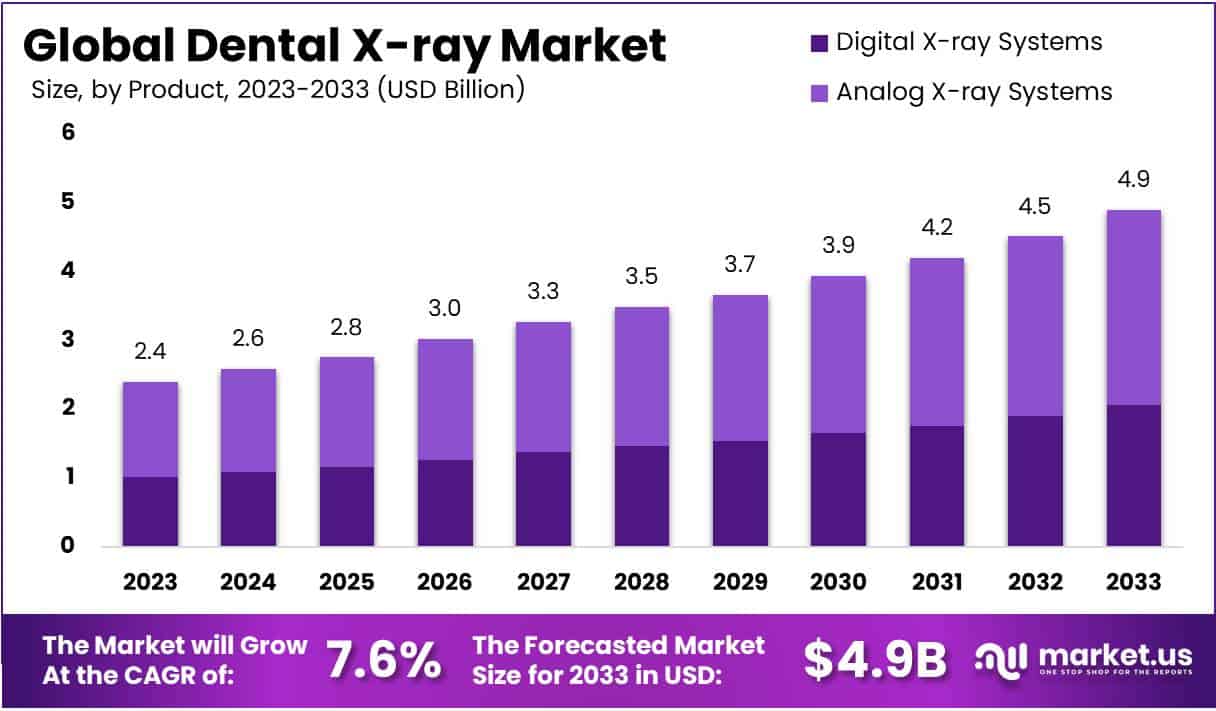
New York, NY – July 20, 2026 – The Dental X-Rays Market Size is projected to grow from USD 2.4 Billion in 2023 to approximately USD 4.9 Billion by 2033. This growth represents a compound annual growth rate (CAGR) of about 7.6% over the ten-year period from 2024 to 2033.
Dental X-rays are essential diagnostic imaging tools used by dental professionals to evaluate oral health and detect conditions that may not be visible during a routine clinical examination. These images provide detailed views of the teeth, jawbone, tooth roots, and surrounding tissues, enabling the early identification of cavities, gum disease, bone loss, impacted teeth, infections, and other oral abnormalities. Early diagnosis through dental X-rays supports timely treatment, helping to prevent complications and reduce long-term healthcare costs.
Modern dental X-ray systems have advanced significantly with the adoption of digital imaging technologies. Digital dental X-rays produce high-quality images within seconds while exposing patients to substantially lower levels of radiation compared to many conventional film-based systems. The digital format also improves image storage, sharing, and analysis, supporting efficient clinical workflows and enhanced patient communication.
Dental X-rays are commonly categorized into intraoral and extraoral imaging. Intraoral X-rays, such as bitewing, periapical, and occlusal images, focus on detailed views of individual teeth and surrounding structures. Extraoral X-rays, including panoramic and cephalometric images, provide broader views of the jaws, facial bones, and overall oral anatomy, making them valuable for orthodontic planning, oral surgery, and complex dental assessments.
As preventive dentistry and digital healthcare continue to expand, dental X-rays remain a cornerstone of accurate diagnosis, personalized treatment planning, and improved patient outcomes across general and specialized dental care.
Key Takeaways
- Market Growth: The Dental X-ray market is projected to expand from USD 2.4 billion in 2023 to USD 4.9 billion by 2033, registering a CAGR of 7.6% during the 2024–2033 forecast period.
- Product Analysis: Analog X-ray Systems accounted for over 58% of the market share in 2023, while Digital X-ray Systems are anticipated to witness robust growth due to ongoing technological advancements and increasing adoption of digital sensors.
- Type Analysis: The Intraoral X-rays segment led the market in 2023, securing more than 54% of the total market share.
- Application Analysis: The Medical Diagnostics segment dominated in 2023, holding over 62.1% of the market share, reflecting the critical role of dental X-rays in oral disease diagnosis.
- End-User Analysis: Dental Hospitals & Clinics emerged as the leading end-user segment in 2023, accounting for more than 39.7% of the market share due to the widespread adoption of dental X-ray technologies in clinical practice.
- Regional Analysis: North America remained the largest regional market in 2023, capturing 37% of the global market and generating approximately USD 0.8 billion in revenue, supported by advanced diagnostic infrastructure and a strong focus on preventive healthcare.
Regional Analysis
In 2023, North America accounted for more than 37% of the global Dental X-ray market, generating approximately USD 0.8 billion in revenue. The region’s leading position is supported by its advanced healthcare infrastructure, widespread adoption of modern dental imaging technologies, and strong emphasis on preventive oral healthcare.
The United States and Canada have a high concentration of dental clinics and hospitals equipped with advanced diagnostic systems, driving the demand for dental X-ray solutions. Rising awareness of oral health, increasing prevalence of dental disorders, and favorable healthcare spending further contribute to market growth. The presence of leading dental X-ray manufacturers, well-established distribution networks, and continuous product innovations strengthens the regional market.
In addition, stringent regulatory standards and quality compliance requirements encourage the adoption of safe and reliable imaging technologies across healthcare facilities. Looking ahead, ongoing technological advancements, increasing investments in healthcare infrastructure, and the growing focus on early disease detection are expected to support sustained market expansion across North America.
Emerging Trends
- Cone Beam Computed Tomography (CBCT): Cone Beam Computed Tomography (CBCT) is gaining widespread adoption in dental diagnostics by providing high-resolution three-dimensional images of teeth, jaws, and surrounding tissues. It supports accurate implant planning, orthodontics, and endodontics, improving diagnostic precision, treatment outcomes, and patient safety while minimizing procedural complications.
- Artificial Intelligence (AI) Integration: Artificial intelligence is transforming dental imaging through automated analysis of dental X-rays and enhanced diagnostic support. AI-powered platforms detect cavities, bone loss, and nerve exposure with greater accuracy, streamline clinical workflows, improve treatment planning, and strengthen communication between dentists and patients through visual insights.
- Digital Imaging: Digital imaging is replacing conventional film-based dental X-rays due to its faster image acquisition, lower radiation exposure, and improved image quality. It simplifies storage, retrieval, and sharing of patient records, enhances collaboration among dental professionals, and supports efficient diagnosis and comprehensive treatment planning.
Use Cases
- Diagnosis of Dental Conditions: Dental X-rays enable early detection of oral conditions that are difficult to identify through visual examination alone. They reveal hidden cavities, jawbone infections, impacted teeth, and other abnormalities, allowing dentists to provide timely treatment, prevent disease progression, and improve long-term oral health outcomes.
- Treatment Planning for Dental Implants: CBCT imaging plays a critical role in dental implant planning by generating detailed three-dimensional views of jawbone structure and density. It helps identify nerves, sinuses, and other anatomical landmarks, ensuring accurate implant placement, reducing surgical risks, and improving long-term implant success rates.
- Orthodontic Assessments: Dental X-rays support orthodontic evaluations by providing detailed information about tooth positioning, jaw alignment, and bone development. Orthodontists use these images to design personalized treatment plans, monitor progress, anticipate complications, and improve the effectiveness of braces, aligners, and other corrective procedures.
- Detection of Carotid Artery Calcifications: Panoramic dental X-rays can identify carotid artery calcifications that may indicate an increased risk of stroke or cardiovascular disease. Early detection enables dentists to refer patients for medical evaluation, supporting timely intervention, preventive healthcare measures, and improved long-term cardiovascular health management.
Frequently Asked Questions on Dental X-Rays
- Why are Dental X-rays important?
Dental X-rays are essential for the early detection of oral health problems, enabling timely diagnosis and treatment planning. They support preventive dental care by revealing hidden conditions, monitoring disease progression, and helping dentists evaluate the success of treatments while improving overall patient outcomes. - What are the different types of Dental X-rays?
Dental X-rays are broadly classified into intraoral and extraoral imaging techniques. Intraoral X-rays provide detailed images of individual teeth and surrounding tissues, while extraoral X-rays capture larger areas of the jaw, skull, and facial structures for orthodontic and surgical assessments. - Are Dental X-rays safe?
Dental X-rays are considered safe because they use very low doses of radiation. Modern digital X-ray systems further reduce radiation exposure while producing high-quality images. Protective measures such as lead aprons and thyroid collars are commonly used to enhance patient safety during imaging procedures. - What factors are driving the growth of the Dental X-rays Market?
The market is expanding due to rising cases of dental disorders, increasing awareness of oral health, growing adoption of digital imaging systems, technological innovations, and expanding access to dental care. Supportive healthcare investments and demand for minimally invasive diagnostic solutions further accelerate market growth. - Which region leads the Dental X-rays Market?
North America currently leads the Dental X-rays Market due to its advanced healthcare infrastructure, widespread adoption of digital dental technologies, high dental care expenditure, and strong presence of leading market participants. Increasing emphasis on preventive dentistry also supports the region’s market leadership. - Which product segment dominates the Dental X-rays Market?
Analog X-ray systems accounted for the largest market share in 2023 due to their widespread use and affordability. However, digital X-ray systems are expected to register faster growth during the forecast period because of superior image quality, lower radiation exposure, and improved workflow efficiency. - What is the future outlook for the Dental X-rays Market?
The Dental X-rays Market is expected to witness steady growth over the coming years, supported by continuous technological advancements, increasing adoption of digital and AI-enabled imaging solutions, rising oral healthcare awareness, and growing demand for early diagnosis and preventive dental care across global markets.
Conclusion
The Dental X-rays Market is expected to witness steady growth, driven by the increasing prevalence of oral diseases, growing awareness of preventive dental care, and continuous advancements in digital imaging technologies. The integration of artificial intelligence and Cone Beam Computed Tomography (CBCT) is improving diagnostic accuracy, treatment planning, and clinical efficiency.
While analog systems continue to maintain a significant market presence, digital X-ray solutions are gaining momentum due to their lower radiation exposure and superior image quality. North America remains the leading regional market, supported by advanced healthcare infrastructure. Overall, technological innovation and expanding access to quality dental care will continue to support long-term market growth.
Discuss your needs with our analyst
Please share your requirements with more details so our analyst can check if they can solve your problem(s)




