


Overview
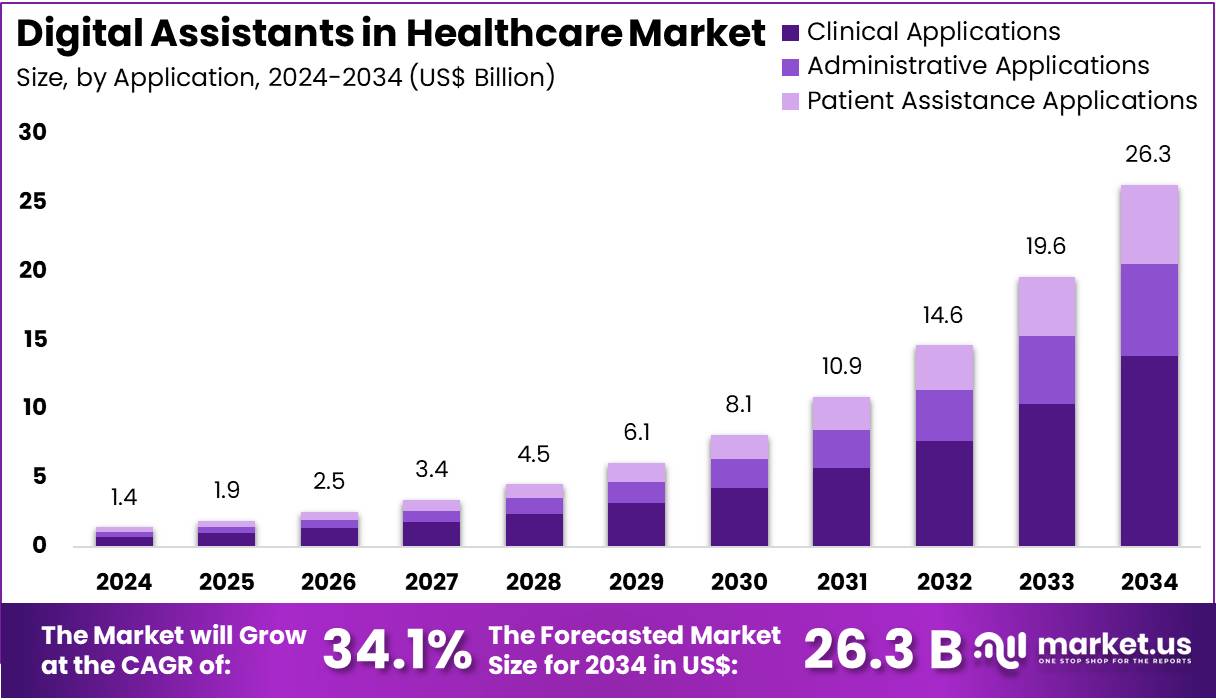
New York, NY – May 13, 2026 –The Global Digital Assistants in Healthcare Market size is expected to be worth around US$ 26.3 Billion by 2034, from US$ 1.4 Billion in 2024, growing at a CAGR of 34.1% during the forecast period from 2025 to 2034. North America held a dominant market position, capturing more than a 42.2% share and holds US$ 0.6 Billion market value for the year.
The global market for digital assistants in healthcare is experiencing steady growth, driven by the increasing adoption of artificial intelligence (AI), voice-enabled technologies, and automation across healthcare systems. Digital healthcare assistants are software-based solutions designed to support patients, healthcare professionals, and administrative staff through functions such as appointment scheduling, symptom assessment, medication reminders, patient engagement, and clinical documentation.
The growing demand for improved patient experience and operational efficiency has accelerated the deployment of virtual health assistants in hospitals, clinics, and home healthcare settings. The integration of natural language processing (NLP), machine learning, and cloud-based platforms has further enhanced the capabilities of digital assistants, enabling real-time communication and personalized healthcare support.
Rising healthcare costs, increasing patient volumes, and the shortage of healthcare professionals are key factors supporting market expansion. In addition, the growing penetration of smartphones, telehealth platforms, and connected healthcare devices is creating favorable opportunities for technology providers in this sector.
North America currently holds a significant share of the market due to strong healthcare infrastructure and early adoption of AI technologies. Meanwhile, Asia-Pacific is expected to witness notable growth owing to expanding digital healthcare initiatives and increasing investments in healthcare IT infrastructure.
Major companies operating in the market are focusing on product innovation, strategic partnerships, and AI integration to strengthen their competitive position and expand their global presence.
Key Takeaways
- In 2024, the global Digital Assistants in Healthcare market was valued at US$ 1.4 billion and is projected to reach US$ 26.3 billion by 2034, expanding at a CAGR of 34.1% during the forecast period.
- Based on product type, the market is categorized into AI-based digital assistants and non-AI-based digital assistants. Among these, AI-based digital assistants dominated the market in 2024, accounting for a revenue share of 61.3%.
- By application, the clinical applications segment emerged as the leading category, capturing 52.7% of the total market revenue in 2024.
- In terms of end users, the market is segmented into hospitals & healthcare providers, patients, and healthcare staff. The hospitals & healthcare providers segment held the largest market share of 49.3% in 2024.
- North America dominated the global Digital Assistants in Healthcare market in 2024, securing a revenue share of 42.2%.
Regional Analysis
North America accounted for the largest share of the Digital Assistants in Healthcare Market, representing 42.2% of total revenue. The regional market growth has been driven by the rapid adoption of artificial intelligence (AI) technologies, increasing demand for efficient patient management systems, and the expanding use of telehealth services. According to the Centers for Disease Control and Prevention (CDC), telehealth usage in the United States increased by 38% in 2023 compared to 2022, with digital assistants significantly improving virtual consultation processes and patient communication.
Furthermore, the National Institutes of Health (NIH) invested approximately US$ 1.2 billion in 2023 to support AI-based healthcare innovations, including advanced digital assistant solutions for clinical and administrative applications. The integration of AI into electronic health records (EHRs) and the growing focus on personalized healthcare have further strengthened regional market expansion.
Meanwhile, the Asia Pacific region is projected to register the fastest CAGR during the forecast period. Market growth is being supported by rising investments in healthcare infrastructure modernization and increasing adoption of AI-enabled healthcare technologies. Governments across countries such as India and China are actively investing in intelligent healthcare systems to improve diagnostics, patient management, and telehealth services, thereby accelerating the adoption of digital assistants across the region.
Emerging Trends
- AI-Powered Virtual Assistants Are Gaining Ground: AI-powered virtual assistants are becoming widely adopted in healthcare for handling symptom checks, appointment scheduling, and patient queries. Improved understanding of medical language and patient intent enhances accuracy, reduces wait times, supports workflows, lowers operational costs, and enables more efficient healthcare service delivery.
- Integration With Electronic Health Records (EHR): Digital assistants are increasingly integrated with electronic health records, enabling healthcare providers to access patient histories, lab reports, and clinical information through voice or chat commands. This integration reduces documentation errors, improves workflow efficiency, supports faster decisions, and enhances real-time patient care management.
- Focus on Patient Engagement and Remote Care: Healthcare digital assistants are improving patient engagement by offering medication reminders, symptom tracking, and continuous health guidance. These tools support remote and post-hospital care, provide 24/7 assistance, reduce unnecessary visits, encourage treatment adherence, and promote proactive healthcare management from home environments.
- Growing Use of Multilingual and Localized Assistants: Healthcare providers are deploying multilingual and localized digital assistants to improve communication across diverse patient populations. These tools overcome language barriers, support culturally relevant healthcare interactions, expand digital health accessibility in urban and rural regions, and ensure more inclusive patient engagement and care delivery.
- Increasing Role in Mental Health Support: Digital assistants are increasingly supporting mental health management through mood tracking, stress guidance, wellness recommendations, and regular emotional check-ins. They provide accessible and private support, reduce stigma associated with therapy, offer continuous assistance, and connect users with professional counselors when necessary for advanced care.
- Privacy and Security Features Are Being Enhanced: Healthcare digital assistants are adopting stronger security measures such as encryption, secure authentication, and compliance with healthcare data regulations like HIPAA. Enhanced privacy protections build patient trust, encourage wider institutional adoption, safeguard sensitive medical information, and ensure secure use of digital healthcare technologies.
Use Cases
- Appointment Scheduling and Reminders: Digital assistants simplify appointment management by enabling patients to book, cancel, or reschedule visits through voice or text interactions. Automated reminders reduce missed appointments, improve attendance rates, decrease administrative workload, enhance operational efficiency, and provide a more convenient healthcare experience for patients and staff.
- Symptom Checking and Initial Triage: Digital assistants help patients describe symptoms and receive preliminary guidance before consulting healthcare professionals. These tools support initial triage by prioritizing urgent cases, reducing waiting times, improving clinic preparedness, enhancing early intervention, and streamlining patient flow without replacing professional medical evaluation or diagnosis.
- Medication Management: Healthcare digital assistants support medication adherence by sending reminders, explaining dosage instructions, and providing information on side effects or drug interactions. These features reduce missed doses, improve treatment compliance, support chronic disease management, minimize hospitalization risks, and simplify medication routines for patients and caregivers.
- Doctor’s Assistant for Note Taking: Digital assistants assist physicians by recording and transcribing patient conversations during consultations in real time. This reduces manual documentation tasks, improves accuracy of medical records, allows doctors to focus more on patient interaction, saves administrative time, and enhances overall clinical workflow efficiency and care quality.
- Answering Frequently Asked Questions (FAQs): Healthcare organizations use digital assistants and chatbots to answer common patient questions regarding services, visiting hours, insurance, and safety guidelines. Available 24/7, these tools provide instant responses, reduce pressure on support staff, improve communication efficiency, and enhance patient satisfaction through quick information access.
- Remote Monitoring and Alerts: Digital assistants enable remote patient monitoring by collecting health data from connected medical devices. They track indicators such as blood pressure or glucose levels, generate alerts for abnormalities, support early medical intervention, improve chronic disease management, and strengthen continuous healthcare support outside clinical settings.
Frequently Asked Questions on Digital Assistants in Healthcare
- How are digital assistants used in hospitals and clinics?
Hospitals and clinics use digital assistants to automate administrative tasks, manage patient inquiries, support appointment booking, and deliver medication reminders. These tools also assist healthcare professionals by reducing paperwork, improving workflow efficiency, and enhancing patient engagement during treatment processes. - What technologies support digital healthcare assistants?
Digital healthcare assistants are supported by technologies such as artificial intelligence, machine learning, natural language processing, and cloud computing. These technologies enable assistants to understand patient requests, analyze medical information, provide personalized responses, and improve operational efficiency within healthcare systems. - What are the major benefits of digital assistants in healthcare?
The major benefits of digital assistants include improved patient communication, reduced administrative workload, faster appointment management, and better healthcare accessibility. These solutions also support healthcare organizations in lowering operational costs while improving patient satisfaction and treatment coordination across facilities. - Which healthcare sectors are adopting digital assistants rapidly?
Healthcare sectors such as hospitals, clinics, telemedicine platforms, health insurance companies, and pharmaceutical organizations are adopting digital assistants rapidly. Increased digital transformation initiatives and rising demand for virtual healthcare services are supporting wider adoption across these sectors globally. - How does artificial intelligence improve digital healthcare assistants?
Artificial intelligence improves digital healthcare assistants by enabling accurate speech recognition, predictive analytics, and personalized patient interactions. AI-powered systems can analyze large healthcare datasets, provide faster responses, and support healthcare professionals in making informed treatment and operational decisions. - Which regions dominate the digital assistants in healthcare market?
North America currently dominates the market due to strong healthcare infrastructure, high technology adoption, and significant investments in artificial intelligence solutions. Europe and Asia-Pacific are also witnessing substantial growth supported by increasing healthcare digitalization and expanding telehealth services. - What role do digital assistants play in telemedicine services?
Digital assistants play an important role in telemedicine by helping patients schedule virtual consultations, receive health reminders, and access basic medical guidance remotely. These tools improve patient convenience while supporting healthcare providers in delivering efficient remote care services.
Conclusion
The global digital assistants in healthcare market is witnessing strong growth due to the rising adoption of artificial intelligence, telehealth services, and automated patient engagement solutions. Increasing demand for operational efficiency, personalized healthcare, and remote patient monitoring continues to accelerate market expansion across hospitals and healthcare systems.
AI-powered assistants are improving clinical workflows, enhancing patient communication, and reducing administrative burdens. North America remains the leading regional market, while Asia-Pacific is emerging as a high-growth region driven by healthcare digitalization initiatives. Continuous advancements in AI, multilingual capabilities, and data security are expected to further strengthen market adoption during the forecast period.
Discuss your needs with our analyst
Please share your requirements with more details so our analyst can check if they can solve your problem(s)




