


Overview
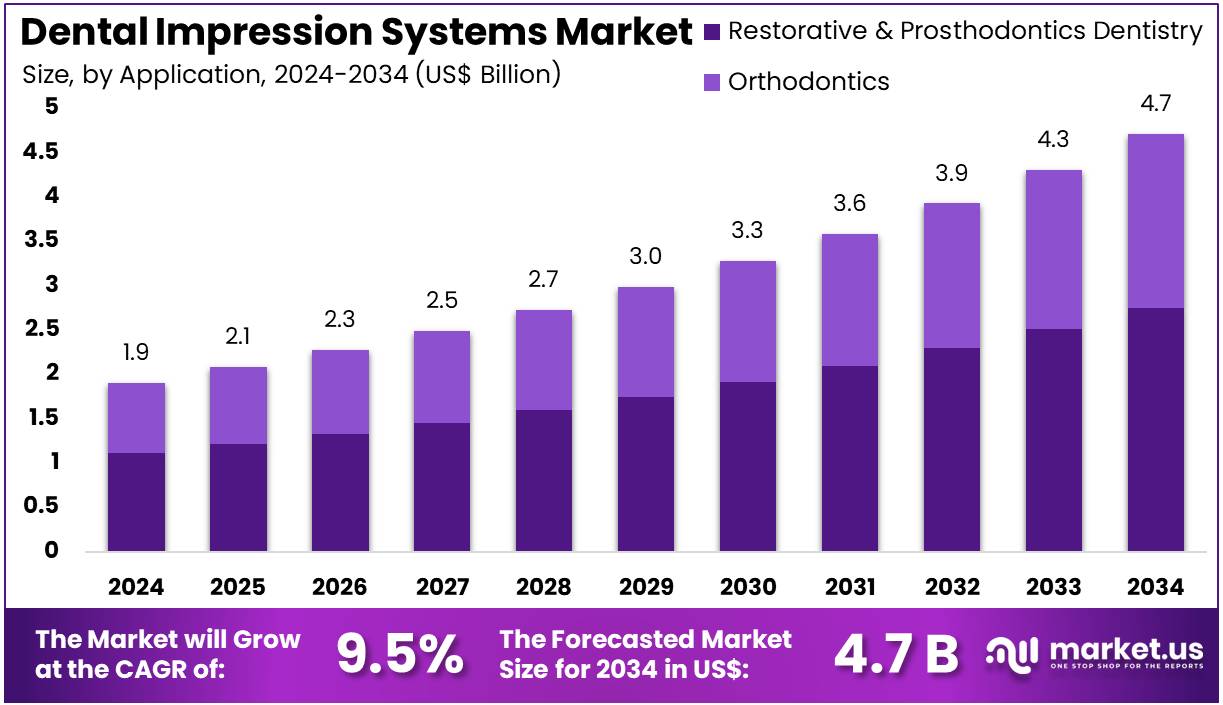
New York, NY – July 17, 2026 – The Global Dental Impression Systems Market Size is expected to be worth around US$ 4.7 Billion by 2034, from US$ 1.9 Billion in 2024, growing at a CAGR of 9.5% during the forecast period from 2025 to 2034. North America held a dominant market position, capturing more than a 39.7% share and holds US$ 0.8 Billion market value for the year.
Dental impression systems are essential tools used in dentistry to create accurate replicas of a patient’s teeth, gums, and surrounding oral structures. These impressions serve as the foundation for the fabrication of dental restorations such as crowns, bridges, dentures, veneers, implants, orthodontic aligners, and other prosthetic devices. The market includes both conventional impression systems, which use materials such as alginate, silicone, and polyether, and digital impression systems that utilize intraoral scanners to capture highly precise three-dimensional images.
The increasing adoption of digital dentistry, growing demand for cosmetic and restorative dental procedures, and continuous advancements in intraoral scanning technologies are supporting the growth of the dental impression systems market. Digital impression systems offer several advantages over conventional methods, including improved patient comfort, enhanced accuracy, reduced chair time, and streamlined communication between dental clinics and laboratories.
Hospitals, dental clinics, academic institutions, and dental laboratories are the primary end users of dental impression systems. North America and Europe represent established markets due to advanced healthcare infrastructure and widespread adoption of digital dental technologies, while the Asia-Pacific region is witnessing rapid growth driven by expanding access to dental care, increasing healthcare investments, and rising awareness of oral health. Ongoing technological innovation is expected to further improve workflow efficiency and support the continued evolution of modern dental practices.
Key Takeaways
- The global dental impression systems market was valued at US$ 1.9 billion in 2024 and is projected to reach US$ 4.7 billion by 2034, expanding at a CAGR of 9.5% during the forecast period.
- By product type, the market is segmented into impression materials, impression trays, intraoral scanners, and others. Among these, the impression materials segment dominated the market, accounting for 45.2% of the total market share.
- Based on application, the market is categorized into restorative & prosthodontics dentistry and orthodontics. The restorative & prosthodontics dentistry segment held the largest share, contributing 58.4% of the market.
- In terms of end user, the market is divided into hospitals, dental clinics, and others. The dental clinics segment emerged as the leading end user, capturing 56.3% of the overall market revenue.
- North America dominated the global dental impression systems market in 2024, accounting for a 39.7% market share.
Regional Analysis
North America led the dental impression systems market with a 39.7% revenue share, supported by its well-established dental infrastructure, widespread adoption of advanced digital technologies, and strong demand for preventive, restorative, and cosmetic dental procedures.
The United States remains the largest contributor, benefiting from an extensive network of dental clinics and hospitals, a high number of practicing dentists, and increasing adoption of intraoral scanners and digital impression systems that enhance treatment accuracy and workflow efficiency.
Asia Pacific is projected to register the fastest CAGR during the forecast period, driven by rising awareness of oral health, increasing demand for cosmetic dentistry, and a growing burden of dental disorders. Expanding healthcare investments, rapid adoption of digital dentistry, and favorable demographic trends are supporting regional growth.
Countries such as Japan are witnessing higher demand due to an aging population and widespread use of CAD/CAM technologies, while India is benefiting from expanding dental tourism, increasing dental infrastructure, and greater adoption of innovative dental impression solutions.
Emerging Trends
- Rapid Growth of Digital Intraoral Scanners: Digital intraoral scanners are becoming standard equipment in dental clinics worldwide. They support diagnosis, treatment planning, and patient communication while providing accurate, fast, and comfortable digital impressions. Growing adoption reflects their ability to improve clinical efficiency, decision-making, workflow integration, and overall patient experience.
- Integration with CAD/CAM and 3D Printing: Digital impressions seamlessly integrate with CAD/CAM and 3D printing technologies, enabling same-day production of crowns, bridges, and restorations. This reduces manual processes, improves restoration accuracy, shortens treatment timelines, lowers laboratory dependence, and enhances operational efficiency and patient satisfaction.
- Cloud-Based Workflows and Connectivity: Cloud-based dental platforms enable secure sharing of digital impressions, treatment plans, and patient records among clinics, laboratories, and specialists. These systems improve collaboration, streamline workflows, strengthen data management, support multi-location practices, and ensure reliable storage with enhanced accessibility.
- Adoption of AI-Assisted Tools: Artificial intelligence is increasingly integrated into digital impression systems to detect scanning errors, support diagnosis, and optimize treatment planning. AI improves clinical accuracy, reduces chair time, minimizes manual intervention, enhances decision-making, and drives greater efficiency across modern dental practices.
- Shift Toward Digital in Orthodontics: Orthodontic practices are increasingly replacing conventional impressions with digital scanning technologies for clear aligners, retainers, and customized appliances. Digital workflows improve treatment precision, accelerate production, simplify planning, and support personalized orthodontic care while reducing patient discomfort and manual procedures.
- Enhanced Patient Experience and Clinical Efficiency: Digital impression systems provide faster, cleaner, and more comfortable scanning experiences while eliminating conventional impression materials. They improve treatment accuracy, reduce appointment frequency, simplify communication with laboratories, minimize restoration remakes, and enhance productivity, patient satisfaction, and overall clinical performance.
Use Cases
- Restorative Dentistry (Crowns, Bridges, Veneers): Digital dental impressions create precise three-dimensional models for designing crowns, bridges, and veneers through CAD/CAM systems. The technology improves restoration accuracy, reduces fabrication time, minimizes manual adjustments, simplifies laboratory communication, and delivers faster, better-fitting prosthetic restorations for patients.
- Orthodontics (Clear Aligners, Retainers, Treatment Planning): Digital impressions enable accurate design of clear aligners, retainers, and orthodontic appliances while supporting detailed treatment planning. Three-dimensional models improve predictability, accelerate workflows, reduce conventional impressions, enhance patient comfort, and enable personalized orthodontic solutions with greater clinical efficiency.
- Implantology and Prosthodontics: Digital impressions improve implant planning by integrating with cone-beam computed tomography imaging to create accurate surgical guides and prosthetic components. These workflows enhance implant placement precision, improve prosthesis fit, reduce chair time, minimize adjustments, and increase treatment success and patient satisfaction.
- Prosthetic Dentures (Removable and Complete): Digital impression technology supports fabrication of removable and complete dentures by improving customization, reducing turnaround times, and simplifying record management. Combined with facial scanning or functional impression techniques, digital workflows enhance fit, patient comfort, long-term documentation, and future prosthetic adjustments.
- Diagnostics and Treatment Monitoring (Multi-disciplinary Use): Digital impressions provide detailed three-dimensional images for diagnosing dental conditions, monitoring treatment progress, and documenting clinical changes. They assist general dentistry, endodontics, and periodontics by improving visualization, supporting accurate planning, enabling comparisons over time, and enhancing multidisciplinary patient care.
- Patient Education and Engagement: Three-dimensional digital dental models improve patient understanding by visually explaining oral conditions and expected treatment outcomes. Enhanced visualization encourages informed decision-making, strengthens communication between dentists and patients, increases treatment acceptance, builds confidence, and promotes greater engagement throughout the care process.
- Efficiency, Sustainability, and Data Archiving: Digital impression systems improve operational efficiency by eliminating physical molds, reducing material waste, and enabling instant electronic file sharing. Digital records remain securely archived, easily accessible, and suitable for future reference, supporting sustainable, organized, and cost-effective dental practice management.
Frequently Asked Questions on Dental Impression Systems
- What are the main types of dental impression systems?
Dental impression systems are broadly classified into conventional and digital systems. Conventional systems use materials such as alginate, silicone, and polyether, while digital systems employ intraoral scanners to capture highly accurate three-dimensional images of the oral cavity. - What are the advantages of digital dental impression systems?
Digital dental impression systems improve accuracy, reduce chair time, enhance patient comfort, minimize the need for retakes, and enable seamless data sharing with dental laboratories. They also support faster workflows and improve the overall efficiency of restorative and orthodontic treatments. - Who are the primary end users of dental impression systems?
Dental impression systems are primarily used by dental clinics, hospitals, dental laboratories, and academic institutions. These facilities rely on accurate impressions for restorative, prosthodontic, orthodontic, and implant procedures, ensuring high-quality treatment outcomes and improved patient satisfaction. - Which dental procedures require impression systems?
Dental impression systems are commonly used for crowns, bridges, dentures, veneers, dental implants, orthodontic aligners, retainers, and other prosthetic restorations. Accurate impressions are essential for ensuring proper fit, function, aesthetics, and long-term treatment success. - What is driving the growth of the dental impression systems market?
The dental impression systems market is growing due to increasing adoption of digital dentistry, rising demand for cosmetic and restorative dental procedures, technological advancements in intraoral scanners, expanding oral healthcare awareness, and the growing prevalence of dental disorders worldwide. - Which product segment dominates the dental impression systems market?
The impression materials segment holds the largest share of the dental impression systems market. Its dominance is attributed to widespread use in routine dental procedures, cost-effectiveness, ease of application, and continued demand across both developed and emerging healthcare markets. - Which region leads the dental impression systems market?
North America is the leading regional market due to its advanced healthcare infrastructure, widespread adoption of digital dental technologies, strong presence of leading manufacturers, high dental care expenditure, and increasing demand for cosmetic and restorative dentistry services. - What is the future outlook for the dental impression systems market?
The dental impression systems market is expected to witness strong long-term growth, supported by continuous technological innovation, increasing use of digital workflows, expanding access to dental care, and growing investments in modern dental equipment across both developed and emerging economies.
Conclusion
The global dental impression systems market is positioned for sustained growth, driven by the rapid transition toward digital dentistry, continuous advancements in intraoral scanning technologies, and increasing demand for restorative, cosmetic, and orthodontic procedures. While conventional impression materials continue to hold a significant market share, digital systems are transforming clinical workflows through greater accuracy, efficiency, and patient comfort.
Rising healthcare investments, expanding dental infrastructure, and growing oral health awareness, particularly in emerging economies, are further supporting market expansion. As integration with CAD/CAM, 3D printing, artificial intelligence, and cloud-based platforms accelerates, dental impression systems will remain a critical component of modern, efficient, and patient-centered dental care.
Discuss your needs with our analyst
Please share your requirements with more details so our analyst can check if they can solve your problem(s)




