


Overview
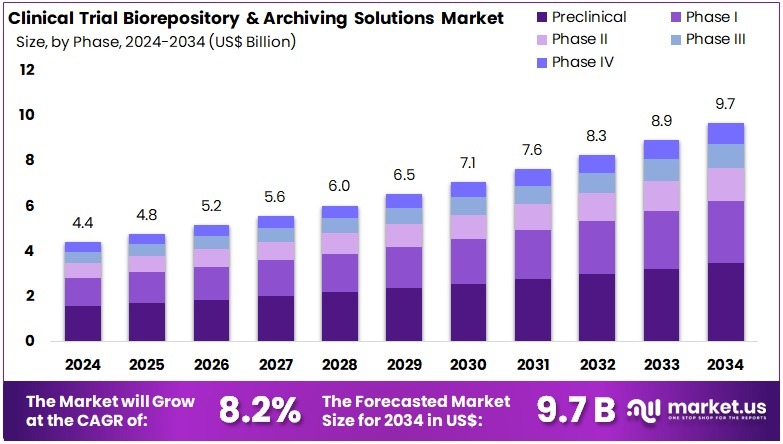
New York, NY – June 01, 2026 –The Global Clinical Trial Biorepository and Archiving Solutions Market size is expected to be worth around US$ 9.7 Billion by 2034, from US$ 4.4 Billion in 2024, growing at a CAGR of 8.2% during the forecast period from 2025 to 2034. North America held a dominant market position, capturing more than a 47.2% share and holds US$ 2.0 Billion market value for the year.
Clinical Trial Biorepository and Archiving Solutions play a critical role in supporting modern clinical research by ensuring the secure collection, storage, management, and preservation of biological samples and trial-related documentation. These solutions are designed to maintain sample integrity, regulatory compliance, and data traceability throughout the lifecycle of a clinical study and beyond.
Biorepository services involve the storage of biospecimens such as blood, tissue, plasma, serum, DNA, RNA, and other biological materials under controlled conditions. Advanced temperature monitoring systems, inventory management technologies, and chain-of-custody protocols help safeguard sample quality and enable efficient retrieval for future analysis. These repositories support biomarker discovery, translational research, and long-term study requirements.
Archiving solutions focus on the secure preservation of essential clinical trial records, including study protocols, informed consent forms, case report forms, regulatory submissions, and electronic data. Compliance with global regulatory standards such as Good Clinical Practice (GCP), FDA regulations, and ICH guidelines is a key component of archiving services.
Growing demand for precision medicine, increasing clinical trial activity, and rising emphasis on regulatory compliance are driving the adoption of comprehensive biorepository and archiving solutions worldwide. Pharmaceutical companies, biotechnology firms, contract research organizations (CROs), and academic research institutions are increasingly leveraging these services to enhance operational efficiency, ensure data integrity, and support future scientific investigations.
Key Takeaways
- The Clinical Trial Biorepository and Archiving Solutions market is anticipated to expand from USD 4.4 billion in 2024 to USD 9.7 billion by 2034.
- The market is forecast to register a CAGR of 8.2% between 2025 and 2034, supported by increasing demand for secure sample storage and regulatory-compliant archiving services.
- Biorepository Services held the largest share of the service segment in 2024, contributing more than 66.7% of total market revenue owing to growing biospecimen preservation requirements.
- Clinical Products accounted for the leading position within the product segment in 2024, representing 48.4% of the market, driven by the need for standardized and compliant storage solutions.
- The Preclinical phase dominated the market by phase in 2024, capturing over 37.2% share as research organizations increasingly focused on early-stage drug development activities.
- North America emerged as the leading regional market in 2024, holding more than 47.2% of the global share and generating approximately USD 2.0 billion in revenue.
Regional Analysis
North America accounted for the largest share of the Clinical Trial Biorepository and Archiving Solutions market in 2024, representing more than 47.2% of global revenue and reaching a market value of USD 2.0 billion. The region’s strong position is supported by a high concentration of clinical research activities, particularly in the United States, which remains a major hub for pharmaceutical, biotechnology, and medical research organizations.
The presence of advanced healthcare infrastructure, well-established research facilities, and a robust regulatory environment has significantly contributed to market growth. Regulatory agencies require strict adherence to clinical data management, documentation, and long-term record retention standards, encouraging the widespread adoption of secure archiving and biorepository solutions. These systems help organizations maintain data integrity, ensure regulatory compliance, and improve accessibility throughout the clinical trial process.
Growing investments in drug development, precision medicine, and genomics research have further strengthened demand for advanced biospecimen storage and management services. Government agencies, academic institutions, and private research organizations continue to allocate substantial funding toward research infrastructure and sample preservation capabilities. Additionally, increasing emphasis on data security and traceability has accelerated the implementation of digital archiving platforms across the region.
Supported by continuous innovation, favorable funding conditions, and stringent regulatory requirements, North America is expected to maintain its leading position in the market over the forecast period.
Emerging Trends
- Personalized Medicine is Driving Biorepository Growth: The increasing adoption of personalized medicine is driving demand for biorepository services. Clinical trials focused on oncology, rare diseases, and gene therapies require extensive biological sample storage. Advanced tracking, labeling, and preservation systems ensure sample integrity, supporting precision medicine research and future therapeutic developments.
- Digital Archiving and Automation Are Replacing Paper: Clinical trial organizations are replacing paper-based documentation with digital archiving systems. Cloud platforms, automated workflows, and real-time data access improve operational efficiency. These technologies reduce errors, simplify audits, enhance compliance, and enable secure management of clinical records across global research networks.
- Rising Regulatory Pressure on Storage and Retention: Regulatory authorities are imposing stricter requirements for long-term sample and data retention. Clinical trial sponsors are investing in secure storage infrastructure, audit trails, and digital recordkeeping systems. These measures improve traceability, ensure compliance, and maintain sample quality throughout the research lifecycle.
- Decentralized Trials Increase Need for Regional Storage: The growth of decentralized and multinational clinical trials is increasing demand for regional biorepository facilities. Local storage hubs reduce transportation risks, maintain sample quality, and improve logistics efficiency. Integrated temperature-controlled delivery systems support timely sample processing and reliable clinical trial operations.
- Cold Chain Logistics Are Now Essential: Cold chain logistics have become essential for preserving biological samples used in clinical trials. Advanced refrigeration, cryogenic storage, and continuous temperature monitoring help maintain sample viability. Reliable backup systems further protect valuable research materials, ensuring compliance and accurate study outcomes.
- Blockchain Use Is Growing for Sample Traceability: Blockchain technology is emerging as a valuable tool for biological sample tracking. Its secure and immutable records improve transparency, traceability, and compliance. Early adoption within biorepositories demonstrates potential for reducing errors, preventing fraud, and strengthening confidence in sample management processes.
Use Cases
- Sample Storage for Long-Term Drug Research: Biorepositories preserve biological samples for extended periods to support future drug research. Stored blood, tissue, and DNA samples enable researchers to investigate long-term treatment outcomes, evaluate safety concerns, and explore additional therapeutic applications without repeating costly clinical studies.
- Regulatory Audits and Trial Documentation: Archiving solutions help organizations securely store clinical trial documentation, including consent forms, protocols, and reports. Quick retrieval of accurate records supports regulatory compliance, simplifies inspections, reduces legal risks, and ensures transparency throughout the clinical trial and approval process.
- Cross-Trial Data Comparison: Researchers use archived samples and historical clinical trial data to compare outcomes across studies. This approach helps identify trends, validate findings, and improve trial designs. Well-organized biorepositories provide efficient access to information, supporting evidence-based research and better treatment strategies.
- Supporting Rare Disease Research: Biorepositories play a crucial role in rare disease research by preserving limited biological samples for future investigations. Stored specimens enable scientists to study disease progression, validate findings, and evaluate therapies, accelerating research efforts despite small patient populations and sample availability.
- Enhancing AI and Machine Learning Models: Biorepositories provide high-quality datasets that support artificial intelligence and machine learning applications in healthcare. Stored samples and clinical information help train predictive models, improve treatment selection, and generate insights. Accurate data archiving enhances reliability and innovation in medical research.
- Facilitating Multi-Center and International Trials: Centralized biorepository services support clinical trials conducted across multiple sites and countries. Standardized storage, processing, and tracking procedures ensure consistency and data quality. Central access to samples improves collaboration, reduces operational complexity, and accelerates the progress of global studies.
Frequently Asked Questions on Clinical Trial Biorepository and Archiving Solutions
- What are Clinical Trial Biorepository and Archiving Solutions?
Clinical trial biorepository and archiving solutions are specialized systems and services used to collect, process, store, preserve, and manage biological samples and trial-related records. These solutions ensure sample integrity, regulatory compliance, traceability, and long-term accessibility throughout clinical research and post-trial periods. - Why are biorepository and archiving solutions important in clinical trials?
Biorepository and archiving solutions play a critical role in maintaining the quality and reliability of biological specimens and research documentation. They support accurate study outcomes, facilitate future analyses, ensure regulatory adherence, and enable efficient retrieval of samples and records when required. - What types of samples are commonly stored in clinical trial biorepositories?
Clinical trial biorepositories typically store blood, plasma, serum, tissue specimens, DNA, RNA, cell cultures, and other biological materials. These samples are preserved under controlled environmental conditions to maintain stability and support future scientific, diagnostic, and therapeutic research activities. - What technologies are used in modern biorepository management?
Modern biorepositories utilize laboratory information management systems, barcode tracking, RFID technology, automated storage systems, temperature monitoring tools, and cloud-based data platforms. These technologies improve operational efficiency, reduce errors, and enhance sample visibility across research workflows. - How are biological samples transported to biorepositories?
Biological samples are transported using validated logistics procedures that include temperature-controlled packaging, real-time monitoring, and compliance with transportation regulations. These practices ensure samples remain stable and maintain their scientific value during transit. - What factors are driving growth in the Clinical Trial Biorepository and Archiving Solutions Market?
Market growth is being driven by increasing clinical trial activity, rising demand for biomarker research, expanding precision medicine initiatives, growing biobanking requirements, and stricter regulatory standards. Technological advancements in sample management and data tracking also contribute significantly to market expansion. - Which regions are leading the Clinical Trial Biorepository and Archiving Solutions Market?
North America leads the market due to strong clinical research activity, advanced healthcare infrastructure, and significant investments in biotechnology. Europe follows closely, while Asia-Pacific is experiencing rapid growth driven by expanding clinical trial operations and research capabilities. - What is the future outlook for the Clinical Trial Biorepository and Archiving Solutions Market?
The market is expected to experience sustained growth due to increasing clinical research investments, rising demand for personalized medicine, and expanding biobanking activities. Continued technological innovation and growing emphasis on data integrity are likely to support long-term market development.
Conclusion
The Clinical Trial Biorepository and Archiving Solutions Market is positioned for strong growth, driven by increasing clinical research activities, expanding precision medicine initiatives, and stringent regulatory requirements. The growing need for secure biospecimen preservation, compliant data archiving, and advanced sample management technologies continues to support market expansion.
Emerging trends such as digital archiving, automation, blockchain integration, and decentralized clinical trials are reshaping industry operations and improving efficiency. With North America maintaining market leadership and global investments in drug development increasing, demand for reliable biorepository and archiving services is expected to rise steadily, supporting long-term innovation in clinical research.
Discuss your needs with our analyst
Please share your requirements with more details so our analyst can check if they can solve your problem(s)




