


Overview
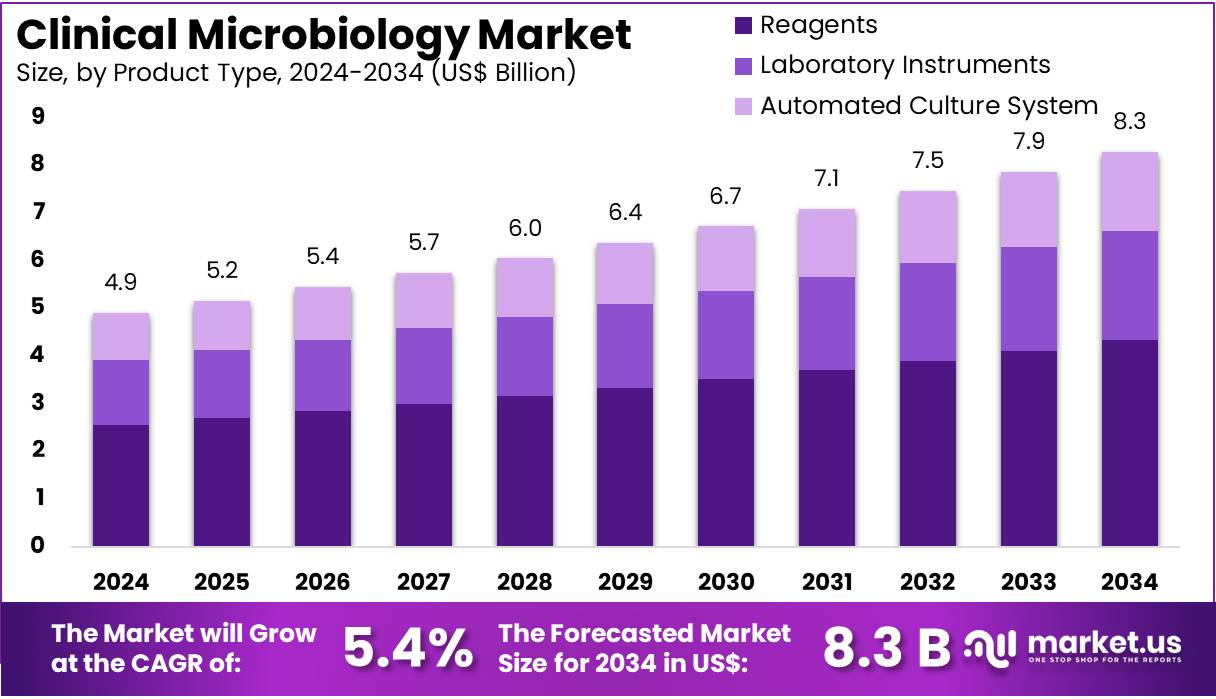
New York, NY – May 13, 2026 – The Clinical Microbiology Market Size is expected to be worth around US$ 8.3 billion by 2034 from US$ 4.9 billion in 2024, growing at a CAGR of 5.4% during the forecast period 2025 to 2034. North America held a dominant market position, capturing more than a 39.9% share and holds US$ 2 Billion market value for the year.
The field of Clinical Microbiology plays a critical role in the diagnosis, prevention, and treatment of infectious diseases caused by bacteria, viruses, fungi, and parasites. Clinical microbiology laboratories support healthcare systems by identifying disease-causing microorganisms and determining the most effective antimicrobial therapies for patients. The increasing prevalence of infectious diseases, antimicrobial resistance, and hospital-acquired infections has significantly strengthened the importance of advanced microbiological testing worldwide.
Technological advancements such as molecular diagnostics, polymerase chain reaction (PCR), next-generation sequencing (NGS), and automated microbial identification systems have enhanced the accuracy and speed of pathogen detection. These innovations are improving clinical decision-making and enabling early disease management across hospitals, diagnostic laboratories, and research institutions.
The growing focus on public health surveillance, infection control programs, and pandemic preparedness is further contributing to the expansion of the clinical microbiology sector. In addition, rising investments in healthcare infrastructure and laboratory automation are supporting market growth across developed and emerging economies.
North America currently represents a major market due to strong healthcare infrastructure and high adoption of advanced diagnostic technologies, while the Asia-Pacific region is expected to witness substantial growth driven by increasing healthcare expenditure and rising awareness regarding infectious disease diagnostics.
Overall, clinical microbiology remains essential for strengthening global healthcare systems and improving patient outcomes through accurate and timely disease diagnosis.
Key Takeaways
- In 2023, the Clinical Microbiology market was valued at US$ 4.9 billion and is projected to reach US$ 8.3 billion by 2033, expanding at a CAGR of 5.4% during the forecast period.
- Based on product type, the market is segmented into laboratory instruments, automated culture systems, and reagents. Among these, the reagents segment dominated the market in 2023, accounting for a share of 52.3%.
- By application, the market is categorized into respiratory diseases, gastrointestinal diseases, sexually transmitted diseases, urinary tract infections, and others. The respiratory diseases segment held the largest market share of 42.7% in 2023.
- North America emerged as the leading regional market in 2023, capturing a market share of 39.9%.
Regional Analysis
North America accounted for the largest share of the Clinical Microbiology market in 2023, supported by strong healthcare infrastructure, technological advancements in diagnostic systems, and growing emphasis on infectious disease management. The increasing incidence of hospital-acquired infections and antimicrobial-resistant diseases has accelerated the demand for advanced microbiological testing solutions across the region.
Government organizations and healthcare agencies are also investing significantly in infectious disease research and laboratory modernization programs, further strengthening market growth. The presence of major industry participants and high adoption of automated diagnostic technologies have additionally contributed to North America’s market leadership.
Meanwhile, the Asia Pacific region is anticipated to register the fastest CAGR during the forecast period. The growth is primarily driven by rising healthcare expenditure, expanding diagnostic laboratory networks, and increasing awareness regarding infectious disease detection. Countries such as India, China, and Southeast Asian nations are witnessing a higher burden of infectious diseases, including tuberculosis and respiratory infections, which is creating strong demand for advanced microbiology diagnostics.
In addition, supportive government initiatives aimed at improving healthcare infrastructure and disease surveillance capabilities are expected to accelerate market expansion. The ongoing modernization of healthcare systems across the region is likely to position Asia Pacific as a major growth hub for the clinical microbiology market in the coming years.
Emerging Trends
- Rising Demand for Rapid Diagnostics: Healthcare providers increasingly prefer rapid diagnostic tools that deliver results within minutes or hours instead of days. Technologies such as molecular diagnostics and point-of-care testing support faster treatment decisions, improve infection control, and enhance patient outcomes, driving strong adoption across healthcare facilities worldwide.
- Automation in Microbiology Labs: Clinical microbiology laboratories are adopting automated systems to improve testing speed, accuracy, and workflow efficiency. Automation reduces human error, handles high sample volumes, and supports consistent pathogen identification. This trend enables laboratories to meet growing diagnostic demand while optimizing technician productivity and operational performance.
- Use of Artificial Intelligence (AI): Artificial Intelligence is transforming clinical microbiology by improving pathogen detection, image analysis, and diagnostic accuracy. AI tools help identify infection patterns, support clinical decision-making, and monitor disease outbreaks in real time. Increasing adoption of AI is making microbiology diagnostics more efficient and data-driven.
- Focus on Antimicrobial Resistance (AMR): The growing threat of antimicrobial resistance is increasing demand for advanced microbiology testing solutions. Laboratories are developing rapid diagnostic methods to detect drug-resistant bacteria early. Faster identification supports targeted treatment, limits infection spread, and strengthens global efforts to manage antibiotic resistance effectively.
- Integration with Electronic Health Records (EHR): Clinical microbiology laboratories are integrating diagnostic results directly with electronic health records to improve healthcare efficiency. Real-time data sharing enables faster clinical decisions, better communication between healthcare teams, and improved patient monitoring. This integration supports timely treatment and enhances overall healthcare delivery systems.
- Growth in Home-Based and Mobile Testing: Home-based and mobile diagnostic testing solutions are expanding access to clinical microbiology services, especially in remote areas. Patients can collect samples conveniently outside hospitals, reducing healthcare visits and improving testing accessibility. Growing demand for flexible healthcare solutions is accelerating innovation in decentralized diagnostic services.
- Personalized Infection Management: Clinical microbiology is supporting personalized infection management by identifying specific pathogens and their resistance profiles. Doctors can select targeted treatments instead of standard antibiotics, improving treatment effectiveness and reducing side effects. Personalized diagnostic approaches are enhancing patient recovery and supporting precision-based healthcare strategies.
Use Cases
- Hospital Infection Control: Clinical microbiology laboratories help hospitals detect infections such as MRSA and C. difficile at early stages. Rapid testing supports patient isolation, limits hospital-acquired infections, and improves infection control measures. Accurate diagnostics enhance patient safety, reduce treatment costs, and strengthen outbreak management within healthcare facilities.
- Diagnosis of Respiratory Illnesses: Clinical microbiology plays a major role in diagnosing respiratory diseases including COVID-19, pneumonia, influenza, and tuberculosis. Accurate and timely testing helps doctors select appropriate treatments, supports outbreak monitoring, and reduces unnecessary antibiotic use. Laboratories are essential during seasonal outbreaks and pandemic situations worldwide.
- Testing for Urinary Tract Infections (UTIs): Microbiology laboratories analyze urine samples to identify bacteria responsible for urinary tract infections and determine effective antibiotics. Accurate testing enables targeted treatment, reduces antibiotic misuse, and prevents complications such as kidney infections. Fast diagnosis improves patient comfort and lowers the risk of recurring infections.
- Foodborne Illness Investigations: Clinical microbiology laboratories investigate foodborne outbreaks by testing food, water, and patient samples for harmful pathogens like Salmonella and E. coli. Early detection helps authorities identify contamination sources, prevent additional infections, and enforce food safety regulations, protecting public health and reducing outbreak severity.
- Sexually Transmitted Infections (STIs) Screening: Clinical microbiology laboratories provide accurate screening for sexually transmitted infections such as HIV, gonorrhea, chlamydia, and syphilis. Early and confidential testing supports timely treatment, prevents disease transmission, and reduces long-term health complications. These diagnostic services contribute significantly to public health awareness and disease prevention.
- Bloodstream Infections and Sepsis Detection: Clinical microbiology laboratories play a critical role in detecting bloodstream infections and sepsis through rapid blood testing. Early pathogen identification helps doctors administer effective treatments quickly, improving survival rates and reducing hospital stays. These tests are especially important in emergency departments and intensive care units.
Frequently Asked Questions on Clinical Microbiology
- Why is clinical microbiology important in healthcare?
Clinical microbiology plays a critical role in healthcare by enabling accurate and early detection of infectious diseases. It assists physicians in selecting suitable treatments, monitoring outbreaks, reducing hospital-acquired infections, and improving overall patient outcomes through timely laboratory-based diagnostic services. - What are the major technologies used in clinical microbiology?
Major technologies used in clinical microbiology include molecular diagnostics, polymerase chain reaction (PCR), automated culture systems, microbial identification systems, and next-generation sequencing. These technologies improve diagnostic accuracy, reduce turnaround time, and enhance the efficiency of infectious disease detection. - What factors are driving the clinical microbiology market?
The clinical microbiology market is driven by the rising prevalence of infectious diseases, increasing antimicrobial resistance, growing demand for rapid diagnostic solutions, and advancements in laboratory automation technologies. Expanding healthcare infrastructure and government support for disease surveillance are also supporting market growth. - Which region dominates the clinical microbiology market?
North America currently dominates the clinical microbiology market due to advanced healthcare infrastructure, strong adoption of innovative diagnostic technologies, and increasing investments in infectious disease research. The region also benefits from the presence of leading biotechnology and diagnostic companies. - Which application segment holds the largest market share?
The respiratory diseases segment accounts for the largest share of the clinical microbiology market owing to the increasing prevalence of respiratory infections, growing diagnostic testing volumes, and rising awareness regarding early disease detection and effective infection management across healthcare facilities. - What are reagents in the clinical microbiology market?
Reagents are chemical substances and biological materials used in microbiological testing procedures to detect and identify microorganisms. They represent a major product segment in the market because of their extensive use in routine diagnostic testing and laboratory research activities. - What is the future outlook of the clinical microbiology market?
The clinical microbiology market is expected to witness steady growth in the coming years due to increasing demand for rapid diagnostics, rising healthcare investments, and technological advancements in microbial testing. Emerging economies are also expected to create significant market opportunities.
Conclusion
The clinical microbiology market is experiencing steady growth due to the rising prevalence of infectious diseases, increasing antimicrobial resistance, and growing demand for rapid and accurate diagnostic solutions. Technological advancements such as molecular diagnostics, automation, and artificial intelligence are significantly improving pathogen detection and laboratory efficiency.
Strong investments in healthcare infrastructure, infection control programs, and disease surveillance are further supporting market expansion globally. North America continues to dominate the market, while Asia Pacific is emerging as a high-growth region. Overall, clinical microbiology remains essential for enhancing disease management, strengthening healthcare systems, and improving patient outcomes through timely and reliable diagnostic testing.
Discuss your needs with our analyst
Please share your requirements with more details so our analyst can check if they can solve your problem(s)




