


Overview
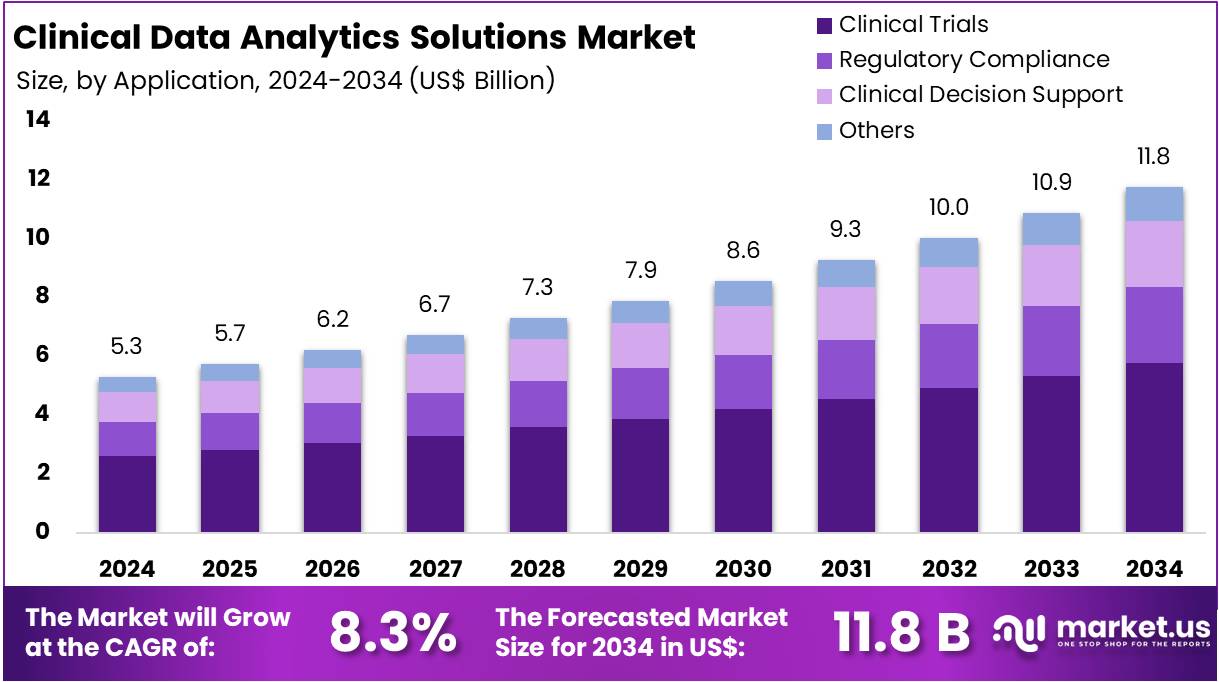
New York, NY – June 05, 2026 – The Global Clinical Data Analytics Solutions Market Size is expected to be worth around US$ 11.8 Billion by 2034, from US$ 5.3 Billion in 2024, growing at a CAGR of 8.3% during the forecast period from 2025 to 2034. North America held a dominant market position, capturing more than a 43.6% share and holds US$ 2.3 Billion market value for the year.
Clinical Data Analytics Solutions is a specialized healthcare technology provider focused on transforming complex clinical and healthcare data into actionable insights. The company delivers advanced data analytics, data management, and reporting solutions that support healthcare organizations, pharmaceutical companies, clinical research institutions, and life sciences enterprises in improving decision-making and operational efficiency.
By leveraging modern analytics technologies, artificial intelligence, machine learning, and predictive modeling, Clinical Data Analytics Solutions helps clients streamline clinical workflows, optimize patient outcomes, and enhance research performance. The company’s solutions are designed to manage large volumes of structured and unstructured healthcare data while ensuring accuracy, compliance, and data security.
The organization offers a comprehensive portfolio of services, including clinical data integration, real-world evidence analytics, clinical trial data management, population health analytics, regulatory reporting, and healthcare performance monitoring. These capabilities enable clients to gain deeper visibility into patient populations, treatment effectiveness, and healthcare delivery trends.
Clinical Data Analytics Solutions is committed to supporting innovation across the healthcare ecosystem through data-driven strategies that improve quality of care and accelerate medical advancements. The company emphasizes regulatory compliance and follows industry standards related to healthcare data privacy and security.
With a focus on innovation, reliability, and client-centric service delivery, Clinical Data Analytics Solutions continues to help healthcare stakeholders unlock the full value of their data and achieve measurable clinical, operational, and business outcomes.
Key Takeaways
- The Clinical Data Analytics Solutions market is expected to expand from US$ 5.3 Billion in 2024 to nearly US$ 11.8 Billion by 2034.
- The market is anticipated to register a CAGR of 8.3% during the forecast period spanning 2025 to 2034.
- In 2024, the cloud-based deployment segment held the largest share, accounting for more than 55.6% of the overall market.
- The clinical trials application segment emerged as the market leader in 2024, capturing over 43.6% of total revenue.
- North America remained the dominant regional market in 2024, representing more than 43.6% of the global market and generating approximately US$ 2.3 Billion in revenue.
Regional Analysis
North America accounted for the largest share of the Clinical Data Analytics Solutions market in 2024, representing more than 43.6% of global revenue and reaching a market value of approximately US$ 2.3 billion. The region’s leadership is primarily driven by its highly developed healthcare infrastructure, extensive adoption of digital health technologies, and widespread implementation of electronic health records (EHRs). Strong government support for healthcare digitization and data interoperability has further accelerated the integration of advanced analytics solutions across healthcare organizations.
Healthcare providers throughout the region are increasingly utilizing real-time analytics, predictive modeling, and data-driven decision-making tools to enhance patient outcomes and optimize clinical operations. Hospitals, research institutions, and academic medical centers continue to invest in analytics platforms that support personalized treatment strategies, reduce medical errors, and improve chronic disease management. These advancements have strengthened the role of clinical data analytics in modern healthcare delivery.
Additionally, favorable regulatory frameworks and healthcare modernization initiatives have encouraged broader adoption of analytics solutions. The growing elderly population and increasing prevalence of chronic diseases have created greater demand for population health management and resource optimization tools. By enabling healthcare organizations to efficiently manage large and complex patient datasets, clinical data analytics solutions continue to support operational improvements. As a result, North America remains at the forefront of market growth, supported by robust infrastructure, regulatory backing, and ongoing digital transformation efforts.
Emerging Trends
- Increased Use of AI and Machine Learning: Artificial intelligence and machine learning are increasingly being integrated into clinical data analytics platforms to process large healthcare datasets. These technologies help identify patterns, support early disease detection, enhance clinical decision-making, and enable personalized treatment approaches, ultimately improving patient outcomes and operational efficiency.
- Shift Toward Predictive Analytics: Healthcare organizations are adopting predictive analytics solutions to forecast patient health risks and disease progression. By analyzing historical and real-time data, these tools help identify at-risk individuals, support preventive care strategies, reduce hospitalizations, and improve long-term healthcare management outcomes.
- Cloud-Based Solutions Are Becoming the Norm: Cloud-based clinical analytics solutions are gaining widespread acceptance due to their scalability, flexibility, and cost-effectiveness. These platforms enable secure remote access to healthcare data, facilitate collaboration, simplify system upgrades, and support real-time decision-making across healthcare networks and facilities.
- Growing Focus on Patient-Centered Care: Clinical data analytics is enabling a transition toward patient-centered healthcare by providing insights into individual patient characteristics, medical histories, and treatment responses. This approach supports personalized care plans, improves treatment effectiveness, enhances patient satisfaction, and promotes better health outcomes.
- Integration with Electronic Health Records (EHRs): The integration of clinical analytics tools with electronic health records streamlines access to patient information and actionable insights. This seamless connectivity improves workflow efficiency, reduces administrative burdens, minimizes clinical errors, and supports faster, more informed healthcare decision-making processes.
- Rising Use in Population Health Management: Clinical data analytics is increasingly used for population health management by identifying disease trends, risk factors, and healthcare disparities across communities. These insights support targeted interventions, efficient resource allocation, preventive healthcare programs, and improved public health outcomes on a broader scale.
Use Cases
- Early Detection of Diseases: Clinical analytics solutions help healthcare providers identify early signs of diseases by analyzing patient records, diagnostic results, and health indicators. Early detection supports timely intervention, improves treatment effectiveness, enhances survival rates, and reduces the burden of advanced-stage disease management.
- Reducing Hospital Readmissions: Healthcare organizations use analytics to identify factors contributing to patient readmissions and improve discharge planning. Data-driven insights support better follow-up care, medication adherence, and patient engagement, ultimately reducing unnecessary hospital visits while lowering healthcare costs and improving patient recovery.
- Optimizing Treatment Plans: Clinical data analytics enables healthcare providers to develop personalized treatment strategies by evaluating patient history, clinical outcomes, and therapeutic responses. This evidence-based approach improves treatment accuracy, minimizes adverse effects, supports precision medicine initiatives, and enhances overall patient care quality.
- Monitoring Chronic Conditions: Analytics tools assist in the continuous monitoring of chronic diseases such as diabetes, hypertension, and cardiovascular disorders. By tracking patient data over time, healthcare providers can detect changes early, adjust treatment plans promptly, and reduce the likelihood of serious complications.
- Improving Operational Efficiency: Hospitals and healthcare facilities leverage analytics to optimize resource utilization, staff scheduling, patient flow, and appointment management. These insights help reduce wait times, improve service delivery, lower operational costs, and enhance the overall efficiency of healthcare operations.
- Drug Safety and Clinical Trials: Clinical data analytics plays a vital role in clinical trials by monitoring patient responses, evaluating treatment effectiveness, and identifying adverse events. These capabilities improve research accuracy, accelerate drug development processes, enhance regulatory compliance, and support the delivery of safer therapies.
Frequently Asked Questions on Clinical Data Analytics Solutions
- What is driving the growth of the Clinical Data Analytics Solutions market?
Market growth is being driven by increasing adoption of electronic health records, rising healthcare data volumes, growing demand for evidence-based decision-making, and advancements in artificial intelligence and machine learning. Healthcare organizations are increasingly investing in analytics to improve care quality and operational performance. - How are Clinical Data Analytics Solutions used in clinical trials?
Clinical Data Analytics Solutions help streamline clinical trials by managing patient data, monitoring trial performance, identifying trends, and ensuring regulatory compliance. These capabilities improve study efficiency, enhance data accuracy, and support faster drug development and research outcomes. - Why is cloud-based deployment gaining popularity in this market?
Cloud-based deployment offers scalability, cost efficiency, remote accessibility, and simplified data management. Healthcare organizations benefit from faster implementation and the ability to analyze large datasets in real time, making cloud platforms a preferred choice for clinical analytics applications. - Which healthcare organizations benefit most from Clinical Data Analytics Solutions?
Hospitals, clinics, pharmaceutical companies, research organizations, and healthcare payers benefit significantly from these solutions. They use analytics to optimize workflows, improve patient care, manage healthcare costs, and gain deeper insights from clinical and operational data. - What role does artificial intelligence play in Clinical Data Analytics Solutions?
Artificial intelligence enhances analytics capabilities by identifying patterns, predicting patient outcomes, and automating data analysis processes. AI-powered tools enable healthcare organizations to make faster and more accurate decisions while improving efficiency and reducing administrative burdens. - Which region leads the Clinical Data Analytics Solutions market?
North America currently leads the market due to its advanced healthcare infrastructure, widespread adoption of digital health technologies, and supportive government initiatives. Strong investments in healthcare IT and data-driven care models continue to strengthen regional market growth. - How do Clinical Data Analytics Solutions improve patient outcomes?
These solutions provide healthcare professionals with real-time insights into patient health, treatment effectiveness, and disease progression. By supporting personalized care strategies and early intervention, analytics solutions contribute to improved clinical outcomes and enhanced patient experiences. - What is the future outlook for the Clinical Data Analytics Solutions market?
The market is expected to experience steady growth over the coming decade, supported by digital transformation in healthcare, increasing use of predictive analytics, and expanding adoption of cloud technologies. Continued innovation is likely to create new opportunities across the healthcare ecosystem.
Conclusion
The Clinical Data Analytics Solutions market is positioned for significant growth, driven by the increasing digitization of healthcare systems, rising adoption of advanced analytics technologies, and growing demand for data-driven clinical decision-making. The integration of artificial intelligence, predictive analytics, cloud computing, and electronic health records is enhancing healthcare efficiency and patient outcomes.
Clinical data analytics is becoming an essential tool for disease management, clinical research, operational optimization, and personalized care delivery. With strong adoption across healthcare organizations and continued technological advancements, the market is expected to witness sustained expansion, creating substantial opportunities for innovation and improved healthcare performance worldwide.
Discuss your needs with our analyst
Please share your requirements with more details so our analyst can check if they can solve your problem(s)




