


Overview
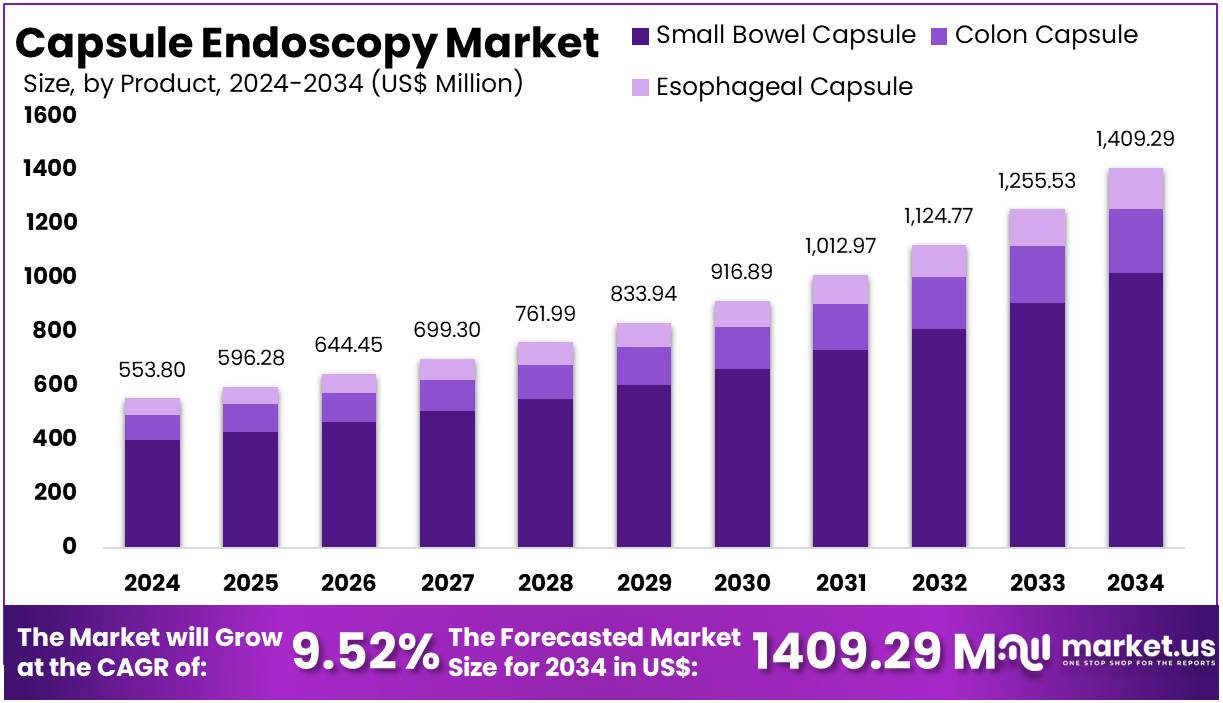
New York, NY – April 27, 2026 – The Global Capsule Endoscopy Market size is expected to be worth around US$ 1409.29 Million by 2034, from US$ 553.8 Million in 2024, growing at a CAGR of 9.52% during the forecast period from 2025 to 2034.
Capsule endoscopy is an advanced, non-invasive diagnostic technology designed to examine the gastrointestinal (GI) tract, particularly areas that are difficult to access using conventional endoscopy. The procedure involves swallowing a small, pill-sized capsule equipped with a miniature camera, light source, battery, and wireless transmitter. As the capsule travels naturally through the digestive system, it captures thousands of high-resolution images, which are transmitted to an external recording device worn by the patient.
This technology is primarily used for the detection and evaluation of conditions such as obscure gastrointestinal bleeding, Crohn’s disease, small intestine tumors, celiac disease, and polyps. Compared to traditional endoscopic procedures, capsule endoscopy offers enhanced patient comfort, eliminates the need for sedation, and reduces procedural risks.
The growing adoption of capsule endoscopy can be attributed to increasing prevalence of gastrointestinal disorders, rising demand for minimally invasive diagnostic techniques, and continuous advancements in imaging and sensor technologies. Healthcare providers are increasingly integrating this solution into clinical practice due to its ability to provide comprehensive visualization of the small bowel.
From a market perspective, steady growth is being observed, supported by technological innovation and expanding healthcare infrastructure. Capsule endoscopy is expected to play a critical role in early diagnosis and improved patient outcomes, reinforcing its position as a valuable tool in modern gastroenterology.
Key Takeaways
- The capsule endoscopy market revenue was valued at US$ 553.80 million and is projected to reach US$ 1,409.29 million, registering a CAGR of 9.52%.
- The small bowel capsule segment accounted for the highest revenue share, contributing 72.30% of the overall market.
- By component, the camera capsule segment held the leading position with a market share of 30.2%.
- In terms of type, the wireless capsule endoscopy segment dominated, capturing 36.9% of the market share.
- Based on application, the obscure gastrointestinal bleeding (OGIB) segment represented the largest share at 58.10%.
- Hospitals emerged as the leading end-use segment, accounting for 47.80% of total market revenue.
- Regionally, North America led the market, securing the highest share of 31.90%.
Regional Analysis
North America holds a dominant position in the capsule endoscopy market, supported by a well-established healthcare infrastructure, widespread adoption of minimally invasive diagnostic technologies, and a rising incidence of gastrointestinal (GI) disorders, including Crohn’s disease, colorectal cancer, and obscure gastrointestinal bleeding. Strong government initiatives, favorable reimbursement frameworks, and high healthcare spending have contributed to sustained demand for advanced diagnostic solutions across the region.
The presence of key industry participants such as Medtronic, Olympus Corporation, and CapsoVision, Inc. has further strengthened market leadership, with continuous advancements focused on enhanced imaging quality, extended battery performance, and integration of AI-based analytical capabilities.
The United States accounts for the largest share within the region, driven by a high disease burden, strong research ecosystem, and a supportive regulatory environment that encourages medical innovation. Canada also contributes significantly, supported by increasing awareness and adoption of advanced diagnostic methods.
Ongoing integration of artificial intelligence and machine learning technologies is improving diagnostic precision and operational efficiency. With continued technological progress and growing preference for non-invasive procedures, North America is expected to sustain its leading position in the global capsule endoscopy market over the forecast period.
Emerging Trends
- AI Integration for Faster and More Accurate Diagnosis: Artificial intelligence is integrated into capsule endoscopy systems to automate image analysis, improve detection accuracy, reduce physician workload, minimize errors, and enable faster diagnosis, allowing earlier treatment initiation.
- Better Image Quality and Longer Battery Life: Advanced capsules feature high-resolution imaging and extended battery life, enabling longer operation, broader gastrointestinal coverage, improved diagnostic accuracy, and reduced need for repeat procedures in clinical practice.
- Use of 3D Imaging and Multi-Camera Capsules: New capsule designs include multiple cameras and 3D or 360-degree imaging, enhancing visualization, improving detection of subtle abnormalities, and supporting early disease diagnosis with greater reliability.
- Expanding Use for Colon and Esophagus Exams: Capsule endoscopy applications now extend to colon and esophagus screening, offering a non-invasive alternative to traditional procedures, improving patient acceptance, and supporting early detection of gastrointestinal diseases.
- Rising Trend of At-Home Capsule Endoscopy: Home-based capsule endoscopy enables patients to undergo testing remotely, improving convenience, expanding access in remote areas, reducing hospital visits, and aligning with the growth of telemedicine services.
- Real-Time Wireless Data Transfer and Cloud Use: Modern capsules support wireless data transmission and cloud integration, enabling real-time image sharing, faster diagnosis, remote specialist collaboration, and improved efficiency in clinical decision-making processes.
- Miniaturization and Rise of Smart Capsules: Capsule devices are becoming smaller and more advanced, with capabilities like controlled movement and targeted drug delivery, offering potential for precise diagnostics and minimally invasive therapeutic interventions.
Use Cases
- Finding Hidden Sources of Bleeding: Capsule endoscopy identifies hidden gastrointestinal bleeding sources by capturing detailed images of hard-to-reach areas, supporting diagnosis in cases of unexplained anemia or obscure bleeding conditions.
- Diagnosing Crohn’s Disease: Capsule endoscopy enables early detection of Crohn’s disease by visualizing the small intestine, identifying inflammation, ulcers, and narrowing, and supporting ongoing disease monitoring and treatment evaluation.
- Detecting Small Intestinal Tumors: This technology improves early detection of small intestinal tumors by providing comprehensive imaging of the digestive tract, identifying abnormalities often missed by conventional diagnostic methods.
- Monitoring Celiac Disease: Capsule endoscopy supports monitoring of celiac disease by assessing intestinal healing, detecting complications, and evaluating mucosal recovery in patients following gluten-free dietary interventions.
- Colon Cancer Screening (Alternative to Colonoscopy): Capsule endoscopy offers a non-invasive screening option for colon cancer, identifying polyps and abnormalities, especially for patients unable to undergo traditional colonoscopy procedures.
- Evaluating Drug Side Effects on the Gut: Capsule endoscopy assesses gastrointestinal damage caused by medications, detecting ulcers, inflammation, or bleeding, and enabling timely adjustments in treatment to prevent severe complications.
Frequently Asked Questions on Capsule Endoscopy
- How does capsule endoscopy work?
Capsule endoscopy works by using a miniature wireless camera inside a capsule that captures thousands of images while moving through the digestive system. These images are transmitted to a recording device, enabling physicians to analyze and diagnose gastrointestinal abnormalities effectively. - What conditions can capsule endoscopy detect?
Capsule endoscopy is commonly used to detect conditions such as obscure gastrointestinal bleeding, Crohn’s disease, small intestine tumors, polyps, and celiac disease. It is particularly effective in visualizing areas of the small intestine that are difficult to access with traditional endoscopy. - What are the advantages of capsule endoscopy?
The procedure offers several advantages, including being minimally invasive, eliminating the need for sedation, and providing detailed imaging of the small intestine. It enhances patient comfort and reduces procedural risks while enabling accurate and early diagnosis of gastrointestinal conditions. - Which segment leads the capsule endoscopy market?
The small bowel capsule segment leads the capsule endoscopy market, primarily due to its high diagnostic effectiveness in detecting small intestine disorders. Its widespread adoption in clinical practice has resulted in a significant share of overall market revenue. - Which region dominates the capsule endoscopy market?
North America dominates the capsule endoscopy market due to advanced healthcare infrastructure, strong presence of key market players, and high adoption of innovative diagnostic technologies. The region also benefits from favorable reimbursement policies and increased healthcare spending. - What role does technology play in the capsule endoscopy market?
Technological advancements, including improved imaging quality, longer battery life, and integration of artificial intelligence, play a critical role in market growth. These innovations enhance diagnostic accuracy, efficiency, and overall clinical outcomes, supporting broader adoption of capsule endoscopy. - Who are the key players in the capsule endoscopy market?
Key players in the capsule endoscopy market include major medical technology companies that focus on innovation and product development. These companies invest in advanced imaging systems and AI-based solutions to strengthen their market position and expand global reach.
Conclusion
Capsule endoscopy has emerged as a transformative diagnostic solution within gastroenterology, supported by its non-invasive nature, high diagnostic accuracy, and patient-friendly approach. Market expansion is being driven by the increasing burden of gastrointestinal disorders, technological advancements, and growing preference for minimally invasive procedures.
Strong adoption across hospitals and continuous innovation in imaging, artificial intelligence, and capsule design are reinforcing its clinical value. North America remains the leading regional market, while emerging applications and home-based solutions are expanding accessibility. Overall, sustained growth is anticipated, with capsule endoscopy positioned as a critical tool for early detection, improved diagnosis, and enhanced patient outcomes.
Discuss your needs with our analyst
Please share your requirements with more details so our analyst can check if they can solve your problem(s)




