


Overview
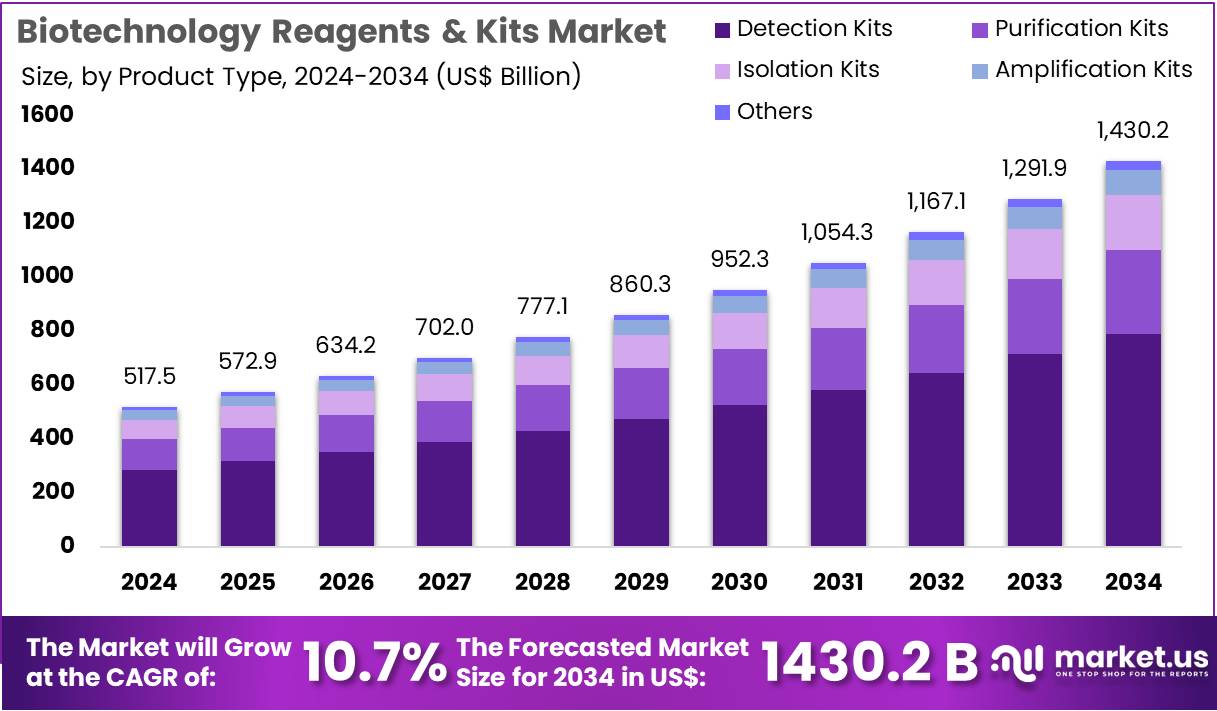
New York, NY – June 01, 2026 – The Biotechnology Reagents & Kits Market Size is expected to be worth around US$ 1430.2 billion by 2034 from US$ 517.5 billion in 2024, growing at a CAGR of 10.7% during the forecast period 2025 to 2034.
The biotechnology reagents and kits market is experiencing significant growth, driven by increasing investments in life sciences research, expanding applications of molecular diagnostics, and growing demand for personalized medicine. Biotechnology reagents and kits are essential tools used in a wide range of biological and biomedical applications, including genomics, proteomics, cell biology, drug discovery, and clinical diagnostics.
These products include PCR reagents, sequencing kits, antibodies, assay kits, cell culture reagents, nucleic acid extraction kits, and other specialized laboratory consumables that support accurate and efficient research outcomes. The growing prevalence of chronic diseases, infectious diseases, and genetic disorders has accelerated the adoption of advanced diagnostic technologies, thereby increasing the demand for high-quality biotechnology reagents and kits.
Technological advancements in next-generation sequencing (NGS), polymerase chain reaction (PCR), gene editing, and biomarker discovery are further supporting market expansion. In addition, increasing research activities by academic institutions, biotechnology companies, pharmaceutical manufacturers, and contract research organizations are contributing to sustained product demand.
North America remains a leading market due to its strong biotechnology infrastructure and substantial research funding, while Asia-Pacific is emerging as a high-growth region supported by expanding healthcare investments and biotechnology capabilities. As innovation in life sciences continues to advance, the biotechnology reagents and kits market is expected to witness continued growth, supported by ongoing research developments and increasing diagnostic applications worldwide.
Key Takeaways
- The biotechnology reagents & kits market was valued at US$ 517.5 billion in 2023 and is projected to reach US$ 1,430.2 billion by 2033, expanding at a CAGR of 10.7% during the forecast period.
- Based on product type, the market is segmented into purification kits, isolation kits, detection kits, amplification kits, and others. Among these, detection kits dominated the market, accounting for 55.3% of the total revenue share in 2023.
- By technology, the market is categorized into LAMP technology, PCR, cell culture, sequencing, chromatography, and others. The cell culture segment emerged as the leading category, holding a 52.5% market share in 2023.
- Based on tested parameters, the market is divided into DNA, RNA, proteins, enzymes, and others. The RNA segment held the largest share, contributing 54.6% of the market revenue in 2023.
- In terms of purpose, the market is segmented into on-site and laboratory applications. The on-site segment led the market with a 59.2% revenue share in 2023.
- By end use, the market is classified into healthcare, natural resources & environment, industrial processing, food & agriculture, and others. The healthcare segment accounted for the highest share, representing 60.7% of the market revenue in 2023.
- North America remained the leading regional market, capturing 39.2% of the global market share in 2023.
Regional Analysis
North America held the largest share of the biotechnology reagents & kits market in 2023, accounting for 39.2% of global revenue. The region’s leadership is supported by a well-established biotechnology ecosystem, advanced healthcare infrastructure, and strong investments in life sciences research.
The presence of leading research institutions, pharmaceutical companies, and biotechnology firms has created sustained demand for reagents and kits used in diagnostics, genomics, proteomics, and drug development. In addition, high healthcare expenditure and continuous innovation in molecular biology and precision medicine have accelerated product adoption across research and clinical settings. Favorable regulatory policies and strong intellectual property protection further strengthen the region’s position as a key hub for biotechnology advancements.
Asia Pacific is anticipated to register the fastest growth rate during the forecast period. Market expansion is being driven by increasing government support for scientific research, rising healthcare investments, and the rapid development of biotechnology industries across countries such as China, India, South Korea, and Japan. Growing adoption of advanced diagnostic technologies, expanding genomics and proteomics research activities, and increasing focus on personalized medicine are contributing to market growth.
Furthermore, the region benefits from a large patient population, a rising number of biotechnology startups, and stronger collaborations between academic institutions and industry participants, creating significant opportunities for the biotechnology reagents & kits market.
Emerging Trends
- Rising Focus on Personalized Medicine: Biotechnology reagents and kits are increasingly supporting personalized medicine by enabling the analysis of individual genetic profiles and biomarkers. These tools help healthcare providers select targeted therapies for specific patients, improving treatment outcomes. Growing applications in cancer care, rare diseases, and genetic disorders are accelerating adoption across hospitals, diagnostic laboratories, and research institutions worldwide.
- Growth of Point-of-Care Testing: Point-of-care testing is expanding rapidly due to the need for fast and convenient diagnostic solutions. Portable biotechnology reagent kits allow healthcare professionals to perform tests directly at clinics, homes, and remote locations. Their ability to deliver accurate results within a short timeframe supports timely treatment decisions and enhances patient care across multiple healthcare settings.
- Advancements in RNA-Based Technologies: The growing importance of RNA-based therapies and vaccines is driving demand for specialized biotechnology reagents and kits. These products are essential for RNA extraction, purification, and analysis in research and clinical laboratories. Increased investment in mRNA technologies, gene therapies, and advanced therapeutics is creating significant opportunities for manufacturers operating in this market segment.
- Automation and Smart Lab Integration: Laboratory automation is transforming biotechnology workflows by increasing testing efficiency and reducing human errors. Modern reagents and kits are being designed for compatibility with automated instruments, robotic systems, and artificial intelligence platforms. This integration supports higher sample throughput, faster data generation, and improved laboratory productivity, making automation a key industry trend.
Use Cases
- Disease Diagnosis in Hospitals: Biotechnology reagents and kits are widely used in hospitals for diagnosing infectious diseases, genetic conditions, and chronic illnesses. PCR-based kits provide rapid and reliable detection of pathogens and biomarkers, enabling timely clinical decisions. Their high accuracy and ability to process numerous samples efficiently make them indispensable tools in modern diagnostic laboratories.
- Drug Development in Pharmaceutical Companies: Pharmaceutical and biotechnology companies rely on reagents and kits throughout the drug discovery and development process. These products support cell culture studies, genetic screening, protein analysis, and toxicity testing. By delivering consistent and accurate experimental results, they help researchers accelerate drug development timelines while improving the reliability of clinical research outcomes.
- Food and Water Safety Testing: Biotechnology reagents and kits are extensively used to monitor food and water quality by detecting harmful microorganisms, toxins, and contaminants. Techniques such as PCR and ELISA enable rapid testing and accurate identification of safety risks. Their application helps manufacturers and regulatory agencies maintain compliance with safety standards and protect public health.
- Genetic Research in Universities: Academic and research institutions use biotechnology reagents and kits for studies involving DNA, RNA, proteins, and gene expression. These products enable accurate sequencing, mutation analysis, and molecular investigations across various scientific disciplines. Their reliability supports both routine laboratory activities and advanced research projects, contributing to significant discoveries in life sciences.
Frequently Asked Questions on Biotechnology Reagents & Kits
- What are the major applications of biotechnology reagents and kits?
Biotechnology reagents and kits are widely used in genomics, proteomics, cell biology, clinical diagnostics, forensic science, and pharmaceutical research. Their ability to simplify complex laboratory procedures and improve testing accuracy has made them essential tools across biotechnology and healthcare sectors. - What factors are driving the growth of the biotechnology reagents and kits market?
Market growth is primarily driven by increasing investments in life science research, rising demand for molecular diagnostics, advancements in genomic technologies, and growing pharmaceutical and biopharmaceutical development activities. Expanding healthcare infrastructure further supports the adoption of these products globally. - Why are biotechnology reagents and kits important in molecular diagnostics?
Biotechnology reagents and kits enable precise detection, identification, and analysis of genetic material, proteins, and biomarkers. Their role in supporting rapid and reliable diagnostic testing has become increasingly important for disease diagnosis, personalized medicine, and infectious disease monitoring. - Which end-user industries utilize biotechnology reagents and kits?
Academic research institutes, biotechnology companies, pharmaceutical manufacturers, clinical laboratories, hospitals, and diagnostic centers represent the primary end users. These organizations rely on reagents and kits to support research activities, product development, disease testing, and quality control processes. - What types of biotechnology reagents and kits are commonly available?
Common product categories include PCR reagents, sequencing kits, cell culture reagents, protein analysis kits, nucleic acid extraction kits, immunoassay kits, and chromatography reagents. Each category is designed to support specific laboratory workflows and analytical applications. - How is technological advancement influencing the biotechnology reagents and kits market?
Technological innovations such as next-generation sequencing, automated sample preparation, multiplex assays, and high-throughput screening systems are enhancing product performance. These advancements improve laboratory efficiency, reduce processing time, and increase the accuracy of research and diagnostic outcomes. - Which regions are leading the biotechnology reagents and kits market?
North America remains a leading market due to strong research funding, advanced healthcare infrastructure, and a large biotechnology industry. Europe and Asia-Pacific are also experiencing significant growth, supported by increasing research activities and expanding biotechnology investments. - How does personalized medicine impact demand for biotechnology reagents and kits?
The growing adoption of personalized medicine has increased demand for advanced reagents and kits used in genetic testing and biomarker analysis. These products support the identification of patient-specific characteristics, enabling more targeted and effective treatment approaches.
Conclusion
The biotechnology reagents & kits market is positioned for strong long-term growth, driven by rising investments in life sciences research, expanding molecular diagnostics applications, and increasing adoption of personalized medicine. Technological advancements in PCR, next-generation sequencing, RNA-based technologies, and laboratory automation continue to enhance research and diagnostic capabilities.
The healthcare sector remains the largest end user, while growing applications in food safety, environmental testing, and academic research further support market expansion. With North America leading the market and Asia-Pacific emerging as the fastest-growing region, the industry is expected to witness sustained demand and innovation, creating significant opportunities through 2034.
Discuss your needs with our analyst
Please share your requirements with more details so our analyst can check if they can solve your problem(s)




