


Overview
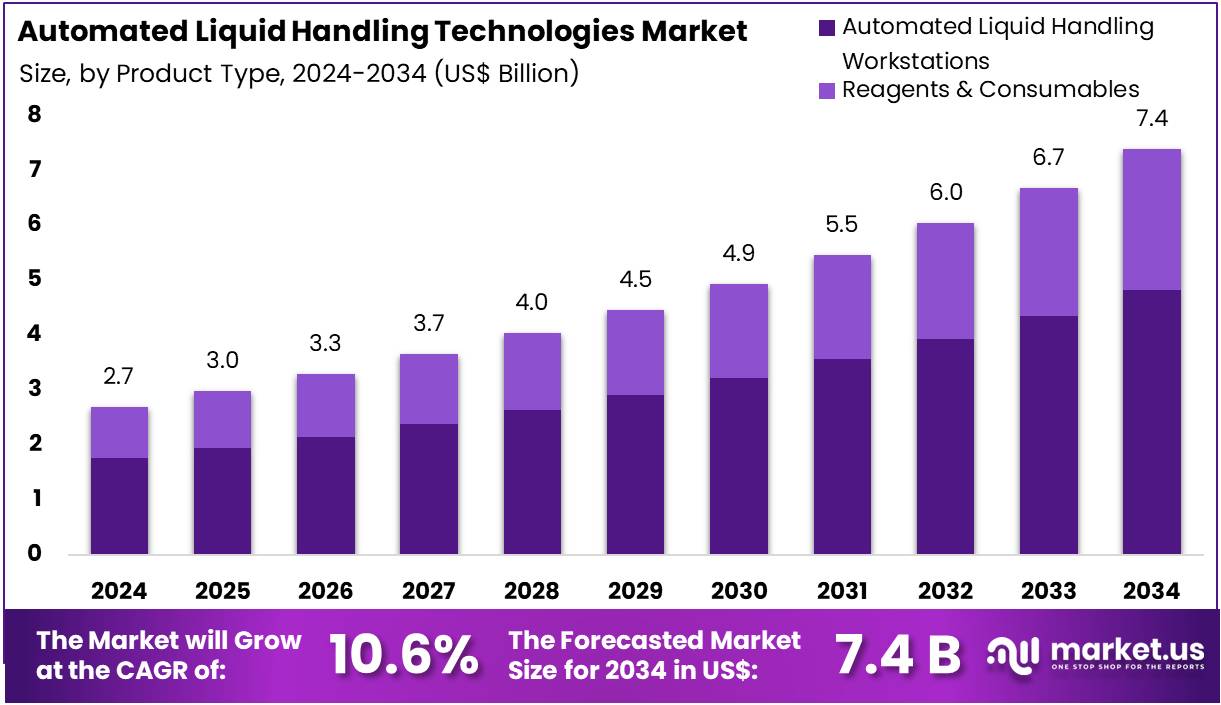
New York, NY – July 14, 2026 – Global Automated Liquid Handling Technologies Market Size is expected to be worth around US$ 7.4 Billion by 2034 from US$ 2.7 Billion in 2024, growing at a CAGR of 10.6% during the forecast period 2025 to 2034.
Automated liquid handling technologies are advanced laboratory systems designed to accurately dispense, transfer, mix, and manage liquid samples with minimal human intervention. These technologies play a vital role in improving the efficiency, precision, and reproducibility of laboratory workflows across pharmaceutical, biotechnology, clinical diagnostics, academic research, and life sciences applications. By automating repetitive pipetting and sample preparation tasks, liquid handling systems help reduce manual errors, increase throughput, and ensure consistent experimental results.
The growing adoption of automated liquid handling technologies is being driven by increasing demand for high-throughput screening, drug discovery, genomics, proteomics, and molecular diagnostics. These systems are capable of handling a wide range of sample volumes and can be integrated with robotic platforms, laboratory information management systems (LIMS), and analytical instruments to streamline laboratory operations.
Technological advancements, including artificial intelligence (AI), machine learning, and cloud-enabled laboratory automation, are further enhancing the capabilities of automated liquid handling systems by improving workflow optimization, data management, and remote monitoring. In addition, increasing investments in life sciences research, personalized medicine, and laboratory automation are supporting market expansion worldwide.
As laboratories continue to focus on operational efficiency, data accuracy, and regulatory compliance, automated liquid handling technologies are expected to remain an essential component of modern laboratory infrastructure, enabling faster research outcomes and improved productivity across a broad range of scientific and healthcare applications.
Key Takeaways
- In 2024, the automated liquid handling technologies market was valued at US$ 2.7 billion and is projected to reach US$ 7.4 billion by 2034, expanding at a CAGR of 10.6% during the forecast period.
- Based on product type, the market is segmented into automated liquid handling workstations and reagents & consumables. The automated liquid handling workstations segment dominated the market, accounting for 65.2% of the total market share in 2023.
- By application, the market is categorized into drug discovery & ADME-Tox research, bioprocessing/biotechnology, cancer & genomic research, and others. Among these, the drug discovery & ADME-Tox research segment held the largest share, representing 41.9% of the market in 2023.
- Based on end user, the market is classified into pharmaceutical & biotechnology companies, contract research organizations (CROs), and academic & research institutes. Pharmaceutical & biotechnology companies emerged as the leading end-user segment, capturing 52.3% of the market revenue in 2023.
- North America remained the leading regional market, accounting for 39.5% of the global automated liquid handling technologies market share in 2023.
Regional Analysis
North America Leads the Automated Liquid Handling Technologies Market
North America accounted for the largest share of the automated liquid handling technologies market, representing 39.5% of global revenue. Market growth is supported by substantial investments in life sciences research, a well-established pharmaceutical and biotechnology industry, and increasing demand for laboratory automation in drug discovery, genomics, and clinical diagnostics.
According to the U.S. National Science Foundation (NSF), total U.S. R&D expenditure reached US$ 892 billion in 2022 and was estimated to increase to US$ 940 billion in 2023, creating favorable conditions for the adoption of automated laboratory solutions. The presence of leading industry participants, including Thermo Fisher Scientific and Danaher Corporation, further strengthens regional market growth through continuous innovation and product development.
Asia Pacific to Register the Fastest Growth
Asia Pacific is expected to record the highest CAGR during the forecast period, driven by increasing R&D investments, expanding pharmaceutical and biotechnology industries, and improving healthcare infrastructure. Rising research expenditure in countries such as China, Japan, and Australia, coupled with growing demand for high-throughput laboratory technologies, is expected to accelerate the adoption of automated liquid handling systems across the region.
Emerging Trends
- Integration of Artificial Intelligence (AI) and Machine Learning: Artificial intelligence and machine learning are transforming automated liquid handling systems by improving dispensing accuracy, predicting workflow errors, optimizing protocols, and reducing manual intervention. These intelligent features enhance laboratory productivity, ensure consistent results, and support faster, more reliable research across life sciences applications.
- Growing Adoption of Miniaturized and Compact Systems: The demand for compact automated liquid handling systems is increasing as laboratories seek space-efficient solutions. These smaller platforms consume fewer reagents, lower operating costs, simplify maintenance, and provide high-performance automation, making them suitable for laboratories with limited infrastructure and growing testing requirements.
- Expansion into High-Throughput Screening: Automated liquid handling technologies are increasingly used in high-throughput screening to process thousands of samples rapidly and accurately. Their ability to accelerate compound screening, improve reproducibility, and shorten research timelines makes them essential for pharmaceutical, biotechnology, and drug discovery laboratories.
- Customization and Flexibility: Manufacturers are introducing modular and customizable liquid handling systems that adapt to diverse laboratory workflows. Flexible configurations allow users to expand functionality as needed, improve operational efficiency, reduce unnecessary investments, and support a wide range of research and diagnostic applications.
- Integration with Other Laboratory Automation Systems: Automated liquid handling platforms are being integrated with robotic systems, analytical instruments, and laboratory information management software. This interconnected approach streamlines workflows, minimizes manual intervention, improves data accuracy, and enhances productivity while supporting fully automated laboratory operations.
- Focus on User-Friendly Interfaces and Remote Monitoring: Modern liquid handling systems feature intuitive touchscreen interfaces and remote monitoring capabilities that simplify operation and maintenance. These technologies enable real-time performance tracking, faster troubleshooting, reduced downtime, and improved laboratory management, ensuring uninterrupted workflows and greater operational efficiency.
Use Cases
- Pharmaceutical Drug Discovery: Automated liquid handling technologies accelerate drug discovery by enabling precise liquid transfers and high-throughput compound screening. These systems reduce manual errors, improve reproducibility, shorten research timelines, and support pharmaceutical companies in identifying promising drug candidates more efficiently.
- Genomics and DNA Analysis: In genomics laboratories, automated liquid handling systems accurately prepare DNA and RNA samples for sequencing and genetic analysis. Their precision ensures consistent results, increases laboratory throughput, minimizes sample contamination, and supports advancements in genetic research and personalized healthcare.
- Clinical Diagnostics: Clinical laboratories use automated liquid handling systems to process patient samples accurately and efficiently. Automation improves diagnostic consistency, reduces testing errors, increases sample throughput, and enables healthcare providers to deliver faster diagnoses and timely treatment decisions for improved patient outcomes.
- Biotechnology Research: Biotechnology companies utilize automated liquid handling systems for protein analysis, cell culture preparation, and molecular biology workflows. Automation enhances experimental consistency, reduces repetitive manual tasks, supports complex laboratory procedures, and accelerates research aimed at developing innovative biotechnology products.
- Food and Environmental Testing: Automated liquid handling technologies improve food safety and environmental testing by accurately preparing samples for contaminant analysis. These systems increase testing speed, reduce human errors, enhance laboratory efficiency, and ensure reliable quality control across food, water, and environmental monitoring applications.
- Personalized Medicine: Automated liquid handling technologies support personalized medicine by enabling precise sample preparation and accurate reagent dispensing. They improve testing efficiency, reduce variability, and facilitate customized treatment development, helping healthcare providers deliver targeted therapies based on individual patient characteristics.
Frequently Asked Questions on Automated Liquid Handling Technologies
- What are automated liquid handling technologies?
Automated liquid handling technologies are laboratory automation systems that accurately transfer, dispense, mix, and prepare liquid samples with minimal human intervention. These systems improve precision, reduce manual errors, increase throughput, and enhance reproducibility across research, diagnostics, and pharmaceutical applications. - What is driving the growth of the automated liquid handling technologies market?
The market is expanding due to increasing demand for laboratory automation, rising investments in pharmaceutical and biotechnology research, growing adoption of high-throughput screening, and the need for accurate sample processing in drug discovery, genomics, and clinical diagnostics. - Which industries are the primary users of automated liquid handling technologies?
Pharmaceutical and biotechnology companies are the largest users of automated liquid handling technologies, followed by contract research organizations, clinical laboratories, academic institutions, and research centers that require efficient, precise, and scalable laboratory workflows. - What are the key benefits of automated liquid handling systems?
Automated liquid handling systems improve laboratory productivity by minimizing human error, increasing accuracy, reducing reagent waste, enhancing workflow efficiency, and enabling high-throughput sample processing. These advantages support faster research outcomes and greater consistency in laboratory operations. - Which application accounts for the largest share of the automated liquid handling technologies market?
Drug discovery and ADME-Tox research account for the largest market share because automated liquid handling systems accelerate compound screening, improve experimental accuracy, and support efficient testing throughout the pharmaceutical research and development process. - Which region leads the automated liquid handling technologies market?
North America holds the largest share of the automated liquid handling technologies market, supported by strong research funding, advanced healthcare infrastructure, leading biotechnology companies, and widespread adoption of laboratory automation across pharmaceutical and academic research facilities. - Which region is expected to grow the fastest in the automated liquid handling technologies market?
Asia Pacific is expected to register the fastest market growth due to increasing investments in life sciences research, expanding pharmaceutical manufacturing, improving healthcare infrastructure, and growing government support for biotechnology innovation and laboratory modernization. - What is the future outlook for the automated liquid handling technologies market?
The market is expected to experience strong long-term growth, supported by advances in artificial intelligence, robotics, and digital laboratory automation. Increasing demand for precision medicine, genomics research, and high-throughput testing will further accelerate technology adoption worldwide.
Conclusion
The automated liquid handling technologies market is poised for robust growth, driven by rising demand for laboratory automation, increasing investments in life sciences research, and continuous technological advancements. The integration of artificial intelligence, robotics, and digital laboratory solutions is improving workflow efficiency, accuracy, and scalability across pharmaceutical, biotechnology, and clinical applications.
North America continues to lead the market due to its strong research ecosystem, while Asia Pacific is expected to witness the fastest growth supported by expanding R&D activities and healthcare investments. As laboratories prioritize precision, productivity, and high-throughput capabilities, automated liquid handling technologies will remain a critical component of modern scientific research and diagnostic operations.
Discuss your needs with our analyst
Please share your requirements with more details so our analyst can check if they can solve your problem(s)




