


Overview
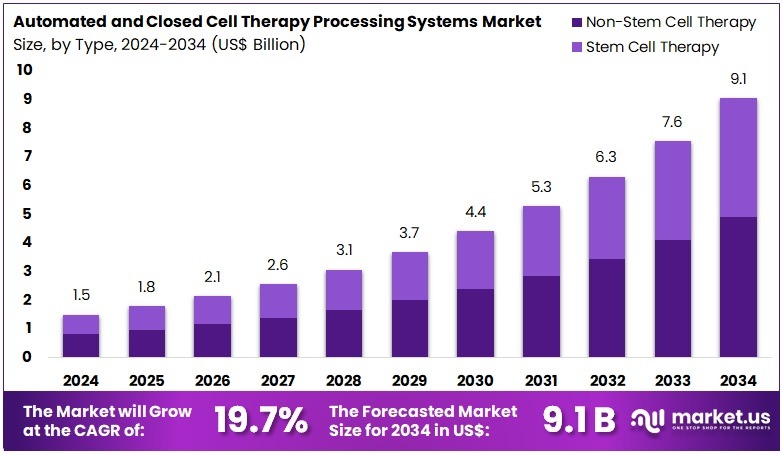
New York, NY – May 28, 2026 – The Global Automated and Closed Cell Therapy Processing Systems Market Size is expected to be worth around US$ 9.1 billion by 2034 from US$ 1.5 billion in 2024, growing at a CAGR of 19.7% during the forecast period 2025 to 2034. North America held a dominant market position, capturing more than a 42.4% share and holds US$ 0.6 Billion market value for the year.
Automated and closed cell therapy processing systems are advanced platforms designed to streamline the manufacturing and handling of cell-based therapies while minimizing contamination risks and improving operational efficiency. These systems integrate multiple processing steps, including cell isolation, expansion, washing, formulation, and cryopreservation, within a single closed environment. The growing demand for personalized medicine, regenerative therapies, and advanced biologics has significantly increased the adoption of automated cell therapy processing technologies across research institutes, biotechnology companies, and pharmaceutical manufacturers.
The market growth is supported by rising investments in cell and gene therapy development, increasing clinical trials, and the need for standardized manufacturing processes. Automated systems reduce manual intervention, improve reproducibility, and support compliance with stringent regulatory standards. In addition, closed systems help maintain sterility and product consistency, which are critical factors in large-scale commercial manufacturing.
Technological advancements such as artificial intelligence integration, real-time monitoring, and digital process control are further enhancing system capabilities. North America currently holds a significant share of the market due to strong research infrastructure and high healthcare investments, while Asia-Pacific is expected to witness rapid growth driven by expanding biotechnology sectors and supportive government initiatives. The market is anticipated to experience steady expansion in the coming years.
Key Takeaways
- The global automated and closed cell therapy processing systems market was valued at US$ 1.5 billion in 2023 and is projected to reach US$ 9.1 billion by 2033, expanding at a CAGR of 19.7% during the forecast period.
- Based on type, the market is categorized into stem cell therapy and non-stem cell therapy. Among these, the non-stem cell therapy segment dominated the market in 2023, accounting for a revenue share of 54.3%.
- By workflow, the market is segmented into cryopreservation, separation, fill-finish, expansion, apheresis, and others. The expansion segment emerged as the leading category, capturing 43.7% of the total market share in 2023.
- In terms of scale, the market is divided into commercial scale and R&D scale. The R&D scale segment held the dominant position with a revenue share of 57.8% in 2023.
- North America accounted for the largest regional share in the automated and closed cell therapy processing systems market, representing 42.4% of the global market revenue in 2023.
Regional Analysis
North America accounted for the largest share of the automated and closed cell therapy processing systems market in 2023, driven by a well-established cell therapy research ecosystem and a strong biopharmaceutical industry presence. Increasing investments in cell and gene therapy research, along with rising regulatory approvals for advanced therapies, have accelerated the demand for scalable and automated manufacturing solutions. The region also benefits from the presence of leading biotechnology companies, academic institutions, and substantial venture capital funding, which continue to support innovation and commercialization activities.
Meanwhile, the Asia Pacific region is projected to register the fastest CAGR during the forecast period due to expanding biotechnology investments and growing focus on cell therapy research and development. Countries such as China are witnessing rapid advancements in biopharmaceutical manufacturing and clinical trial activities.
In addition, increasing prevalence of chronic and target diseases, combined with supportive government initiatives for the biotechnology sector, is expected to boost the adoption of automated and closed cell therapy processing systems across the region.
Emerging Trends
- Shift Toward End-to-End Automation: Cell therapy companies are increasingly adopting fully automated systems to reduce manual handling, lower contamination risks, and improve production efficiency. End-to-end automation supports complete workflows from cell collection to formulation, helping manufacturers achieve faster turnaround times and consistent output across commercial and clinical operations.
- Customization for Specific Cell Types: Manufacturers are developing customized systems designed specifically for T-cells, NK cells, and dendritic cells to improve therapy performance. These tailored platforms enhance cell viability, growth, and recovery while supporting flexible protocols, leading to improved clinical success rates and better patient treatment outcomes.
- Miniaturization and Portability: Compact and modular cell therapy systems are gaining popularity due to their portability and lower infrastructure requirements. These platforms enable localized production within hospitals and small laboratories, reducing transportation costs and improving patient access to therapies, especially in decentralized and point-of-care healthcare settings.
- AI-Driven Process Optimization: Artificial intelligence and machine learning technologies are increasingly integrated into cell therapy systems to improve process monitoring and quality control. AI tools help detect errors, predict production outcomes, and optimize workflows in real time, resulting in fewer failed batches, reduced downtime, and greater operational efficiency.
- Increased Focus on Regulatory Readiness: Companies are prioritizing regulatory-ready cell therapy systems designed to comply with GMP and international manufacturing standards. Built-in compliance features improve transparency, reduce approval delays, and support safer large-scale commercialization, helping manufacturers accelerate the transition from clinical development to commercial production successfully.
Use Cases
- CAR-T Cell Therapy Manufacturing: Automated closed systems are widely used in CAR-T cell therapy manufacturing to improve precision and reduce contamination risks. These platforms streamline processes such as cell expansion and gene modification, helping hospitals and biotech companies accelerate cancer treatment production with greater consistency and operational efficiency.
- Allogeneic Cell Therapy Production: Automated systems support scalable production of allogeneic therapies by expanding donor-derived cells into large treatment volumes efficiently. Their closed design maintains product consistency and reduces contamination risks, making them highly suitable for commercial-scale therapies targeting leukemia, autoimmune diseases, and other chronic medical conditions.
- Clinical Trial Sample Processing: Cell therapy developers use automated closed systems during clinical trials to support flexible, small-batch production with reduced contamination risks. Configurable platforms allow multiple therapy studies simultaneously, improving process consistency, accelerating research timelines, and supporting faster development of innovative cell-based treatment approaches.
- Hospital-Based Point-of-Care Manufacturing: Hospitals are increasingly adopting compact closed systems for on-site cell therapy manufacturing within cleanroom environments. These platforms enable rapid same-day treatment preparation, reduce transportation dependency, and improve patient access to personalized therapies, particularly for urgent medical conditions requiring immediate therapeutic intervention.
- Gene Editing Workflow Integration: Automated systems are increasingly integrated into gene-editing workflows involving CRISPR and related technologies. These platforms automate washing, formulation, and concentration processes while reducing human error and improving traceability, supporting efficient production of advanced gene-edited therapies for cancer and rare disease treatments.
Frequently Asked Questions on Automated and Closed Cell Therapy Processing Systems
- What factors are driving the growth of the automated and closed cell therapy processing systems market?
The market growth is primarily driven by increasing investments in cell and gene therapy research, rising clinical trials, and growing demand for scalable manufacturing technologies. Advancements in automation and the need for standardized processing solutions are also contributing significantly to market expansion. - Which regions are leading the automated and closed cell therapy processing systems market?
North America currently leads the market due to strong biotechnology infrastructure, increasing research funding, and higher adoption of advanced manufacturing technologies. Meanwhile, Asia Pacific is emerging as the fastest-growing region supported by expanding biotechnology investments and increasing cell therapy development activities. - Why are closed processing systems important in cell therapy manufacturing?
Closed processing systems are important because they help maintain sterility, minimize contamination risks, and ensure product consistency throughout manufacturing. These systems also reduce manual intervention and improve compliance with stringent regulatory standards required for commercial-scale cell therapy production. - What are the major workflow segments in the automated and closed cell therapy processing systems market?
The market includes workflow segments such as expansion, cryopreservation, separation, fill-finish, apheresis, and others. Among these, the expansion segment holds a significant market share due to the increasing demand for large-scale cell cultivation during therapy development. - How is automation improving cell therapy manufacturing processes?
Automation enhances cell therapy manufacturing by reducing human errors, improving process reproducibility, and enabling real-time monitoring of production activities. It also helps manufacturers optimize workflow efficiency, lower operational costs, and accelerate the commercialization of advanced therapies. - Which end users are adopting automated and closed cell therapy processing systems?
Biotechnology companies, pharmaceutical manufacturers, research laboratories, and academic institutions are among the major end users adopting these systems. Increasing research collaborations and growing commercial production of cell therapies are further supporting adoption across these organizations. - What role does artificial intelligence play in automated cell therapy processing systems?
Artificial intelligence supports automated cell therapy processing by enabling predictive monitoring, process optimization, and advanced data analysis. AI-powered systems can improve manufacturing accuracy, reduce processing time, and enhance overall operational performance in cell therapy production facilities. - What is the future outlook for the automated and closed cell therapy processing systems market?
The market is expected to witness strong growth in the coming years due to rising demand for personalized medicine and regenerative therapies. Continuous technological advancements and increasing commercialization of cell therapies are anticipated to create significant market opportunities globally.
Conclusion
The automated and closed cell therapy processing systems market is witnessing substantial growth due to increasing demand for personalized medicine, regenerative therapies, and advanced biologics. Rising investments in cell and gene therapy research, coupled with advancements in automation, artificial intelligence, and process monitoring technologies, are accelerating market expansion globally.
North America continues to dominate the market owing to strong research infrastructure and biopharmaceutical investments, while Asia Pacific is emerging as the fastest-growing region. In addition, growing adoption of scalable and contamination-free manufacturing solutions across biotechnology companies, hospitals, and research institutions is expected to further support the commercialization and large-scale production of innovative cell-based therapies in the coming years.
Discuss your needs with our analyst
Please share your requirements with more details so our analyst can check if they can solve your problem(s)




