


Overview
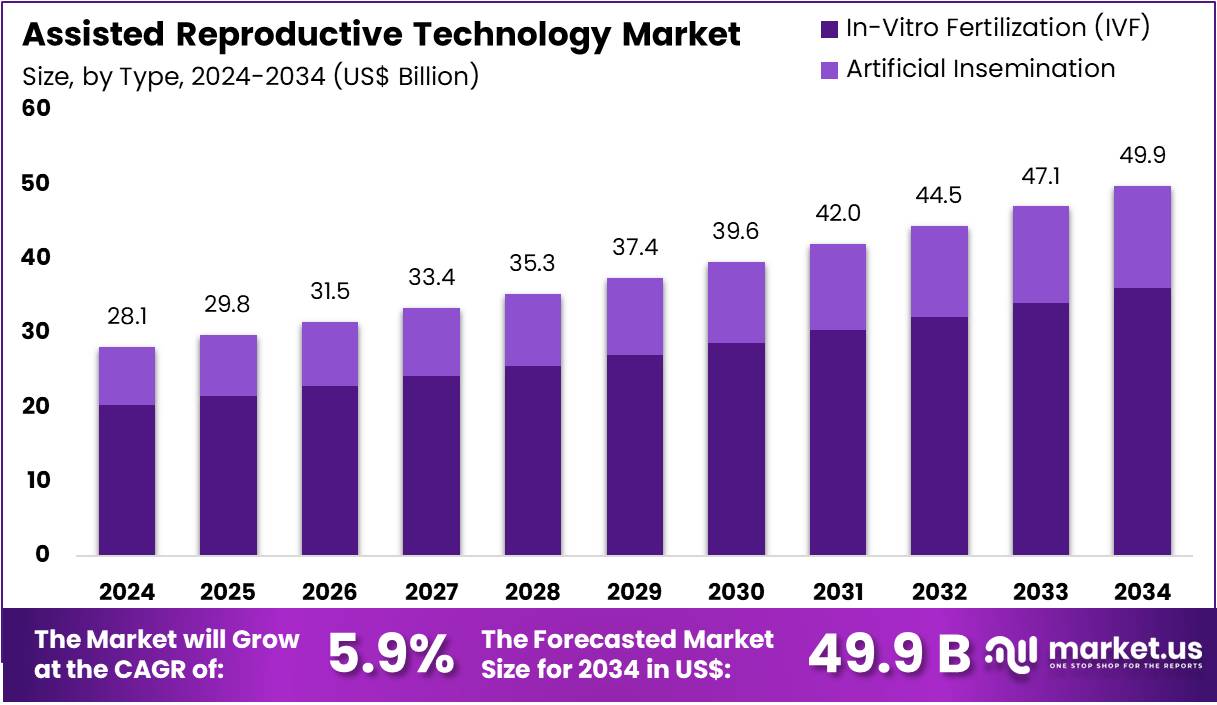
New York, NY – July 16, 2026 – The Global Assisted Reproductive Technology Market Size is expected to be worth around US$ 49.9 Billion by 2034, from US$ 28.1 Billion in 2024, growing at a CAGR of 5.9% during the forecast period from 2025 to 2034. North America held a dominant market position, capturing more than a 37.5% share and holds US$ 10.5 Billion market value for the year.
Assisted Reproductive Technology (ART) refers to a group of advanced medical procedures used to help individuals and couples achieve pregnancy by handling eggs, sperm, or embryos outside the human body. These technologies are widely used to address infertility caused by factors such as ovulation disorders, male infertility, age-related fertility decline, unexplained infertility, and certain genetic conditions.
The most commonly used ART procedure is In Vitro Fertilization (IVF), in which eggs are retrieved from the ovaries, fertilized with sperm in a laboratory, and the resulting embryo is transferred into the uterus. Other ART techniques include Intracytoplasmic Sperm Injection (ICSI), Frozen Embryo Transfer (FET), egg and sperm donation, embryo donation, and fertility preservation through egg, sperm, or embryo freezing.
Advancements in reproductive medicine have significantly improved ART success rates through enhanced laboratory techniques, genetic testing, embryo selection, and cryopreservation methods. These innovations have expanded treatment options for married couples, single individuals, same-sex couples, and cancer patients seeking fertility preservation before medical treatment.
The growing awareness of infertility, increasing maternal age, supportive healthcare policies in several countries, and continuous technological developments are contributing to the rising adoption of ART services worldwide. As a result, Assisted Reproductive Technology continues to play a vital role in improving reproductive healthcare and helping millions of people build families.
Key Takeaways
- The global assisted reproductive technology market was valued at US$ 28.1 billion in 2024 and is projected to reach US$ 49.9 billion by 2034, expanding at a CAGR of 5.9% during the forecast period.
- Based on type, the market is segmented into in-vitro fertilization (IVF) and artificial insemination. Among these, the in-vitro fertilization (IVF) segment dominated the market, accounting for a 72.5% share in 2023.
- By end user, the market is categorized into fertility clinics & other facilities and hospitals & other settings. The fertility clinics & other facilities segment held the largest market share of 66.3% in 2023.
- North America emerged as the leading regional market, capturing a 37.5% share of the global assisted reproductive technology market in 2023.
Assisted Reproductive Technology (ART) Statistics
- IVF Births (2022): A total of 91,771 babies were born through IVF in the United States, representing 2.5% of all births and a 2.5% increase compared with 2021.
- Growing ART Demand: The number of ART treatment cycles increased by 6%, reaching 389,993 cycles in 2022, indicating rising demand for fertility treatments.
- Egg Freezing Growth: Egg-freezing procedures increased from 24,560 cycles in 2021 to 29,803 cycles in 2022, reflecting greater interest in fertility preservation.
- Single Embryo Transfer Adoption: The use of elective Single Embryo Transfer (eSET) continued to increase, reducing the incidence of multiple births from 5% to 4%.
- Safer Pregnancy Outcomes: Approximately 73.9% of ART cycles in 2022 involved a single embryo transfer, contributing to improved maternal and neonatal health outcomes.
- Singleton Births: Nearly 96% of babies conceived through ART in 2022 were singleton births, compared with 80% in 2015.
- Live Birth Success by Age: Live birth rates per intended egg retrieval were 43.1% for women under 35, 31.0% for ages 35–37, 19.0% for ages 38–40, and 3.2% for women over 42.
- ART Activity in 2021: In the United States, 238,126 patients underwent 413,776 ART cycles across 453 fertility clinics, resulting in 91,906 live births and 97,128 infants.
- Egg and Embryo Banking: Around 167,689 ART cycles in 2021 were performed for egg or embryo cryopreservation for future reproductive use.
- Historical ART Growth: More than 140,000 ART procedures were conducted in the United States in 2006, resulting in approximately 55,000 births.
- Initial Fertility Evaluation Costs: Fertility assessments generally cost between US$1,600 and US$3,100, depending on diagnostic procedures performed.
- IVF Treatment Costs: A single IVF treatment cycle in the United States typically ranges from US$15,600 to US$46,800, depending on treatment complexity.
- Insurance Coverage Impact: States with mandated fertility insurance coverage report 278% higher utilization of fertility treatment services.
Regional Analysis
North America Leads the Assisted Reproductive Technology Market, While Asia Pacific Records the Fastest Growth
North America accounted for 37.5% of the global assisted reproductive technology (ART) market and maintained its leading position due to rising infertility rates, increasing acceptance of fertility treatments, and advanced healthcare infrastructure. The growing number of IVF procedures reflects strong market demand, supported by improved access to fertility services and expanding insurance and employer-sponsored coverage. The continued decline in fertility rates has further encouraged individuals and couples to seek assisted reproductive treatments.
Meanwhile, the Asia Pacific region is projected to register the fastest growth during the forecast period. Market expansion is driven by increasing infertility prevalence, rising disposable incomes, greater awareness of fertility treatments, and the rapid development of fertility clinics.
Countries such as China and India are key contributors, offering cost-effective treatment options and attracting medical tourists. In addition, advancements in IVF technologies, embryo selection techniques, and genetic testing, coupled with supportive government initiatives and growing social acceptance of ART, are expected to accelerate regional market growth.
Emerging Trends
- Cryopreservation Advancements: Cryopreservation has advanced with vitrification, a rapid-freezing technique that prevents ice crystal formation and improves the survival of eggs, sperm, and embryos. Compared with conventional slow freezing, vitrification increases cell viability, enhances pregnancy success rates, and has become the preferred preservation method in assisted reproductive technology.
- In-Vitro Fertilization (IVF) Enhancements: IVF procedures have improved through innovations such as intracytoplasmic sperm injection, assisted hatching, and preimplantation genetic testing. These technologies increase fertilization rates, improve embryo implantation, identify genetic abnormalities before transfer, and enhance overall treatment effectiveness, resulting in better clinical and pregnancy outcomes.
- INVOcell Technology: INVOcell technology enables fertilization and early embryo development inside the woman’s body using a specialized device instead of a laboratory incubator. This approach lowers treatment costs, provides a natural developmental environment, supports embryo growth, and expands access to affordable fertility treatment options.
- Endometrial Receptivity Array (ERA): The Endometrial Receptivity Array is a personalized diagnostic test that analyzes endometrial gene expression to determine the optimal implantation window. By identifying the most receptive timing for embryo transfer, ERA improves implantation success, enhances pregnancy outcomes, and supports individualized fertility treatment strategies.
- Artificial Intelligence (AI) Integration: Artificial intelligence is transforming assisted reproductive technology by improving embryo selection, predicting treatment success, and optimizing clinical decision-making. AI analyzes extensive clinical and imaging data to identify high-quality embryos, enhance treatment precision, reduce subjectivity, and improve overall fertility treatment outcomes and efficiency.
Use Cases
- Infertility Treatment: Assisted reproductive technology is widely used to treat infertility by enabling fertilization outside the body and transferring healthy embryos into the uterus. Techniques such as IVF and ICSI provide effective solutions for couples facing conception challenges, improving pregnancy rates and supporting family-building goals.
- Cancer Patients: Cancer patients use assisted reproductive technology for fertility preservation by freezing eggs, sperm, or embryos before undergoing chemotherapy or radiation treatment. Cryopreservation safeguards future reproductive potential, allowing patients to pursue biological parenthood after successful cancer treatment and long-term recovery from the disease.
- Single Mothers and Same-Sex Couples: Assisted reproductive technology enables single women and same-sex couples to achieve parenthood through donor sperm, donor eggs, embryo donation, or surrogacy. Expanding social acceptance and improved fertility services have increased access, supporting diverse family structures and broader reproductive choices for intended parents.
- Genetic Screening: Preimplantation genetic testing is used to screen embryos for inherited genetic disorders and chromosomal abnormalities before implantation. This technology helps select healthier embryos, lowers the risk of transmitting genetic diseases, improves pregnancy outcomes, and benefits families with hereditary conditions or recurrent pregnancy loss.
Frequently Asked Questions on Assisted Reproductive Technology
- What are the most common types of Assisted Reproductive Technology?
The most widely used ART procedures include in vitro fertilization (IVF), intracytoplasmic sperm injection (ICSI), frozen embryo transfer (FET), artificial insemination, egg donation, sperm donation, embryo donation, and fertility preservation through egg, sperm, or embryo freezing for future reproductive use. - Who can benefit from Assisted Reproductive Technology?
ART is beneficial for individuals and couples experiencing infertility due to age-related fertility decline, ovulation disorders, male infertility, unexplained infertility, genetic conditions, or medical treatments that may affect fertility. It also supports fertility preservation and family planning for diverse patient groups. - What factors are driving the adoption of Assisted Reproductive Technology?
The adoption of ART is increasing due to rising infertility rates, delayed parenthood, technological advancements in reproductive medicine, greater awareness of fertility treatments, supportive healthcare policies, and improved success rates achieved through advanced laboratory techniques and embryo selection methods. - What is driving the growth of the Assisted Reproductive Technology market?
Market growth is driven by increasing infertility prevalence, delayed pregnancies, rising healthcare expenditure, growing awareness of fertility treatment options, expanding fertility clinic networks, favorable reimbursement in selected countries, and continuous innovations in IVF procedures, embryo culture, and genetic testing technologies. - Which region dominates the Assisted Reproductive Technology market?
North America currently holds the largest share of the Assisted Reproductive Technology market due to its advanced healthcare infrastructure, high adoption of fertility treatments, increasing number of IVF cycles, favorable regulatory environment, and strong presence of leading fertility clinics and technology providers. - Which region is expected to witness the fastest market growth?
The Asia Pacific region is expected to record the highest growth during the forecast period, supported by increasing infertility rates, improving healthcare infrastructure, expanding fertility clinics, rising disposable incomes, government initiatives, and affordable treatment options that also encourage medical tourism. - What are the future trends in the Assisted Reproductive Technology market?
Future market trends include greater adoption of artificial intelligence in embryo selection, expanded fertility preservation services, increased use of genetic testing, automation in IVF laboratories, personalized reproductive treatments, and broader access to fertility care through technological advancements and supportive healthcare policies.
Conclusion
The global assisted reproductive technology (ART) market is poised for steady growth, driven by rising infertility rates, delayed parenthood, increasing awareness, and continuous technological advancements. Innovations such as AI-assisted embryo selection, vitrification, genetic testing, and personalized fertility treatments are improving clinical success rates and expanding treatment accessibility.
North America continues to lead the market due to advanced healthcare infrastructure, while Asia Pacific is expected to witness the fastest growth owing to expanding fertility services and medical tourism. As healthcare systems increasingly support reproductive care, ART will remain a vital component of modern medicine, enabling millions of individuals and couples worldwide to achieve parenthood.
Discuss your needs with our analyst
Please share your requirements with more details so our analyst can check if they can solve your problem(s)




