


Overview
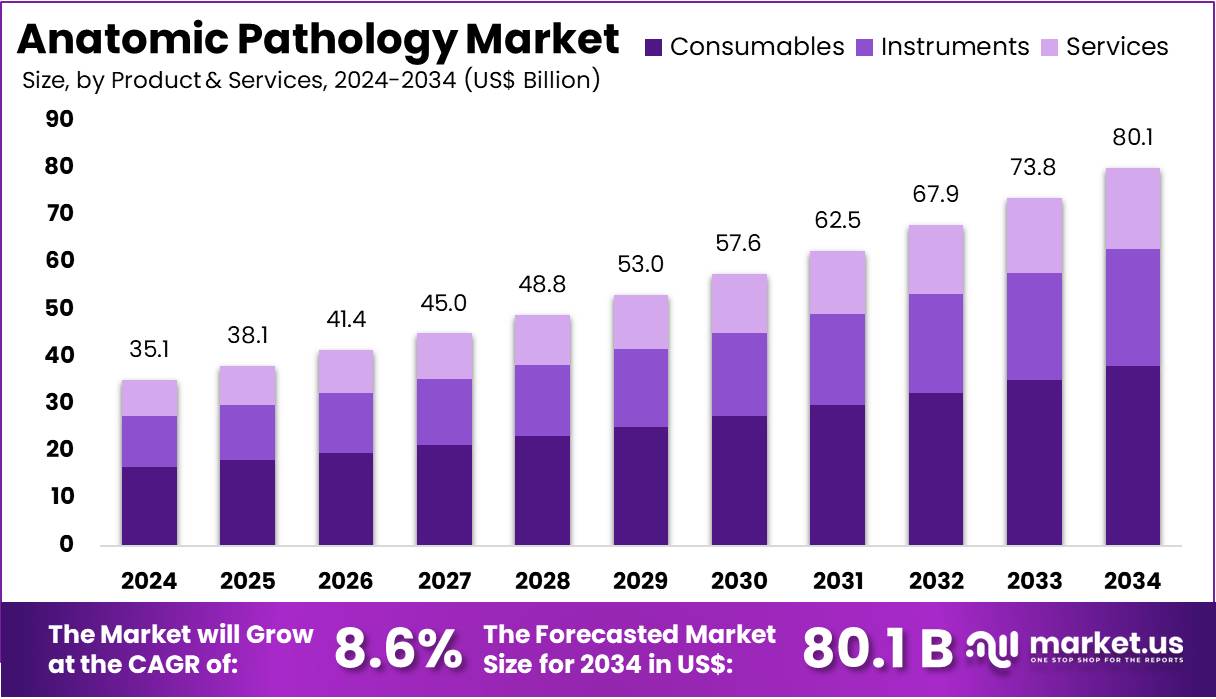
New York, NY – May 06, 2026 – The Anatomic Pathology Market size is expected to be worth around US$ 80.1 Billion by 2034 from US$ 35.1 Billion in 2024, growing at a CAGR of 8.6% during the forecast period 2025 to 2034. North America held a dominant market position, capturing more than a 40.3% share and holds US$ 14.1 Billion market value for the year.
Anatomic pathology represents a fundamental branch of diagnostic medicine focused on the examination of organs, tissues, and cells to identify disease. It plays a critical role in modern healthcare systems by enabling accurate diagnosis, prognosis, and treatment planning across a wide range of medical conditions, including cancer, infectious diseases, and inflammatory disorders.
The discipline primarily involves histopathology, cytopathology, and autopsy evaluation. Tissue samples obtained through biopsies or surgical procedures are processed and examined microscopically to detect structural and cellular abnormalities. Advanced techniques such as immunohistochemistry and molecular diagnostics are increasingly integrated, improving diagnostic precision and supporting personalized treatment approaches.
The demand for anatomic pathology services has been steadily increasing, driven by the rising global burden of chronic diseases, particularly oncology-related cases. It is estimated that cancer diagnostics account for a significant proportion of pathology workloads, reinforcing the importance of timely and accurate tissue-based analysis.
Technological advancements, including digital pathology and artificial intelligence, are transforming laboratory workflows by enhancing efficiency, enabling remote consultations, and supporting data-driven decision-making. These innovations are expected to improve diagnostic turnaround times and expand access to specialized expertise.
Overall, anatomic pathology continues to serve as a cornerstone of evidence-based medicine, supporting clinicians in delivering effective and targeted patient care while contributing to ongoing medical research and innovation.
Key Takeaways
- In 2023, the anatomic pathology market generated revenue of US$ 35.1 billion and is projected to reach US$ 80.1 billion by 2033, expanding at a CAGR of 8.6%.
- Within the product and services segmentation, the market is categorized into instruments, consumables, and services, with consumables emerging as the leading segment, accounting for a 47.6% share in 2023.
- Based on application, the market is segmented into disease diagnosis, drug discovery and development, and other applications. Disease diagnosis dominated this segment, contributing 54.2% of the total market share.
- By end user, the market is classified into hospitals, research laboratories, diagnostic laboratories, and others. Hospitals represented the largest share, holding 49.8% of total revenue in 2023.
- Regionally, North America led the global anatomic pathology market, capturing a 40.3% share in 2023.
Regional Analysis
North America led the anatomic pathology market in 2023, accounting for a revenue share of 40.3%. This dominance has been supported by continuous advancements in digital pathology and the growing volume of cancer diagnostics. The introduction of next-generation digital pathology platforms, including innovations by F. Hoffmann-La Roche Ltd, has improved collaboration among medical professionals through seamless sharing of high-resolution pathology images. The adoption of whole-slide imaging and artificial intelligence-based analysis has enhanced diagnostic accuracy while improving laboratory efficiency.
The increasing prevalence of chronic conditions such as cancer, neurodegenerative, and autoimmune diseases has further strengthened demand for advanced pathology solutions. Investments in laboratory automation and telepathology have expanded access to specialized diagnostic services, while government initiatives promoting early disease detection and precision medicine have accelerated technology adoption across healthcare institutions.
Asia Pacific is projected to register the fastest CAGR over the forecast period. Growth is being driven by rising cancer incidence and expanding healthcare infrastructure across key markets such as China, India, and Japan. Increased investments in laboratory modernization, along with the adoption of AI-driven diagnostics and telepathology, are expected to enhance accessibility, improve workflow efficiency, and support sustained market expansion.
Emerging Trends
- Digital Pathology Is Replacing Glass Slides: Digital pathology is replacing traditional microscopes by using high-resolution images instead of glass slides. This enables easier analysis, faster workflows, remote collaboration, improved data storage, and supports artificial intelligence integration in diagnostics.
- Telepathology Enables Remote Access: Telepathology allows pathologists to access and review digital slides remotely. It improves diagnostic access in underserved regions, enables faster consultations, supports real-time collaboration, and enhances medical education through remote case sharing.
- Virtual Staining is an Emerging Technique: Virtual staining uses artificial intelligence to simulate stained tissue images digitally, eliminating chemical processes. It reduces preparation time, minimizes errors, preserves samples, and offers a faster, cost-effective alternative in pathology workflows.
- Molecular Techniques are Now Integrated: Molecular pathology integrates genetic and biomarker analysis with tissue examination. This approach enhances diagnostic accuracy, supports personalized treatment strategies, enables targeted therapies, and improves patient outcomes through precision medicine advancements.
Use Cases
- Cancer Diagnosis and Classification: Anatomic pathology is widely used in cancer diagnosis by examining tissue samples to detect and classify tumors. It helps determine cancer type, progression, and guides treatment decisions, ensuring accurate and effective patient management.
- Surgical Pathology During Operations: Surgical pathology provides rapid tissue analysis during operations using frozen sections. It helps surgeons make immediate decisions, reduces the need for repeat procedures, and improves outcomes in time-sensitive and complex surgical cases.
- Monitoring Organ Transplant Rejections: Anatomic pathology plays a key role in monitoring transplanted organs by analyzing tissue samples for rejection signs. Early detection allows timely medical intervention, helping preserve organ function and improve long-term patient survival rates.
- Identifying Infectious Diseases: Anatomic pathology helps identify infections by examining tissue samples using specialized staining and molecular techniques. It detects bacteria, viruses, and fungi, enabling accurate diagnosis and supporting appropriate treatment, especially in complex or rare cases.
Frequently Asked Questions on Anatomic Pathology
- What are the key components of anatomic pathology?
Anatomic pathology primarily includes histopathology, cytopathology, and autopsy services. These components involve examining tissue biopsies, cell samples, and post-mortem analyses to detect disease presence, progression, and underlying causes with a high degree of diagnostic accuracy. - What factors are driving the growth of the anatomic pathology market?
Market growth is driven by the rising prevalence of cancer and chronic diseases, increasing demand for early diagnosis, and advancements in digital pathology. Expanding healthcare infrastructure and growing adoption of personalized medicine further contribute to sustained market expansion globally. - What role does technology play in anatomic pathology?
Technological advancements such as digital pathology, artificial intelligence, and molecular diagnostics have enhanced diagnostic precision and workflow efficiency. These innovations enable faster image analysis, remote consultations, and improved data management, supporting more accurate and timely clinical decisions. - Which segment dominates the anatomic pathology market by application?
Disease diagnosis dominates the application segment, as pathology testing is essential for identifying and monitoring various conditions, particularly cancer. The increasing need for accurate diagnostic tools continues to strengthen this segment’s contribution to overall market revenue. - Who are the major end users in the anatomic pathology market?
Hospitals represent the largest end-user segment due to high patient volumes and access to advanced diagnostic infrastructure. Diagnostic laboratories and research institutions also play significant roles in supporting disease detection, clinical studies, and drug development activities. - Which region leads the anatomic pathology market?
North America leads the global anatomic pathology market, supported by strong healthcare infrastructure, early adoption of advanced technologies, and high investment in research and development. The region also benefits from a high prevalence of chronic diseases requiring diagnostic services.
Conclusion
The anatomic pathology market demonstrates strong growth potential, driven by increasing disease burden, technological advancements, and expanding healthcare infrastructure. The integration of digital pathology, artificial intelligence, and molecular diagnostics has significantly enhanced diagnostic accuracy and operational efficiency.
North America maintains market leadership, while Asia Pacific is emerging as a high-growth region. Key segments such as consumables, disease diagnosis, and hospital end users continue to dominate revenue contribution.
Additionally, evolving trends including telepathology and virtual staining are reshaping diagnostic practices. Overall, the market is positioned for sustained expansion, supported by innovation and rising demand for precision medicine.
Discuss your needs with our analyst
Please share your requirements with more details so our analyst can check if they can solve your problem(s)




