


Overview
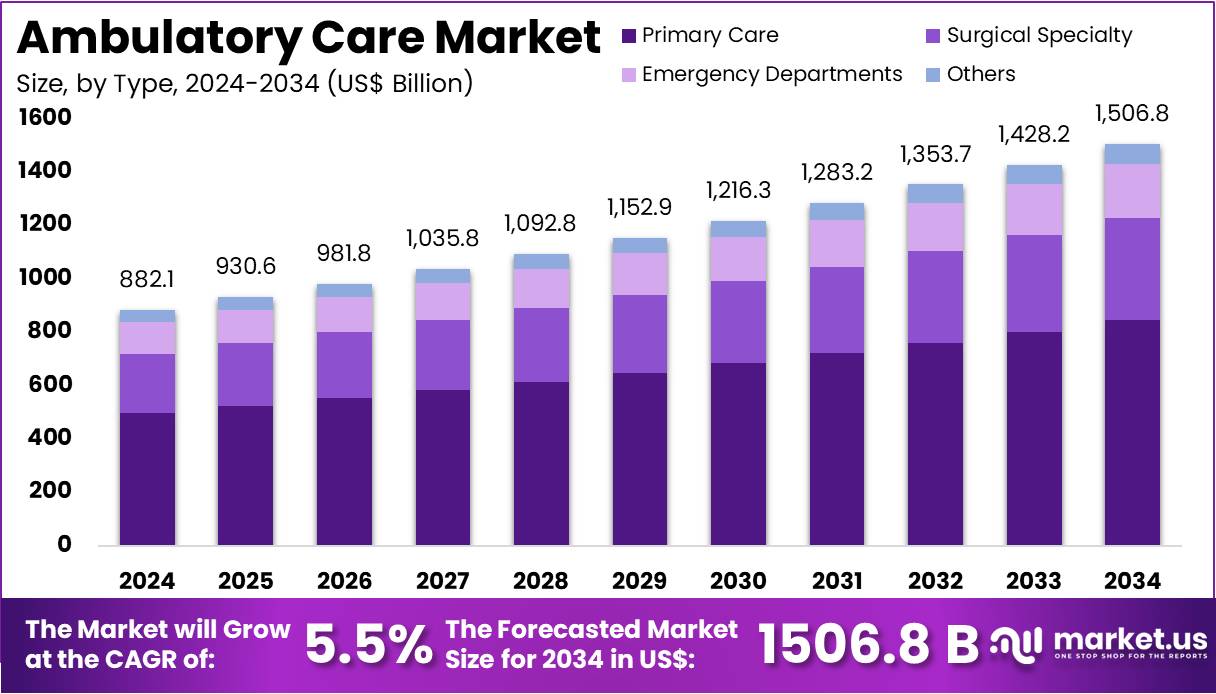
New York, NY – May 23, 2026 – The Ambulatory care Market Size is expected to be worth around US$ 1506.8 billion by 2034 from US$ 882.1 billion in 2024, growing at a CAGR of 5.5% during the forecast period 2025 to 2034. North America held a dominant market position, capturing more than a 41.7% share and holds US$ 367.8 Billion market value for the year.
The ambulatory care market is experiencing significant growth due to the increasing demand for cost-effective healthcare services, rising prevalence of chronic diseases, and growing preference for outpatient treatment settings. Ambulatory care refers to medical services provided without hospital admission, including diagnosis, treatment, preventive care, and minor surgical procedures performed in outpatient facilities such as clinics, ambulatory surgical centers, and physician offices.
The market expansion is being supported by advancements in minimally invasive procedures, improved healthcare infrastructure, and the adoption of digital health technologies. Healthcare providers are increasingly shifting toward outpatient care models to reduce hospitalization costs and enhance patient convenience. In addition, favorable government initiatives promoting accessible and affordable healthcare services are contributing to market growth.
Chronic conditions such as cardiovascular diseases, diabetes, respiratory disorders, and orthopedic problems are increasing globally, leading to higher demand for ambulatory care services. The aging population and rising healthcare awareness are also supporting market development. Furthermore, technological innovations including telehealth platforms, electronic health records, and remote patient monitoring systems are improving operational efficiency and patient outcomes in ambulatory care settings.
North America holds a substantial share of the ambulatory care market due to advanced healthcare systems and high healthcare spending, while Asia-Pacific is expected to witness rapid growth driven by expanding healthcare infrastructure, urbanization, and increasing investments in healthcare services. The market is expected to continue expanding steadily during the forecast period.
Key Takeaways
- In 2024, the ambulatory care market was valued at US$ 882.1 billion and is projected to reach US$ 1,506.8 billion by 2033, registering a CAGR of 5.5% during the forecast period.
- Based on type, the market is segmented into primary care, surgical specialty, emergency departments, and others. Among these, the primary care segment dominated the market in 2024, accounting for a 56.2% share.
- By application, the market is categorized into gastroenterology, ophthalmology, orthopedics, and others. The gastroenterology segment held the largest market share of 45.7% in 2024.
- North America emerged as the leading regional market, capturing a 41.7% share of the global ambulatory care market in 2024.
Regional Analysis
North America dominated the ambulatory care market in 2024, accounting for the largest revenue share of 41.7%. The regional market growth is driven by the increasing demand for cost-effective outpatient healthcare services, rising adoption of minimally invasive procedures, and expanding telehealth utilization.
The Centers for Medicare & Medicaid Services (CMS) reported a 12% increase in outpatient visits in the United States between 2022 and 2023, while Medicare spending on ambulatory services rose by US$ 8.5 billion during the same period. Additionally, the American Hospital Association (AHA) recorded a 15% increase in freestanding ambulatory surgery centers in 2023, reflecting a growing preference for outpatient treatment settings. Government initiatives supporting ambulatory care expansion and rising approvals for outpatient medical devices further contributed to regional market growth.
Asia Pacific is anticipated to register the fastest CAGR during the forecast period owing to increasing healthcare investments, growing chronic disease burden, and expanding access to outpatient services. Countries such as China, India, Japan, and Australia are witnessing strong growth in same-day surgeries, standalone clinics, and outpatient consultations. Furthermore, increasing medical tourism, healthcare digitalization, and adoption of AI-driven diagnostic technologies are expected to support long-term market expansion across the region.
Emerging Trends
- Growth of Telemedicine and Virtual Visits: Ambulatory care providers are increasingly adopting telemedicine services to offer virtual consultations for minor illnesses, follow-ups, and mental health support. This trend improves patient convenience, reduces waiting times, enhances healthcare accessibility, and allows clinics to manage larger patient volumes efficiently.
- Shift Toward Preventive and Routine Care: Outpatient centers are focusing more on preventive healthcare services such as vaccinations, screenings, chronic disease monitoring, and routine checkups. This approach supports early disease detection, lowers healthcare costs, reduces hospital admissions, and improves long-term patient health outcomes significantly.
- Rise in Outpatient Surgeries: Advancements in minimally invasive procedures and anesthesia technologies are increasing the number of same-day surgeries performed in ambulatory surgery centers. Patients benefit from faster recovery, reduced hospitalization expenses, lower infection risks, and greater convenience through home-based post-surgical recovery.
- Integrated Digital Health Records: The adoption of electronic health records across ambulatory care facilities is improving healthcare coordination and patient management. Digital systems enable faster access to medical histories, streamline referrals and prescriptions, reduce medical errors, and support personalized treatment planning for patients.
- Focus on Patient Experience and Convenience: Ambulatory care centers are enhancing patient satisfaction through online appointment systems, shorter waiting times, digital check-ins, and patient portals. Improved communication, comfortable environments, and efficient healthcare delivery are helping outpatient facilities attract and retain a larger patient population.
- Expansion in Rural and Underserved Areas: Healthcare providers are expanding ambulatory care services into rural and underserved regions through community clinics, telehealth, and mobile healthcare units. This expansion improves healthcare accessibility, supports early diagnosis, reduces travel burdens, and strengthens healthcare delivery in remote populations.
Use Cases
- Routine Checkups and Preventive Care: Ambulatory care centers provide regular health examinations, vaccinations, screenings, and laboratory testing to support preventive healthcare. These services help detect diseases early, reduce long-term treatment costs, and encourage patients to maintain healthier lifestyles through continuous medical monitoring.
- Chronic Disease Management: Patients with long-term conditions such as diabetes, asthma, and hypertension frequently use ambulatory care services for monitoring and treatment. These centers provide medication management, lifestyle counseling, and routine evaluations, helping reduce emergency visits and improve disease control effectively.
- Minor Surgeries and Procedures: Ambulatory surgery centers perform same-day procedures including cataract surgeries, endoscopies, hernia repairs, and orthopedic treatments. These facilities offer efficient surgical care, faster patient discharge, lower operational costs, and reduced risk of hospital-acquired infections compared to traditional hospitals.
- Post-Surgery Follow-Up Visits: Outpatient centers provide follow-up care after surgeries through wound assessments, rehabilitation services, and recovery monitoring. These visits help ensure proper healing, prevent complications, support patient recovery, and reduce unnecessary hospital readmissions through continuous medical supervision and guidance.
- Urgent but Non-Emergency Care: Ambulatory care facilities treat non-life-threatening conditions such as cuts, fractures, infections, allergies, and sprains. These centers offer quick medical attention, diagnostic services, and affordable treatment options, reducing emergency room overcrowding while improving patient access to timely healthcare services.
- Mental Health and Counseling: Many ambulatory care centers offer outpatient mental health services including therapy, counseling, medication management, and support programs. These services provide accessible and continuous mental healthcare, helping patients manage stress, anxiety, depression, and emotional well-being without hospitalization.
Frequently Asked Questions on Ambulatory care
The global ambulatory care market is witnessing substantial growth due to the increasing demand for convenient, cost-effective, and high-quality outpatient healthcare services. Ambulatory care refers to medical services provided without the need for hospital admission, including preventive care, diagnosis, treatment, rehabilitation, and minor surgical procedures conducted in outpatient facilities such as clinics, physician offices, and ambulatory surgical centers.
Market growth is being driven by the rising prevalence of chronic diseases, growing aging population, and increasing preference for minimally invasive procedures that allow faster recovery and reduced hospitalization costs. Technological advancements, including telehealth services, remote patient monitoring, electronic health records, and AI-based diagnostic systems, are further improving patient management and operational efficiency in ambulatory care settings.
Healthcare providers and governments are increasingly focusing on expanding outpatient infrastructure to reduce pressure on hospitals and improve healthcare accessibility. Favorable reimbursement policies and growing investments in healthcare facilities are also supporting market expansion. In addition, the increasing adoption of same-day surgeries and personalized treatment approaches is contributing to rising patient preference for ambulatory care services.
North America currently dominates the market due to advanced healthcare infrastructure and strong outpatient service adoption, while Asia Pacific is expected to witness the fastest growth driven by healthcare modernization, rising medical tourism, and expanding healthcare access across developing economies.
Conclusion
The ambulatory care market is expected to witness steady growth due to rising demand for affordable and efficient outpatient healthcare services. Increasing prevalence of chronic diseases, expanding aging population, and growing adoption of minimally invasive procedures are supporting market expansion globally.
Technological advancements such as telehealth, electronic health records, and AI-based diagnostic solutions are further improving patient care and operational efficiency. North America continues to lead the market owing to advanced healthcare infrastructure, while Asia Pacific is projected to experience the fastest growth driven by healthcare investments and improving accessibility. Continuous innovation and preventive healthcare adoption will further strengthen market development.
Discuss your needs with our analyst
Please share your requirements with more details so our analyst can check if they can solve your problem(s)




