


Overview
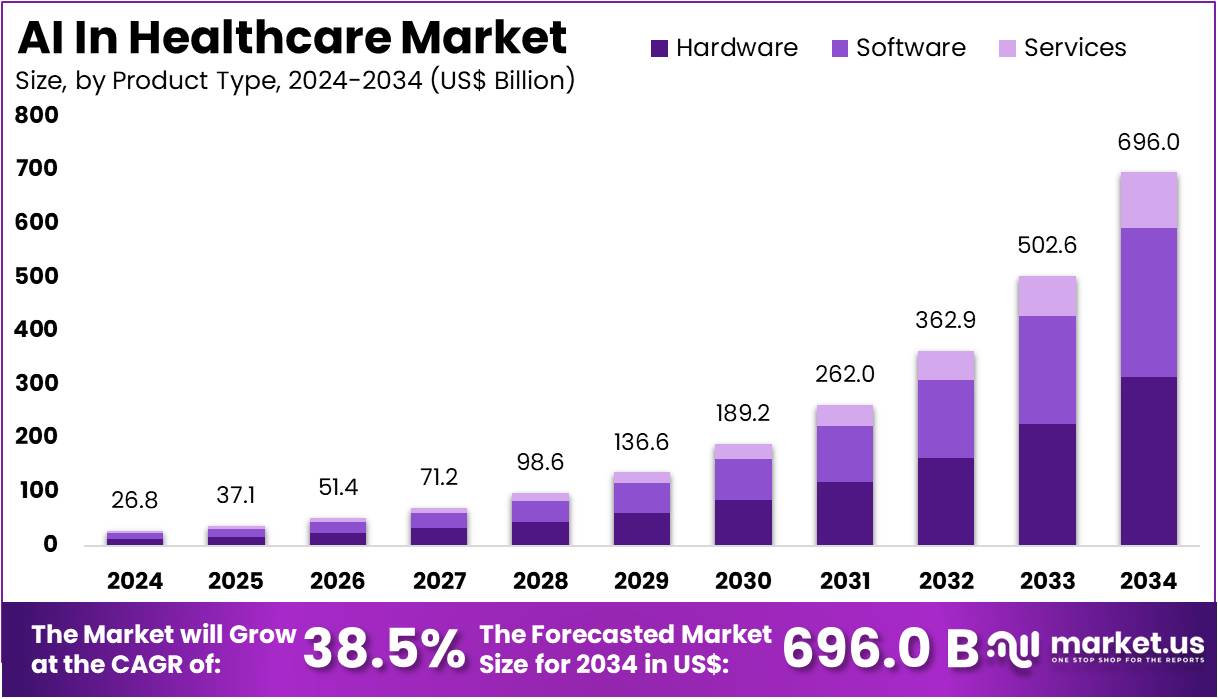
New York, NY – July 01, 2026 – The AI In Healthcare Market Size is expected to be worth around US$ 696.0 billion by 2034 from US$ 26.8 billion in 2024, growing at a CAGR of 38.5% during the forecast period 2025 to 2034.
Artificial intelligence in healthcare is emerging as a transformative technology that enhances clinical decision-making, patient care and operational efficiency across healthcare systems worldwide. The integration of AI driven tools is supporting early disease detection, medical imaging analysis, drug discovery and personalized treatment planning.
The market growth of AI in healthcare can be attributed to increasing demand for efficient diagnostics, rising healthcare data volumes and advancements in machine learning algorithms. Healthcare providers are adopting AI solutions to reduce operational costs, improve accuracy and enhance patient outcomes. Furthermore integration of AI with electronic health records and wearable devices is improving real time monitoring capabilities.
The expansion of cloud computing infrastructure and data interoperability is further accelerating adoption. Challenges such as data privacy, regulatory compliance and algorithm bias continue to be addressed through ongoing technological improvements and policy frameworks. The outlook for AI in healthcare remains strongly positive driven by continuous innovation and increasing investment across global healthcare ecosystems.
Stakeholders are expected to benefit from improved efficiency reduced costs and enhanced clinical decision support systems enabling more precise and scalable healthcare delivery models across developed and emerging markets with increasing adoption in hospitals clinics and research institutions worldwide. The technology is also expected to support preventive healthcare strategies and population health management systems through advanced predictive analytics and data driven insights enabling better
Key Takeaways
- In 2024, the AI in healthcare market generated revenue of US$ 26.8 billion and is projected to reach US$ 696.0 billion by 2034, registering a CAGR of 38.5% during the forecast period.
- By product type, the market is segmented into hardware, software, and services, with the hardware segment leading the market, accounting for a 45.3% share.
- Based on technology, the market comprises machine learning, natural language processing, context-aware computing, and computer vision. Among these, machine learning dominated with a 46.2% market share.
- By application, the market includes several use cases, with robot-assisted surgery emerging as the leading segment, capturing a 25.4% revenue share.
- Based on end user, the market is categorized into healthcare companies, healthcare providers, patients, healthcare payers, and others, with healthcare companies holding the largest share at 50.5%.
- North America dominated the global AI in healthcare market, accounting for a 43.5% market share.
Regional Analysis
North America dominated the AI in healthcare market, accounting for the largest revenue share of 43.5%, supported by strong investments in digital health, widespread adoption of AI-powered healthcare solutions, and favorable government initiatives. In 2024, the U.S. digital health sector attracted US$ 17.2 billion in venture capital funding, with 58% directed toward AI-based technologies, reflecting the growing emphasis on medical diagnostics, personalized medicine, and healthcare management.
Strategic collaborations, such as Medtronic’s partnership with Siemens Healthineers to advance AI-enabled spine surgery, further strengthened regional market growth. Additionally, a Microsoft-IDC study reported that 79% of healthcare organizations had adopted AI, achieving an average return of US$3.20 for every US$ 1 invested. Canada also accelerated AI adoption through its Budget 2024 investment package, which included funding for AI infrastructure and healthcare innovation.
Asia Pacific is projected to register the fastest growth during the forecast period, driven by increasing government support, expanding digital healthcare infrastructure, and rising demand for advanced patient care solutions. Governments across India, China, and Japan are promoting AI integration through healthcare modernization initiatives and supportive policies. The launch of AI-powered healthcare applications, such as Andhra Pradesh’s Janani Mitra app, along with technology providers including Huawei introducing advanced AI healthcare solutions, is expected to accelerate regional market expansion and strengthen the adoption of AI-driven healthcare services.
Emerging Trends
- Increased Use of AI in Diagnosis: AI is transforming disease diagnosis by analyzing medical images, laboratory results, and patient data with high speed and accuracy. It supports early detection of cancer, cardiovascular diseases, and eye disorders, helping physicians improve clinical decisions, accelerate treatment, reduce diagnostic errors, and enhance patient outcomes.
- Personalized Treatment Plans: AI enables personalized healthcare by creating customized treatment plans using patient history, genetic information, lifestyle factors, and clinical data. It continuously monitors treatment responses, allowing doctors to modify therapies, improve effectiveness, minimize side effects, enhance recovery, and increase patient satisfaction across healthcare settings.
- AI-Powered Virtual Assistants and Chatbots: AI-powered virtual assistants help patients schedule appointments, receive medication reminders, access healthcare information, and communicate with providers anytime. These tools improve patient engagement, reduce administrative workloads, enhance healthcare accessibility, support routine care, and allow medical staff to focus on complex clinical responsibilities.
- AI in Drug Development: AI accelerates drug discovery by analyzing extensive scientific and clinical datasets to identify promising compounds and predict treatment effectiveness. It reduces research time, lowers development costs, improves clinical trial efficiency, minimizes failures, and enables pharmaceutical companies to introduce innovative medicines more rapidly.
- Remote Patient Monitoring: AI supports remote patient monitoring through wearable devices that continuously track vital health indicators, including heart rate, blood pressure, and glucose levels. Real-time analysis identifies potential health risks, enables timely medical intervention, improves chronic disease management, and reduces unnecessary hospital admissions.
- Predictive Analytics for Hospital Operations: Predictive analytics powered by AI helps hospitals forecast patient admissions, staffing needs, bed occupancy, and resource demand. These insights improve operational planning, reduce overcrowding, optimize workforce allocation, increase healthcare efficiency, minimize staff burnout, and enhance the overall quality of patient care.
Use Cases
- Medical Imaging Analysis: AI analyzes medical images such as X-rays, CT scans, and MRIs to detect abnormalities with exceptional accuracy. It assists radiologists in identifying diseases earlier, reduces diagnostic errors, improves confidence in clinical decisions, supports timely treatment, and enhances patient outcomes across healthcare facilities.
- Chronic Disease Management: AI helps manage chronic diseases by monitoring health data collected through wearable devices and mobile applications. It detects unusual patterns, provides timely alerts, supports treatment adjustments, encourages patient self-management, reduces emergency hospital visits, and improves long-term health outcomes through continuous monitoring.
- Virtual Health Assistants: AI-powered virtual health assistants provide symptom assessments, appointment scheduling, medication reminders, and health information through digital platforms. Available around the clock, they improve patient engagement, reduce healthcare workloads, increase access to medical guidance, and support efficient delivery of routine healthcare services.
- Clinical Decision Support: AI-powered clinical decision support systems analyze patient records, laboratory results, symptoms, and medical histories to recommend diagnoses and treatment options. These systems improve decision-making, reduce clinical errors, support physicians in complex cases, enhance patient safety, and deliver higher-quality healthcare outcomes.
- Robot-Assisted Surgeries: AI-assisted surgical robots improve precision during complex procedures by guiding surgical instruments with exceptional accuracy. They reduce complications, minimize blood loss, shorten recovery periods, enable minimally invasive operations, improve surgical outcomes, and assist surgeons in performing delicate procedures with greater confidence.
- Health Risk Predictions: AI predicts future health risks by analyzing patient genetics, medical history, lifestyle, and clinical information. It identifies individuals vulnerable to chronic diseases, supports preventive healthcare strategies, encourages early interventions, improves long-term health management, and helps reduce severe medical complications before they develop.
- Administrative Automation: AI automates administrative tasks including medical billing, insurance claims processing, appointment scheduling, and electronic health record management. It reduces paperwork, minimizes operational errors, improves workflow efficiency, lowers healthcare costs, enhances staff productivity, and allows healthcare professionals to dedicate more time to patient care.
Frequently Asked Questions on AI In Healthcare
- What is the AI in Healthcare Market?
The AI in healthcare market comprises technologies, software, hardware, and services that leverage artificial intelligence to improve clinical, operational, and administrative healthcare processes. The market includes solutions for diagnostics, medical imaging, virtual assistants, predictive analytics, robot-assisted surgery, and healthcare workflow optimization across hospitals, clinics, and research organizations. - What are the key factors driving the AI in Healthcare Market?
The market is primarily driven by the growing demand for accurate diagnostics, increasing healthcare data generation, rising adoption of digital health technologies, and continuous advancements in AI algorithms. Government initiatives, investments in healthcare infrastructure, and the need to reduce operational costs are also accelerating market growth worldwide. - Which technologies are widely used in AI in Healthcare?
Machine learning is the most widely adopted technology, followed by natural language processing, computer vision, and context-aware computing. These technologies enable automated diagnosis, medical image interpretation, clinical documentation, predictive analytics, patient monitoring, and personalized treatment planning while improving overall healthcare efficiency. - What are the major applications of AI in Healthcare?
AI is extensively used in robot-assisted surgery, medical imaging, drug discovery, virtual health assistants, patient monitoring, clinical decision support, precision medicine, and hospital workflow management. These applications improve treatment accuracy, reduce human errors, enhance patient outcomes, and streamline healthcare operations. - Which region dominates the AI in Healthcare Market?
North America holds the largest share of the AI in healthcare market due to its advanced healthcare infrastructure, high digital health investments, strong presence of leading technology companies, supportive government policies, and rapid adoption of AI-powered healthcare solutions across hospitals and healthcare organizations. - Which region is expected to witness the fastest growth?
The Asia Pacific region is expected to register the fastest growth during the forecast period, driven by increasing government support for digital healthcare, expanding healthcare infrastructure, growing AI adoption, rising healthcare expenditure, and rapid technological advancements across countries such as China, India, Japan, and South Korea. - Who are the major end users of AI in Healthcare solutions?
Major end users include healthcare companies, healthcare providers, healthcare payers, patients, research institutions, and government organizations. Healthcare companies account for the largest market share due to significant investments in AI-driven research, product development, and digital healthcare innovation. - What is the future outlook for the AI in Healthcare Market?
The AI in healthcare market is expected to witness robust long-term growth as healthcare organizations increasingly adopt intelligent technologies for diagnostics, treatment planning, predictive analytics, and operational efficiency. Continued innovation, favorable government initiatives, and expanding investments in digital health are anticipated to support sustained market expansion globally.
Conclusion
The AI in healthcare market is positioned for substantial long-term growth, driven by rapid advancements in artificial intelligence, expanding digital healthcare infrastructure, and increasing demand for efficient, data-driven medical solutions. AI is improving disease diagnosis, personalized treatment, drug discovery, hospital operations, and patient monitoring, enabling better clinical outcomes and operational efficiency.
Strong government support, rising investments, and growing adoption across healthcare providers and research institutions continue to accelerate market expansion. Although challenges related to data privacy, regulatory compliance, and algorithm transparency remain, ongoing technological innovations are expected to address these issues, supporting widespread adoption and sustainable growth across global healthcare ecosystems.
Discuss your needs with our analyst
Please share your requirements with more details so our analyst can check if they can solve your problem(s)




