


Overview
New York, NY – Aug 17, 2026 –The Global Generic Injectable Market size is expected to be worth around US$ 419.5 Billion by 2034 from US$ 117.2 Billion in 2024, growing at a CAGR of 13.6% during the forecast period 2025 to 2034. North America held a dominant market position, capturing more than a 40.7% share and holds US$ 47.5 Billion market value for the year.
The generic injectable market is experiencing steady growth as healthcare providers increasingly adopt affordable alternatives to branded injectable medicines. Rising cases of chronic diseases, hospital-acquired infections, cancer, and critical care conditions are increasing demand for injectable therapies.
According to the World Health Organization (WHO), noncommunicable diseases cause around 41 million deaths annually, representing approximately 74% of all deaths worldwide, creating significant demand for cost-effective treatments such as generic injectables.
The increasing shortage of essential injectable medicines is encouraging investment in domestic manufacturing and supply chain improvements. The U.S. Food and Drug Administration (FDA) reported that approximately 130 injectable drugs were in shortage during 2023, affecting critical medicines used in hospitals and intensive care units.
Generic injectable manufacturers are focusing on high-demand products such as antibiotics, anesthetics, cardiovascular drugs, chemotherapy agents, and emergency medicines to improve availability.
Cancer treatment remains a major growth opportunity for injectable generics. According to the National Cancer Institute (NCI), an estimated 20 million new cancer cases and 9.7 million cancer-related deaths occurred globally in 2022, increasing the requirement for affordable oncology injectables. In August 2024, Lupin launched Doxorubicin Hydrochloride Liposome Injection in the U.S., providing a lower-cost alternative for cancer therapy.
Healthcare facilities are also increasing the use of automated infusion systems and ready-to-use injectable formats to improve efficiency and reduce medication errors. The American Hospital Association (AHA) reported that more than 6,100 hospitals operate across the U.S., creating a large demand base for hospital-administered generic injectables. Investments in sterile manufacturing, lyophilization technology, prefilled syringes, and biosimilar injectables are expected to strengthen market expansion and improve global access to essential medicines.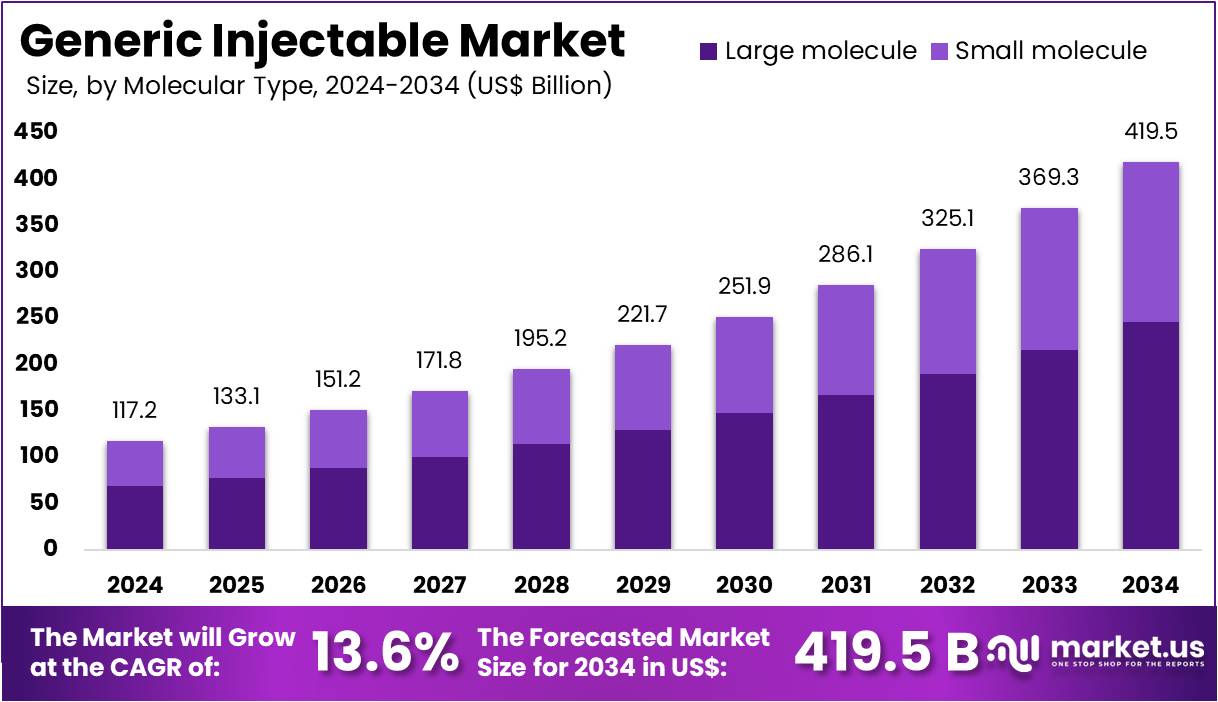
Key Takeaways
- In 2024, the generic injectable market generated revenue of US$ 117.2 billion and is projected to reach US$ 419.5 billion by 2034, expanding at a CAGR of 13.6% during the forecast period.
- Based on product type, the market includes monoclonal antibodies, vaccines, small molecule antibiotics, peptide hormones, peptide antibiotics, insulin, immunoglobulin, cytokines, chemotherapy agents, and blood factors. The monoclonal antibodies segment dominated in 2023, accounting for 26.7% of the market share.
- By molecular type, the market is categorized into large molecules and small molecules, with the large molecule segment holding a leading position with a 58.6% market share.
- By application, the oncology segment emerged as the dominant segment in 2023, capturing the largest revenue share of 29.4%, driven by increasing demand for injectable cancer therapies.
- Based on distribution channels, the market is segmented into hospital pharmacies, retail pharmacies, online pharmacies, and drug stores. The hospital pharmacy segment led the market with a revenue share of 44.7%.
- By administration route, the market is divided into intravenous (IV), subcutaneous (SC), and intramuscular (IM) segments. The intravenous (IV) segment accounted for the largest share of 53.6% due to its widespread use in hospital-based treatments.
- Regionally, North America dominated the generic injectable market in 2023, holding a market share of 40.5%, supported by advanced healthcare infrastructure, high adoption of injectable therapies, and strong pharmaceutical manufacturing capabilities.
Statistical Information
- Rising Cancer Incidence Increasing Demand for Oncology Injectable Drugs: The growing global cancer burden is increasing demand for injectable chemotherapy agents, monoclonal antibodies, and supportive cancer therapies. According to the CDC, the United States recorded 1,851,238 new cancer cases in 2022 and 613,349 cancer deaths in 2023. Major cancer types included 255,395 prostate cancer cases, 279,731 breast cancer cases, 218,893 lung cancer cases, and 147,931 colorectal cancer cases in 2022, creating significant demand for affordable injectable oncology medicines.
- Injectable Drug Shortages Driving Manufacturing Expansion: Shortages of critical injectable medicines are increasing the need for reliable generic injectable manufacturing. The U.S. FDA reported 224 drug shortages in 2023, with sterile injectable medicines representing approximately 61% of reported shortages. Manufacturing delays, quality issues, and limited production capacity were identified as major causes of shortages, encouraging pharmaceutical companies to expand sterile injectable production facilities.
- Increasing Adoption of Large Molecule Injectable Therapies: Large molecule injectable therapies, including monoclonal antibodies and biosimilars, are expanding due to their use in cancer, autoimmune diseases, diabetes, and other chronic conditions. The FDA has approved more than 70 biosimilar products, improving competition and increasing access to high-cost biologic medicines. Although biologics represent around 5% of prescriptions in the U.S., they account for nearly 51% of total drug spending, creating opportunities for affordable biosimilar injectables.
- Diabetes Prevalence Increasing Demand for Insulin and Injectable Therapies: Diabetes is a major contributor to the growth of injectable medicines, particularly insulin and GLP-1 injectable therapies. The CDC reported that 38.4 million people in the United States had diabetes in 2021, representing approximately 11.6% of the population. Additionally, around 97.6 million U.S. adults had prediabetes, creating a large patient population requiring future diabetes management solutions.
- Growing Use of Injectable Antibiotics for Infectious Disease Management: Injectable antibiotics remain essential for treating severe infections, hospital-acquired infections, and patients unable to take oral medicines. The CDC estimates that more than 2.8 million antimicrobial-resistant infections occur annually in the United States, resulting in more than 35,000 deaths each year. This continues to support demand for reliable injectable anti-infective medicines in hospitals.
- Increasing Demand for Chemotherapy Injectables Due to Aging Population: The aging population is increasing demand for injectable cancer treatments because cancer risk rises significantly with age. According to the National Cancer Institute (NCI), approximately 85% of cancer diagnoses occur in people aged 50 years and older, increasing the need for chemotherapy agents and supportive injectable therapies.
- Increasing Need for Injectable Medicines in Aging Populations: The aging population is increasing demand for injectable treatments due to higher rates of cancer, diabetes, cardiovascular disease, and neurological disorders among older adults. According to the United Nations, the global population aged 65 years and older is expected to reach 1.6 billion by 2050, increasing healthcare requirements for chronic disease management.
Regional Analysis
North America led the market by securing a market share of 40.5% in 2023.
North America holds a leading position in the generic injectable market due to strong healthcare infrastructure, increasing demand for affordable medicines, and rapid adoption of biosimilar and generic therapies.
The region benefits from a large hospital network, advanced pharmaceutical manufacturing capabilities, and regulatory support from the U.S. Food and Drug Administration (FDA). The FDA continues to expand access to lower-cost medicines through generic drug approvals and biosimilar pathways, supporting competition in injectable therapies.
The United States remains a major contributor because of increasing demand for oncology, anti-infective, and critical care injectables. The FDA approved multiple first generic drugs in 2024, including injectable products such as Ephedrine Sulfate Injection, Minocycline for Injection, Methohexital Sodium for Injection, and Dexmedetomidine Injection, improving availability of essential hospital medicines.
The growing adoption of biosimilar injectables is further strengthening the regional market. FDA initiatives under the Biosimilar User Fee Amendments (BsUFA) support faster review and development of biosimilar products, helping increase competition and improve patient access to high-cost biologic therapies.
North America’s extensive healthcare system, including approximately 6,100 hospitals in the United States, creates continuous demand for injectable medicines used in oncology, intensive care, surgery, and chronic disease management. The combination of regulatory support, increasing biosimilar adoption, and demand for cost-effective therapies is expected to maintain North America’s strong position in the generic injectable market
Emerging Trends
- Increasing Adoption of Biosimilar Injectable Medicines: Biosimilar injectables are becoming a major trend as healthcare providers seek affordable alternatives to high-cost biologic therapies. The FDA supports biosimilar development to improve patient access and reduce treatment costs. As of 2025, the FDA had approved 76 biosimilars, supporting competition in oncology, autoimmune disease, and diabetes treatments.
- Rising Demand for Oncology Generic Injectables: Cancer treatment remains a major growth area for generic injectables due to increasing patient numbers and the need for affordable chemotherapy and biologic therapies. The CDC reported 1,851,238 new cancer cases in the U.S. in 2022 and 613,349 cancer deaths in 2023, increasing demand for cost-effective injectable oncology medicines.
- Growth of Advanced Sterile Manufacturing Technologies: Pharmaceutical companies are investing in advanced sterile manufacturing, automation, and quality-control systems to improve injectable drug production. Sterile injectable shortages have highlighted the importance of reliable manufacturing capacity. The FDA continues monitoring supply challenges and supports improvements in production quality for essential medicines.
- Expansion of Ready-to-Use Injectable Drug Formats: Ready-to-use injectables, prefilled syringes, and simplified delivery systems are gaining attention because they reduce preparation time and improve medication safety in hospitals. Increasing demand for efficient administration methods is encouraging manufacturers to develop convenient injectable formats for emergency care, chronic diseases, and specialty treatments.
- Increasing Focus on Drug Shortage Prevention and Supply Security: Healthcare organizations are focusing on improving injectable medicine supply chains due to repeated shortages of critical products. The FDA highlights that manufacturing limitations, quality issues, and production delays are key reasons behind shortages. Strengthening domestic production and supplier diversification is becoming an important strategy for ensuring continuous availability of essential injectables.
Use Cases
- Injectable Therapies for Critical Care and Emergency Medicine: Generic injectable medicines are widely used in intensive care units and emergency departments for rapid treatment of life-threatening conditions. Hospitals depend on injectable antibiotics, cardiovascular medicines, anesthetics, and emergency drugs because they provide faster therapeutic action compared with oral alternatives. The U.S. healthcare system includes approximately 6,100 hospitals, creating continuous demand for injectable medicines.
- Generic Injectable Chemotherapy for Affordable Cancer Treatment: Generic injectable chemotherapy agents are increasingly used to reduce cancer treatment expenses while maintaining therapeutic effectiveness. With cancer cases continuing to rise, healthcare systems are adopting lower-cost injectable alternatives. CDC data shows that major cancers such as lung cancer (218,893 cases), breast cancer (279,731 cases), and prostate cancer (255,395 cases) were reported in the U.S. during 2022.
- Injectable Insulin and Diabetes Management Applications: Diabetes care represents an important use case for injectable medicines, particularly insulin therapies. The CDC reported that 38.4 million Americans had diabetes in 2021, representing approximately 11.6% of the U.S. population. Increasing diabetes prevalence is supporting demand for affordable injectable insulin products and biosimilar insulin options.
- Injectable Antibiotics for Severe Infection Treatment: Hospitals are increasingly dependent on injectable antibiotics for treating severe infections and antimicrobial-resistant diseases. The WHO reported that antimicrobial resistance directly caused approximately 1.27 million deaths globally in 2019, highlighting the need for reliable access to injectable anti-infective medicines in healthcare facilities.
- Home-Based and Outpatient Injectable Treatment Expansion: The shift toward outpatient care and home-based treatment is increasing the use of self-administered and long-acting injectable medicines. Injectable biologics, insulin, and specialty medicines allow patients to manage chronic conditions outside hospitals. FDA-approved biosimilar products are supporting wider access to injectable therapies by increasing treatment choices and affordability.
Frequently Asked Questions on Generic Injectable
- What factors are driving the growth of the generic injectable market?
The generic injectable market is growing due to rising healthcare costs, increasing chronic disease cases, drug shortages, and demand for affordable treatments. Hospitals are adopting generic injectables for oncology, antibiotics, emergency care, and critical care because they help reduce medication expenses. - What role do biosimilar injectables play in market growth?
Biosimilar injectables are expanding treatment access by providing lower-cost alternatives to expensive biologic medicines. These products are increasingly used in oncology, autoimmune diseases, and diabetes care. Regulatory approvals from agencies such as the FDA are supporting greater competition and wider availability of injectable biologic therapies. - Which therapeutic areas use generic injectable medicines the most?
Generic injectable medicines are widely used in oncology, infectious diseases, diabetes, cardiovascular care, anesthesia, and emergency medicine. Cancer treatment, antibiotics, insulin therapy, and critical care applications represent major areas where healthcare providers depend on affordable injectable alternatives for effective patient management. - What are the major product types available in the generic injectable market?
The generic injectable market includes monoclonal antibodies, vaccines, antibiotics, insulin, peptide hormones, immunoglobulins, cytokines, chemotherapy agents, and blood factors. These products support treatment across multiple medical conditions, including cancer, infections, immune disorders, metabolic diseases, and emergency healthcare requirements. - Why are monoclonal antibody injectables gaining importance?
Monoclonal antibody injectables are gaining importance due to their effectiveness in treating cancer, autoimmune disorders, and chronic diseases. Increasing adoption of biosimilars is improving affordability and patient access. Regulatory support is encouraging pharmaceutical companies to develop cost-effective alternatives to high-value biologic therapies. - What are the advantages of intravenous (IV) generic injectables?
Intravenous generic injectables provide rapid drug delivery and immediate therapeutic effects, making them essential in hospitals and emergency settings. They are commonly used for antibiotics, chemotherapy, fluids, and critical care medicines where quick absorption and controlled administration are necessary for effective patient treatment. - Which region dominates the generic injectable market?
North America represents a significant region for generic injectable adoption due to advanced healthcare infrastructure, strong pharmaceutical manufacturing capabilities, and regulatory support. The region benefits from high demand for oncology drugs, biosimilars, hospital medicines, and affordable injectable therapies across healthcare facilities.
Conclusion
The generic injectable market is experiencing significant growth due to increasing demand for affordable medicines, rising chronic disease prevalence, and the need for reliable hospital-based treatments. Growing adoption of biosimilar injectables, oncology therapies, antibiotics, and critical care medicines is creating new opportunities for manufacturers.
Regulatory support, advanced sterile manufacturing technologies, and efforts to overcome drug shortages are further strengthening market development. Hospitals and specialty clinics continue to rely on generic injectables to improve treatment accessibility and reduce healthcare costs. With continuous innovation and expanding applications across multiple therapeutic areas, the market is expected to maintain strong growth in the coming years.
Discuss your needs with our analyst
Please share your requirements with more details so our analyst can check if they can solve your problem(s)




