


Overview
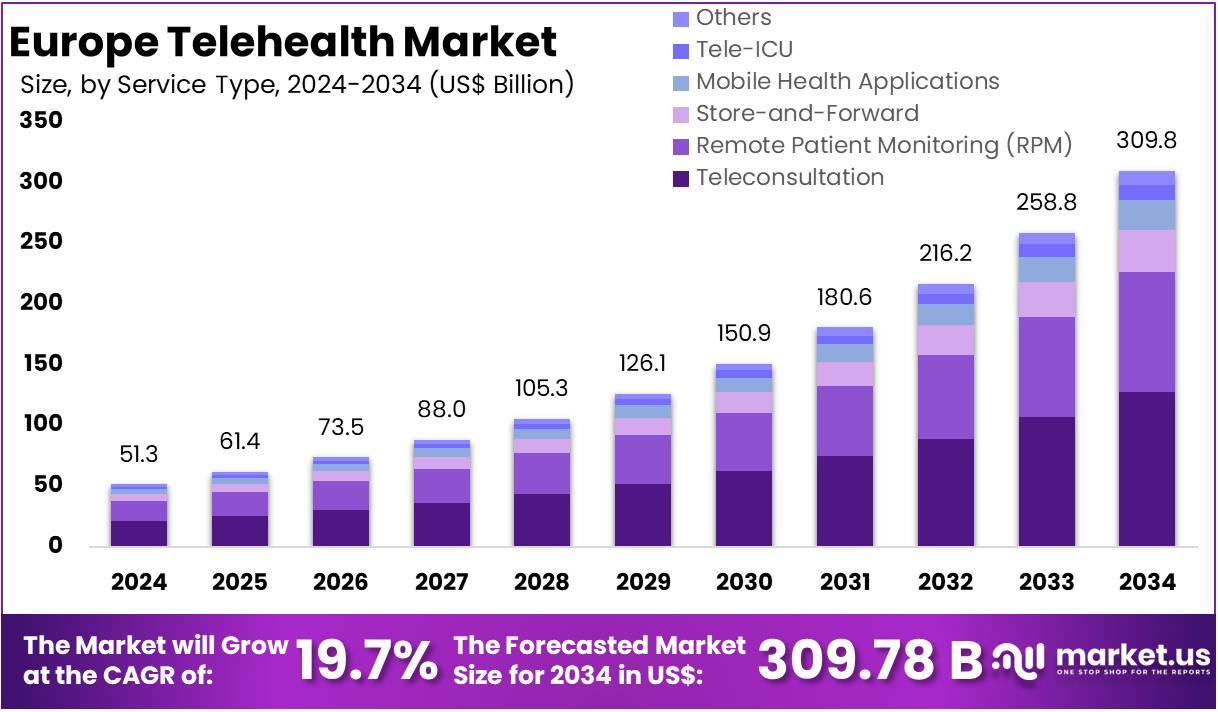
New York, NY – June 22, 2026 – The Europe Telehealth Market size is expected to be worth around US$ 309.8 Billion by 2034, from US$ 51.3 Billion in 2024, growing at a CAGR of 19.7% during the forecast period from 2025 to 2034.
The Europe Telehealth market is experiencing significant growth, driven by increasing digitalization in healthcare, rising demand for remote patient monitoring, and growing adoption of virtual healthcare services across the region. Telehealth solutions enable healthcare providers to deliver medical consultations, diagnosis, treatment, and patient monitoring remotely through digital communication technologies, improving accessibility and efficiency of healthcare services.
The growing prevalence of chronic diseases, aging population, and increasing healthcare expenditure have accelerated the adoption of telehealth platforms in European countries. Government initiatives supporting digital health transformation, favorable reimbursement policies, and investments in healthcare IT infrastructure are further contributing to market expansion. Additionally, the lessons learned during the COVID-19 pandemic have strengthened the role of telehealth as an essential component of modern healthcare delivery systems.
Key telehealth services include teleconsultation, telemonitoring, telemedicine, telecare, and mobile health applications. Healthcare providers are increasingly leveraging artificial intelligence, cloud computing, and connected medical devices to enhance patient outcomes and streamline clinical workflows.
Major markets within Europe include the Germany, United Kingdom, France, Italy, and Spain, where digital healthcare adoption continues to rise. As healthcare systems increasingly prioritize patient-centered care and cost-effective treatment delivery, the Europe Telehealth market is expected to witness sustained growth over the coming years, creating opportunities for technology providers, healthcare organizations, and investors across the healthcare ecosystem.
Key Takeaways
- By Service Type, the Europe Telehealth market is segmented into Teleconsultation, Remote Patient Monitoring (RPM), Store-and-Forward, Mobile Health Applications, Tele-ICU, and Others. Teleconsultation accounted for the largest share of 40.8%, supported by the increasing adoption of virtual healthcare consultations across primary and specialty care settings.
- By Deployment Mode, the market is categorized into Cloud-Based and On-Premises solutions. The Cloud-Based segment led the market with a 65.9% share, owing to its flexibility, scalability, cost efficiency, and ability to provide secure access to telehealth services from multiple locations.
- By Application, the market is segmented into Telepsychiatry, Teleradiology, Teledermatology, Teleneurology, and Others. Telepsychiatry emerged as the leading segment, capturing 27.5% of the market share, driven by growing demand for remote mental healthcare services and a shortage of mental health professionals across the region.
- By End User, the market is divided into Healthcare Providers, Patients, Payers, and Others. Healthcare Providers dominated the segment with a 46.2% market share, as hospitals, clinics, and independent practitioners continue to be the primary adopters of telehealth technologies for patient care delivery.
Segmentation Analysis
- Service Type Analysis: Teleconsultation holds the largest share of the European telehealth market at 40.8%. The service enables patients to consult healthcare professionals through video, voice, or messaging platforms. Growing demand for convenient healthcare access, digital advancements, and supportive regulations continues to strengthen teleconsultation adoption across Europe.
- Deployment Mode Analysis: Cloud-based deployment accounts for 65.9% of the European telehealth market, making it the dominant deployment model. Cloud solutions provide scalability, flexibility, and secure access to healthcare data while supporting EHR integration. Their cost efficiency and ability to streamline healthcare operations continue driving widespread adoption.
- Application Analysis: Telepsychiatry represents the leading application segment, capturing 27.5% of the European telehealth market. Rising awareness of mental health, increased demand for remote counseling services, and improved accessibility have accelerated adoption. Government support, insurance coverage, and AI-enhanced mental health solutions further contribute to segment growth.
- End User Analysis: Healthcare providers account for 46.2% of the European telehealth market, making them the largest end-user segment. Hospitals, clinics, and physician practices increasingly utilize telehealth to improve patient access, reduce operational burdens, and enhance care coordination through digital platforms and integrated healthcare technologies.
Emerging Trends
- Telehealth Is Becoming a Regular Part of Healthcare: Telehealth has evolved from an emergency solution during the COVID-19 pandemic into a standard component of healthcare delivery across Europe. Hospitals and clinics increasingly offer both virtual and in-person consultations, allowing patients to access medical advice, follow-up care, and mental health services conveniently while improving healthcare efficiency and accessibility.
- AI Is Helping Doctors and Improving Care: Artificial intelligence is transforming telehealth services in Europe by supporting faster and more accurate clinical decision-making. AI-powered tools analyze patient records, identify health patterns, and assist with treatment recommendations. Chatbots and virtual assistants also streamline patient assessments, enabling healthcare professionals to focus on complex cases and improve overall care quality.
- Hybrid Care Models Are the Future: Hybrid healthcare models are gaining popularity across Europe by combining traditional face-to-face consultations with telehealth services, remote monitoring, and AI-driven support. This integrated approach improves patient convenience, enhances healthcare accessibility, reduces hospital workloads, and enables providers to deliver continuous care while optimizing healthcare resources and operational efficiency.
- Privacy and Security Remain Top Concerns: As telehealth adoption increases, safeguarding patient data has become a critical priority throughout Europe. Healthcare providers must comply with strict regulations such as GDPR while implementing advanced cybersecurity measures. Secure platforms, data encryption, identity verification, and cloud protection technologies are essential for maintaining patient trust and ensuring healthcare data security.
Use Cases
- General Practitioner Visits: Telehealth enables patients across Europe to consult general practitioners through video or phone appointments for common health concerns. This approach reduces travel requirements, shortens waiting times, and improves healthcare access. Integrated digital platforms often support appointment scheduling, consultations, and prescription services within a single healthcare ecosystem.
- Post-Hospital Care at Home: Virtual post-hospital care allows healthcare professionals to monitor patients remotely after discharge through video consultations, phone calls, and digital health tools. This approach supports recovery, identifies complications early, reduces hospital readmissions, and provides continuous medical guidance, particularly benefiting elderly patients and individuals recovering from surgical procedures.
- Digital Therapies and Mobile Health Apps: Digital therapeutics and mobile health applications are becoming important components of healthcare management in Europe. These solutions help patients address mental health conditions, pain management, smoking cessation, and chronic disease care. Many applications are clinically validated, enabling healthcare providers to integrate them into comprehensive treatment plans.
- Women’s Health and Wellness: Telehealth platforms are expanding access to specialized women’s healthcare services across Europe, including fertility counseling, pregnancy support, menopause management, hormone therapy, and contraceptive consultations. Virtual care improves convenience, privacy, and timely access to specialists, particularly for women living in rural or underserved regions.
Frequently Asked Questions on Europe Telehealth
- What factors are driving the growth of the Europe telehealth market?
The growth of the Europe telehealth market is primarily driven by the increasing prevalence of chronic diseases, rising healthcare expenditure, expanding internet penetration, and growing adoption of digital health solutions. Additionally, favorable government initiatives, aging populations, and the need for efficient healthcare management continue to accelerate market expansion across European countries. - Which telehealth services are most commonly used in Europe?
Remote consultations, telemonitoring, telepsychiatry, teleradiology, and mobile health applications are among the most commonly utilized telehealth services in Europe. These services enable healthcare providers to deliver timely medical care, improve patient engagement, and reduce healthcare costs while maintaining high-quality treatment standards across various medical specialties. - How did the COVID-19 pandemic impact the Europe telehealth market?
The COVID-19 pandemic significantly accelerated telehealth adoption throughout Europe as healthcare systems sought alternatives to in-person consultations. Demand for virtual healthcare services increased substantially, leading to greater investments in digital infrastructure, expanded regulatory support, and wider acceptance of remote healthcare solutions among both patients and healthcare providers. - Which countries are leading the Europe telehealth market?
Countries such as Germany, United Kingdom, France, and Netherlands are leading the Europe telehealth market. These countries benefit from advanced healthcare infrastructure, strong digital health policies, high internet connectivity, and increasing investments in healthcare technology innovation and implementation. - What role does remote patient monitoring play in the market?
Remote patient monitoring has become a vital component of the Europe telehealth market by enabling continuous tracking of patient health conditions outside traditional healthcare settings. This approach helps healthcare providers manage chronic diseases more effectively, reduce hospital admissions, improve treatment adherence, and enhance overall patient care efficiency. - How is artificial intelligence influencing telehealth services in Europe?
Artificial intelligence is enhancing telehealth services through advanced diagnostics, predictive analytics, virtual health assistants, and personalized treatment recommendations. AI-powered solutions improve clinical decision-making, optimize healthcare workflows, and support healthcare professionals in delivering more accurate and efficient patient care across telehealth platforms. - Which end users contribute significantly to the Europe telehealth market?
Hospitals, clinics, healthcare providers, homecare settings, and individual patients are major contributors to the Europe telehealth market. Increasing demand for remote healthcare services, coupled with the growing need for cost-effective treatment options, has encouraged widespread adoption among these end-user segments throughout the region. - What is the future outlook for the Europe telehealth market?
The Europe telehealth market is expected to experience sustained growth in the coming years due to continuous technological advancements, supportive healthcare policies, and increasing consumer acceptance of digital healthcare solutions. The integration of artificial intelligence, wearable devices, and remote monitoring technologies is anticipated to further strengthen market development and innovation.
Conclusion
The Europe telehealth market is witnessing robust growth, driven by increasing digitalization of healthcare, rising prevalence of chronic diseases, an aging population, and strong government support for digital health initiatives. Teleconsultation remains the leading service segment, while cloud-based platforms dominate deployment due to their scalability and cost efficiency.
The growing adoption of telepsychiatry, remote patient monitoring, and AI-powered healthcare solutions is further enhancing patient care and operational efficiency. As healthcare systems increasingly embrace hybrid care models and prioritize accessible, patient-centered services, telehealth is expected to become an integral part of healthcare delivery across Europe, creating significant opportunities for technology providers and healthcare stakeholders.
Discuss your needs with our analyst
Please share your requirements with more details so our analyst can check if they can solve your problem(s)




