
Overview
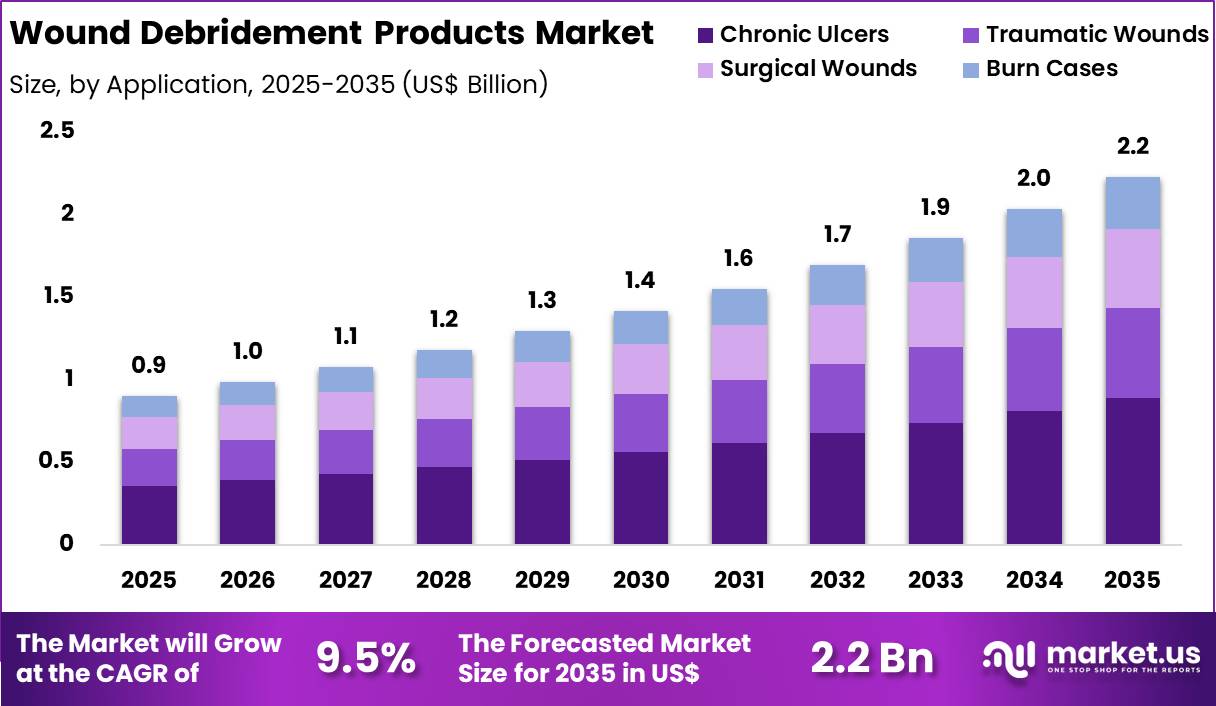
New York, NY – Oct 30, 2026 – Global Wound Debridement Products Market size is expected to be worth around US$ 2.2 Billion by 2035 from US$ 0.9 Billion in 2025, growing at a CAGR of 9.5% during the forecast period 2026-2035. In 2025, North America led the market, achieving over 39.7% share with a revenue of US$ 0.4 Billion.
Wound debridement products are medical devices and treatment solutions designed to remove dead, damaged, infected, or non-viable tissue from wounds to support the natural healing process. These products play an important role in wound management by preparing the wound bed, reducing the risk of infection, and promoting healthy tissue regeneration. Common wound debridement methods include mechanical, enzymatic, autolytic, surgical, and ultrasonic debridement.
Wound debridement products are widely used in hospitals, specialty wound care centers, ambulatory surgical centers, and home healthcare settings. They are commonly applied in the treatment of chronic wounds, diabetic foot ulcers, pressure ulcers, venous leg ulcers, burns, and traumatic injuries.
The market is supported by the rising prevalence of diabetes, increasing incidence of chronic wounds, an ageing population, and growing demand for advanced wound care solutions. Technological advancements in enzymatic formulations, hydrogel dressings, wound cleansing solutions, and ultrasonic debridement devices are further contributing to market development.
Additionally, increasing healthcare expenditure, expanding access to specialized wound care services, and growing awareness of effective wound management are creating new growth opportunities. With continued innovation and rising demand for advanced wound healing solutions, the global wound debridement products market is expected to experience steady expansion over the coming years.
Key Takeaways
- In 2025, the global wound debridement products market generated revenue of US$ 0.9 Billion and is projected to reach US$ 2.2 Billion by 2035, registering a CAGR of 9.5% during the forecast period.
- Based on product type, the market is segmented into hydrosurgical debridement devices, traditional wound debridement devices, surgical wound debridement devices, mechanical debridement pads, low-frequency ultrasound devices, and larval therapy. Among these, hydrosurgical debridement devices dominated the market, accounting for 28.6% of the total share.
- By application, the market is categorized into chronic ulcers, traumatic wounds, surgical wounds, and burn cases. The chronic ulcers segment held the largest share, accounting for 39.8% of the market.
- Based on end users, the market is divided into hospitals, specialized clinics, ambulatory surgical centers, and others. Hospitals dominated the segment, capturing 52.7% of the total market revenue.
- Regionally, North America dominated the global wound debridement products market, accounting for 39.7% of the total market share.
Key Market Segments
- Product Type Analysis: Hydrosurgical debridement devices dominated the product type segment, accounting for 28.6% market share. Their precision, faster tissue removal, and ability to preserve healthy tissues support adoption. Reduced procedure time, improved wound bed preparation, and increasing demand for advanced wound management solutions are further driving segment growth across hospitals and specialized wound care facilities.
- Application Analysis: Chronic ulcers dominated the application segment, accounting for 39.8% market share, driven by the rising prevalence of diabetes, vascular disorders, and pressure injuries. The need for repeated debridement to prevent infections and promote healing supports product demand. Growing elderly populations and expanding specialized wound care services are further strengthening segment growth.
- End-User Analysis: Hospitals dominated the end-user segment, accounting for 52.7% market share, supported by high patient volumes and increasing treatment of complex wounds. Rising surgical procedures, emergency care requirements, and expanding hospital-based wound care services are driving adoption. Increasing investments in infection prevention, advanced treatment technologies, and specialized clinical teams are further supporting segment growth.
Regional Analysis
North America Dominates the Wound Debridement Products Market
North America accounted for 39.7% of the wound debridement products market in 2024, driven by the rising prevalence of chronic wounds and widespread adoption of advanced wound care technologies. Increasing cases of diabetes, an ageing population, and growing demand for effective wound management are supporting regional growth.
Hospitals and specialized wound care centers are increasingly adopting enzymatic, mechanical, and surgical debridement solutions to improve healing outcomes and reduce infection risks. Additionally, expanding outpatient wound care services and favorable reimbursement policies are strengthening market demand. According to the CDC, 38.4 million Americans were living with diabetes in 2023, highlighting the growing need for chronic wound management.
Asia Pacific is Expected to Register the Highest CAGR
The Asia Pacific wound debridement products market is expected to register the highest CAGR during the forecast period, supported by rising diabetes prevalence, expanding healthcare infrastructure, and increasing awareness of advanced wound management. Growing investments in hospitals, specialized wound care facilities, and medical technologies are further accelerating regional market expansion.
Emerging Trends
- Growing Adoption of Enzymatic Debridement Products: Enzymatic debridement products, including collagenase-based ointments, are gaining clinical attention because they help break down dead tissue without requiring extensive physical removal. These products are particularly relevant when selective tissue removal is required or access to trained specialists is limited.
- Increasing Demand for Advanced Wound Dressings: Hydrogels, hydrocolloids, alginates, and other moisture-management dressings are being used to support autolytic debridement. These products help maintain suitable wound moisture levels and support the body’s natural process of removing damaged tissue.
- Greater Focus on Biofilm and Bacterial Management: Healthcare providers are placing greater emphasis on removing dead tissue and reducing bacterial buildup in chronic wounds. Debridement methods are increasingly considered an important part of wound-bed preparation and infection management.
- Development of Advanced Mechanical and Hydrosurgical Technologies: Mechanical irrigation and water-assisted debridement technologies are receiving attention for their ability to remove unwanted tissue and wound debris. These approaches provide additional treatment options, particularly in specialised wound care settings.
- Growing Preference for Patient-Specific Wound Management: Treatment selection is increasingly based on wound size, tissue condition, infection status, patient tolerance, and existing health conditions. This is encouraging the use of different debridement approaches rather than relying on a single treatment method.
Use Cases
- Diabetic Foot Ulcers: Debridement products are used to remove dead, thickened, and damaged tissue from diabetic foot ulcers. This helps prepare the wound bed for further treatment, while appropriate pressure relief, blood circulation assessment, and infection management remain essential.
- Pressure Ulcers: These products are used in the treatment of pressure injuries, particularly when dead tissue accumulates and interferes with wound healing. Moisture-retaining dressings, enzymatic products, and professional sharp debridement may be selected according to wound assessment.
- Venous Leg Ulcers: Debridement products help remove slough and non-viable tissue from venous leg ulcers, supporting wound-bed preparation. Their use is combined with appropriate compression therapy when clinically suitable and assessment of the patient’s vascular condition.
- Surgical and Postoperative Wounds: Debridement products are used when surgical wounds contain dead tissue, accumulated debris, or delayed-healing areas. They help prepare the wound surface for appropriate dressings and further clinical treatment, depending on the patient’s recovery needs.
- Traumatic and Chronic Wounds: Debridement products are applied in selected traumatic injuries and long-lasting wounds where damaged tissue or slough affects wound-bed condition. Mechanical, enzymatic, and autolytic methods may be considered based on the wound’s characteristics.
Frequently Asked Questions About Wound Debridement Products
- What are the different types of wound debridement products?
Major product categories include enzymatic ointments, hydrogels, hydrocolloid dressings, mechanical debridement products, wound cleansing solutions, and biological debridement products. Each category works differently and is selected according to wound condition and clinical requirements. - How do enzymatic wound debridement products work?
Enzymatic products contain specific enzymes that break down proteins within dead tissue. Collagenase-based ointments are commonly used examples. They help remove unwanted tissue while supporting selective wound cleaning under appropriate clinical supervision. - What types of wounds require debridement products?
Debridement products may be used for diabetic foot ulcers, pressure injuries, venous leg ulcers, surgical wounds, and traumatic injuries. Their suitability depends on tissue damage, wound depth, infection status, and the patient’s overall health. - What are the benefits of autolytic debridement products?
Autolytic debridement products maintain a suitable moist environment that allows the body’s natural enzymes to break down dead tissue. This method is generally selective and less invasive, although treatment can take longer. - What factors influence the selection of wound debridement products?
Important selection factors include wound size, depth, amount of dead tissue, moisture levels, infection, patient tolerance, circulation, and treatment costs. Clinical assessment helps determine the most suitable debridement method for each wound. - What are the major factors driving the wound debridement products market?
The market is supported by increasing cases of diabetes, chronic wounds, pressure injuries, and ageing-related health conditions. Greater awareness of advanced wound management and the need for effective wound healing solutions also support demand. - Which regions offer opportunities in the wound debridement products market?
North America and Europe represent established markets due to developed healthcare infrastructure and specialised wound care services. Asia-Pacific offers opportunities through expanding healthcare access, increasing chronic disease prevalence, and growing awareness of advanced wound management. - What is the future outlook for the wound debridement products market?
The market is expected to benefit from continued developments in advanced dressings, enzymatic treatments, mechanical technologies, and biofilm management. Increasing demand for personalised wound treatment and home-based healthcare may further support product adoption.
Conclusion
The global wound debridement products market is expected to witness steady growth, supported by the rising prevalence of diabetes, chronic wounds, and an ageing population. Increasing adoption of advanced wound care technologies, including hydrosurgical devices, enzymatic formulations, and specialised dressings, is further supporting market development.
Hospitals are expected to remain major end users due to the growing treatment of complex wounds, while Asia-Pacific is anticipated to offer significant growth opportunities through expanding healthcare infrastructure and increasing awareness. Continuous product innovation, rising healthcare expenditure, and growing demand for effective wound management solutions are expected to strengthen the market’s long-term growth prospects.
Discuss your needs with our analyst
Please share your requirements with more details so our analyst can check if they can solve your problem(s)