


Overview
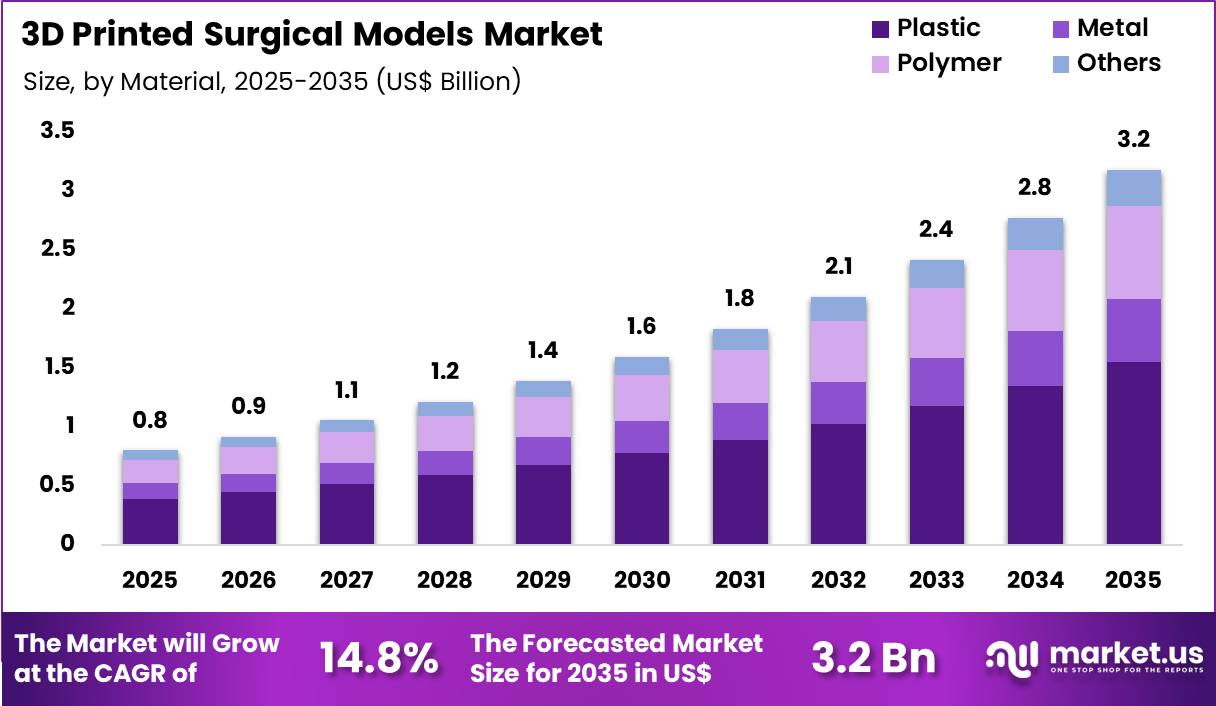
New York, NY – Oct 30, 2026 – The Global 3D Printed Surgical Models Market size is expected to be worth around US$ 3.2 Billion by 2035 from US$ 0.8 Billion in 2025, growing at a CAGR of 14.8% during the forecast period 2026-2035. In 2025, North America led the market, achieving over 42.8% share with a revenue of US$ 0.3 Billion.
3D printed surgical models are advanced medical tools developed using patient-specific medical imaging data, such as CT scans and MRI scans. These models replicate the anatomical structures of individual patients, including bones, organs, blood vessels, and other tissues, providing healthcare professionals with realistic physical representations of complex anatomical conditions.
The adoption of 3D printing technology in healthcare has been increasing due to its ability to support personalized treatment planning, improve surgical precision, and enhance medical education. Surgeons can use these models to examine complex anatomical structures, plan surgical procedures, evaluate potential complications, and practice critical surgical techniques before performing actual operations.
3D printed surgical models are widely used in orthopedics, neurosurgery, cardiovascular surgery, dental surgery, and reconstructive procedures. They also support medical students and healthcare professionals through practical, hands-on training.
Technological advancements in medical imaging, additive manufacturing, biocompatible materials, and multi-material printing are further expanding the application potential of these models. Growing demand for personalized healthcare, minimally invasive procedures, and improved surgical outcomes is expected to create new opportunities for the 3D printed surgical models industry.
As healthcare systems increasingly adopt advanced medical technologies, 3D printed surgical models are expected to play an important role in the future of precision medicine and patient-specific surgical care.
Key Takeaways
- In 2025, the global market was valued at US$ 0.8 Billion and is projected to grow at a CAGR of 14.8%, reaching US$ 3.2 Billion by 2035.
- Based on material, the market is segmented into plastic, metal, polymer, and others. Among these, plastic dominated the market, accounting for a share of 48.7%.
- Based on technology, the market is categorized into fused deposition modeling (FDM), stereolithography (SLA), multijet/polyjet printing, colorjet printing (CJP), and others. Fused deposition modeling (FDM) emerged as the leading segment, capturing a market share of 37.5%.
- Based on speciality, the market is segmented into orthopedic surgery, transplant surgery, surgical oncology, reconstructive surgery, neurosurgery, gastroenterology endoscopy of esophagus, and cardiac surgery. Orthopedic surgery dominated the segment, accounting for the largest revenue share of 33.8%.
- Regionally, North America dominated the global market, accounting for the largest market share of 42.8%.
Key Market Segments
- Material Analysis: Plastic dominated the material segment, accounting for 48.7% of the market, driven by its affordability, versatility, and ease of production. Its widespread use in hospitals and academic institutions is supported by rapid prototyping capabilities, lightweight properties, and anatomical accuracy. Advancements in printing materials are further strengthening adoption.
- Technology Analysis: Fused deposition modeling (FDM) led the technology segment, capturing a 37.5% market share, owing to its cost-effectiveness, accessibility, and operational simplicity. Its compatibility with thermoplastics enables efficient production of patient-specific surgical models. Improvements in printing accuracy, reliability, and imaging software integration are further supporting its adoption across healthcare facilities.
- Speciality Analysis: Orthopedic surgery dominated the speciality segment, accounting for 33.8% of the market, driven by increasing demand for precise surgical planning in fracture repair, joint replacement, and bone deformity correction. 3D printed models enable detailed anatomical visualization, improve implant positioning, and support preoperative simulation, strengthening their adoption in orthopedic procedures.
Regional Analysis
North America Dominates the 3D Printed Surgical Models Market
North America accounted for 42.8% of the 3D Printed Surgical Models market in 2024, supported by the growing adoption of additive manufacturing in surgical planning and medical education. Hospitals increasingly use patient-specific anatomical models to improve surgical precision, particularly in cardiac, orthopedic, and neurosurgical procedures.
Investments in in-house 3D printing facilities, collaborations between healthcare providers and technology developers, and advancements in medical imaging have further strengthened regional adoption. Additionally, the US FDA reported authorizing more than 100 3D printed medical devices by 2023, highlighting the expanding clinical acceptance of the technology.
Asia Pacific Expected to Register the Highest CAGR
Asia Pacific is anticipated to record the highest CAGR during the forecast period, driven by increasing healthcare infrastructure investments and the adoption of advanced surgical technologies.
Growing demand for personalized treatment planning, rising complex surgical procedures, and the integration of 3D printed anatomical models into medical education are supporting market expansion. Government initiatives promoting additive manufacturing and collaborations between hospitals, imaging centers, and local technology providers are further accelerating regional growth.
Emerging Trends
- Increasing Adoption of Patient-Specific Anatomical Models: The demand for customized surgical models is increasing as healthcare providers use patient-specific CT and MRI scans to create accurate physical replicas of organs, bones, blood vessels, and other anatomical structures. These models support better understanding of complex anatomy before surgery.
- Expansion of 3D Printing Facilities Within Hospitals: Hospitals and healthcare facilities are increasingly exploring in-house 3D printing capabilities. This approach allows medical teams to produce patient-specific anatomical models closer to the point of care, potentially reducing production delays and improving coordination between radiologists, surgeons, and engineers.
- Development of Advanced Printing Materials: The availability of different printing materials is expanding the applications of surgical models. Transparent, flexible, and multi-material printing technologies are enabling the production of anatomical replicas that better represent tissue structures, vascular pathways, and complex organ geometries.
- Integration of Artificial Intelligence With Medical Imaging: AI-assisted image processing and segmentation are creating opportunities to convert CT and MRI scans into three-dimensional anatomical models more efficiently. These technologies can support the identification of important anatomical structures and improve the preparation of patient-specific models.
- Growing Focus on Quality Standards and Regulatory Compliance: As clinical adoption increases, greater attention is being given to model accuracy, software validation, material selection, and production quality. Healthcare institutions are focusing on standardized workflows to ensure that printed models are reliable for their intended clinical applications.
Use Cases
- Preoperative Surgical Planning: Surgeons use patient-specific 3D printed models to examine anatomical structures before performing complex procedures. These replicas help identify the location of abnormalities, understand anatomical variations, plan surgical approaches, and assess potential procedural challenges.
- Cardiovascular Surgery: Three-dimensional heart and blood vessel models are used to understand congenital heart defects, vascular abnormalities, and complex cardiac structures. Surgeons can examine internal pathways and evaluate possible treatment approaches before performing cardiovascular procedures.
- Orthopedic and Spinal Surgery: Printed models of bones, joints, and spinal structures help surgeons understand fractures, deformities, and complex skeletal conditions. These models can support surgical planning, implant positioning, and the preparation of patient-specific surgical guides.
- Neurosurgery and Craniofacial Procedures: Three-dimensional models of the brain, skull, and facial bones help surgeons study complex anatomical relationships before surgery. They are particularly useful for understanding skull defects, craniofacial abnormalities, and structures surrounding sensitive neurological regions.
- Medical Training and Patient Education: Medical institutions use 3D printed anatomical models to train medical students, demonstrate surgical procedures, and explain treatment options to patients. Physical models provide a practical learning experience and make complex anatomical conditions easier to understand.
Frequently Asked Questions About 3D Printed Surgical Models
- How are 3D printed surgical models manufactured?
These models are generally manufactured by converting medical images into digital three-dimensional designs through specialized software. The designs are processed for additive manufacturing, where selected materials are deposited layer by layer to produce physical anatomical replicas. - What materials are used in 3D printed surgical models?
Common materials include photopolymers, plastics, resins, and flexible polymers. Material selection depends on the required anatomical details, model flexibility, transparency, durability, printing technology, and intended clinical application. - What are the major benefits of 3D printed surgical models?
These models provide a physical understanding of complex patient anatomy before surgery. They support preoperative planning, improve communication among medical teams, assist surgical training, and help patients understand their conditions and proposed treatment procedures. - Which medical specialties use 3D printed surgical models?
Major specialties include cardiovascular surgery, orthopedics, neurosurgery, craniofacial surgery, and oncology. These models are also used in medical education and research, particularly when complex anatomical structures require detailed examination before treatment. - Which region is expected to create growth opportunities in the 3D printed surgical models market?
North America and Europe represent important markets due to established healthcare infrastructure, advanced medical technologies, and increasing clinical adoption. Asia-Pacific also presents opportunities through healthcare modernization, expanding hospital infrastructure, and growing investments in medical technology. - What role does technological advancement play in the 3D printed surgical models market?
Technological advancements in medical imaging, AI-assisted segmentation, multi-material printing, and digital modeling are improving model development capabilities. These improvements support more detailed anatomical representations, efficient production workflows, and wider adoption across specialized medical applications. - How are hospitals adopting 3D printed surgical models?
Hospitals are incorporating anatomical modeling into surgical planning workflows by combining medical imaging, digital design, and additive manufacturing. Some healthcare facilities are establishing in-house printing laboratories to improve access to customized models and strengthen multidisciplinary collaboration. - What is the difference between 3D printed surgical models and 3D printed surgical guides?
Surgical models are physical anatomical replicas primarily used for visualization, planning, and education. Surgical guides are devices designed to assist specific procedural steps, such as instrument positioning or implant placement, according to the intended clinical application.
Conclusion
The 3D printed surgical models market is expected to witness steady growth, driven by increasing adoption of advanced medical technologies and the rising need for personalized surgical planning. Advancements in medical imaging, AI-assisted modeling, and multi-material printing are improving model accuracy and clinical applications.
Growing utilization across cardiovascular surgery, orthopedics, neurosurgery, and other specialties is further supporting market expansion. Additionally, investments in hospital-based 3D printing facilities and healthcare infrastructure are creating new opportunities. While North America and Europe remain established markets, Asia-Pacific is expected to offer significant growth potential due to expanding healthcare capabilities and increasing technological investments.
Discuss your needs with our analyst
Please share your requirements with more details so our analyst can check if they can solve your problem(s)



