


Overview
New York, NY – July 28, 2026 – The Global Epigenomics Market Size is expected to be worth around US$ 69.6 Billion by 2034 from US$ 16.9 Billion in 2024, growing at a CAGR of 15.2% during the forecast period 2025 to 2034. North America held a dominant market position, capturing more than a 41.3% share and holding a US$ 7 Billion market value for the year.
The epigenomics market is gaining momentum due to increasing research focus on understanding how epigenetic modifications influence gene activity, disease development, and treatment response. Unlike genetic changes, epigenetic alterations regulate gene expression without modifying the DNA sequence, making them important areas of study in cancer biology, neurological disorders, aging research, and personalized medicine. Advances in epigenomic technologies are helping scientists analyze DNA methylation, histone modifications, and chromatin changes with greater accuracy.
Growing demand for precision healthcare is encouraging the development of advanced epigenomic tools and diagnostic solutions. Researchers are increasingly using epigenomic profiling to identify disease biomarkers, understand disease progression, and develop targeted therapies. Oncology remains a major application area, as abnormal epigenetic patterns are closely associated with tumor formation and progression. Epigenomic approaches are also being explored for early disease detection and treatment personalization.
Technological advancements, including next-generation sequencing, artificial intelligence-based data analysis, and improved bioinformatics platforms, are enhancing the efficiency of epigenomic research. Companies are focusing on innovative kits, analytical tools, and integrated solutions to support complex epigenetic studies.
Increasing funding from government organizations, academic institutions, and biotechnology companies is further supporting market growth. Investments in biomedical research and personalized medicine initiatives are accelerating the transition of epigenomics from laboratory research toward clinical applications. With expanding applications in diagnostics, drug discovery, and therapeutic development, the epigenomics market is positioned for continued advancement in the healthcare and life sciences sectors.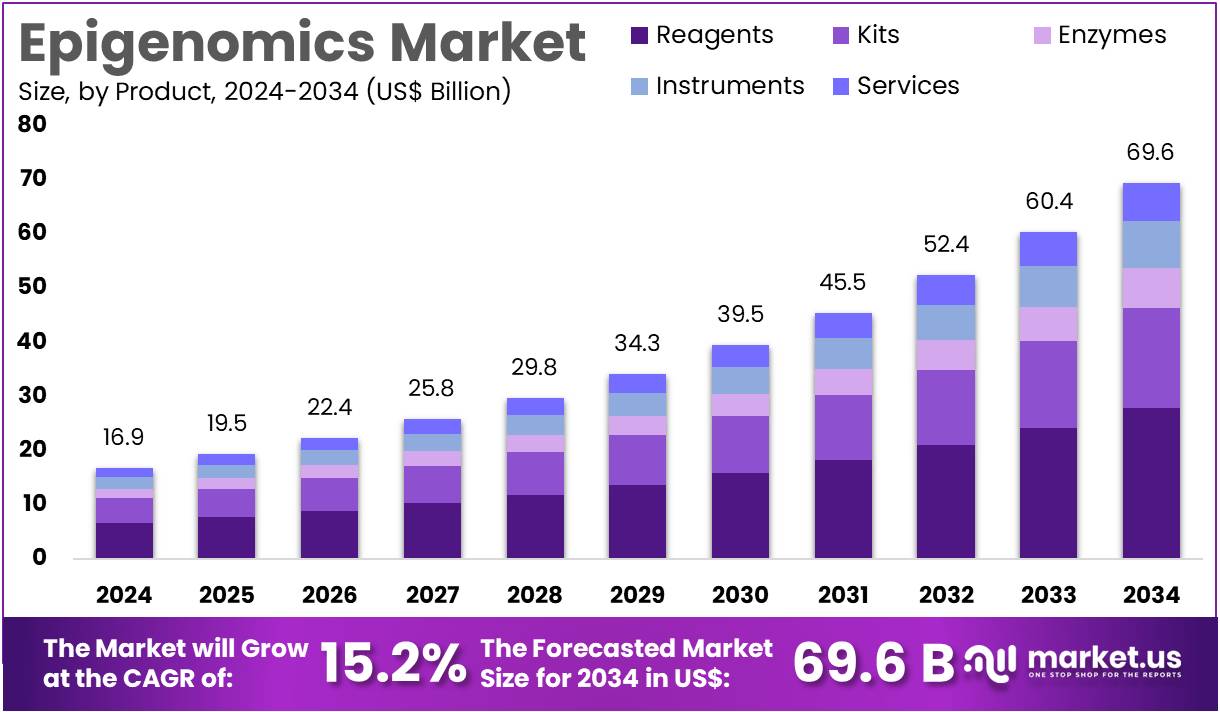
Key Takeaways
- In 2024, the Epigenomics market generated revenue of US$ 16.9 billion and is projected to grow at a CAGR of 15.2%, reaching US$ 69.6 billion by 2034.
- Based on product type, the market is segmented into reagents, kits, enzymes, instruments, and services. Reagents dominated the segment in 2023, accounting for a 40.1% market share.
- By application, the Epigenomics market is categorized into oncology and non-oncology. Oncology held a leading position with a 57.2% market share.
- Based on technology, the market is segmented into DNA methylation, microRNA modification, large non-coding RNA, histone methylation, and histone acetylation. DNA methylation emerged as the dominant technology segment, capturing a 48.1% revenue share.
- North America led the global Epigenomics market in 2023, holding a 41.3% market share.
Statistical Information
- Growth in Epigenetics R&D Funding and Project Volume: Total global research funding in epigenetics increased from about USD 200 million in 2004 to over USD 4.5 billion in 2024, supporting approximately 2,700 projects annually by 2024. This reflects a more than twenty‑fold increase in funding and a large, stable project base, signaling strong institutional and governmental support for epigenomic research and associated tools.
- Publication and Patent Activity as a Commercial Proxy: The CAS Content Collection has compiled nearly 150,000 publications related to epigenetics, with patent publications nearly doubling between 2023 and 2025, indicating a sharp rise in commercially oriented innovation. This surge in patenting activity is a strong proxy for industry engagement, suggesting increasing investment by biopharma and diagnostics companies in epigenomic technologies, platforms, and biomarkers.
- NIH Common Fund Epigenomics – Program‑Level Funding: The NIH Common Fund Epigenomics program received approximately USD 137 million via the American Recovery and Reinvestment Act (ARRA) for fiscal years 2009–2010, dedicated to developing tools and technologies to study the epigenetic basis of disease. This large one‑time injection of federal funds catalyzed method development, platform validation, and data resource creation, which companies later leveraged to design commercial epigenomic assays, sequencing kits, and analytics services.
- Commercial Significance epigenetics Drugs and Therapies in Trials: CAS Insights data show that the commercial significance of epigenetics has expanded dramatically, with more than 10 epigenetic drugs approved (including azacitidine/Vidaza and vorinostat/Zolinza) and over 35 epigenetic therapies in clinical trials worldwide.
- Patient Compliance and Behavioral Preference for Blood‑Based Screening: Internal modeling cited in the annual report indicates that compliance rates above 70% for this blood‑based epigenetic assay can match the screening performance of more invasive methods, highlighting a strong behavioral preference that supports market expansion for epigenomic liquid biopsy tests.
- Epigenetic IVD Tests for Precision Medicine: Review data on epigenetic in‑vitro diagnostic (IVD) tests indicates that epigenetic alterations are used as biomarkers for predictive and precision medicine in cancer, supporting personalized treatment decisions.
- Epigenetic Biomarkers as Commercially Relevant Tools: Current strategies for epigenetic biomarkers emphasize their role in controlling physiological and pathological features and their utility in diagnosis, prognosis, and therapy response monitoring.
Regional Analysis
North America led the global Epigenomics market in 2023, holding a 41.3% market share.
North America remains a key region for epigenomics research due to advanced healthcare infrastructure, strong biotechnology capabilities, and significant investment in biomedical research. The National Cancer Institute (NCI) under NIH supports epigenetics and epigenomics studies focused on understanding how molecular changes influence cancer development, diagnosis, and treatment.
NIH-funded initiatives have also created large-scale genomic and biological datasets that support precision medicine research. The NIH All of Us Research Program includes genomic information from nearly 250,000 participants and supports research on disease mechanisms and personalized healthcare approaches. Asia Pacific is witnessing increasing growth in epigenomics research due to rising investments in biotechnology, genomic medicine, and life science infrastructure.
Countries including China, Japan, and South Korea are expanding research capabilities through government-supported genomics initiatives and academic collaborations. Growing adoption of precision medicine approaches and increasing focus on disease biomarker discovery are supporting regional development. Public research programs and biotechnology investments are helping strengthen capabilities in sequencing, bioinformatics, and epigenetic analysis across the region.
Emerging Trends
- Expansion of Reference Epigenome Mapping for Disease Research: Large-scale epigenomic mapping is becoming an important trend as researchers build detailed reference datasets. The NIH Epigenomics Program created 111 reference epigenomes from healthy human cells and tissues and generated more than 2,600 datasets to study disease-related gene regulation patterns.
- Growing Use of DNA Methylation Biomarkers in Cancer Diagnosis: DNA methylation analysis is increasingly used for cancer biomarker discovery because abnormal methylation patterns can indicate tumor development and disease progression. NCI-supported research focuses on epigenetic markers for cancer detection, diagnosis, treatment response, and recurrence monitoring.
- Integration of Epigenomics with Precision Medicine: Epigenomics is moving toward personalized healthcare by helping researchers understand differences in disease biology among individuals. NIH-supported projects have developed large-scale epigenomic resources covering multiple tissues, enabling identification of patient-specific molecular patterns for improved diagnosis and targeted treatment strategies.
- Increasing Adoption of Multi-Omics and Advanced Data Analysis: Combining epigenomic data with genomic and transcriptomic information is becoming a key research approach. The NIH Roadmap Epigenomics database contains more than 3,200 experimental records, supporting computational analysis of DNA methylation, histone changes, and chromatin regulation in human biology.
- Rising Focus on Epigenetic Therapies for Oncology Applications: Cancer treatment research is increasingly exploring therapies targeting epigenetic changes such as DNA methylation and histone modifications. NCI research highlights that epigenetic alterations influence cancer initiation, progression, and therapy resistance, creating opportunities for new precision oncology approaches.
Use Cases
- Early Cancer Detection and Risk Assessment: Epigenomics is being applied in cancer screening through DNA methylation-based biomarkers. Research shows that methylation changes can be detected in normal and cancer tissues, helping identify cancer risk, support early diagnosis, and improve disease monitoring strategies.
- Drug Discovery and Target Identification: Pharmaceutical and academic researchers use epigenomic profiling to identify disease pathways and therapeutic targets. NIH-supported studies analyze DNA modifications, histone changes, and chromatin structures to understand how gene regulation contributes to cancer and other diseases.
- Personalized Cancer Treatment Selection: Epigenomic analysis helps classify tumors based on molecular characteristics and supports treatment decision-making. NCI research programs use epigenetic analysis along with genomic approaches to discover biomarkers related to cancer diagnosis, progression, patient survival, and therapy response.
- Research on Aging and Environmental Disease Effects: Epigenomics is increasingly used to study how lifestyle and environmental exposures influence gene regulation. NIH research initiatives examine epigenetic changes associated with aging, environmental factors, and disease susceptibility using large-scale human epigenome datasets.
- Development of Advanced Research Platforms and Databases: Publicly available epigenomic resources are accelerating scientific discoveries. The NIH Roadmap Epigenomics Project provides reference datasets, analytical tools, and experimental information that researchers use for studying tissue-specific gene regulation and disease mechanisms.
Frequently Asked Questions on Epigenomics
- What is driving the growth of the Epigenomics Market?
The Epigenomics Market is driven by increasing research in cancer biology, personalized medicine, biomarker discovery, and advanced sequencing technologies. Growing investments from organizations such as NIH and biotechnology companies are supporting the development of new epigenetic research tools and applications. - How is epigenomics used in cancer research?
Epigenomics plays an important role in cancer research by identifying abnormal DNA methylation and histone modification patterns. These molecular changes help researchers discover biomarkers, understand tumor progression, improve diagnosis, and develop targeted therapies for different cancer types. - What are the major technologies used in the Epigenomics Market?
Major technologies include DNA methylation analysis, chromatin immunoprecipitation sequencing (ChIP-seq), histone modification analysis, microRNA profiling, and next-generation sequencing platforms. These technologies enable researchers to study gene regulation patterns and identify disease-related molecular changes. - Why is DNA methylation important in epigenomics research?
DNA methylation is important because it controls gene expression and can indicate disease-related changes. Researchers study methylation patterns to identify biomarkers associated with cancer, neurological disorders, aging, and other conditions without altering the underlying DNA sequence. - How does epigenomics support personalized medicine?
Epigenomics supports personalized medicine by analyzing individual molecular differences that influence disease behavior and treatment response. Researchers use epigenetic information to identify suitable therapies, predict outcomes, and develop patient-specific approaches for improving healthcare decisions. - What role does artificial intelligence play in epigenomics?
Artificial intelligence helps analyze large and complex epigenomic datasets by identifying patterns in DNA methylation, histone modifications, and gene regulation. AI-based tools improve biomarker discovery, data interpretation, and research efficiency in precision medicine and drug development. - Which diseases are studied using epigenomics technologies?
Epigenomics technologies are widely studied in cancer, neurological disorders, cardiovascular diseases, metabolic conditions, and aging-related research. Scientists use epigenetic information to understand disease mechanisms, discover biomarkers, and explore new diagnostic and therapeutic approaches. - What is the future outlook for the Epigenomics Market?
The Epigenomics Market is expected to advance with continued developments in sequencing technologies, bioinformatics, and precision medicine. Increasing research funding, expanding clinical applications, and growing understanding of epigenetic mechanisms will support future innovation in healthcare and biotechnology.
Conclusion
The Epigenomics Market is advancing rapidly due to increasing research focus on gene regulation, disease mechanisms, and personalized healthcare. Growing applications in oncology, biomarker discovery, drug development, and precision medicine are creating new opportunities for epigenomic technologies. Government-funded initiatives, advanced sequencing platforms, and improved data analysis methods are accelerating research and clinical adoption.
DNA methylation analysis, multi-omics approaches, and AI-based solutions are strengthening the ability to identify disease-related molecular patterns. With continued investment in life sciences and expanding healthcare applications, epigenomics is expected to play an important role in developing next-generation diagnostics and targeted therapies.
Discuss your needs with our analyst
Please share your requirements with more details so our analyst can check if they can solve your problem(s)




