


Overview
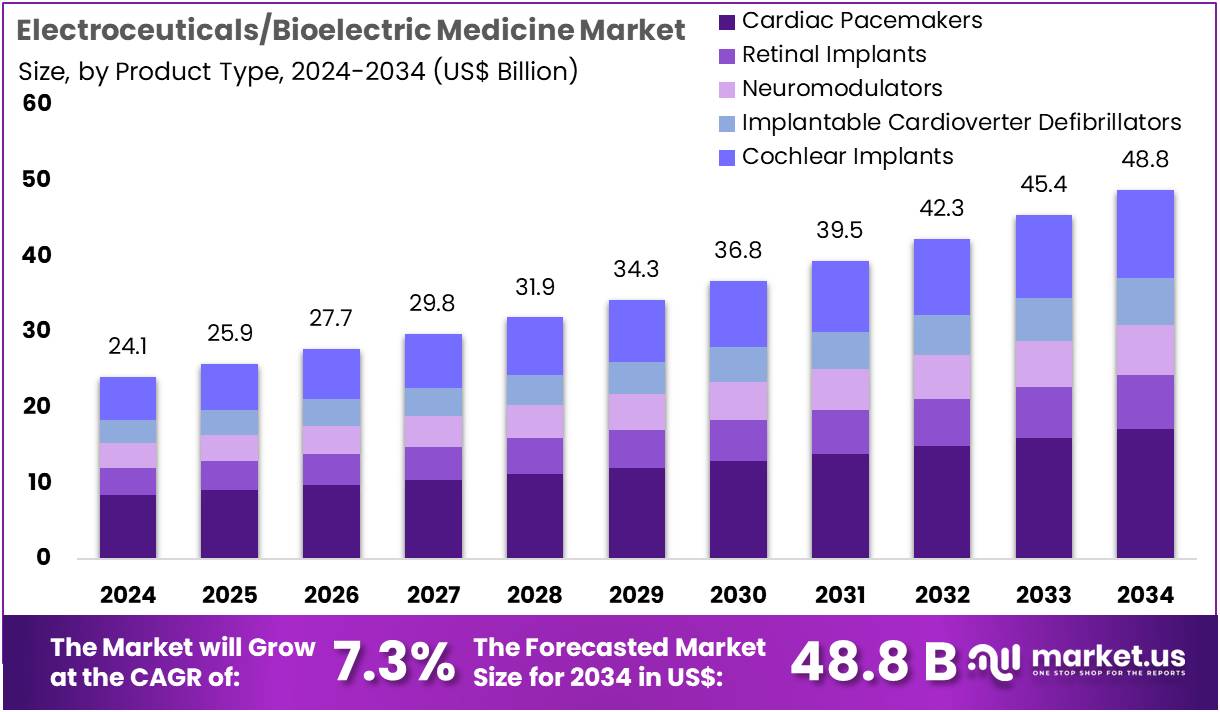
New York, NY – July 24, 2026 – The Global Electroceuticals/Bioelectric Medicine Market size is expected to be worth around US$ 48.8 Billion by 2034 from US$ 24.1 Billion in 2024, growing at a CAGR of 7.3% during the forecast period 2025 to 2034. North America held a dominant market position, capturing more than a 38.8% share and holding a US$ 9.4 Billion market value for the year.
The global electroceuticals market is witnessing significant growth due to rapid advancements in medical device technologies, increasing adoption of value-based healthcare models, and rising demand for non-pharmaceutical treatment solutions. Electroceuticals use electrical signals to modulate biological functions and treat various neurological, cardiovascular, and chronic disorders. Innovations such as closed-loop stimulation systems, miniaturized implants, advanced sensors, and artificial intelligence (AI)-enabled devices are improving treatment precision and patient outcomes.
Technological progress is becoming a key competitive factor as manufacturers focus on developing smarter and more personalized therapies. Modern electroceutical devices can continuously monitor physiological signals and automatically adjust stimulation parameters, enabling more effective management of complex conditions such as epilepsy, chronic pain, Parkinson’s disease, and cardiac arrhythmias.
Regulatory support is also accelerating market expansion through initiatives such as breakthrough device pathways that help innovative medical technologies reach patients faster. Increasing clinical evidence and approvals for advanced bioelectric therapies are strengthening confidence among healthcare providers and patients. Recent advancements in cardiac ablation systems and nerve stimulation technologies highlight the growing role of electroceuticals in improving disease management.
Additionally, increased investments from research organizations, including the National Institutes of Health (NIH), and collaborations between medical device companies, academic institutions, and regulatory agencies are supporting innovation in bioelectric medicine. As healthcare systems prioritize cost-effective treatments with measurable outcomes, electroceuticals are expected to play an increasingly important role in the future of personalized and precision medicine.
Key Takeaways
- In 2024, the electroceuticals/bioelectric medicine market generated revenue of US$ 24.1 billion and is projected to grow at a CAGR of 7.3%, reaching approximately US$ 48.8 billion by 2034.
- Based on product type, the market includes cardiac pacemakers, retinal implants, neuromodulators, implantable cardioverter defibrillators, and cochlear implants. Among these, cardiac pacemakers dominated in 2024 with a market share of 35.2%.
- By application, the electroceuticals/bioelectric medicine market is segmented into arrhythmia, Parkinson’s disease, depression, chronic pain management, and other applications. The arrhythmia segment accounted for a significant share of 38.4% in 2024.
- Based on device type, the market is categorized into implantable and non-invasive devices. The implantable device segment held the leading position, capturing the largest revenue share of 61.7% in 2024.
- Regionally, North America dominated the electroceuticals/bioelectric medicine market in 2024, accounting for a market share of 38.8%, supported by advanced healthcare infrastructure, high adoption of medical technologies, and strong research activities.
Statistical Information
- FDA-Approved Bioelectric Stimulation Technologies: The U.S. FDA has cleared multiple electroceutical technologies, including vagus nerve stimulation (VNS), deep brain stimulation (DBS), spinal cord stimulation (SCS), and non-invasive nerve stimulation devices for neurological and pain-related medical applications.
- Vagus Nerve Stimulation in Drug-Resistant Epilepsy: FDA-approved vagus nerve stimulation therapy is used for drug-resistant epilepsy, with clinical evidence showing reduced seizure frequency in many patients who do not respond adequately to anti-seizure medications.
- Rheumatoid Arthritis Bioelectric Therapy Clinical Trial: The RESET-RA randomized controlled trial evaluated vagus nerve stimulation in 242 rheumatoid arthritis patients, achieving a 35.2% ACR20 response at 3 months with active stimulation.
- Spinal Cord Stimulation for Chronic Pain: FDA-approved spinal cord stimulation systems use implanted electrical stimulation to treat chronic intractable pain conditions affecting the trunk and limbs.
- FDA Breakthrough Device Program Activity: The FDA Breakthrough Device Program reported 1,284 breakthrough device designations and 198 marketing authorizations, supporting development of advanced medical technologies.
- Clinical Electroceutical Technology Categories: Current electroceutical technologies include VNS for epilepsy, DBS for movement disorders, SCS for chronic pain, and peripheral nerve stimulation for pain management.
- Company Development of Electroceutical Devices: Companies including Medtronic, Boston Scientific, and LivaNova develop FDA-regulated neurostimulation technologies for applications such as deep brain stimulation, spinal cord stimulation, and vagus nerve stimulation.
Regional Analysis
North America dominated the electroceuticals/bioelectric medicine market in 2024, accounting for a 38.8% market share
North America remains a major region for electroceutical adoption due to advanced healthcare systems, strong medical device innovation, and a high prevalence of chronic neurological and cardiovascular disorders. In the U.S., cardiovascular disease remains a major health challenge, with 919,032 deaths recorded in 2023 according to the CDC, increasing demand for advanced cardiac rhythm management and neuromodulation technologies.
The region also benefits from strong FDA regulatory pathways supporting the approval of innovative bioelectric devices, including neuromodulation and stimulation-based therapies. Asia Pacific is witnessing increasing demand for advanced medical technologies due to rapid population aging and rising chronic disease burden.
According to WHO, the global population aged 60 years and older is expected to reach 1.4 billion by 2030, creating greater healthcare needs related to age-associated neurological and cardiovascular conditions. Governments across the region are investing in healthcare modernization and medical technology adoption, supporting the expansion of electroceutical applications such as neurostimulation and cardiac devices.
Emerging Trends
- Shift Toward Personalized and Adaptive Neuromodulation: Electroceutical devices are moving toward personalized stimulation systems that adjust therapy according to patient signals. In 2025, the FDA approved adaptive deep brain stimulation (aDBS) for Parkinson’s disease, enabling real-time adjustment of stimulation based on brain activity.
- Expansion of Bioelectric Therapies Beyond Neurological Disorders: Bioelectric medicine research is expanding into immune and inflammatory conditions. The RESET-RA clinical trial evaluated vagus nerve stimulation in 242 rheumatoid arthritis patients, supporting research into nerve-based regulation of inflammatory pathways.
- Increasing Adoption of Implantable Neurostimulation Devices: Implantable electroceutical devices are increasingly used for Parkinson’s disease, epilepsy, chronic pain, and movement disorders. FDA-approved DBS systems deliver electrical pulses directly to brain regions, with continued improvements in device programming and safety.
- Development of Closed-Loop Electrical Stimulation Systems: Closed-loop technology is becoming a key trend in bioelectric medicine by allowing devices to monitor biological signals and automatically adjust stimulation. NIH-supported research showed adaptive DBS could improve Parkinson’s symptoms by responding to real-time brain activity changes.
- Growth of Non-Invasive and Home-Based Electroceutical Solutions: Non-invasive electrical stimulation devices are gaining attention because they reduce the need for surgical implantation. Research and regulatory developments are supporting at-home stimulation approaches for conditions such as depression and neurological disorders.
Use Cases
- Epilepsy Management Using Vagus Nerve Stimulation: Vagus nerve stimulation (VNS) is used for patients with drug-resistant epilepsy who do not achieve adequate control with medications. The FDA approved VNS therapy for epilepsy, and the technology has been clinically used for more than 25 years to reduce seizure frequency.
- Parkinson’s Disease Treatment Through Deep Brain Stimulation: Deep brain stimulation (DBS) delivers controlled electrical impulses to targeted brain regions to manage symptoms of Parkinson’s disease, including tremors and movement difficulties. The FDA has approved DBS systems for Parkinson’s disease and essential tremor treatment.
- Chronic Pain Management Using Spinal Cord Stimulation: Spinal cord stimulation (SCS) is used for patients with chronic intractable pain by delivering electrical signals to spinal nerves. FDA-approved SCS systems are indicated for chronic pain conditions affecting the trunk and limbs when conventional treatments are insufficient.
- Inflammatory Disease Modulation Through Vagus Nerve Stimulation: Bioelectric medicine is being studied for immune regulation through vagus nerve stimulation. The RESET-RA randomized clinical trial evaluated this approach in 242 rheumatoid arthritis patients, investigating electrical stimulation as a potential treatment for inflammatory disorders.
- Stroke Rehabilitation and Neurological Recovery: Electroceutical technologies are being investigated for stroke rehabilitation by stimulating neural pathways involved in movement recovery. Clinical studies supported by NIH and rehabilitation researchers are evaluating electrical stimulation approaches to improve motor function after stroke.
Frequently Asked Questions on
- What are the major applications of Electroceuticals / Bioelectric Medicine?
Electroceutical technologies are used in neurological disorders, chronic pain management, cardiac rhythm regulation, and rehabilitation. Major applications include epilepsy treatment through vagus nerve stimulation, Parkinson’s disease management using deep brain stimulation, and pain control through spinal cord stimulation. - How does bioelectric medicine work?
Bioelectric medicine works by delivering precise electrical impulses to targeted nerves, brain regions, or tissues. These signals modify abnormal electrical activity within the body and help regulate functions related to movement, pain, inflammation, and organ performance. - What diseases can be treated using electroceutical devices?
Electroceutical devices are used for epilepsy, Parkinson’s disease, essential tremor, chronic pain, migraine, and cardiac rhythm disorders. Researchers are also studying their potential applications in depression, stroke rehabilitation, inflammatory diseases, and gastrointestinal disorders. - Why is vagus nerve stimulation important in bioelectric medicine?
Vagus nerve stimulation is important because it allows electrical modulation of the vagus nerve, which connects the brain with multiple organs. FDA-approved VNS therapy is used for drug-resistant epilepsy and is being investigated for immune and inflammatory conditions. - What factors are driving the growth of the Electroceuticals / Bioelectric Medicine Market?
The market growth is supported by rising neurological disease prevalence, increasing demand for minimally invasive therapies, advancements in medical device technology, growing clinical research, and development of advanced stimulation systems with improved treatment precision. - Are electroceutical devices approved by regulatory authorities?
Yes, several electroceutical devices have received regulatory approval from agencies such as the U.S. FDA. Approved technologies include vagus nerve stimulation systems, deep brain stimulation devices, spinal cord stimulation systems, and other neuromodulation platforms. - What are the emerging trends in the Electroceuticals / Bioelectric Medicine Market?
Key emerging trends include personalized stimulation therapies, closed-loop devices, adaptive neuromodulation, non-invasive electrical stimulation systems, wearable technologies, and expansion of bioelectric medicine research into inflammatory, psychiatric, and rehabilitation applications.
Conclusion
The Electroceuticals / Bioelectric Medicine Market is advancing with the development of innovative electrical stimulation technologies for neurological disorders, chronic pain, cardiac conditions, and rehabilitation applications. FDA-approved solutions such as vagus nerve stimulation, deep brain stimulation, and spinal cord stimulation have demonstrated clinical value in improving patient outcomes.
Increasing research in personalized neuromodulation, closed-loop systems, and non-invasive therapies is expanding the potential applications of bioelectric medicine. With continued investments in clinical research, regulatory approvals, and medical device innovation, electroceutical technologies are expected to play an important role in future healthcare treatment strategies.
Discuss your needs with our analyst
Please share your requirements with more details so our analyst can check if they can solve your problem(s)




