


Overview
New York, NY – Sep 08, 2026 – The Global DNA/RNA Extraction Market size is expected to be worth around US$ 2.8 Billion by 2034 from US$ 1.4 Billion in 2024, growing at a CAGR of 7.2% during the forecast period 2025 to 2034. In 2024, North America led the market, achieving over 39.4% share with a revenue of US$ 0.6 Billion.
DNA/RNA Extraction is witnessing robust growth due to the rapid expansion of molecular diagnostics, genomics research, and precision medicine worldwide.
DNA and RNA extraction is the first and most critical step in molecular testing, enabling accurate downstream applications such as polymerase chain reaction (PCR), next-generation sequencing (NGS), microarrays, gene expression analysis, and forensic investigations. The increasing burden of infectious diseases, cancer, and genetic disorders continues to boost demand for high-quality nucleic acid extraction technologies.
According to the World Health Organization (WHO), approximately 20 million new cancer cases and 9.7 million cancer-related deaths were reported globally in 2022, driving greater use of molecular diagnostics.
The National Institutes of Health (NIH) invests more than US$48 billion annually in biomedical and genomics research, supporting continuous innovation in extraction technologies. The Human Genome Project reduced genome sequencing costs from nearly US$100 million in 2001 to less than US$200 per genome today, significantly increasing sequencing volumes worldwide.
Modern automated extraction platforms can process 96, 192, or 384 samples in a single run with extraction times ranging from 20 to 60 minutes, improving laboratory efficiency and reproducibility. High-purity DNA and RNA are now routinely extracted from blood, saliva, tissue, plasma, urine, plants, microorganisms, and environmental samples for clinical and research applications. More than 1 million genome sequences are generated each year globally, fueling demand for advanced extraction kits and automated instruments.
Magnetic bead-based extraction methods now account for a substantial share of automated workflows because of their high recovery rates, scalability, and compatibility with robotic systems. Growing investments in precision medicine, biobanking, companion diagnostics, and infectious disease surveillance, combined with expanding biotechnology and pharmaceutical R&D activities, continue to strengthen the long-term outlook for the global DNA/RNA extraction market.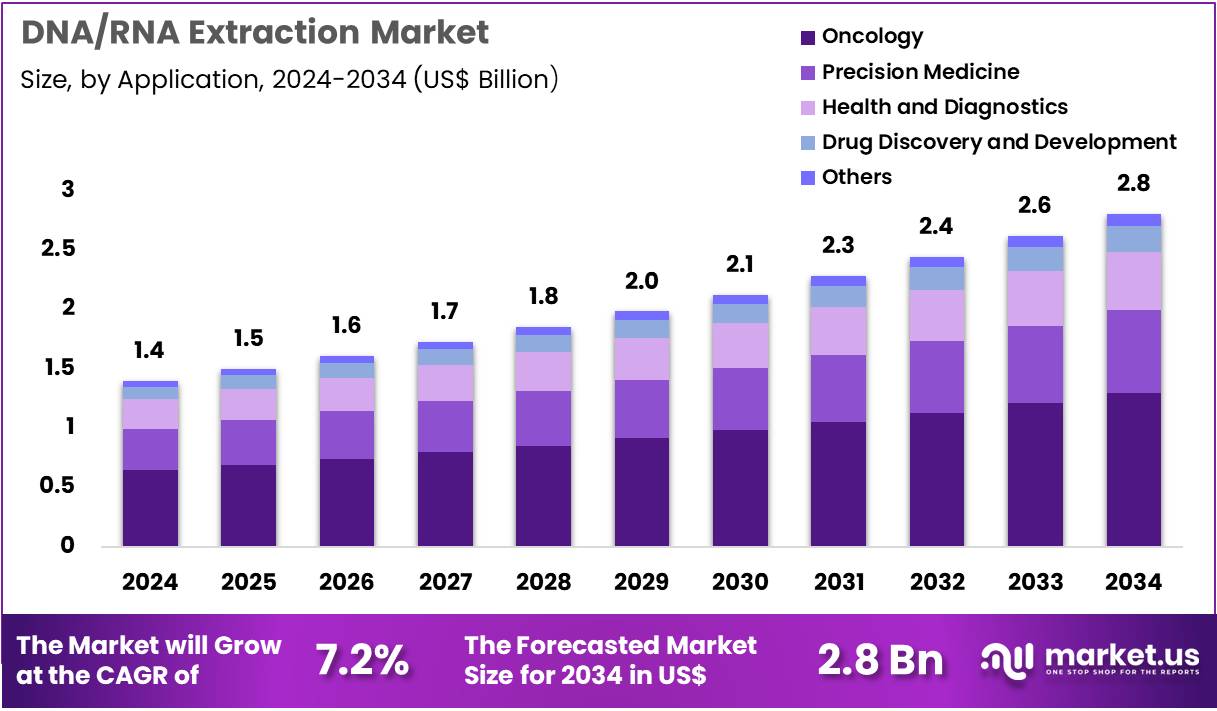
Key Takeaways
- In 2024, the DNA/RNA Extraction Market generated US$ 1.4 billion in revenue and is projected to reach US$ 2.8 billion by 2034, expanding at a CAGR of 7.2% during the forecast period.
- By product type, the market is segmented into kits & reagents, instruments, DNA isolation & purification kits, RNA isolation & purification kits, and others. Among these, kits & reagents dominated the market in 2024, accounting for 48.9% of the total market share.
- Based on method, the market is categorized into magnetic bead-based, reagent-based, column-based, and other methods. The magnetic bead-based segment emerged as the leading category, capturing 44.3% of the market share in 2024.
- By application, the market is segmented into oncology, precision medicine, health & diagnostics, drug discovery & development, and others. The oncology segment held the largest share, contributing 46.1% of the market revenue in 2024.
- In terms of end users, the market comprises hospital laboratories, academic & research laboratories, diagnostic laboratories, biopharmaceutical companies, and others. Hospital laboratories led the segment with a 41.7% revenue share in 2024.
- North America remained the leading regional market, accounting for 39.4% of the global DNA/RNA Extraction Market revenue in 2024.
Statistical Information
- Growing Burden of Cancer is Increasing Demand for DNA/RNA Extraction: Cancer remains one of the largest users of DNA and RNA extraction technologies because molecular profiling and genomic testing are now widely used for diagnosis and treatment selection. According to the World Health Organization (WHO), 20 million new cancer cases and 9.7 million cancer deaths occurred worldwide in 2022. Similarly, the U.S. National Cancer Institute’s Cancer Genome Atlas (TCGA) has generated genomic datasets covering 33 different cancer types, supporting precision oncology research that relies on high-quality DNA and RNA extraction.
- Precision Medicine Programs are Expanding Genomic Testing Volumes: Large-scale precision medicine initiatives continue to increase the need for automated DNA and RNA extraction. According to the U.S. NIH, the All of Us Research Program has become the world’s largest integrated genomics and health database, containing data from more than 747,000 participants, including over 535,000 whole-genome sequences linked with nearly 482,000 electronic health records.
- NIH Supports Large-Scale Genomics Research Through the All of Us Program: The U.S. National Institutes of Health (NIH) has established the world’s largest integrated genomics and health database, providing researchers with access to data from more than 747,000 participants, including over 535,000 whole-genome sequences, 553,000+ genotyping arrays, and 1.3 billion genetic variants. The dataset also contains 482,000 electronic health records, demonstrating the rapidly growing demand for DNA/RNA extraction technologies in precision medicine.
- NIH Has Published More Than 1,400 Scientific Studies Using Genomic Data: The NIH reports that its All of Us dataset has supported more than 1,400 peer-reviewed publications involving nearly 23,000 researchers worldwide. These studies rely on high-quality DNA and RNA samples obtained through standardized extraction methods before sequencing and molecular analysis.
- CDC Shows NGS Can Sequence Over 8 Billion DNA Base Pairs Daily: The U.S. Centers for Disease Control and Prevention (CDC) reports that conventional sequencing systems process approximately 2.1 million DNA base pairs per day, while next-generation sequencing (NGS) platforms can sequence more than 8 billion DNA base pairs daily. This dramatic increase in throughput has accelerated demand for efficient DNA/RNA extraction workflows.
- FDA GenomeTrakr Network Has Sequenced More Than 1.8 Million Pathogen Isolates: The U.S. FDA reports that its GenomeTrakr network has generated more than 1.8 million pathogen genome sequences and completed over 500 closed genomes. The network includes 19 federal laboratories, 40 state health and university laboratories, and 27 international laboratories, all of which depend on reliable DNA extraction before sequencing.
- NIH Researchers Identified 275 Million Previously Unknown Genetic Variants: The NIH announced that researchers discovered more than 275 million previously unreported genetic variants using genomic data from nearly 250,000 whole-genome sequences in the All of Us Research Program. Approximately 4 million variants were located in genomic regions potentially associated with disease risk, increasing the importance of high-quality DNA extraction.
- Complete Human Genome Contains Approximately 3 Billion DNA Bases: The NIH reports that the completed human reference genome contains approximately 3 billion DNA base pairs, with researchers adding nearly 200 million previously unresolved DNA bases beyond the original Human Genome Project. Accurate sequencing of these regions depends on high-quality DNA extraction and purification.
- Human Genome Project Reduced Sequencing Costs by More Than 99.99%: The U.S. National Human Genome Research Institute (NHGRI) reports that the cost of sequencing a human genome declined from approximately US$100 million in 2001 to less than US$200 today, enabling widespread genomic testing and significantly increasing the need for efficient DNA/RNA extraction technologies.
Regional Analysis
North America led the market by securing a market share of 39.4% in 2024.
North America dominated the DNA/RNA Extraction Market in 2024 due to its advanced molecular diagnostics infrastructure, strong genomics research ecosystem, and widespread adoption of next-generation sequencing. The United States continues to lead regional growth through increasing applications in oncology, infectious disease surveillance, precision medicine, and genetic testing.
According to the U.S. National Institutes of Health (NIH), the All of Us Research Program includes genomic and health data from more than 747,000 participants, supporting large-scale precision medicine research. The U.S. Centers for Disease Control and Prevention also maintains extensive genomic surveillance programs for emerging infectious diseases, increasing demand for high-quality DNA/RNA extraction technologies.
The presence of leading biotechnology and life sciences companies, well-equipped hospital and diagnostic laboratories, and continuous investments in automated sample preparation platforms further support market expansion. Growing pharmaceutical R&D activities and increasing clinical adoption of genomic testing continue to strengthen North America’s leadership in the global DNA/RNA extraction market.
Emerging Trends
- Expansion of Multi-Omics Research: Genomics research is rapidly moving beyond DNA sequencing to include RNA sequencing, proteomics, and multi-omics analysis. According to the NIH, the All of Us Research Program now includes data from 747,000+ participants, 535,000+ whole-genome sequences, 9,000+ RNA sequencing datasets, and 10,000+ proteomics datasets, increasing demand for high-quality DNA/RNA extraction workflows.
- Rapid Growth in Clinical Genomics: The World Health Organization (WHO) identified more than 6,500 genomic clinical studies conducted globally between 1990 and 2024. Cancer and rare diseases account for the largest share of these studies, while genomic research has accelerated significantly since 2010 due to lower sequencing costs and improved extraction technologies.
- High-Throughput Sequencing Driving Automation: Public health laboratories are increasingly adopting automated extraction systems to support next-generation sequencing (NGS). According to the CDC, modern NGS platforms can sequence over 8 billion DNA base pairs per day, compared with only 2.1 million base pairs using conventional sequencing, requiring faster and automated nucleic acid extraction methods.
- Increasing Investment in RNA Research: RNA analysis is becoming a major focus in biomedical research. The NIH launched its RNomics Program to develop advanced RNA technologies, noting that RNA can undergo more than 170 different chemical modifications. This trend is driving innovation in RNA extraction kits with higher purity and improved stability.
- Standardization of Biospecimen Processing: Research organizations are emphasizing standardized DNA/RNA extraction protocols to improve reproducibility. The U.S. National Cancer Institute (NCI) released updated 2026 Best Practices for Biospecimen Resources and highlighted DNA/RNA extraction protocols among the most frequently downloaded laboratory standard operating procedures, reflecting increased laboratory adoption.
Use Cases
- Cancer Genomic Testing: DNA/RNA extraction is widely used for tumor profiling, biomarker identification, and companion diagnostics. According to WHO, 20 million new cancer cases were reported globally in 2022, increasing demand for molecular diagnostics that rely on high-quality nucleic acid extraction before sequencing and PCR analysis.
- Precision Medicine Programs: Large precision medicine initiatives depend on DNA/RNA extraction to generate genomic datasets. NIH reports that the All of Us Research Program includes 1.3 billion genetic variants and genomic information from 535,000+ whole-genome sequences, supporting personalized treatment development and pharmacogenomics research.
- Infectious Disease Surveillance: Public health agencies use DNA/RNA extraction before whole-genome sequencing to identify pathogens and monitor outbreaks. According to the CDC, genomic sequencing starts with nucleic acid extraction and supports surveillance of bacteria, viruses, and fungi through high-throughput sequencing technologies.
- Rare Disease and Genetic Disorder Diagnosis: Clinical laboratories increasingly use DNA extraction for whole-genome and exome sequencing to identify inherited disorders. WHO reports that genomic technologies are now widely integrated into research on rare diseases, making reliable extraction methods essential for accurate genetic diagnosis.
- Drug Discovery and Biomarker Research: Pharmaceutical and biotechnology companies use DNA/RNA extraction to study gene expression, identify therapeutic targets, and validate biomarkers. NIH’s genomics technology programs continue to support development of faster, lower-cost sequencing and genomic analysis tools, expanding the use of nucleic acid extraction in biomedical R&D.
Frequently Asked Questions on DNA/RNA Extraction
- How is next-generation sequencing (NGS) influencing the DNA/RNA Extraction Market?
NGS has increased demand for high-quality DNA and RNA extraction because sequencing accuracy depends on purified genetic material. Growing applications in oncology, rare disease diagnosis, pathogen monitoring, and genomic research are encouraging laboratories to adopt advanced extraction technologies. - What role does automation play in DNA/RNA extraction workflows?
Automation improves laboratory productivity by reducing manual errors, increasing sample processing capacity, and delivering consistent extraction results. Automated systems support high-volume testing in hospitals, diagnostic laboratories, research institutions, and biotechnology companies by streamlining nucleic acid purification processes. - Why is DNA/RNA extraction important in precision medicine?
DNA/RNA extraction enables analysis of genetic variations, biomarkers, and gene expression patterns required for personalized treatment approaches. These technologies support targeted therapies, disease risk assessment, pharmacogenomics, and improved clinical decision-making, especially in cancer and rare genetic disorder management. - What are the advantages of magnetic bead-based extraction technology?
Magnetic bead-based extraction provides high nucleic acid recovery, improved purity, faster processing, and compatibility with automated systems. These advantages make it suitable for large-scale genomic testing, infectious disease analysis, clinical diagnostics, and research laboratories requiring reliable results. - How are hospitals using DNA/RNA extraction technologies?
Hospitals use DNA/RNA extraction for molecular diagnostics, infectious disease testing, genetic screening, cancer profiling, and pathology applications. Increasing adoption of PCR and sequencing-based tests is encouraging healthcare facilities to implement efficient extraction platforms for faster and accurate patient testing. - How do biotechnology companies use DNA/RNA extraction?
Biotechnology companies utilize DNA/RNA extraction for drug discovery, gene therapy research, vaccine development, biomarker identification, and cell-based studies. High-quality nucleic acids support accurate molecular analysis, helping companies develop innovative therapies and improve research outcomes. - What trends are shaping the future of DNA/RNA extraction technologies?
Major trends include automated extraction platforms, integration with sequencing systems, liquid biopsy applications, miniaturized devices, and improved reagent chemistry. These developments help laboratories achieve faster processing, higher accuracy, and increased efficiency across clinical and research applications.
Conclusion
The DNA/RNA Extraction Market is experiencing steady growth due to increasing demand for molecular diagnostics, genomic research, precision medicine, and next-generation sequencing applications. Rising cancer cases, infectious disease surveillance programs, and biotechnology advancements are creating strong opportunities for extraction technologies. Automated systems, magnetic bead-based methods, and improved reagent solutions are enhancing laboratory efficiency and accuracy.
North America continues to lead the market due to advanced healthcare infrastructure and strong research investments, while Asia Pacific shows significant growth potential through expanding genomic initiatives. Overall, continuous innovation in nucleic acid purification technologies will support broader adoption across clinical, research, and pharmaceutical applications.
Discuss your needs with our analyst
Please share your requirements with more details so our analyst can check if they can solve your problem(s)




