
Overview
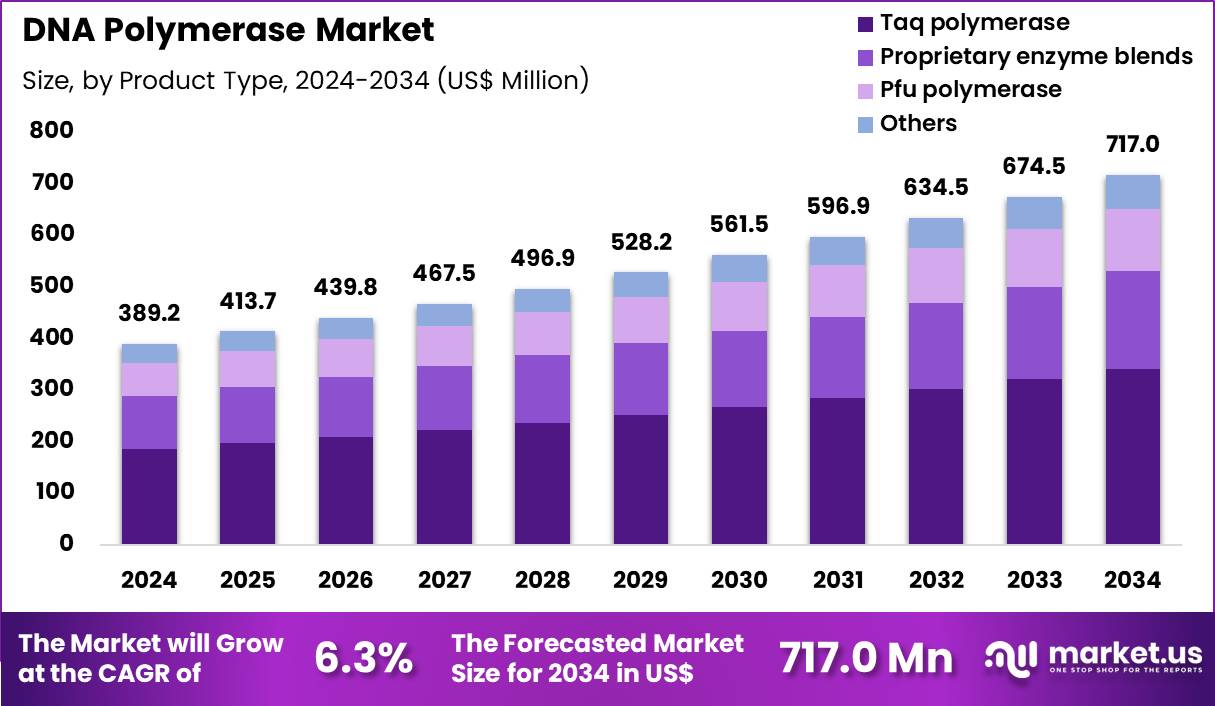
New York, NY – Oct 13, 2026 – The Global DNA Polymerase Market size is expected to be worth around US$ 717.0 Million by 2034 from US$ 389.2 Million in 2024, growing at a CAGR of 6.3% during the forecast period 2025 to 2034. In 2024, North America led the market, achieving over 40.0% share with a revenue of US$ 155.7 Million.
DNA polymerase is an essential enzyme responsible for synthesizing new DNA strands by using an existing DNA strand as a template. It plays a critical role in DNA replication, genetic inheritance, and the maintenance of genetic information in living organisms. By adding nucleotides to a growing DNA strand, DNA polymerase ensures the accurate duplication of genetic material before cell division.
DNA polymerases are widely used in molecular biology, biotechnology, clinical diagnostics, pharmaceutical research, and genetic engineering. One of their most important applications is the polymerase chain reaction (PCR), a technique used to amplify specific DNA sequences for further analysis. Thermostable DNA polymerases, such as Taq polymerase, are particularly valuable in PCR because they remain functional during repeated heating cycles.
Different types of DNA polymerases are available, each with specific characteristics, including synthesis speed, accuracy, processivity, and proofreading capability. These properties determine their suitability for applications such as routine DNA amplification, high-fidelity PCR, DNA sequencing, cloning, and next-generation sequencing workflows.
Growing demand for molecular diagnostics, genomics research, personalized medicine, and biotechnology development continues to support the importance of DNA polymerases in scientific and commercial applications. Ongoing advancements in enzyme engineering are improving polymerase performance, reliability, and efficiency, enabling researchers to achieve more accurate and consistent results across diverse molecular biology applications.
Key Takeaways
- In 2024, the DNA polymerase market was valued at US$ 389.2 million and is projected to grow at a CAGR of 6.3%, reaching US$ 717.0 million by 2034.
- By product type, the market is segmented into Taq polymerase, proprietary enzyme blends, Pfu polymerase, and others. Taq polymerase dominated the segment in 2024, accounting for a 47.6% market share.
- Based on application, the market is categorized into polymerase chain reaction, DNA cloning, DNA sequencing, and others. Polymerase chain reaction led the segment with a 58.3% market share.
- By end user, the market is divided into pharmaceutical and biotechnology companies, academic and research institutes, hospitals and diagnostic centers, and others. Pharmaceutical and biotechnology companies held the largest revenue share of 54.9%.
- North America dominated the global DNA polymerase market in 2024, accounting for a 40.0% market share.
Key Market Segments
- Product Type Analysis: Taq polymerase dominated the product type segment in 2024, accounting for 47.6% of the market. Its cost efficiency, thermal stability, and reliability in routine PCR applications support widespread adoption across diagnostic laboratories, academic institutions, and research facilities, sustaining its leading position globally.
- Application Analysis: Polymerase chain reaction led the application segment in 2024, capturing 58.3% of the market. Growing demand for molecular diagnostics, pathogen detection, genetic testing, pharmaceutical research, and automated laboratory workflows continues to strengthen PCR adoption, supporting its dominant position in the DNA polymerase market.
- End-User Analysis: Pharmaceutical and biotechnology companies dominated the end-user segment in 2024, accounting for 54.9% of the market. Increasing investment in drug discovery, biologics development, vaccine research, gene therapy, and molecular diagnostics continues to drive DNA polymerase consumption across pharmaceutical and biotechnology research activities.
Regional Analysis
North America DNA Polymerase Market Analysis
North America dominated the DNA polymerase market in 2024, accounting for 40.0% of the global market share. Regional growth is supported by advanced genomic research, expanding molecular diagnostics, and strong pharmaceutical and biotechnology industries.
Increasing applications in next-generation sequencing, oncology testing, infectious disease diagnosis, vaccine development, and personalized medicine are driving demand for reliable DNA polymerases. Investments in research infrastructure, automated laboratory platforms, and high-quality enzyme formulations further strengthen regional market development.
Asia Pacific DNA Polymerase Market Analysis
Asia Pacific is expected to register the highest CAGR during the forecast period, supported by expanding biotechnology infrastructure, increasing government investments, and rising demand for molecular diagnostics. Growing research activities in genetic disorders, infectious diseases, biosimilar development, and genomic sequencing are creating opportunities for DNA polymerase manufacturers.
Localized enzyme production and cost-effective diagnostic solutions are expected to improve market accessibility. Additionally, government support for biotechnology startups, research collaborations, and workforce development is anticipated to accelerate regional growth and strengthen the adoption of advanced molecular biology technologies.
Emerging Trends
- Increasing demand for high-accuracy DNA polymerases: The demand for high-fidelity DNA polymerases is increasing as laboratories require more accurate DNA copying for genetic testing, research and sequencing. These enzymes help reduce copying errors, making them valuable for applications where small genetic changes must be identified reliably.
- Growing use of DNA polymerases in next-generation sequencing: Next-generation sequencing (NGS) is creating new opportunities for DNA polymerase suppliers. These enzymes support DNA preparation and, in sequencing-by-synthesis methods, help build DNA strands that can be read to identify genetic variations. Growing use of genomic analysis supports demand for specialized enzymes.
- Expansion of precision medicine and genetic testing: Precision medicine uses genetic and other patient information to support more individualized healthcare decisions. As genomic testing expands in cancer care, rare disease investigation and treatment selection, demand can increase for dependable DNA polymerases used in laboratory testing workflows.
- Development of faster and more convenient enzyme formulations: Manufacturers are developing DNA polymerase products for different laboratory needs, including ready-to-use mixtures and enzymes designed for specific reaction conditions. Research also points to growing interest in freeze-dried formulations that may support storage, transport and testing outside centralized laboratories.
- Increasing investment in specialized enzyme engineering: Enzyme development is moving beyond standard DNA copying toward products designed for particular research and industrial applications. Improvements in enzyme performance can support better sequencing, whole-genome amplification and challenging DNA samples, creating opportunities for suppliers that offer application-specific solutions.
Use Cases
- Infectious disease diagnosis: DNA polymerases are used in PCR-based tests to increase the amount of target genetic material, helping laboratories detect disease-causing organisms. These methods support the diagnosis of infections such as pertussis and other infectious diseases when suitable validated tests are used.
- Cancer and inherited disease research: DNA polymerases support the preparation and analysis of genetic material used to investigate cancer-related mutations and inherited conditions. When combined with suitable testing methods, DNA analysis can help identify genetic changes that inform diagnosis, research and selected treatment decisions.
- Next-generation and whole-genome sequencing: DNA polymerases help copy DNA during many sequencing workflows, allowing researchers to examine genetic information in detail. These techniques support genome studies, gene discovery and the identification of variations associated with diseases, biological traits and differences between organisms.
- Forensic identification and DNA profiling: DNA polymerases are used to amplify small amounts of genetic material collected from biological evidence. This allows forensic laboratories to obtain sufficient DNA for analysis and comparison, supporting investigations involving samples such as blood, hair and other biological traces.
- Drug discovery and biotechnology research: In pharmaceutical and biotechnology research, DNA polymerases support gene cloning, genetic construct preparation and experiments that study gene function. These applications help researchers investigate biological processes, develop experimental tools and evaluate potential approaches for future medicines and biotechnology products.
Frequently Asked Questions About DNA Polymerase
- What is DNA polymerase?
DNA polymerase is an enzyme that builds new DNA strands by adding DNA building blocks to an existing template. It plays an essential role in DNA replication and is widely used in molecular biology research and laboratory testing. - What are the main types of DNA polymerase?
DNA polymerases include enzymes found in bacteria, animals, plants and other organisms. Common laboratory examples include Taq polymerase and Pfu polymerase, while natural cellular enzymes perform different roles in DNA replication, repair and maintenance. - Why is DNA polymerase important in PCR?
DNA polymerase is essential for PCR because it copies selected DNA regions during repeated temperature cycles. This process produces many copies of a target sequence, making genetic material easier to detect and analyze in laboratory applications. - Is DNA polymerase used in medical diagnostics?
Yes, DNA polymerase is used in molecular diagnostic workflows, including PCR-based tests for infectious diseases and genetic analysis. Test accuracy also depends on sample quality, assay design, laboratory procedures and appropriate interpretation of results. - What factors affect DNA polymerase performance?
DNA polymerase performance depends on enzyme type, temperature, reaction conditions, DNA template quality and the intended application. Enzyme accuracy, speed, stability and compatibility with laboratory methods can influence the quality and efficiency of DNA amplification. - What challenges affect the DNA polymerase market?
Market challenges include the need for consistent enzyme quality, reliable supply, application-specific performance and competitive pricing. Diagnostic applications also require suitable validation and quality controls, while research laboratories may face budget constraints and technical limitations. - Which emerging technologies could create opportunities in the DNA polymerase market?
Emerging opportunities include advanced sequencing methods, digital PCR, whole-genome amplification and specialized enzyme formulations. These technologies require enzymes suited to specific performance needs, potentially creating new product opportunities for manufacturers serving clinical, academic and biotechnology customers.
Conclusion
The DNA polymerase market is expected to experience steady growth, supported by increasing demand for molecular diagnostics, genetic testing, DNA sequencing, and biotechnology research. The widespread use of PCR and the growing adoption of precision medicine are creating significant opportunities for market participants.
Taq polymerase continues to hold a strong position due to its thermal stability, cost efficiency, and suitability for routine applications. North America remains a leading regional market, while Asia Pacific offers promising growth opportunities through expanding research infrastructure and healthcare investments. Furthermore, advancements in enzyme engineering are expected to improve accuracy, efficiency, and reliability, supporting long-term market development.
Discuss your needs with our analyst
Please share your requirements with more details so our analyst can check if they can solve your problem(s)