
Overview
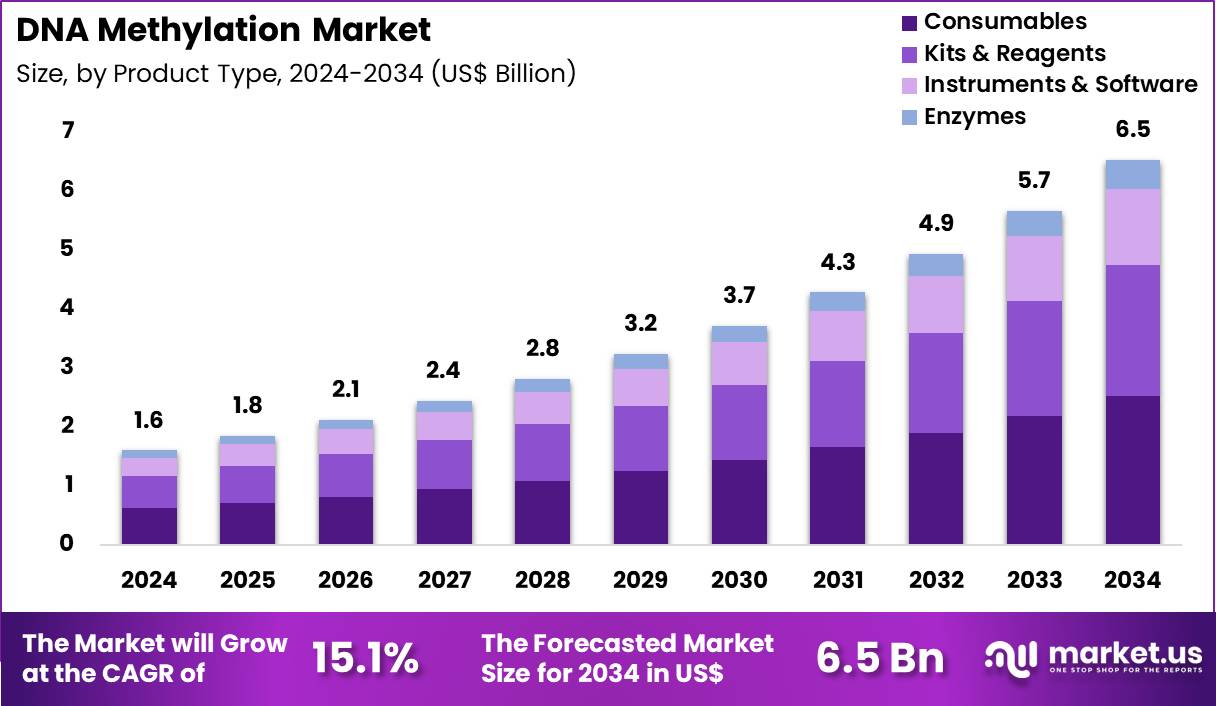
New York, NY – Oct 23, 2026 – Global DNA Methylation Market size is expected to be worth around US$ 6.5 Billion by 2034 from US$ 1.6 Billion in 2024, growing at a CAGR of 15.1% during the forecast period 2025 to 2034. In 2024, North America led the market, achieving over 42.7% share with a revenue of US$ 0.7 Billion.
DNA methylation is an important biological process that helps regulate gene activity and maintain normal cellular functions. It involves the addition of methyl groups to DNA, most commonly at cytosine bases in specific DNA sequences. This process can influence whether genes are active or inactive without changing the underlying DNA sequence.
DNA methylation plays a critical role in several biological functions, including embryonic development, cellular differentiation, genomic stability, and aging. Changes in DNA methylation patterns have also been associated with various health conditions, including cancer, neurological disorders, and metabolic diseases.
Growing scientific interest in DNA methylation has expanded its applications in biomedical research, disease investigation, and the development of diagnostic tools. Researchers are increasingly examining methylation patterns to identify potential biomarkers for early disease detection, monitor disease progression, and support personalized medicine approaches.
Technological advancements in DNA sequencing, methylation profiling, and molecular analysis are improving the ability to study epigenetic changes with greater accuracy and efficiency. These developments are creating new opportunities for research laboratories, healthcare institutions, biotechnology companies, and pharmaceutical organizations.
As research continues to advance, DNA methylation is expected to remain an important area of investigation in epigenetics and molecular biology. A deeper understanding of this process may contribute to improved knowledge of disease mechanisms and support the development of more targeted approaches to disease prevention, diagnosis, and treatment.
Key Takeaways
- In 2024, the market was valued at US$ 1.6 Billion and is projected to reach US$ 6.5 Billion by 2034, growing at a CAGR of 15.1%.
- By product type, the market is segmented into consumables, kits & reagents, instruments & software, and enzymes. The consumables segment dominated the market, accounting for 38.6% of the total share.
- Based on technology, the market is categorized into polymerase chain reaction (PCR), sequencing, microarray, and others. The PCR segment held a significant market share of 41.8%.
- By application, the market is segmented into gene therapy, diagnostics, clinical research, and others. The gene therapy segment led the market, capturing the largest revenue share of 36.9%.
- By end user, the market is divided into pharmaceutical & biotechnology companies, hospital & diagnostic laboratories, and research & academic institutes. Pharmaceutical & biotechnology companies dominated the market, accounting for 44.7% of total revenue.
- Regionally, North America dominated the market, accounting for a market share of 42.7%.
Key Market Segments
- Product Type Analysis: The consumables segment dominated the DNA methylation market, accounting for 38.6% of the market share. Its leading position is supported by recurring demand for reagents, assay components, plates, and buffers used in routine methylation testing. Increasing research activity in oncology, rare diseases, and developmental biology further drives consumption. Growing adoption of standardized laboratory workflows is expected to sustain segment demand.
- Technology Analysis: The polymerase chain reaction (PCR) segment held a significant 41.8% share of the DNA methylation market. Its growth is driven by high sensitivity, rapid analysis, cost efficiency, and compatibility with existing laboratory infrastructure. PCR-based methods support targeted methylation detection, biomarker validation, and cancer research. Advancements in digital PCR and multiplex testing are further improving accuracy and operational efficiency.
- Application Analysis: The gene therapy segment accounted for 36.9% of the DNA methylation market, supported by increasing research into gene expression regulation and therapeutic stability. Methylation analysis helps researchers evaluate transgene activity, identify potential gene silencing, and optimize vector design. Rising investments in oncology and rare disease therapies, alongside growing demand for precise molecular characterization, are expected to support segment expansion.
- End-User Analysis: Pharmaceutical and biotechnology companies dominated the DNA methylation market, accounting for 44.7% of the total market share. Growth is supported by increasing investments in drug discovery, epigenetic research, and precision medicine. These companies use methylation analysis to identify therapeutic targets and validate disease mechanisms. Expanding biomarker development and companion diagnostic programs are expected to strengthen demand across pharmaceutical and biotechnology research activities.
Regional Analysis
North America is Leading the DNA Methylation Market
North America accounted for 42.7% of the global DNA methylation market in 2024, supported by advanced healthcare infrastructure, strong biotechnology investments, and extensive epigenetic research. Leading companies, including Illumina and Thermo Fisher Scientific, continue to advance methylation analysis technologies for oncology, diagnostics, and personalized medicine. Government funding, academic-industry collaborations, and increasing demand for epigenetic biomarkers further support regional market growth.
Asia Pacific is Expected to Register the Highest CAGR
The Asia Pacific DNA methylation market is expected to record the highest CAGR during the forecast period, driven by increasing investments in biotechnology, genomic research, and precision medicine. China and India are strengthening research infrastructure through government initiatives and international collaborations.
Growing biotechnology startups, expanding diagnostic capabilities, and rising healthcare expenditure are supporting regional adoption. Furthermore, increasing demand for affordable methylation testing solutions and advancements in sequencing technologies are expected to create significant growth opportunities across emerging Asian markets.
Emerging Trends
- Growth in cancer detection and screening: DNA methylation patterns are being studied as biomarkers for identifying cancer and supporting early diagnosis. These changes may help distinguish cancer-related signals from normal biological activity and support the development of new diagnostic tests.
- Increasing use of liquid biopsy: Researchers are studying methylation signals in cell-free DNA found in blood and other body fluids. This approach may support less invasive cancer testing and disease monitoring, although clinical usefulness depends on the specific test and cancer type.
- Advances in sequencing and methylation analysis: Next-generation sequencing and improved laboratory methods are enabling researchers to examine methylation at many genomic locations. These technologies support more detailed epigenetic studies and may improve the detection of biologically meaningful changes.
- Expansion of precision medicine research: Methylation profiles are being investigated to understand differences between patients, disease subtypes, and treatment responses. This could support more individualized treatment decisions as stronger clinical evidence becomes available.
- Development of epigenetic therapies: Research into DNA methylation is helping scientists understand how abnormal gene activity contributes to disease. Drugs that affect DNA methylation are already used for certain cancers, while further research is exploring additional therapeutic applications.
- Use of artificial intelligence in methylation data analysis: Machine learning is being explored to identify complex patterns in large methylation datasets. These tools may help researchers classify diseases and interpret results faster, provided that the models are tested on reliable and diverse patient data.
- Increasing interest in biological ageing: DNA methylation patterns are being used to develop epigenetic clocks that estimate biological age. Research is examining how these measurements relate to ageing, lifestyle, environmental exposures, and age-associated diseases, although they are not direct measures of overall health.
- Expansion of targeted epigenome editing: Researchers are developing tools that can add or remove methylation at selected DNA regions. This approach may help establish whether specific epigenetic changes cause disease and could support future targeted treatments, although most applications remain experimental.
Use Cases
- Cancer diagnosis and tumour classification: DNA methylation profiles can help identify and distinguish certain tumour types, including difficult-to-classify brain tumours. The National Cancer Institute has described the use of methylation profiling to support tumour classification and clinical decision-making.
- Colorectal cancer screening: Methylation biomarkers can be measured in blood-based tests to identify signals associated with colorectal cancer. In July 2026, the US Food and Drug Administration approved the SimpleScreen CRC test for screening eligible adults at average risk, demonstrating a real clinical application.
- Treatment selection in cancer care: Methylation testing can help assess specific tumour characteristics that may affect treatment decisions. For example, MGMT promoter methylation is used in evaluating glioblastoma and can provide information relevant to the potential benefit of temozolomide chemotherapy.
- Research into inherited and developmental conditions: DNA methylation analysis can help investigate disorders associated with abnormal genomic imprinting and epigenetic regulation. Researchers use these tests to study how genes are activated or silenced and to support the investigation of certain genetic and developmental conditions.
- Ageing and environmental exposure research: Methylation measurements can be used to study biological ageing and the relationship between environmental factors and changes in gene regulation. Researchers are investigating these patterns to better understand long-term health risks, ageing processes, and differences between individuals.
Frequently Asked Questions About DNA Methylation
- Why is DNA methylation important in healthcare?
DNA methylation is important because changes in methylation patterns can provide information about gene regulation, disease development, and cellular activity. Healthcare researchers use these patterns to investigate cancer, developmental disorders, ageing, and potential diagnostic biomarkers. - How is DNA methylation detected?
DNA methylation is measured using laboratory methods such as methylation-specific PCR, bisulfite sequencing, and DNA methylation arrays. The selected technique depends on the sample type, number of DNA regions being studied, required accuracy, and purpose of the test. - Can DNA methylation testing detect cancer?
Yes, certain DNA methylation tests can detect molecular signals associated with specific cancers. Their accuracy and intended use vary by test, and a positive screening result may require further investigations, such as colonoscopy, to confirm a diagnosis. - What are the major factors driving the DNA methylation market?
Market development is supported by growing cancer research, increasing demand for molecular diagnostics, advances in sequencing technologies, and wider use of epigenetic analysis. These factors are expanding the potential applications of methylation testing in laboratories and healthcare settings. - Which technologies are commonly used in the DNA methylation market?
Common technologies include methylation-specific PCR, bisulfite sequencing, DNA methylation arrays, and methylation-sensitive digital PCR. Each method offers different levels of detail, processing speed, and cost, influencing its suitability for clinical testing or large-scale research projects. - Which application segment is important in the DNA methylation market?
Cancer research and molecular diagnostics are important application areas because methylation patterns can support tumour classification, biomarker discovery, and selected screening tests. Other applications include developmental genetics, ageing research, drug development, and investigations into environmental influences on gene regulation. - What opportunities are emerging in the DNA methylation market?
Potential opportunities include blood-based cancer testing, improved methylation analysis software, single-cell profiling, and more targeted epigenetic research. Commercial adoption will depend on demonstrating reliable performance, clinical value, manageable costs, and appropriate regulatory compliance for each intended application. - How is DNA methylation used in pharmaceutical research?
Pharmaceutical researchers study DNA methylation to understand disease mechanisms, identify potential drug targets, and investigate treatment responses. Methylation-modifying medicines are already used for certain cancers, while additional epigenetic approaches are being evaluated through preclinical and clinical research.
Conclusion
The DNA methylation market is gaining importance due to growing applications in cancer diagnostics, epigenetic research, precision medicine, and pharmaceutical development. Advances in PCR, DNA sequencing, and methylation profiling are improving the ability to analyse epigenetic changes and identify potential disease biomarkers. Consumables, PCR-based technologies, and pharmaceutical and biotechnology companies represent key segments within the market estimates provided.
North America currently holds a leading regional position, while Asia Pacific offers opportunities through expanding research infrastructure and biotechnology investments. Continued technological innovation, clinical validation, and improved testing accessibility are expected to influence future market development and adoption across healthcare and research applications.
Discuss your needs with our analyst
Please share your requirements with more details so our analyst can check if they can solve your problem(s)