


Overview
New York, NY – Aug 18, 2026 – The Global DNA Diagnostics Market size is expected to be worth around US$ 27.84 Billion by 2034 from US$ 11.44 Billion in 2024, growing at a CAGR of 9.3% during the forecast period from 2025 to 2034. In 2024, North America led the market, achieving over 42.5% share with a revenue of US$ 4.86 Billion.
The DNA diagnostics market is growing rapidly due to rising disease prevalence, increasing demand for early detection, and advancements in genomic technologies. DNA-based testing plays a crucial role in oncology, infectious disease identification, rare disease diagnosis, genetic screening, and personalized treatment planning. According to the World Health Organization (WHO), approximately 20 million new cancer cases and 9.7 million cancer deaths occurred globally in 2022, and cancer cases are projected to reach nearly 35 million annually by 2050, creating strong demand for genomic testing solutions.
A major factor supporting market expansion is the declining cost of DNA sequencing. The U.S. National Human Genome Research Institute (NHGRI) reported that the cost of sequencing a human genome has decreased from around $100 million in 2001 to several hundred dollars today, improving accessibility and enabling wider clinical adoption of next-generation sequencing (NGS). These advancements are supporting faster diagnosis, improved accuracy, and large-scale genomic screening programs.
Public healthcare initiatives are further accelerating adoption. The WHO Global Genomic Surveillance Strategy 2022–2032 aims to strengthen genomic sequencing capabilities across all 194 WHO Member States for improved disease surveillance and pandemic preparedness. Additionally, genomic medicine programs are integrating DNA testing into routine healthcare pathways.
The growing burden of genetic disorders, ageing populations, and increasing focus on precision medicine are expanding the application scope of DNA diagnostics. With improved regulatory frameworks, reimbursement support, and continuous innovation in sequencing technologies, DNA diagnostics is becoming an essential tool for modern healthcare systems worldwide.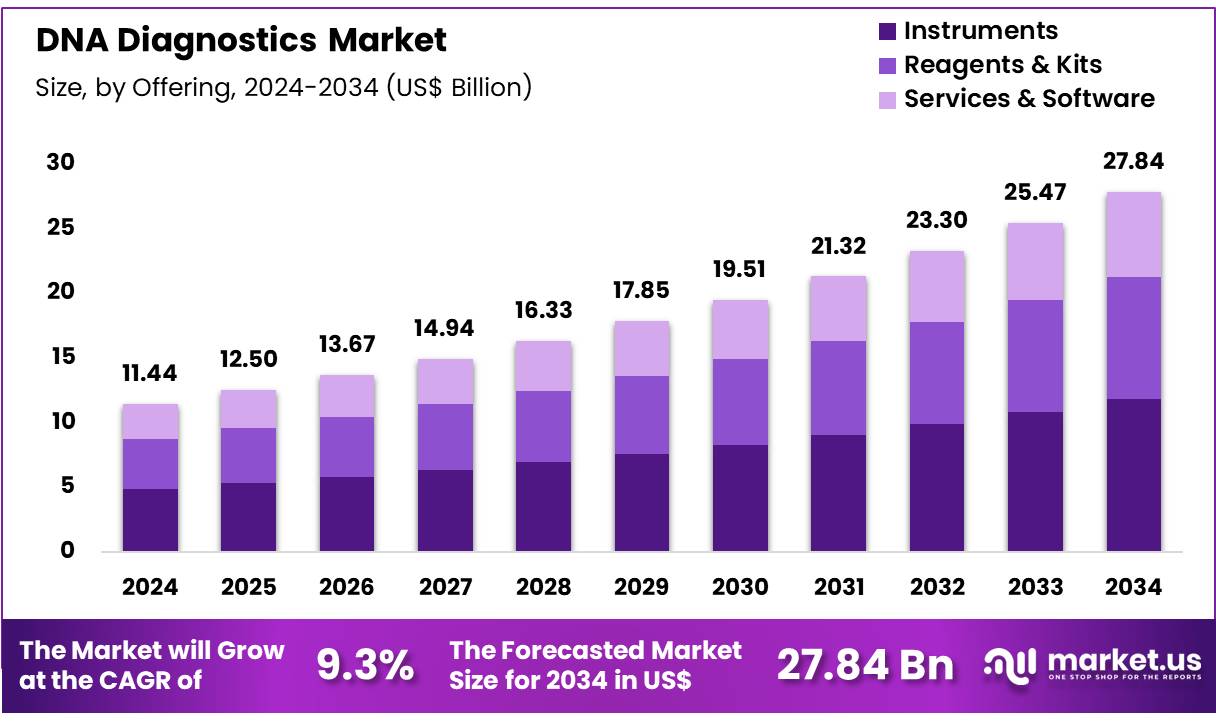
Key Takeaways
- Market Size: The global DNA diagnostics market is projected to reach approximately US$ 27.84 billion by 2034, increasing from US$ 11.44 billion in 2024.
- Market Growth: The DNA diagnostics market is expected to expand at a CAGR of 9.3% from 2025 to 2034, driven by rising demand for genomic testing and precision medicine.
- Offering Analysis: The instruments segment held the leading position in the DNA diagnostics market in 2024, accounting for 42.5% of the overall market share.
- Technology Analysis: Polymerase Chain Reaction (PCR) was the dominant technology segment in 2024, representing 49.4% of the global DNA diagnostics market share.
- Application Analysis: The oncology segment accounted for the largest market share in 2024, contributing 30.5% of the total market, supported by increasing cancer screening and molecular testing adoption.
- End-Use Analysis: Diagnostic laboratories emerged as the leading end-user segment in 2024, capturing 43.6% of the global market share due to increasing demand for advanced testing services.
- Regional Analysis: North America dominated the DNA diagnostics market in 2024, accounting for more than 42b.5% share with a market value of approximately US$ 4.86 billion, supported by advanced healthcare infrastructure and genomic research investments.
Statistical Information
- Increasing Global Cancer Burden Driving Demand for DNA Diagnostics: Cancer is one of the strongest application areas for DNA diagnostics, especially genomic profiling, mutation testing, and companion diagnostics. According to the World Health Organization (WHO), the world recorded approximately 20 million new cancer cases and 9.7 million cancer deaths in 2022. Global cancer cases are projected to exceed 35 million annually by 2050, increasing demand for molecular testing for early detection and targeted therapy selection.
- Genetic Mutations Increasing Need for Molecular Testing in Oncology: Modern cancer treatment increasingly depends on identifying DNA alterations such as EGFR, HER2, BRCA, and other biomarkers. The U.S. Food and Drug Administration (FDA) has approved more than 50 companion diagnostic devices to help identify patients who may benefit from specific targeted therapies.
- Human Genome Sequencing Costs Have Fallen by More Than 99%: The decline in sequencing costs has significantly improved DNA diagnostics accessibility. The National Human Genome Research Institute (NHGRI) reported that sequencing a human genome cost approximately $95 million in 2001, while recent sequencing costs have fallen to around $500 per genome, enabling broader adoption of next-generation sequencing (NGS).
- Rare Diseases Creating Long-Term Demand for Genetic Testing: Genetic diagnostics are becoming important for identifying rare inherited disorders. The National Institutes of Health (NIH) estimates that approximately 7,000 rare diseases exist globally, with around 80% having a genetic origin. DNA sequencing helps reduce diagnostic delays and improves identification of disease-causing variants.
- Large Genomic Dataset Availability Accelerating DNA Research: The NIH All of Us program has released genomic and health data from hundreds of thousands of participants. The program includes more than 747,000 participants with available data, including over 535,000 whole-genome sequences, supporting research in disease risk prediction and precision medicine.
- Expansion of Available Genetic Tests and Clinical Applications: The availability of genetic testing has expanded significantly, supporting the growth of DNA diagnostics. The NIH Genetic Testing Registry (GTR) lists more than 64,000 genetic tests, covering approximately 29,000+ conditions, 18,700+ genes, and hundreds of laboratories. This growth reflects increasing clinical use of DNA testing for disease diagnosis, risk assessment, and treatment planning.
- Large-Scale Genomic Data Supporting Precision Medicine Research: The NIH All of Us Research Program has created one of the largest genomic healthcare databases. The program provides data from more than 747,000 participants, including over 535,000 whole genome sequences linked with electronic health records. This large genomic dataset supports the discovery of disease-related genetic patterns and improves future DNA diagnostic development.
- Discovery of Hundreds of Millions of Genetic Variants: Large genomic studies are increasing knowledge of human DNA variation. NIH researchers analyzing data from nearly 250,000 participants identified more than 275 million previously unreported genetic variants, including nearly 4 million variants located in regions potentially associated with disease risk.
Regional Analysis
North America held a dominant market position, capturing more than a 42.5% share
North America remains a leading region for DNA diagnostics due to advanced healthcare infrastructure, strong genomic research capabilities, and increasing adoption of precision medicine. The U.S. has significantly expanded the use of molecular diagnostics through initiatives focused on cancer genomics, rare disease identification, and personalized healthcare. The National Institutes of Health (NIH) All of Us Research Program aims to collect health and genomic data from 1 million or more participants, supporting innovation in genomic medicine.
Cancer and genetic disorder testing continue to drive demand, with the National Cancer Institute emphasizing genomic testing for targeted cancer therapies. The region also benefits from strong regulatory support from the U.S. FDA and reimbursement pathways through CMS for eligible next-generation sequencing tests.
Canada is strengthening genomic healthcare through national research programs and public-private collaborations. Increasing investments in sequencing technologies, laboratory infrastructure, and preventive healthcare are expected to support continued DNA diagnostics adoption across North America.
Emerging Trends
- Expansion of Next-Generation Sequencing (NGS) in Clinical Diagnostics: Next-generation sequencing is becoming a major trend in DNA diagnostics due to improved accuracy and lower costs. The National Human Genome Research Institute reported genome sequencing costs declined from about $95 million in 2001 to several hundred dollars, enabling wider clinical adoption in cancer, rare diseases, and genetic screening.
- Growing Adoption of Precision Oncology Testing: Precision oncology is increasing demand for DNA diagnostics as healthcare providers use genomic information to select targeted therapies. The National Cancer Institute states molecular testing helps identify tumor mutations for treatment decisions. In 2022, approximately 20 million cancer cases were reported globally, increasing the need for genomic cancer testing.
- Increasing Use of Liquid Biopsy Technologies: Liquid biopsy is emerging as a non-invasive DNA diagnostic approach using circulating tumor DNA (ctDNA) from blood samples. The National Cancer Institute highlights its potential for cancer detection, treatment monitoring, and identifying genetic changes. This technology is improving access to repeated molecular testing without invasive tissue procedures.
- Expansion of Population Genomic Screening Programs: Healthcare systems are increasingly implementing population-level genomic programs to identify disease risks earlier. The NIH All of Us Research Program aims to enroll 1 million or more participants and combines genomic information with health records to support personalized healthcare research and future DNA diagnostic applications.
- Increasing Role of Artificial Intelligence in Genomic Data Interpretation: Artificial intelligence is becoming important for analyzing large genomic datasets and identifying disease-related patterns. NIH-supported genomic initiatives use advanced computational tools to interpret genetic variations. Large databases such as ClinVar contain millions of genetic variant records, supporting faster and more accurate DNA test interpretation.
Use Cases
- Cancer Diagnosis and Personalized Treatment Selection: DNA diagnostics are widely used in oncology to identify mutations and guide targeted therapies. FDA-approved companion diagnostics help determine suitable treatments based on patient biomarkers. The FDA maintains a database containing hundreds of approved companion diagnostic applications supporting personalized cancer care.
- Rare Disease Detection and Genetic Diagnosis: DNA testing is improving diagnosis for rare genetic disorders by identifying disease-causing mutations. The NIH estimates there are approximately 7,000 rare diseases, with many linked to genetic changes. Whole genome and exome sequencing help patients receive faster and more accurate diagnoses.
- Infectious Disease Identification and Genomic Surveillance: DNA diagnostics support rapid pathogen detection and outbreak monitoring through molecular testing and sequencing. WHO’s Global Genomic Surveillance Strategy aims to strengthen genomic capabilities across 194 Member States by 2032, improving disease tracking and pandemic preparedness worldwide.
- Newborn Screening and Early Genetic Risk Detection: DNA diagnostics are increasingly used in newborn screening programs to identify inherited conditions early. The U.S. HRSA Recommended Uniform Screening Panel includes more than 30 core conditions, helping healthcare providers detect metabolic and genetic disorders before severe complications develop.
- Pharmacogenomics for Personalized Drug Selection: Pharmacogenomic testing helps predict how patients may respond to specific medicines based on DNA variations. The FDA reports more than 500 drug labels containing pharmacogenomic information, supporting the integration of genetic testing into medication selection and personalized treatment strategies.
Frequently Asked Questions on DNA Diagnostics
- What factors are driving the growth of the DNA Diagnostics Market?
The DNA diagnostics market is driven by increasing cancer cases, rising genetic disorder awareness, declining sequencing costs, and growing adoption of precision medicine. Advancements in next-generation sequencing, molecular testing technologies, and government-supported genomic initiatives are further accelerating market expansion globally. - What role does next-generation sequencing play in DNA diagnostics?
Next-generation sequencing enables rapid and detailed analysis of DNA by identifying multiple genetic changes simultaneously. It supports cancer profiling, rare disease diagnosis, inherited disorder detection, and personalized treatment planning by providing comprehensive genomic information for healthcare professionals. - Why is oncology a major application area for DNA diagnostics?
Oncology is a leading application because genomic testing helps detect cancer-related mutations and identify suitable targeted therapies. DNA diagnostics supports early detection, treatment selection, and disease monitoring, making it an important tool in modern precision cancer care. - How are declining sequencing costs impacting DNA diagnostics adoption?
The reduction in DNA sequencing costs has increased accessibility and affordability of genomic testing. Lower costs allow hospitals, laboratories, and research institutions to implement advanced sequencing technologies for clinical diagnosis, genetic screening, population health programs, and personalized medicine applications. - What are the major technologies used in DNA diagnostics?
Key technologies in DNA diagnostics include Polymerase Chain Reaction (PCR), next-generation sequencing (NGS), microarrays, and DNA amplification methods. PCR remains widely used for rapid testing, while NGS is expanding due to its ability to analyze complex genetic information. - What role do governments play in DNA diagnostics development?
Governments support DNA diagnostics through genomic research funding, regulatory approvals, reimbursement policies, and public health initiatives. Programs focused on precision medicine, genomic surveillance, and genetic screening are improving healthcare systems’ ability to adopt advanced molecular diagnostic technologies. - How is DNA diagnostics used in infectious disease monitoring?
DNA diagnostics enables rapid identification of infectious organisms through molecular testing and sequencing technologies. These methods support outbreak monitoring, pathogen tracking, antimicrobial resistance detection, and public health surveillance by providing faster and more precise disease information.
Conclusion
The DNA diagnostics market is becoming a crucial component of modern healthcare due to rising disease burden, technological advancements, and increasing demand for personalized medicine. Growing adoption of next-generation sequencing, PCR-based testing, and genomic analysis is improving disease detection, treatment selection, and patient outcomes.
Increasing cancer cases, genetic disorders, infectious disease surveillance, and government-supported genomic programs are creating strong opportunities for market expansion. Declining sequencing costs and improved regulatory support are further enhancing accessibility and clinical adoption. With continuous innovation in molecular diagnostics and precision healthcare, DNA diagnostics is expected to play an increasingly important role in future medical decision-making.
Discuss your needs with our analyst
Please share your requirements with more details so our analyst can check if they can solve your problem(s)




