


Overview
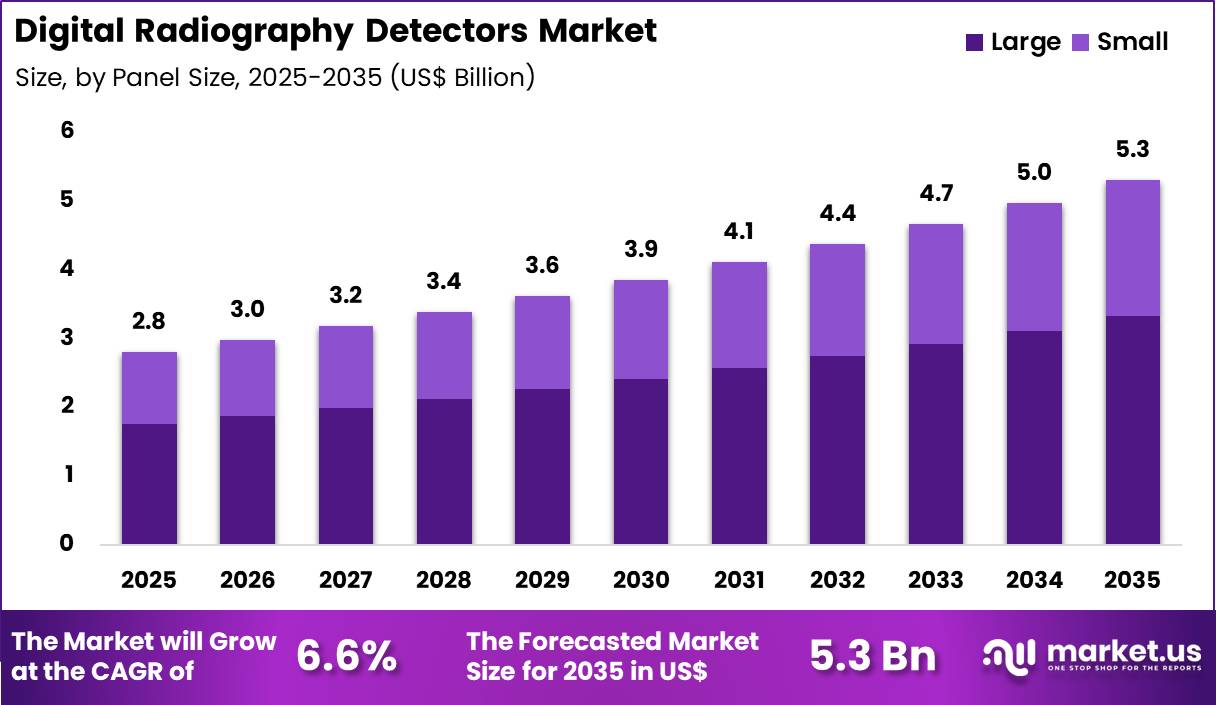
New York, NY – Nov 05 2026 –The Global Digital Radiography Detectors Market size is expected to be worth around US$ 5.3 billion by 2035 from US$ 2.8 billion in 2025, growing at a CAGR of 6.6% during the forecast period 2026-2035. In 2025, North America led the market, achieving over 37.4% share with a revenue of US$ 1.0 Billion.
The Digital Radiography Detectors Market is growing due to the rising adoption of advanced medical imaging technologies and the increasing demand for faster diagnostic procedures. Digital radiography detectors convert X-ray energy into digital images, helping healthcare professionals examine bones, organs, and other body structures with greater clarity and accuracy. These detectors are widely used in hospitals, diagnostic imaging centers, specialty clinics, and emergency care facilities.
The growing preference for digital imaging over traditional film-based radiography is supporting market expansion. Digital detectors offer faster image processing, improved image quality, easy image storage, and better workflow efficiency.
They also help reduce repeat examinations through advanced image processing capabilities. Flat panel detectors, including direct and indirect conversion technologies, are gaining importance because of their ability to produce detailed medical images.
Furthermore, the increasing prevalence of chronic diseases, rising geriatric population, and growing number of diagnostic imaging procedures are strengthening market demand. Technological developments in wireless detectors, portable X-ray systems, and artificial intelligence-based image enhancement are creating new growth opportunities.
Increasing healthcare investments and the expansion of diagnostic infrastructure across emerging economies are also expected to support the growth of the global Digital Radiography Detectors Market in the coming years.
Key Takeaways
- In 2025, the Digital Radiography Detectors Market reached US$ 2.8 Billion and is projected to grow at a CAGR of 6.6%, reaching US$ 5.3 Billion by 2035.
- Based on product type, the market is segmented into direct flat panel detectors, indirect flat panel detectors, and computed radiography (CR) detectors. Direct flat panel detectors dominated the segment with a 45.8% market share.
- By panel size, the market is categorized into large and small panels, with the large panel segment accounting for the leading share of 62.6%.
- Based on modality, the market is divided into portable and fixed systems. The portable segment dominated with the highest revenue share of 54.3%.
- By module type, the market is classified into digital and retrofit segments, with the digital segment leading with a revenue share of 71.2%.
- Regionally, North America dominated the Digital Radiography Detectors Market, accounting for a market share of 37.4%.
Key Market Segments
- Product Type Analysis: Direct flat panel detectors dominated the product type segment with a 45.8% market share, driven by their high image quality and efficient signal conversion. They convert X-ray photons directly into electrical signals, improving image resolution and reducing noise. Rising demand for faster imaging and advanced diagnostic accuracy supports their adoption across hospitals and diagnostic centers.
- Panel Size Analysis: Large panels dominated the panel size segment with a 62.6% market share, supported by their wide coverage and suitability for general radiography. They are commonly used for chest, spine, and abdominal imaging. Their ability to capture larger anatomical areas in a single exposure improves workflow efficiency and reduces patient repositioning during examinations.
- Modality Analysis: Portable systems led the modality segment with a 54.3% market share, driven by increasing demand for bedside imaging. These systems are widely used in intensive care units, emergency departments, and operating rooms. Their mobility reduces patient transportation and supports faster diagnosis. Growing adoption of point-of-care imaging further strengthens segment growth.
- Module Type Analysis: Digital modules dominated the module type segment with a 71.2% market share, supported by the growing shift toward fully digital imaging systems. These modules enable efficient image storage, processing, and sharing through hospital networks. Their integration with PACS and hospital information systems improves radiology workflows, reporting speed, and diagnostic efficiency.
Regional Analysis
North America is leading the Digital Radiography Detectors Market
North America accounted for a 37.4% share of the Digital Radiography Detectors market in 2024, driven by the modernization of hospital imaging infrastructure. Healthcare providers increasingly adopted flat panel detectors to replace traditional computed radiography systems, improving image quality and acquisition speed.
Rising emergency visits, orthopedic procedures, and outpatient imaging services further supported demand. Integration with picture archiving and communication systems (PACS) improved reporting efficiency and workflow management. According to the CDC, US emergency departments recorded over 130 million visits in 2023, highlighting the need for advanced diagnostic imaging.
Asia Pacific is expected to register the highest CAGR during the forecast period
Asia Pacific is projected to experience strong growth due to expanding healthcare infrastructure and rising demand for diagnostic services. Government investments in hospitals, increasing road accidents, and growing private diagnostic networks are supporting equipment adoption.
Local manufacturers are also introducing affordable detector solutions, improving access to advanced digital imaging across emerging economies.
Emerging Trends
- Growing Adoption of Wireless Flat-Panel Detectors: Hospitals and diagnostic centers are increasingly adopting wireless flat-panel detectors to improve imaging flexibility. These detectors allow healthcare professionals to capture X-ray images without fixed connections, making patient positioning easier and supporting faster examinations. Portable systems are also useful in emergency departments and bedside imaging.
- Development of High-Resolution Detector Technology: Manufacturers are focusing on detectors that provide sharper images and better visibility of small anatomical structures. Improvements in pixel design, image conversion materials, and detector sensitivity are helping radiologists examine bones, lungs, and soft tissues with greater clarity.
- Integration of Artificial Intelligence in Digital Imaging: Artificial intelligence is becoming an important development in digital radiography. AI-based software can support image analysis, identify suspicious findings, and help prioritize examinations. These technologies may improve radiology workflows and assist healthcare professionals in making faster clinical decisions.
- Increasing Focus on Radiation Dose Optimization: Healthcare providers are placing greater importance on reducing unnecessary radiation exposure during X-ray examinations. Modern detector systems support efficient image capture and advanced image processing. Better exposure management can help maintain diagnostic image quality while supporting patient radiation safety.
- Expansion of Portable and Point-of-Care Imaging: Portable digital radiography is gaining attention because it allows imaging services to reach patients outside conventional radiology departments. Compact systems are increasingly useful in remote healthcare facilities, intensive care units, emergency settings, and community screening programs.
Use Cases
- Orthopedic Diagnosis and Bone Fracture Detection: Digital radiography detectors are widely used to examine bones and joints. They help healthcare professionals identify fractures, dislocations, and joint abnormalities. High-quality digital images also support the assessment of bone healing after surgery or injury.
- Chest Imaging and Respiratory Disease Diagnosis: Hospitals use digital radiography detectors for chest X-rays to examine lung conditions, infections, and other respiratory problems. These systems help doctors assess pneumonia, lung abnormalities, and certain signs of tuberculosis through detailed chest images.
- Emergency and Trauma Care: Emergency departments use digital detectors to capture X-ray images of patients with accidents, injuries, and suspected internal bone damage. Rapid image availability helps medical teams evaluate injuries and plan appropriate treatment without waiting for film processing.
- Bedside Imaging in Intensive Care Units: Portable digital radiography detectors support bedside examinations for patients who cannot easily move to imaging departments. They are useful for checking chest conditions, monitoring medical devices, and examining critically ill patients in intensive care units.
- Breast Cancer Screening and Diagnosis: Digital X-ray detectors are used in digital mammography to capture detailed breast images. Healthcare professionals examine these images to identify suspicious changes, lumps, and other abnormalities. Digital mammography also supports breast cancer screening and diagnostic examinations.
Frequently Asked Questions About Digital Radiography Detectors
- What are digital radiography detectors?
Digital radiography detectors are medical imaging devices that capture X-ray signals and convert them into digital images. They help doctors examine bones, organs, and other body structures for identifying injuries, diseases, and abnormalities. - How do digital radiography detectors work?
Digital radiography detectors receive X-rays passing through the patient’s body and convert them into electrical signals. These signals are processed by imaging software to create digital images that radiologists can view on computer screens. - What are the main types of digital radiography detectors?
The main types include direct-conversion and indirect-conversion flat-panel detectors. Direct detectors convert X-rays into electrical charges, while indirect detectors first convert X-rays into light before producing electrical signals for digital image formation. - What are the benefits of digital radiography detectors?
Digital radiography detectors provide faster image acquisition, improved workflow, and convenient image storage. They also support image enhancement, easier sharing of medical images, and efficient examination processes compared with traditional film-based radiography systems. - Where are digital radiography detectors commonly used?
Digital radiography detectors are commonly used in hospitals, diagnostic imaging centers, orthopedic clinics, emergency departments, and intensive care units. They support different examinations, including chest X-rays, bone imaging, trauma assessment, and general diagnostic procedures. - What factors are driving the Digital Radiography Detectors Market?
Market growth is supported by increasing diagnostic imaging requirements, rising hospital investments, and the replacement of traditional X-ray equipment. Growing demand for faster imaging, better image quality, and portable diagnostic systems also supports adoption. - Which healthcare facilities use digital radiography detectors?
Hospitals represent an important end-user group, alongside diagnostic imaging centers, specialty clinics, and ambulatory surgical centers. These facilities use digital detectors for routine examinations, emergency imaging, orthopedic assessments, and respiratory disease diagnosis.
Conclusion
The Digital Radiography Detectors Market is expected to witness steady growth, driven by rising demand for advanced medical imaging and faster diagnostic procedures. Increasing adoption of direct flat panel detectors, portable imaging systems, and AI-based technologies is improving diagnostic efficiency across healthcare facilities.
North America continues to lead the market, while Asia Pacific is expected to experience the fastest growth due to expanding healthcare infrastructure and investments. Growing chronic disease cases, an aging population, and the replacement of traditional X-ray systems with digital solutions will further support market expansion. Technological advancements will create new opportunities through 2035.
Discuss your needs with our analyst
Please share your requirements with more details so our analyst can check if they can solve your problem(s)



