


Overview
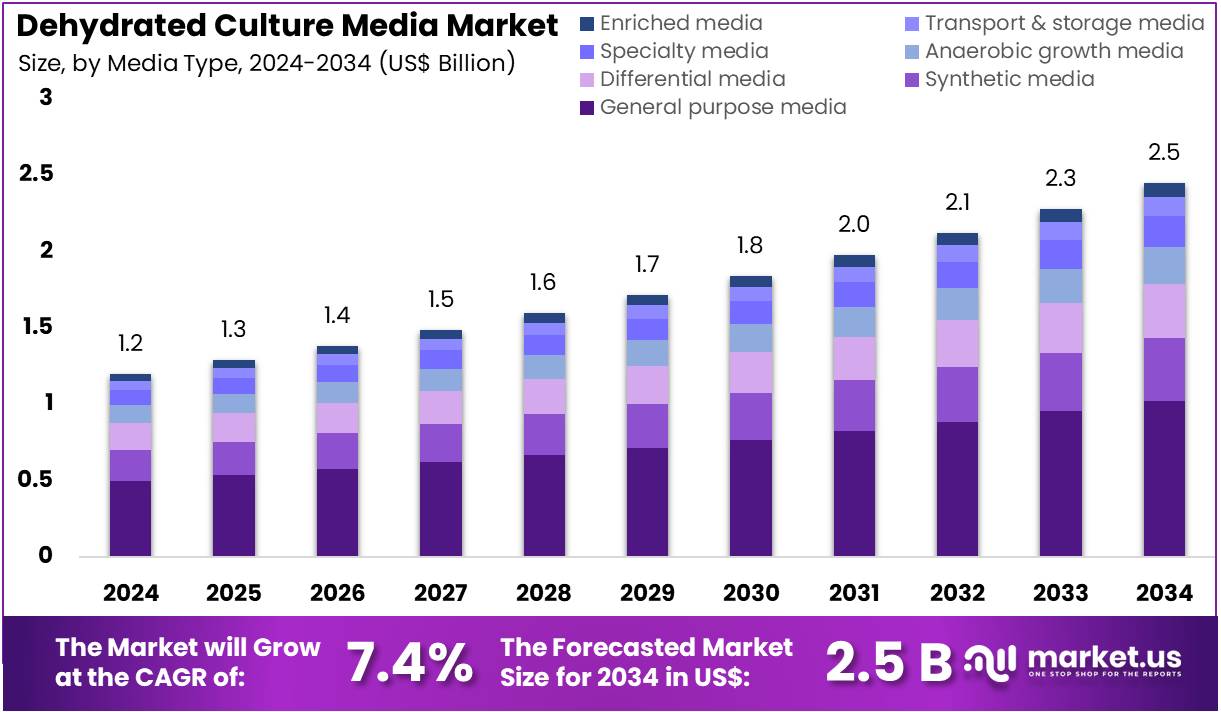
New York, NY – Aug 27, 2026 – The Dehydrated Culture Media Market Size is expected to be worth around US$ 2.5 Billion by 2034 from US$ 1.2 Billion in 2024, growing at a CAGR of 7.4% during the forecast period 2025 to 2034. North America held a dominant market position, capturing more than a 40.9% share and holds US$ 0.5 Billion market value for the year.
Dehydrated Culture Media plays a vital role in microbiology laboratories by providing a stable, convenient, and cost-effective source of nutrients for the cultivation, isolation, and identification of microorganisms. These powdered media are widely used across pharmaceutical manufacturing, clinical diagnostics, food and beverage testing, environmental monitoring, biotechnology, and academic research. Their long shelf life, easy transportation, and consistent formulation make them a preferred choice for quality control and microbial testing worldwide.
The growing emphasis on infection surveillance, food safety, and pharmaceutical quality assurance is driving demand for dehydrated culture media. According to the World Health Organization (WHO), antimicrobial resistance is directly responsible for an estimated 1.27 million deaths annually, highlighting the importance of accurate microbial detection and laboratory testing.
Additionally, the U.S. Food and Drug Administration (FDA) requires microbiological quality testing for many pharmaceutical and food products, further supporting demand for standardized culture media. The global pharmaceutical industry generated more than US$ 1.6 trillion in revenue in recent years, creating sustained demand for reliable microbiological testing materials throughout production and quality assurance processes.
Technological advancements have also improved dehydrated culture media through enhanced formulations, chromogenic media, and specialized products designed for rapid pathogen detection. As healthcare systems strengthen laboratory infrastructure and regulatory standards become more stringent, the adoption of dehydrated culture media is expected to continue expanding across both developed and emerging markets, supporting accurate diagnostics, product safety, and scientific research.
Key Takeaways
- In 2024, the market was valued at US$ 1.2 billion and is projected to reach US$ 2.5 billion by 2034, expanding at a CAGR of 7.4% during the forecast period.
- By media type, the market is segmented into general-purpose media, synthetic media, differential media, anaerobic growth media, specialty media, transport & storage media, and enriched media. Among these, general-purpose media dominated the market with a 41.8% share in 2023.
- Based on application, the market is categorized into gastroenterology, urology, radiology, peripheral, neurovascular, coronary, and others. The gastroenterology segment accounted for the largest share of 37.6%.
- In terms of form, the market is classified into powder, liquid, and granulated. The powder segment led the market, capturing a 54.2% revenue share.
- By strain, the market is divided into bacterial, viral, fungal, and others, with the bacterial segment holding the leading position at 63.7% of the market revenue.
- Based on end user, the market includes clinical diagnostic laboratories, pharmaceutical and biopharmaceutical companies, hospitals, the food and beverage industry, food & water testing laboratories, CROs, biotechnology companies, and academic & research institutions. Clinical diagnostic laboratories emerged as the leading end-user segment with a 46.5% market share.
- North America dominated the global market in 2024, accounting for a 40.9% share of the total market revenue.
Statistical Information
- ISO/DIS 11133:2025 entered the 12-week international ballot phase on 23 June 2025, with voting scheduled to close on 16 September 2025. This revision governs preparation, production, storage, and performance testing of dehydrated culture media used in microbiology laboratories.
- The ISO/FDIS 11133 standard progressed to Stage 50 (Final Draft International Standard) on 31 March 2026, indicating completion of technical development before publication.
- The Final Draft International Standard (FDIS) ballot for ISO 11133 is scheduled for 8 weeks during 2026 before publication as the new international standard.
- The draft European adoption (DIN EN ISO 11133:2025-08) contains 279 pages, reflecting expanded technical requirements for preparation, storage, and performance testing of culture media, including dehydrated media.
- The British Standards Institution released Draft Standard 25/30485739 DC on 23 June 2025 for BS EN ISO 11133, aligning UK implementation with the updated ISO requirements.
- A 2025 peer-reviewed computational study reported that intensified mammalian cell culture media formulations typically contain approximately 50–100 chemical compounds, highlighting the complexity of optimizing dehydrated media formulations while minimizing precipitation.
Regional Analysis
North America
North America accounted for 40.9% of the global dehydrated culture media market in 2024, supported by its advanced microbiology laboratory infrastructure and stringent food safety regulations. The region benefits from widespread use of dehydrated culture media in clinical diagnostics, pharmaceutical quality control, and food microbiology testing.
Government agencies such as the U.S. Food and Drug Administration (FDA) and the Centers for Disease Control and Prevention (CDC) continue to strengthen foodborne disease surveillance, increasing the need for standardized microbiological testing materials. FDA’s Coordinated Outbreak Response and Evaluation (CORE) Network also supports rapid pathogen detection across food supply chains, encouraging laboratories to adopt reliable dehydrated media for routine analysis.
The presence of leading biotechnology companies, accredited testing laboratories, and continuous investments in antimicrobial resistance monitoring further reinforce regional market growth and sustain North America’s leadership in the global market.
Asia Pacific
Asia Pacific is projected to register the fastest growth during the forecast period due to expanding biotechnology research, pharmaceutical manufacturing, and food safety initiatives. Countries including China, India, Japan, and South Korea are investing in microbiology laboratories, infectious disease surveillance, and academic research, driving demand for standardized culture media.
Government-backed research programs and collaborations are improving laboratory capabilities while encouraging local production of microbiological testing products. Growing adoption of international microbiological testing standards and increased regulatory focus on pharmaceutical quality assurance are further supporting market expansion.
Rising healthcare investments, expanding diagnostic networks, and stronger food safety monitoring across developing economies are expected to accelerate the use of dehydrated culture media throughout the Asia Pacific region.
Emerging Trends
- Growing focus on food safety testing: Food testing laboratories are increasing the use of dehydrated culture media because standardized media provide consistent microbial growth and longer storage life. CDC’s FoodNet monitors infections through more than 700 clinical laboratories across a surveillance area covering 16% of the U.S. population (about 54 million people), supporting sustained demand for reliable microbiology media.
- Higher demand from pathogen surveillance programs: Governments are expanding surveillance for foodborne diseases, increasing routine microbiological culture testing. In 2024, FoodNet reported 24,624 infections, 6,746 hospitalizations, and 178 deaths, encouraging laboratories to maintain ready-to-use dehydrated culture media for bacterial isolation and confirmation.
- Stronger quality-control requirements: Laboratories are emphasizing validated commercial media to improve testing accuracy. U.S. regulations require the first preparation from every lot of commercial dehydrated culture media to undergo growth-promotion testing, and media stored for 90 days or longer must be retested before use, increasing demand for high-quality products.
- Expansion of antimicrobial resistance testing: Rising antimicrobial resistance is increasing microbiology culture workloads. FDA continues regulating antimicrobial susceptibility culture media as Class II devices, while healthcare laboratories rely on standardized dehydrated media to produce reproducible susceptibility testing and organism recovery across clinical settings.
- Greater adoption of standardized commercial media: Clinical laboratories increasingly prefer commercially prepared dehydrated media that comply with recognized quality standards such as CLSI M22-A3, improving batch consistency, reducing preparation errors, and supporting regulatory compliance for microbiological diagnostics and pharmaceutical quality testing.
Use Cases
- Food microbiology laboratories: Dehydrated culture media are widely used to detect pathogens such as Salmonella, Listeria, and pathogenic E. coli in food samples. CDC tracks eight major foodborne pathogens, making standardized culture media essential for surveillance, outbreak investigations, and routine food quality monitoring.
- Clinical diagnostic laboratories: Hospitals use dehydrated culture media to isolate bacteria from patient samples before identification and antimicrobial susceptibility testing. Culture remains an important diagnostic method for bacterial foodborne illnesses, supporting accurate treatment decisions and infection control programs.
- Pharmaceutical quality control: Pharmaceutical and vaccine manufacturers use dehydrated culture media for sterility testing, environmental monitoring, and microbial contamination detection. U.S. regulations permit validated dehydrated formulations when they provide equivalent microbiological performance to freshly prepared media, supporting consistent manufacturing quality.
- Public health surveillance laboratories: Government laboratories employ dehydrated culture media during outbreak investigations and national surveillance programs. FoodNet routinely works with more than 700 laboratories, highlighting the importance of standardized microbiological media for comparable results across multiple testing sites.
- Environmental and water testing: Environmental laboratories use dehydrated culture media to monitor microbial contamination in water, production facilities, and food-processing environments. Standardized media improve reproducibility, simplify laboratory workflows, and support regulatory monitoring programs aimed at reducing pathogen-related public health risks.
Frequently Asked Questions on Dehydrated Culture Media
- What factors are driving the Dehydrated Culture Media Market?
The market is expanding because of rising infectious disease testing, stricter food safety standards, increasing pharmaceutical production, and higher investments in life science research. Growing demand for standardized microbiological testing in hospitals, environmental monitoring, and industrial laboratories also supports market growth. - Where is dehydrated culture media commonly used?
Dehydrated culture media is widely used in hospitals, diagnostic laboratories, pharmaceutical manufacturing, food and beverage testing, environmental monitoring, veterinary laboratories, academic institutions, and biotechnology research. It helps detect microorganisms, ensure product safety, maintain quality standards, and support scientific research activities. - What are the major types of dehydrated culture media?
Major types include general-purpose media, selective media, differential media, enriched media, transport media, anaerobic media, synthetic media, and specialty media. Each type is designed to support specific microbial growth, isolate target organisms, or identify microbial characteristics in laboratory testing. - Why is dehydrated culture media preferred over ready-to-use media?
Dehydrated culture media is preferred because it has a longer shelf life, lower transportation costs, reduced storage requirements, and greater flexibility in preparing different batch sizes. Laboratories also benefit from consistent formulations, making routine microbiological testing more reliable and cost-effective. - Which industries create the highest demand for dehydrated culture media?
Healthcare, pharmaceuticals, biotechnology, food and beverage, cosmetics, agriculture, and environmental testing industries generate the highest demand. These sectors rely on microbiological analysis for contamination detection, product quality assurance, regulatory compliance, research, and routine microbial monitoring across production processes. - Which region leads the Dehydrated Culture Media Market?
North America currently leads the market due to its advanced healthcare infrastructure, strong pharmaceutical manufacturing base, extensive microbiology research, and strict food safety regulations. High laboratory testing volumes and continuous investments in biotechnology further strengthen regional market leadership. - What is the future outlook for the Dehydrated Culture Media Market?
The market is expected to witness steady growth as demand increases for clinical diagnostics, vaccine production, pharmaceutical quality testing, food safety monitoring, and biotechnology research. Advances in microbiological technologies and expanding laboratory capacity across emerging economies will further support long-term market expansion.
Conclusion
The dehydrated culture media market is expected to maintain steady growth as microbiological testing expands across clinical diagnostics, pharmaceuticals, biotechnology, food safety, and environmental monitoring. Rising demand for standardized, shelf-stable, and cost-effective media is encouraging laboratories to adopt dehydrated formulations that simplify storage, transportation, and preparation.
North America continues to lead due to its advanced laboratory infrastructure and strict quality standards, while Asia-Pacific is emerging as the fastest-growing region because of increasing healthcare investments and research activities. Continuous innovation in culture media formulations, automation, and quality assurance will strengthen market competitiveness and support broader adoption across global laboratory and industrial applications.
Discuss your needs with our analyst
Please share your requirements with more details so our analyst can check if they can solve your problem(s)




