


Overview
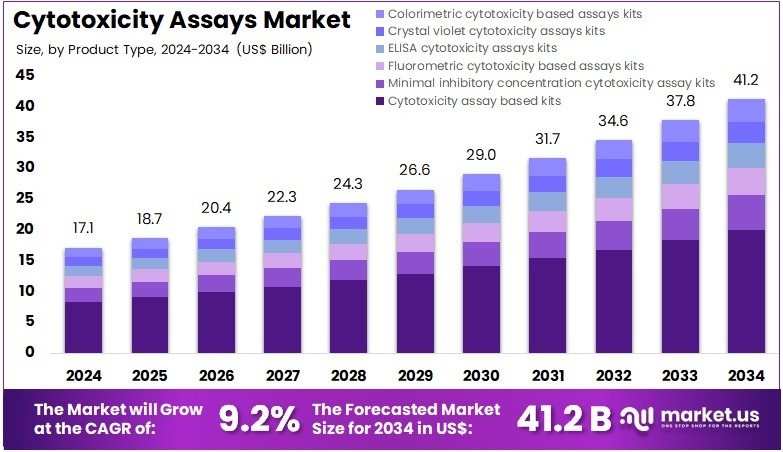
New York, NY – July 30, 2026 – Global Cytotoxicity Assays Market size is expected to be worth around US$ 41.2 Billion by 2034 from US$ 17.1 Billion in 2024, growing at a CAGR of 9.2% during the forecast period 2025 to 2034. North America held a dominant market position, capturing more than a 39.9% share and holds US$ 6.8 Billion market value for the year.
The global Cytotoxicity Assays Market is witnessing steady growth, driven by the increasing demand for reliable cell-based testing in drug discovery, toxicology studies, cancer research, and biopharmaceutical development. Cytotoxicity assays are essential laboratory techniques used to evaluate the toxic effects of drugs, chemicals, medical devices, and other substances on living cells. These assays help researchers identify potential safety concerns at an early stage of product development, reducing risks and improving the efficiency of preclinical research.
Rising investments in pharmaceutical and biotechnology research, coupled with the growing adoption of advanced cell-based assays, are supporting market expansion. The increasing prevalence of cancer and chronic diseases has also accelerated the need for effective screening methods, where cytotoxicity assays play a critical role in evaluating therapeutic candidates. Furthermore, advancements in high-throughput screening technologies, automation, and three-dimensional (3D) cell culture models are improving assay accuracy and enabling faster research outcomes.
North America continues to dominate the market due to its strong biotechnology ecosystem, extensive research funding, and the presence of leading pharmaceutical companies. Meanwhile, the Asia-Pacific region is expected to experience the fastest growth, supported by expanding clinical research activities, increasing healthcare investments, and the rapid development of life science infrastructure.
As precision medicine, immunotherapy, and biologics continue to evolve, the demand for sensitive, reproducible, and cost-effective cytotoxicity assays is expected to increase. Ongoing innovations in assay technologies and growing regulatory emphasis on product safety are anticipated to create significant opportunities for market participants over the coming years.
Key Takeaways
- In 2024, the Cytotoxicity Assays Market was valued at US$ 17.1 billion and is projected to grow at a CAGR of 9.2%, reaching approximately US$ 41.2 billion by 2034.
- Based on product type, the market is segmented into cytotoxicity assay-based kits, minimal inhibitory concentration cytotoxicity assay kits, fluorometric cytotoxicity assay kits, ELISA cytotoxicity assay kits, crystal violet cytotoxicity assay kits, and colorimetric cytotoxicity assay kits. Among these, cytotoxicity assay-based kits emerged as the leading segment in 2023, accounting for 48.5% of the total market share.
- By application, the market is categorized into nephrotoxicity, immunohistochemistry, cell proliferation, cardiotoxicity, apoptosis, and others. The nephrotoxicity segment held the largest share, contributing 39.4% of the market in 2023.
- In terms of end users, the market comprises hospitals, pharmaceutical & biotechnology companies, diagnostic centers, academic & research laboratories, and others. Hospitals dominated this segment, capturing the highest revenue share of 45.9% in 2023.
- Regionally, North America maintained its leadership position, accounting for 39.9% of the global Cytotoxicity Assays Market share in 2023.
Statistical Information
- A 2026 duplex planar Ames–cytotoxicity bioassay simultaneously measures mutagenicity and cytotoxicity on a single plate, using a 15 × 20 cm HPTLC plate to increase analytical throughput while integrating metabolic S9 activation into one workflow.
- The 2026 duplex planar cytotoxicity assay applies 4 µL of sample per application and accommodates up to 75 parallel sample tracks on one HPTLC plate, significantly improving testing throughput for complex mixtures.
- A 2025 study on immune cell-mediated cytotoxicity reported that conventional CAR-T cytotoxicity assays typically require more than 24 hours of target-cell incubation, motivating development of faster impedance-based potency assays.
- The OECD 2025–2026 draft test guideline specifies that cell viability must not decrease by more than 20% during cytotoxicity assessment; samples exceeding a 20% cytotoxic effect should be retested at lower concentrations or excluded.
- The OECD draft protocol recommends dissolving assay dye using 100 µL of DMSO per well, shaking plates for 10 minutes, and measuring absorbance at both 570 nm and 640 nm to standardize cytotoxicity evaluation.
- The OECD protocol further requires each test chemical to be evaluated in at least 3 independent assay runs to ensure reproducibility of cytotoxicity measurements.
- A 2026 integrated cytotoxicity testing workflow combined 5 biological endpoints cell viability, metabolic activity, reactive oxygen species, inflammatory mediators, and mRNA profiling within a single-well assay, reducing sample consumption while increasing data generated per experiment.
Regional Analysis
North America held the largest share of the global cytotoxicity assays market in 2024, accounting for 39.9% of total revenue. The region’s leadership is driven by stringent regulatory requirements under ISO 10993-5, which mandate in vitro cytotoxicity testing for medical device biocompatibility. Pharmaceutical and biotechnology companies extensively use high-throughput assays, including MTT, LDH release, and live-cell imaging, to identify toxicity during early drug discovery while reducing animal testing. The growing adoption of 3D spheroid models and organ-on-chip platforms has further strengthened predictive toxicology research. In addition, the National Institute of Environmental Health Sciences (NIEHS) has supported innovation through grants of up to US$ 400,000 annually for developers of advanced in vitro test methods.
Asia Pacific is projected to record the fastest CAGR during the forecast period, supported by rapid expansion of the biotechnology and pharmaceutical sectors and increasing government investments in life science research. China, India, Japan, South Korea, and Australia are strengthening regulatory frameworks and expanding the use of high-content screening, luminescence-based assays, CRISPR-enabled testing, and 3D cell culture technologies.
Public funding continues to encourage the development of alternative toxicity assessment methods. For example, Japan’s Agency for Medical Research and Development (AMED) allocated JPY 16.2 billion in fiscal year 2023 for psychiatric and neurological research programs, including cytotoxicity evaluations for neurotherapeutic development. These investments, combined with growing research infrastructure and increasing demand for predictive safety testing, are expected to accelerate market growth across the Asia Pacific region.
Emerging Trends
- Growing adoption of animal-free in vitro testing: Regulatory agencies increasingly encourage in vitro cytotoxicity testing to reduce animal studies. OECD Test Guidelines are internationally accepted, and 7 new OECD Test Guidelines were introduced in 2026, reflecting continued expansion of advanced laboratory testing methods and greater reliance on cell-based assays for chemical and medical product safety.
- Higher demand for standardized laboratory practices: Laboratories are increasingly following Good In Vitro Method Practices (GIVIMP) to improve data quality. OECD guidance recommends using two or more complementary viability endpoints, such as cell viability and cell death markers, instead of relying on a single measurement, improving reproducibility in cytotoxicity testing.
- Expansion of high-throughput cytotoxicity screening: Drug developers are adopting automated cytotoxicity assays to evaluate hundreds of compounds rapidly during early drug discovery. High-throughput platforms shorten screening time while reducing laboratory costs, enabling faster identification of toxic compounds before animal or clinical studies begin.
- Greater focus on medical device biocompatibility testing: Medical device manufacturers increasingly perform cytotoxicity assays before commercialization to comply with international safety standards. Cell-based testing is becoming a routine first step for evaluating material compatibility, helping manufacturers identify toxic responses early and reduce development risks.
- Integration of advanced cell models with cytotoxicity assays: Researchers increasingly combine traditional assays with 3D cell cultures and organ-like models to generate results closer to human biology. These advanced systems improve prediction of human cellular responses and strengthen confidence in preclinical safety assessments for pharmaceuticals and chemicals.
Use Cases
- Drug discovery and pharmaceutical screening: Pharmaceutical companies use cytotoxicity assays to identify harmful drug candidates before expensive clinical studies. OECD guidance uses the IC50 (50% inhibitory concentration) from Neutral Red Uptake assays to estimate toxicity, helping researchers prioritize safer compounds during early-stage development.
- Medical device safety evaluation: Manufacturers evaluate medical device materials using cytotoxicity assays before regulatory submission. These tests determine whether materials damage living cells, supporting compliance with international biocompatibility standards and improving patient safety before products reach healthcare facilities.
- Chemical and industrial product safety testing: Chemical manufacturers perform cytotoxicity assays to assess potential health risks of industrial chemicals, cosmetics ingredients, and consumer products. Internationally recognized OECD testing methods enable laboratories worldwide to generate comparable safety data for regulatory approval.
- Nanomaterial toxicity assessment: Researchers use cytotoxicity assays to evaluate the biological safety of engineered nanomaterials before biomedical or industrial applications. Cell-based testing helps determine safe exposure levels while supporting innovation in nanotechnology, drug delivery, and advanced medical materials.
- Academic and biomedical research: Universities and research institutes use cytotoxicity assays to study disease mechanisms, evaluate experimental therapies, and investigate cellular responses. OECD guidance recommends maintaining identical testing conditions and appropriate controls to produce reliable and reproducible laboratory results for scientific research.
Frequently Asked Questions on Cytotoxicity Assays
- What are cytotoxicity assays?
Cytotoxicity assays are laboratory tests used to measure whether a substance damages or kills living cells. Researchers use these assays to evaluate drug safety, medical devices, chemicals, and biomaterials before clinical use, helping reduce risks during product development and regulatory approval. - Why are cytotoxicity assays important in drug development?
Cytotoxicity assays help pharmaceutical companies identify harmful compounds early in the research process. By detecting cell toxicity before animal or human studies, these tests improve research efficiency, reduce development costs, and support compliance with international safety standards for new therapies. - Which industries use cytotoxicity assays the most?
Cytotoxicity assays are widely used by pharmaceutical companies, biotechnology firms, academic research institutes, contract research organizations (CROs), and medical device manufacturers. They are also applied in cosmetic safety testing, chemical evaluation, and regenerative medicine to assess the biological effects of products. - What are the most common types of cytotoxicity assays?
The most widely used cytotoxicity assays include MTT, XTT, LDH release, ATP-based, neutral red uptake, and flow cytometry assays. Each method measures cell health differently, allowing researchers to select the most suitable approach based on experimental objectives and sample characteristics. - What factors are driving the growth of the Cytotoxicity Assays Market?
The Cytotoxicity Assays Market is expanding because of increasing pharmaceutical research, rising biologics development, greater adoption of high-throughput screening, and stricter regulatory requirements for product safety. Growing investments in precision medicine and cell-based therapies are also boosting demand for reliable cytotoxicity testing. - Which region leads the Cytotoxicity Assays Market?
North America currently leads the Cytotoxicity Assays Market due to strong pharmaceutical and biotechnology industries, advanced laboratory infrastructure, high research spending, and strict regulatory standards. Europe and Asia-Pacific are also experiencing significant growth driven by expanding clinical research and biotechnology investments. - What challenges does the Cytotoxicity Assays Market face?
The market faces challenges including high costs of advanced assay platforms, variability between assay methods, difficulties in reproducing experimental results, and the need for skilled laboratory professionals. Standardization across laboratories remains an important objective for improving consistency and regulatory acceptance. - How is artificial intelligence influencing cytotoxicity assays?
Artificial intelligence is improving cytotoxicity assays by accelerating image analysis, automating data interpretation, and predicting toxic effects using large biological datasets. AI-supported workflows enhance testing efficiency, reduce manual errors, and enable faster decision-making during pharmaceutical discovery and toxicology research. - What role do cytotoxicity assays play in medical device testing?
Cytotoxicity assays are essential for evaluating the biocompatibility of medical devices before clinical use. They determine whether device materials cause harmful cellular responses, helping manufacturers comply with international standards and ensuring patient safety for implants, catheters, and other healthcare products. - What is the future outlook for the Cytotoxicity Assays Market?
The Cytotoxicity Assays Market is expected to grow steadily as demand increases for safer drugs, advanced biologics, personalized medicine, and 3D cell culture models. Continuous innovations in automation, high-content screening, and organ-on-chip technologies will further strengthen market expansion in the coming years.
Conclusion
The global cytotoxicity assays market is witnessing strong growth due to increasing demand for reliable in vitro toxicity testing in pharmaceutical research, biotechnology, medical device development, and academic laboratories. Growing regulatory emphasis on reducing animal testing, expanding biologics and cell therapy pipelines, and rising investments in drug discovery are accelerating the adoption of advanced cytotoxicity assays. Innovations such as high-throughput screening, automated platforms, real-time cell analysis, multiplex assays, and single-cell technologies are improving testing accuracy, efficiency, and reproducibility across research workflows.
North America continues to lead the market because of its advanced life sciences infrastructure, stringent regulatory standards, and high research spending, while Asia-Pacific is emerging as the fastest-growing region with expanding pharmaceutical manufacturing and biotechnology investments.
Increasing collaborations between assay developers, research institutions, and pharmaceutical companies are expected to drive product innovation and broader adoption. As precision medicine, immunotherapy, and regenerative medicine continue to expand, cytotoxicity assays will remain an essential tool for evaluating drug safety, biomaterial compatibility, and therapeutic effectiveness, supporting sustained long-term market growth.
Discuss your needs with our analyst
Please share your requirements with more details so our analyst can check if they can solve your problem(s)




